DON’T STOP AT FRIDAY – Good Friday 2020

Earthly people are like the man of earth; heavenly people are like the man from heaven. We have borne the image of the man made of earth; we shall also bear the image of the man from heaven. [1 Corinthians 15:48-49 (NLT)]
loretto - santa fe NMEaster will be a little different this year. Instead of getting up early for the sunrise service, we’ll have all day to go to online church and, rather than new Easter attire, we can attend church in sweats or jammies and our proverbial Easter bonnet can be a baseball cap. The kids won’t have brunch with the Easter Bunny, no family or friends will come for dinner, and, instead of hunting for Easter eggs, we’ll search for hand sanitizer or face masks on the Internet. Fortunately, we don’t need new clothes, eggs, brunch, jelly beans, Peeps, parades, Easter lilies, chocolate bunnies, beautiful hymns, or even a church service for Easter. All we really need is the Resurrection!

Nevertheless, some people are just Christmas through Good Friday believers. While they believe Jesus was born, walked the earth, and died on the cross, they doubt His resurrection and the promise of our resurrection. Their faith stops on Good Friday rather than going all of the way to Easter Sunday. Some of those in the church at Corinth were like that and, in 1 Corinthians 15, we find Paul’s response to those who couldn’t believe in the resurrection of the body. Without resurrection, he said, Jesus couldn’t have risen from the dead and, if Jesus didn’t rise from the dead, their faith was futile; they were merely false witnesses whose faith was grounded on a lie.

If we only believe from Christmas through Good Friday, we have a philosophy but not a faith and Jesus was just a godly, wise, and loving man. Paul suggests that, without the resurrection of Jesus and His followers, we might as well live with the attitude, “Let’s eat and drink, because tomorrow we’re going to die!” If our belief stops at Friday, we finish like a Looney Tunes cartoon with, “That’s all folks!” On the other hand, if we believe through Sunday, our lives are just beginning! That Jesus was raised from the dead means that even though all people die, all those in Christ will rise again! Instead of a philosopher who offered answers, the Resurrection means we have a Messiah who was the answer.

When we accept the resurrection of the dead, we’re bound to wonder how it’s done and what we’ll look like. Rather than putrefied remains, ashes or the broken bodies we had at death, Paul uses the analogy of a seed growing into a plant. Transformed, our resurrected bodies will be as different from our earthly ones as an oak is from an acorn, a chicken from an egg, a butterfly from a caterpillar, or a sunflower from its seed. Because imperfect finite bodies can’t inhabit a world that is infinite and perfect, Paul explains that God will take our perishable bodies and replace them with ones that are spiritual and imperishable. By spiritual, Paul doesn’t mean something ghostly or indistinct. There will be a body of some kind but, unlike our earthly one, it won’t be subject to decay, weakness, or death. Incapable of deterioration, it will be a beautiful and perfect vehicle for God’s Spirit.

I like C.S. Lewis’ explanation. Pointing out that, in this life, we tend to think of the soul as inhabiting the body, he suggests that, in the glorified body of the resurrection, the physical body will inhabit the soul and, rather than being less, we’ll be more. Of course, it’s all speculation. We don’t know what it will look like nor can we understand how it will be done because we’re not God. But, because we are Resurrection Sunday people, we know that it will happen!

The body that Jesus wore when he walked the earth—the one that fed a multitude, healed the sick, ate with the disciples, prayed in the garden, sweat blood, stood trial, was beaten, had nails driven into it, and hung on a cross—was a body like ours. Subject to pain, injury, disease and death, it was a body designed for an earthly life. But, Jesus’ story didn’t end on Friday and He rose on Sunday with a body suited for heaven!

One day, we will inherit His everlasting kingdom with everlasting bodies of our own. Yes, we will die in mortality, weakness, and infirmity but we will be resurrected in glory, strength, and power. We will be resurrected because we are Easter people!

On what does the Christian argument for Immortality really rest? It stands upon the pedestal on which the theologian rests the whole of historical Christianity—the Resurrection of Jesus Christ. [Henry Drummond]

‘I am the resurrection and the life,’ replied Jesus. ‘Anyone who believes in me will live, even if they die. And anyone who lives and believes in me will never, ever die.’ [John 11:25-26 (NTE)]

Copyright ©2020 jsjdevotions. All rights reserved.

THE MAUNDATUM – Maundy Thursday

oxeye daisyIf any of you wants to be great, he must be your servant. If any of you wants to be first, he must be the slave of all. That’s how it is with the son of man: he didn’t come to have servants obey him, but to be a servant – and to give his life as “a ransom for many.” [Matthew 20:26b-28 (NTE)]

When my coed grand arrived in Florida last December, she wanted to celebrate going from boots to sandals with a pedicure. Although I enjoyed the comfy chair with its rolling massage, the warm whirlpool bathing my feet, the technician massaging the knots in my feet and calves, the exfoliating and buffing, and having someone else clip and paint my nails, I was incredibly uncomfortable with the whole thing (which is why I usually do my own pedicures). Even though I’d scrubbed my feet before arriving, was paying for the service, and liked being pampered, having someone wash my feet and tend to my toes seemed too intimate for me. I felt awkward being served in such a personal way.

My discomfort brought to mind that of the disciples on that Thursday evening so long ago when Jesus washed their feet in the upper room. Unlike mine, the men’s feet were filthy from walking sockless in sandals along unpaved dirt roads littered with animal waste, garbage, and the contents of people’s chamber pots. While the washing of feet was usually the job of the lowest servant, if no servant was present, people usually washed their own feet. Luke tells us the disciples argued that night about who would have the most prestige in the Kingdom. Perhaps it was then that Jesus, their rabbi, the guest of honor, and truly the greatest among them, removed his robe and, dressed like a slave, took on the menial task of washing their filthy feet—a task none of them were doing for themselves, one another, or Him.

If I’m uncomfortable with a pedicure, I can only imagine the discomfort of the disciples as their teacher humbly knelt before them, bathed their filthy calloused feet in the basin, and dried them with the towel at his waist. Not wanting to see his teacher perform such a menial task, Peter even objected and then, in typical Peter manner, told Jesus to wash his hands and head as well!

Today is Maundy Thursday, a day Christians throughout the world remember Jesus washing the disciples’ feet, the breaking of bread and drinking of wine during their Passover supper, Judas’ betrayal, Jesus’ prayers in Gethsemane, His arrest in the garden, and Peter’s betrayal. While many Christians observe this day with the sacrament of Holy Communion, most have no idea how this day got its name. “Maundy” comes from the Latin maundatum for commandment; after being translated into the French mande it was anglicized into “maundy.” This day is named for the mandate or command Jesus gave to his disciples after performing His extraordinary act of humility by washing the men’s feet. This new commandment (maundatum novarum ) was to love one another as Jesus loved them.

Maundy Thursday is a day for more than remembering the Last Supper. It is a day to remember Jesus’ lesson that we must serve others in the same way He did: as a lowly servant who willingly served with humility and love. As He loved us, so we must love one another, not just today but every day.

Love consecrates the humblest act
and haloes mercy’s deeds;
it sheds a benediction sweet
and hallows human needs.
Love serves and willing stoops to serve;
what Christ in love so true
has freely done for one and all,
let us now gladly do!
[“Love Consecrates the Humblest Act” (Silas B. McManus)]

Well, then: if I, as your master and teacher, washed your feet just now, you should wash each other’s feet. I’ve given you a pattern, so that you can do things in the same way that I did to you. … I’m giving you a new commandment, and it’s this: love one another! Just as I have loved you, so you must love one another. This is how everybody will know that you are my disciples, if you have love for each other. [John 13:14-15,34-35 (NTE)]

Copyright ©2020 jsjdevotions. All rights reserved.

IN REMEMBRANCE OF HIM – Maundy Thursday

When the time came, Jesus sat down at table, and the apostles with him. ‘I have been so much looking forward to eating this Passover with you before I have to suffer,’ he said to them. [Luke 22:14-15 (NTE)]

butterflyChristians call it the Lord’s Supper, the Lord’s Table, the Sacrament, Holy Communion, or the Eucharist; some denominations consider it a “sacrament” while others call it an “ordinance.”  While they may not agree on what to call it, they do agree that, during that last supper with His disciples, Jesus instituted or ordained its practice when He shared bread and wine, said the elements were His body and blood, and instructed the disciples to repeat the ceremony in remembrance of Him.
That was a Passover dinner and, on any other Passover, Jesus may have held up the matzo symbolizing Israel’s suffering, slavery, and privation in Egypt and said, “This is the bread of affliction our fathers ate in Egypt.” The night he was betrayed, however, Jesus held up the bread and said, “This is my body, which is given for you. Do this in remembrance of me.” On any other Passover, Jesus might have raised the Passover cup and said, “Blessed are You, Lord our God, King of the Universe, who creates the fruit of the vine.” That night, however, He lifted the cup and said, “This cup is the new covenant between God and his people—an agreement confirmed with my blood. Do this in remembrance of me as often as you drink it.”

What Jesus didn’t do that night was give step-by-step instructions regarding this rite of remembrance and there is disagreement across the denominations about the exact meaning of the elements and the whos, whats, wheres, whens, and hows of doing communion. Whether we agree or disagree over the theological details, we all probably agree that we miss coming together at the Lord’s Table during this time of social distancing. Sheltering in place, however, shouldn’t keep us from partaking in the Eucharist; it just means that we have to do it differently.

As we struggle to worship in a world where we can’t gather as a church, let us remember that the church is not a building. Altars, altar rails, chalices, patens, and specific wafers weren’t mentioned by Jesus the night he was betrayed. He didn’t say that priests or ministers were required nor did he specify songs, prayers, or method of receiving the elements. Read the gospel accounts. Jesus was at a table eating the Passover meal dinner with His friends when, with just a few well-chosen words, He instituted the Eucharist as a way of remembering Him!

Palm Sunday, while watching the on-line service, our church had Holy Communion. Using whatever we had in our kitchens, people gathered in front of their computers, tablets, and smartphones, prayed over the elements, and partook of this holy and blessed sacrament in remembrance of Him. The bread we used ranged from Triscuits, Ritz crackers, and saltines to pita, sour dough rolls, or Wonder Bread. For wine, we used whatever we had; for some, that was wine or grape juice and, for others, it could have been lemonade or water. Our purpose was to remember Jesus and we remembered Him with what we had!

Tomorrow is Maundy Thursday, the day Christians throughout the world commemorate the Last Supper and the institution of Communion. Even without an official service, my husband and I will partake of this sacrament in much the same way the early church did: in the context of a meal with a little bread and wine. We will remember Jesus, not just for what He did on the cross, but for who He was and is: our friend, Savior, Lord, and King! Won’t you join us? No matter how far apart we may be from each another, the body of Christ is one in Spirit!

We offer and present unto thee, O Lord, our selves, our souls and bodies, to be a reasonable, holy, and living sacrifice unto thee; humbly beseeching thee that we, and all others who shall be partakers of this Holy Communion, may worthily receive the most precious Body and Blood of thy Son Jesus Christ, be filled with thy grace and heavenly benediction, and made one body with him, that he may dwell in us, and we in him. [The Book of Common Prayer (1979)]

On the night when the Lord Jesus was betrayed, he took bread, gave thanks, broke it, and said, ‘This is my body; it’s for you! Do this as a memorial of me.’  He did the same with the cup after supper, and said, ‘This cup is the new covenant in my blood. Whenever you drink it, do this as a memorial of me.’ For whenever you eat this bread and drink the cup, you are announcing the Lord’s death until he comes. [1 Corinthians 11:23-26 (NTE)]

Copyright ©2020 jsjdevotions. All rights reserved.

JESUS SAVES

This, you see, is how much God loved the world: enough to give his only, special son, so that everyone who believes in him should not be lost but should share in the life of God’s new age. [John 3:16 (NTE)]

Another one of my Abundance assignments gave an interesting twist to paying it forward. We were to give an extra $3.16 to the drive-thru cashier who was supposed to credit it to the next customer and tell them the 3.16 was from John. We rarely utilize drive-thrus and now, with social distancing, aren’t going out, so this was one assignment I set aside. Nevertheless, I thought about the ways we do or don’t evangelize.

Christians tend to get upset when the presence of a religious symbol on public property is threatened. Yet, other than an occasional Christmas decoration, we rarely display anything religious on our own private property. We claim our children should be allowed to pray at school yet how many of us use our freedom to openly say grace before meals in a public restaurant or pray with others in public spaces? We’ll wear tee-shirts with logos advertising our favorite designers, restaurants, and teams; how many do we have with Bible verses on them?

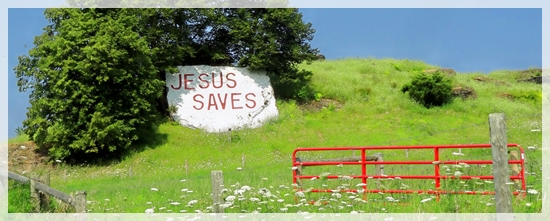
For nearly forty years, we drove by the “Jesus Saves” rock. Prior to 1955, however, that big rock displayed a Potosi Beer advertisement. A prayer group from the local Presbyterian church obtained permission to repaint the rock and the “Jesus Saves” rock now is known throughout a tri-state area. To my knowledge, in all of these years, the rock has never been defaced. Granted, it is in rural Illinois, but it’s hard to believe that no youngsters have tried adding something to the sign. While that speaks to the virtue of small town values, it probably helps that the farmer who owns the land keeps a watchful eye on the famous rock (and a bull has been known to roam in the pasture below). A local family installed a light so that it can even been seen in the dark of night and various community organizations continue to keep the sign freshly painted. The “Jesus Saves” sign is both a community effort and a community witness.

While I disagree with their theology, I admire Jehovah’s Witnesses for their persistent evangelizing. Most of us hesitate to discuss Jesus with our neighbor, but Witnesses are willing to speak with strangers, often going door-to-door. They and their display are an almost daily fixture at our area parks and beaches. Few of us are that dedicated to spreading the Word of God, although I did read of one man who named his Wi-Fi router “Jesus Saves” so that anyone searching for a signal would see the message! Since his router probably is password protected and Jesus welcomes all, his would seem to be a slightly mixed message. Nevertheless, he’s witnessing in a small way.

Failure to share the message of John 3:16 isn’t like not telling someone about the latest NetFlix offering, our favorite YouTube video, or even the news that Walmart finally has toilet paper and hand sanitizer! Let us remember that people’s eternal destiny rests in our witness. As Charles Stanley said, “The joy you’ll have when you meet that person in heaven will far exceed any discomfort you felt in sharing the gospel.”

“All who call upon the name of the Lord,” you see, “will be saved.” So how are they to call on someone when they haven’t believed in him? And how are they to believe if they don’t hear? And how will they hear without someone announcing it to them? [Romans 10:13-14 (NTE)]

Copyright ©2020 jsjdevotions. All rights reserved.

COFFEE WITH GOD

Before daybreak the next morning, Jesus got up and went out to an isolated place to pray. Later Simon and the others went out to find him. [Mark 1:35-36 (NLT)]

Then Jesus said, “Let’s go off by ourselves to a quiet place and rest awhile.”… But many people recognized them and saw them leaving, and people from many towns ran ahead along the shore and got there ahead of them. [Mark 6:31,33 (NLT)]

brown pelicanWhen my “Weekly Wisdom” email reminded me that time is the price we must pay for intimacy with God, I thought of Cindy. A recent widow struggling to make sense of her new normal, Cindy wanted a closer relationship with God, but wasn’t quite sure how to go about it. Rather than reciting the same prayers over and over again, she wanted to sit down and talk to Him, as she would with a good friend.

When a friend mentioned that she’d stocked a cozy corner with devotionals, Bible, encouraging books, and inspirational verses and dedicated it as a special place to read Scripture, reflect and pray, Cindy decided to do the same. In spite of preparing a peaceful spot in her house, however, her life was so chaotic and disorganized that she never found the time to use it!

No matter how well stocked it is with Bibles, devotionals, candles, or framed Bible verses, a dedicated space is pointless if it’s never used! For this to work, Cindy found she had to link her God time with something she did every day; for her, that was her morning cup of coffee while reading the newspaper. Thus began Cindy’s “Coffee with God!”

While continuing the requisite coffee, Cindy replaced the newspaper with devotions, Scripture, and prayers. Within a few days’ time, she and God were on regular speaking terms. She admits those conversations over coffee seemed rather one-sided but added that God’s responses came throughout the day. By approaching Him regularly and humbly, Cindy has become more attuned to His voice and presence in all things all day long. As for the newspaper, she knows that there’s time enough for that after she’s enjoyed her morning coffee with God and His Word.

If I neglected doing something I’d promised to do, my mother would remind me that the road to hell is paved with good intentions. Expanding on that, Aldous Huxley said, “Hell isn’t merely paved with good intentions; it’s walled and roofed with them. …and furnished too.” As Christians, we are filled with good intentions, but being flawed people, we often fail to act on them. Like Cindy, until I set aside both place and time for Scripture, meditation and prayer, my relationship with God was pretty hit or miss.

Jesus wanted the disciples to understand the importance of a close relationship with the Lord: God first, everything else second. Even so, He had trouble finding quiet time with His Father. Sometimes, Jesus was interrupted and, other times, the crowds followed him. If God’s Son had difficulty finding time to pray, it’s understandable that we do, too. On the other hand, Jesus was busy doing His Father’s business while the busyness that keeps us from God is ours alone!

While yesterday’s message linked praying for peace with brushing our teeth, it’s pretty hard to build a relationship with God like that. As Christians, we won’t mature without deliberately spending time in God’s presence—reading Scripture, meditating on His word and talking with Him in prayer. Our quiet time with God needs to be a non-negotiable item on our calendars rather than an afterthought. As with any relationship, you’ve got to put in the time if you want it to grow! Tomorrow morning, why not enjoy your morning coffee with God!

Hear me as I pray, O Lord. Be merciful and answer me! My heart has heard you say, “Come and talk with me.” And my heart responds, “Lord, I am coming.” [Psalm 27:7-8 (NLT)]

Copyright ©2020 jsjdevotions. All rights reserved.

FOR SUCH A TIME AS THIS

Who knows if perhaps you were made queen for just such a time as this?” [Esther 4:14b (NLT)]

balloon over serengettiAlthough the book of Esther never mentions God by name, His fingerprints are found throughout the story as it illustrates God’s providence in human affairs. The Jews were in captivity in Persia and the Persian King had banished the queen. Along with all the other beautiful virgins in the land, the young Jewess Esther is taken to the King’s harem. She finds favor with the king and is declared queen while the evil Haman plots the massacre of every Jew. When Esther’s cousin Mordecai requests her help in begging for the king’s mercy, she hesitates out of fear. Reminding Esther that she isn’t exempt from Haman’s evil plot, Mordecai asks, “Who knows if perhaps you were made queen for just such a time as this?”

I thought of Haman’s question as churches around the world struggle to provide worship and study opportunities during this crisis. By the time our church, Coastal Fellowship Church, was a year old, we’d developed a free App providing more than calendar, prayer requests, devotions and online giving. Through strategic partnerships, it provided preschool video Bible adventures and material from the Bible Project that now includes videos on reading Scripture, the Bible’s books from Genesis through Revelation, wisdom topics, and a word study. More recent offerings include a number of short videos showing where sports and faith connect and two series from Dave Ramsey’s Financial Peace University.

At the time, I’m sure people wondered why a church like ours – brand new, without a building, with minimal financial support, and a small congregation of mostly senior citizens (some of whom still use flip phones) – became so committed to 21st century technology and developing an App. Our pastor felt God’s call to do an App and, as he led, the congregation, without clearly understanding its importance, followed in obedience to God’s urging. If anyone wondered why we did it, the last few weeks gave us the answer. Rephrasing Mordecai’s words, “Who knows if the App was developed for just such a time as this!”

We didn’t know over a year ago that online resources and platforms would be essential to serving the Church during this global pandemic. Distanced geographically, we remain connected by faith. We are a global church serving a global God and the App allows us to do just that!

The technical expertise acquired while creating the App enabled us to stream services within a few days’ time and develop a permanent platform for services and Bible study by the second week. Because the App received 30 awards for everything from logo to video and animation, it’s had international exposure; available on several platforms, there have been 40,000 downloads from all over the world. The strategic partnerships that started with the App led to more partnerships, including one with N. T. Wright, and expanded our offerings to better serve the global community. Our first Sunday service was viewed by people throughout the world with 2,182 viewings in the first week! What’s really important is that 88% of those viewers watched the entire service! (I’m not sure 88% of a congregation stays awake during a live sermon!)

As mortals, we don’t know God’s long range plans; even if we did, we wouldn’t understand them. Joseph didn’t understand why he ended up a slave in Egypt until he saved his entire family from famine. Moses didn’t know why he was raised by Pharaoh’s daughter until God spoke to him from a burning bush. David didn’t know why he kept doing target practice with his sling until he came face to face with Goliath. Esther didn’t understand why she became queen until she saved an entire nation and I never knew that sending a daily Bible verse to a few women would morph into a daily devotional. Even though we don’t see God’s vision, like Abraham, we follow His lead. Once we get wherever God has taken us, we’ll know why we’re there. God will tell us, “For just such a time as this!”

It was by faith that Abraham obeyed when God called him to leave home and go to another land that God would give him as his inheritance. He went without knowing where he was going. [Hebrews 11:18 (NLT)]

“My thoughts are nothing like your thoughts,” says the Lord. “And my ways are far beyond anything you could imagine. For just as the heavens are higher than the earth, so my ways are higher than your ways and my thoughts higher than your thoughts.” [Isaiah 55:8-9 (NLT)]

Copyright ©2020 jsjdevotions. All rights reserved.