DIAMOND MINING

Some of his [Paul’s] comments are hard to understand, and those who are ignorant and unstable have twisted his letters to mean something quite different, just as they do with other parts of Scripture. And this will result in their destruction. [2 Peter 3:16 (NLT)]

butterfly weed“You have to drill through mud and water to get oil; you have to sift through sand and silt to get gold; you have to chop and hack through stone to get diamonds. So why do so many people feel that the treasure of ideas should come to them with little or no effort?” asked Sydney J. Harris. Even though he wasn’t referring to the Bible, the journalist’s words made me think of the way we often approach Scripture; complaining that it’s too hard to understand, we simply don’t study it!

If we’ll put forth effort to perfect our golf or tennis swing, train for a marathon, master chess or bridge, plant a garden, or become a gourmet cook, I wonder why we think understanding Scripture should be effortless. It’s only natural that words penned by 40 (or more) people, between 1400 BC to 90 AD, in a wide variety of genres, in another language, and shaped by different cultures and traditions, require some work to comprehend. Scripture’s words were God breathed by the One who created words and thoughts! He is greater than any novelist or journalist so we should expect His words and ideas to be more difficult to understand than theirs! But, because of the effort required to understand them, many of us don’t bother and stick to a few favorite stories, verses and Psalms.

During this sheltering in place, our church conducted an online Bible study and, after thirteen weeks of video lectures given by Biblical scholar N. T. Wright, we finally completed our study of Philippians. In some sessions, Professor Wright walked us through as few as five verses, but the way he shed light on Paul’s circumstances, the Philippians’ society and environment, the political situation of the time, the original Greek meaning of many of the words, the way Paul’s words in Philippians related to his other letters, and what the Apostle’s words meant to us, was immensely rewarding. It was like taking a beautiful old piece of heavily tarnished silver and polishing it. Before this study, I appreciated Philippians the way I might the tarnished silver piece. After studying the epistle in depth, however, the profoundness of Paul’s words were uncovered the same way silver’s true beauty is revealed when it’s polished! Polishing silver, however, takes “elbow grease” and comprehending Scripture takes effort, as well.

Admittedly, understanding Bible passages and spiritual concepts can be challenging but that shouldn’t discourage or surprise us. Even the Apostle Peter admitted the difficulty of comprehending Paul’s words! Nevertheless, the Apostle knew the importance of trying to understand Scripture to avoid being misled. Peter was concerned about teachers who claimed that Christ’s followers could still live immoral lives. Today’s false teachers may be spouting other nonsense but, without our making the effort to study Scripture, we won’t recognize their errors.

Since each Bible study on Philippians lasted about 45 minutes, we spent around 585 minutes on four chapters. That sounds like a lot of time until we consider the 52 billion-plus minutes of The Office that were streamed by Netflix users in 2018 or the 437 billion minutes spent watching NFL and college football’s regular seasons that same year.

For the last several years, I’ve devoted a part of every day to studying Scripture. I still can’t quote chapter and verse, but my life is fuller and more purposeful because of its words. It’s worth the effort because, like mining for diamonds, each time I dig deep into God’s word, another beautiful gem appears.

The book to read is not the one which thinks for you, but the one which makes you think. No book in the world equals the Bible for that. [Harper Lee]

All Scripture is inspired by God and is useful to teach us what is true and to make us realize what is wrong in our lives. It corrects us when we are wrong and teaches us to do what is right. God uses it to prepare and equip his people to do every good work. [2 Timothy 3:16-17 (NLT)]

Copyright ©2020 jsjdevotions. All rights reserved.

A NEW SYMBOL OF LOVE

So now I am giving you a new commandment: Love each other. Just as I have loved you, you should love each other. Your love for one another will prove to the world that you are my disciples. [John 13:34-35 (NLT)]

Last week, I saw a video of a prayer service in the streets of a major American city. “Give a shout!” called the pastor and the crowd shouted back before raising their voices in song. In another time, I’d have been thrilled to see so many people gathered to praise Jesus, but these are not normal times. This was in a state where COVID-19 cases are on the increase and even those considered low risk have been asked to wear face coverings and refrain from gathering in groups greater than ten. Nevertheless, the crowd of several hundred stood tightly together and few wore face masks.

Franklin Roosevelt was wrong when he said, “The only thing we have to fear is fear itself!” There’s much we should fear; after all, Scripture tells us to fear God. Along with fearing God, the fear of both spiritual and physical danger can keep us safe. The minute David put his eyes on the naked Bathsheba, he was in spiritual danger but, instead of turning around in fear, he walked straight into the enemy’s trap. The good fear of physical danger is what gets us in the basement during a tornado warning or puts up shutters before a hurricane. It’s the fear that seeks shelter from lightning, looks both ways even after the light turns green, gets vaccinated, wears seat belts, and puts life jackets on toddlers when they wade in the ocean. It’s when we allow our fear of spiritual or physical danger to turn into preoccupation or obsession, when we lose perspective or faith, or when we become anxious, neurotic, hopeless, incompetent or incapacitated, that good fear goes bad.

Our bodies are not our own; like everything else we have, they belong to God. As His stewards, we are expected to take good care of them; a certain amount of fear helps us do that by assessing risks. There may be times we are called to risk our lives, as are firemen when entering a burning building. Needlessly risking health and safety, however, is not God’s intention for us. “You’re afraid!” is not an insult when it comes to COVID-19; we all should have a healthy fear of this virus. As Christians, we live by faith not fear, but that doesn’t mean we live foolishly or inconsiderately!

It’s not just the elderly or those with secondary conditions who are at risk. One of the mysteries of this disease is that relatively healthy young people, including small children and teens, can become critically ill or die. Everyone should have a healthy fear of this virus and respect it the same way we would a bear on the back deck: by keeping our distance! Moreover, our reckless actions have ramifications and can cause collateral damage. Every attendee at that prayer rally later interacted with family, friends, co-workers, and even strangers; their carelessness might cost someone else their health or even their life! Christians are called to love and that love should respect, honor, and value the lives of others as much as their own.

Ignoring scientific data, our state, like many others, is re-opening and some churches have followed suit. After all, empty pews often mean empty collection baskets. While our church, like many, wants to resume services, we readily admit to being afraid. We take the numbers and threat seriously and needlessly bringing ourselves or our church family into a risky situation is irresponsible. “Let the vulnerable stay home!” say some while other churches tell those over 65 they can’t attend. I don’t think the Lord who spoke of leaving the ninety-nine sheep to find the one who was lost, would agree. Every single life mattered to Him and it is the most vulnerable God has called us to serve!  Believing that the church should be a place of sanctuary not infection, our church is not yet meeting in person. It’s not a popular choice, but Jesus was never about being popular. He was about love—about doing the right thing—about caring for the health and safety of others.

Face masks and social distancing aren’t about politics; they’re about love! When Bishop Michael Curry was on the Today show last week, he spoke of choosing to live in the way of love which, he explained, is seeking the good of others as well as of self. After placing his two hands in the shape of a heart, he said there was a new symbol of love: a face mask! “I wear it to protect you and you wear it to protect me,” explained the Bishop. Me doing all I can to protect you from harm and you doing all you can to protect me exemplify Christian love! Right now, for many of us, along with wearing a face mask, that means continuing to worship together from a distance!

This is real love—not that we loved God, but that he loved us and sent his Son as a sacrifice to take away our sins. Dear friends, since God loved us that much, we surely ought to love each other. … We love each other because he loved us first. [1 John 4:10-11,19 (NLT)]

Copyright ©2020 jsjdevotions. All rights reserved.


HE HAS FAITH IN US!

And I’ve got something to tell you, too: you are Peter, the rock, and on this rock I will build my church, and the gates of hell won’t overpower it. [Matthew 16:18 (NTE)]

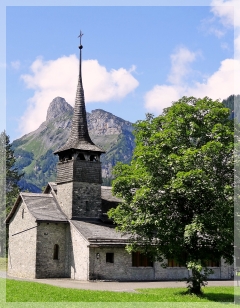
Kandersteg - SwitzerlandAfter Simon Peter professed his belief in Jesus as the Messiah, the Lord declared that he would be known from then on as Peter (Petros) meaning rock (petra). Yet, a short time later, the Rock became a stumbling block when he resisted all that being the Messiah required: Jesus’ suffering and death. When studying the man our Lord chose to lead His church, we find Peter had enough faith to climb out of the boat but not enough faith to trust Jesus when the wind started to blow. Impetuous, Peter immediately wanted to memorialize the Transfiguration rather than learn from it. Presumptuous, he hastily spoke for Jesus regarding paying tax to Caesar. Rash, he used his sword to wound the high priest’s slave. He resisted Jesus when the Lord knelt with a wash pan at his feet and, after boldly declaring his commitment to Jesus, denied him three times within a few hours! Yet, it was to this man that Jesus entrusted the job of shepherd and the task of feeding His sheep!
The rest of the disciples were no better. Along with Peter, they thought Jesus was talking about bread when He warned them about the yeast of the Pharisees, argued with one another about who among them was the greatest, fell asleep when asked to pray, abandoned Jesus following His arrest, and returned to fishing after the crucifixion.

Not a one was a scholar, aristocrat, or priest. Yet, it was to these common ordinary men, men who had sinned and who were likely to sin again, men who had failed Jesus while He was flesh and blood, to whom Jesus entrusted His church! Although the only thing extraordinary about the disciples was their faith in Jesus, He charged them with the Great Commission: the future of His church. Have you ever wondered at the tremendous faith Jesus showed in the disciples 2,000 years ago? Legions of angels could have spread the Good News wider and faster than any mortal and yet Jesus had faith that His band of ordinary men would obey His command and succeed!

Christ’s followers continue to be as unremarkable and flawed as were Peter, John and the rest of the disciples. Nevertheless, Jesus continues to have faith in us. It is through the power of His Holy Spirit that we carry on the good work begun by those first believers. Let us continue to have faith in the God who has such great faith in us!

A dozen ignorant peasants proclaiming a crucified Jew as the founder of a new faith; bearing as the symbol of their worship an instrument which was the sign of ignominy, slavery and crime; preaching what must have seemed an absurd doctrine of humility, patient suffering and love to enemies – graces undreamed of before; demanding what must have seemed an absurd worship for one who had died like a malefactor and a slave, and making what must have seemed an absurd promise of everlasting life through one who had himself died, and that between two thieves. [“The Divine Origin of the Bible” by B.B. Warfield]

Jesus came towards them and addressed them. “All authority in heaven and on earth,” he said, “has been given to me! So you must go and make all the nations into disciples. Baptize them in the name of the father, and of the son, and of the holy spirit. Teach them to observe everything I have commanded you. And look: I am with you, every single day, to the very end of the age.” [Matthew 28:18-20 (NTE)]

Copyright ©2020 jsjdevotions. All rights reserved.

NATIONAL DAY OF PRAYER – MAY 7, 2020

After Jesus said this, he looked toward heaven and prayed: “Father, the hour has come. Glorify your Son, that your Son may glorify you.” [John 17:1 (NIV)]

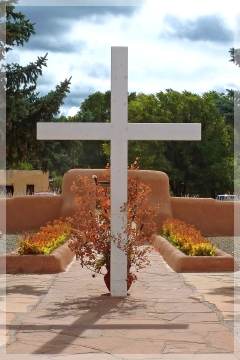
taos, NMThis pandemic may have may have postponed the Olympics but it hasn’t delayed the National Day of Prayer. Today’s observances, however, will look quite different from previous ones. There won’t be any prayer breakfasts or luncheons and large groups won’t assemble in parks, churches or on courthouse steps. Instead, churches will stream their services and religious leaders from across the county will participate in a national broadcast to be aired tonight from 8 to 10 PM ET (see their website or Facebook page for details). Because of the many “virtual” events planned, today’s observance actually could be this day’s largest prayer gathering.

The theme this year is “Pray God’s Glory across the Earth.” Since the Westminster Catechism says, “Man’s chief end is to glorify God, and to enjoy Him forever,” I understand why we’d want to pray God’s glory across the earth. Man was created to give glory to God and this year’s theme probably was chosen long before coronavirus so drastically impacted the lives of people throughout this nation. In all likelihood, prayer resources, promotional materials, and PSAs were finished and distributed by the time we’d heard of COVID-19. I wondered how we can pray God’s glory when our hearts are so broken but that’s precisely what Jesus did on the eve of His death and betrayal. John 17 tells us that Jesus didn’t pray with anxiety, doubt or fear. His prayer focused on the glory of God: the revelation of his character and presence. Jesus’ words show us that the purpose of prayer isn’t for us to get something from God; it is to give God the glory He deserves!

The National Day of Prayer task force asks us to pray today’s prayer together, yet individually, at noon your local time. Please join me today in saying the following prayer. Let us lift our voices as one people and pray God’s glory across the earth!

Lord, we exist to give You glory. We exist because of Your glory, and in Your glory, as our Creator, Redeemer, and Sustainer. We give you thanks and praise for every breath and moment You have given to us. We repent of our sin; for the shameful things we have done against You and for our silence when we did not speak up to proclaim Your Name, profess Your Word, or protect and practice Your will. We ask Your forgiveness.

We pray that the knowledge of the glory of the Lord will spread across our nation and the entire earth as we seek Your Kingdom and righteousness; as we walk in obedience to You, and in humble unity, love one another.

Jesus, the Bible says that You are “the knowledge of the glory of the Lord.” You have taught us to pray, commanded us to love, and commissioned us to share Your gospel of grace. Your glory fills our hearts and families, it overflows into our neighborhoods, workplaces, campuses, churches, entertainment, and media.

We give thanks for our military and ask that Your glory would spread to, and through them as they preserve freedom around the world. We pray for our government, that all of our leaders and laws would be filled with Your glory, that they would magnify Your Holy Word and honor Your will and ways. We pray that Your grace and glory would spread to bring hope to the hopeless, and love where there is hurt and hate.

God, use us as we pray your promise, that “the earth will be filled with the knowledge of the glory of the Lord as the waters cover the sea.” In Jesus Name, Amen! [Kathy Branzell, President, National Day of Prayer Task Force]

For the earth will be filled with the knowledge of the glory of the Lord as the waters cover the sea. [Habakkuk 2:14 (NIV)]

Ascribe to the Lord the glory due his name; worship the Lord in the splendor of his holiness. [Psalm 29:2 (NIV)]

Copyright ©2020 jsjdevotions. All rights reserved.

KOINONIA – FELLOWSHIP

pelicans - royal terns - clam passGod is faithful! And it is through God that you have been called into the fellowship of his son, King Jesus, our Lord. Now I must appeal to you, my brothers and sisters, through the name of King Jesus our Lord, that you should all be in agreement, and that there should be no divisions among you. Instead, you should be fully equipped with the same mind and the same opinion. [1 Corinthians 1:9-10 (NTE)]
Because there are various Christian fellowship associations, our churches have fellowship halls, and they sponsor fellowship meetings, meals, and events, we tend to associate Christian fellowship with friendship and socializing. Christian fellowship, however, is a great deal more than simply spending time with other believers. The Greek word commonly translated as “fellowship” is koinonia. While it does mean fellowship, association, community, and communion, it also denotes intimacy, participation, or a share which one has in something. No one English word fully captures all that koinonia encompasses.

Signifying more than merely associating with each other, the sharing of food and necessities, or even joining together in the celebration of the Eucharist, Paul used koinonia to include the fellowship Christ’s followers have both with one another and with the Father, Son and Holy Spirit, the church’s sharing of Jesus’ sufferings, and their combined effort both to serve one another and to spread the gospel with the funding of missions work. In that light, koinonia (Christian fellowship) is far more than filling a pew for an hour a week, gathering for coffee before services, or bringing a dish to a church potluck. Rather than a membership in a club, koinonia is more like the commitment a businessman makes when he forms a partnership and it was during a video Bible study with N.T. Wright that I first heard koinonia translated as “partnership.”

Perhaps, because my husband has been involved in several business ventures with partners, the word “partnership” resonated with me. His partners were more than just acquaintances, friends, or colleagues and their partnerships required an investment of some kind. In some cases that was a capital investment but, in others, it was sweat equity through a service that added value. Along with financial responsibility, his business partners shared the same vision and goals, were passionate about their venture, and motivated in pursuing it. Seeing themselves as a team, they didn’t base decisions on their individual wants but looked to what was best for the business. They knew and appreciated both their own strengths and weaknesses and those of their partners. Because his partners were committed, ethical, honest, and dependable, his ventures succeeded.

Sometimes, we mistakenly think of ourselves as customers and the church as a business we patronize; if we like the ambiance, approve of the message, and enjoy being with the other patrons, we continue to support it. That, however, is not koinonia! We may not get the minister’s or worship leader’s paychecks, but we are partners with them and with each other. If anyone is the customer in this scenario, it is God! He is the One we all serve and the one we are supposed to please. He is the One who matters and He, as the only customer, is always right!

Simply put, koinonia is the art of Christian community. In the spirit of koinonia, rather than “members,” many churches have what they call “partners.” With membership, people are inclined to ask, “What do I get from this group?” but, when we become partners, we ask “What do I bring to this group?” Partnership means a commitment (and not just to regular attendance). It’s a commitment to study, serve, and support. It means living an authentic Christian life both in and out of church, growing in God’s word, praying with and for others, focusing on commonality rather than differences, sharing spiritually and materially, and reaching out to others. In koinonia, our connection to Jesus connects us to one another and we become partners in Christ!

The winning word in the 2018 Scripps National Spelling Bee was koinonia. Knowing how to spell it or even knowing what it means is useless, however, unless, as Christians, we live in koinonia!

My prayer is this: that the partnership which goes with your faith may have its powerful effect, in realizing every good thing that is at work in us to lead us into the King. [Philemon 1:6 (NTE)]

Copyright ©2020 jsjdevotions. All rights reserved.

THE OPEN DOOR

There is no longer Jew or Gentile, slave or free, male and female. For you are all one in Christ Jesus. [Galatians 3:28 (NLT)]

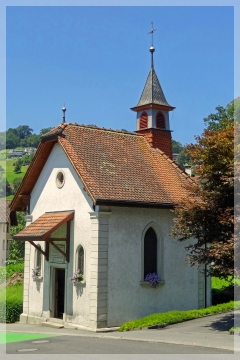
weggis - switzerland - mudslide chapel

When this pandemic first began, many thought of it as a Chinese virus. We now realize it’s not a Chinese, Italian, or even a New York thing; it’s affecting everyone everywhere, if not directly then indirectly. Lockdowns, quarantines, social distancing, face masks, make-shift hospitals and morgues, silent streets, shortages, closed churches, along with shuttered stores, schools and businesses and the financial fallout from those closures: these have altered the lives people across the globe. COVID-19 is no respecter of borders; as of yesterday, the number of confirmed cases was more than two million in at least 177 different countries.

Acknowledging that there is nothing typical about church during this pandemic, we didn’t air a typical church service on Palm Sunday. Instead, we chose to host a global celebration of our global Savior and offered messages and music from Britain, Ireland, Scotland, India, South Africa, South Korea, China, and Cuba, along with words and music from across the U.S. As I watched an Englishwoman recite a poem about prayer, witnessed a couple raise their voices in praise from a rooftop in a strangely silent Havana, joined a family as they sang from their living room in India, and shed a tear while a South Korean violinist played Ave Maria in an empty room, I realized how much this pandemic has brought us together across the world.

As beautiful and inspiring as were Palm Sunday’s musical offerings, I was touched most by the words of a man in China who thanked our church for its free App. His words reminded me that Jesus can be as contagious as COVID and that faith, hope and love can cross borders as easy as a virus. Coronavirus reminds us that, rather than an isolated community, we are part of a global community. We are not one church or one denomination; we are not Protestant, Roman Catholic, or Orthodox. We are one Church—the global Christian Church—and we follow one Savior—Jesus Christ!

While unable to attend church, we can continue being the Church and our congregation is larger than we think! My church has fewer than 70 people but in their first 24-hours, our Palm Sunday service was seen by over 5,700 people and our Easter one by over 7,800 (with over 80% of those views out of the U.S.!) Just as borders can’t stop COVID-19, they can’t stop Jesus. Let us thank God that today’s technology allows us to reach much further than we ever thought possible.

Alexander Graham Bell said, “When one door closes, another opens.” The rest of his quotation is, ”But we often look so long and so regretfully upon the closed door that we do not see the one which has opened for us.” Lament over the closed doors to our churches must not blind us to the digital door that has opened. Imagine the possibilities if, instead of being a single church or denomination, we acted as one family and all of Christ’s followers reached out virtually to join hands with the rest of the world. We serve a global Savior; indeed, in Christ there is no east or west!

In Christ there is no east or west, In him no south or north,
But one great fam’ly bound by love Throughout the whole wide earth.
In him shall true hearts ev’rywhere Their high communion find;
His service is the golden cord Close binding humankind.
In Christ now meet both east and west, In him meet south and north,
All Christly souls are one in him Throughout the whole wide earth.
[John Oxenham (1908)]

Make every effort to keep yourselves united in the Spirit, binding yourselves together with peace. For there is one body and one Spirit, just as you have been called to one glorious hope for the future. There is one Lord, one faith, one baptism, one God and Father of all, who is over all, in all, and living through all. [Ephesians 4:3-6 (NLT)]

Copyright ©2020 jsjdevotions. All rights reserved.