SHAVUOT

At the Festival of Harvest, when you present the first of your new grain to the Lord, you must call an official day for holy assembly, and you may do no ordinary work on that day. [Numbers 28:26 (NLT)]

fruitAt sunset yesterday, the Jewish feast of Shavuot began. Originally known as Festival of Harvest or First Fruits, Shavuot is the second of the three pilgrimage festivals given to the Israelites. The first was that of Unleavened Bread (Passover) and the third was the Final Harvest or Ingathering (Sukkot or Tabernacles). Originally, all three festivals were tied to the harvest with Passover at the beginning of the barley harvest, Shavuot seven weeks later at the start of the wheat harvest, and Sukkot at the last harvest of the season. For a nation who’d left Canaan because of famine, spent four hundred years in a foreign land (much of it as slaves) and then another forty years as nomads, the promise of becoming a people with land of their own, who could plant and harvest for themselves, must have been almost inconceivable.

Two distinct rituals were observed on Shavuot. In gratitude for the harvest, two loaves of bread baked from the new crop of wheat, a bull, seven lambs, two rams, and a goat were offered. In the second ritual, the choicest of the harvest’s first fruits were presented to the priests as these words from Deuteronomy were said: “With this gift I acknowledge to the Lord your God that I have entered the land he swore to our ancestors he would give us.” [26:3] Continuing with verses 5 through 10, the worshiper then acknowledged God’s faithfulness in bringing the people out of Egypt and in keeping His promise to the patriarchs to bring His people to a land “flowing with milk and honey.” Because it fell a full seven weeks (50 days) after the Passover, this festival became known as the Feast of Weeks (Shavuot).

Ten days after Christ’s ascension, during Shavuot, a group of believers gathered together in Jerusalem. A powerful wind roared and flashes of fire appeared and “everyone present was filled with the Holy Spirit.” Because of the uproar, a crowd gathered and Peter preached the gospel to them. That day, 3,000 people believed and were baptized; these new believers were the first fruits of the gospel harvest. Because it occurs fifty days after Easter, Christians call this day Pentecost, from the Greek meaning “fiftieth.” Because of the difference between the Jewish and Gregorian calendars, however, 2021’s Shavuot began last night but Pentecost will not occur until Sunday, the 23rd.

Because rabbinic tradition held that the Law was given on Mt. Sinai exactly seven weeks from the beginning of the Exodus, the day’s emphasis gradually moved from the first fruits of the harvest to the Torah. By the 2nd century, with the Temple destroyed, what began as a harvest festival commemorated the giving of the law at Mt. Sinai.

Today, Shavuot celebrates Israel’s bond because of the Torah and Pentecost celebrates Christians’ bond because of the Holy Spirit. Nevertheless, when looking at the origin of this ancient Jewish festival and its acknowledgement that God fulfilled His promise to bring His people into the Promised Land, I think of the many Messianic promises of the Old Testament. Rather than freeing us from slavery in Egypt, God faithfully fulfilled His promise and freed us from slavery to sin. Rather than physically bringing us into Canaan, He brought the Kingdom of God to us. Granted, the story is not over and the Kingdom is not fully realized, but we are in the land He promised and the best is yet to come! Let us be thankful and praise God for all He’s given us!

For the Lord your God is bringing you into a good land of flowing streams and pools of water, with fountains and springs that gush out in the valleys and hills. It is a land of wheat and barley; of grapevines, fig trees, and pomegranates; of olive oil and honey. It is a land where food is plentiful and nothing is lacking. It is a land where iron is as common as stone, and copper is abundant in the hills. When you have eaten your fill, be sure to praise the Lord your God for the good land he has given you. [Deuteronomy 8:7-10 (NLT)]

Copyright ©2021 jsjdevotions. All rights reserved.

SABBATH CONFLICTS

What can we bring to the Lord? Should we bring him burnt offerings? … No, O people, the Lord has told you what is good, and this is what he requires of you: to do what is right, to love mercy, and to walk humbly with your God. [Micah 6:6a,8 (NLT)]

In the Holy Place of the Tabernacle, there was a table on which the showbread was placed. Consisting of twelve loaves of unleavened bread stacked in two columns, it remained on the table for a week. When new loaves replaced it, the showbread was removed and eaten by the priests in the sanctuary. Because it was holy, no one other than a priest could eat it. Nevertheless, when David and his hungry men arrived in the town of Nob where the Tabernacle was located, Ahimelech the priest gave them the previous week’s showbread once he was assured the men were ceremonially clean. Having no other food for the famished men, the priest understood that feeding them was more essential than compliance with the ceremonial law. He knew the laws of compassion, mercy and love took precedence over ritual.

A thousand years later, Jesus and his disciples were walking through a grain field on the Sabbath when the hungry men picked some heads of grain and ate them. The Pharisees charged them with breaking the law, but not because they were picking grain in someone else’s field. It was perfectly permissible to do what they’d done any other day of the week but they’d done it on the Sabbath! Although harvesting grain was one of the thirty-nine categories of forbidden work on this day of rest, it’s not as if they were reaping sheaves of grain! Actually, the hungry men were doing no more work than someone feeding himself at a table. Moreover, Jewish tradition prohibited fasting on the Sabbath.

That subtle difference, however, was lost on the Pharisees who couldn’t see beyond the technicalities of the law. After Jesus reminded them of the story of David and the sacred loaves, He pointed out that they clearly didn’t understand God’s words in Micah about preferring mercy to sacrifices and that compassion was as important as the Law. Declaring Himself Lord over the Sabbath, Jesus then claimed authority over how the Sabbath was to be observed. To the Pharisees, however, His words were heresy.

Soon after, the Pharisees continued to exhibit their lack of mercy when they condemned Jesus for healing a man on the Sabbath. Jesus exposed their inconsistency by asking if they could save an animal on the Sabbath and then pointing out that a man was more valuable than a sheep. The laws of the Sabbath were never meant to release people from the need for mercy, whether to feed the hungry or relieve the misery of the afflicted.

Jesus regularly came into conflict with the Pharisees regarding the Sabbath but His issue wasn’t with the Sabbath; it was with the Pharisees. God didn’t create the Sabbath before making man! After creating humanity, God knew people would need a rest from the burden of work so He created the Sabbath for them. “The Sabbath,” Jesus explained, “was made to meet the needs of the people, and not the people to meet the requirements of the Sabbath.”

While this sacred day of rest and worship should have been viewed as a gift from God, by Jesus’ day, it had been complicated with an extensive list of restrictions (along with a variety of devious ways to skirt them). The Pharisees, however, had built their lives around rules and regulations and when Jesus questioned their authority, they called a meeting to plot His death. They didn’t understand that our God is a God of love not ritual, a God of people not regulations, a God who asks us to do is what is right, love mercy, and walk humbly with Him.

And I know it is important to love him with all my heart and all my understanding and all my strength, and to love my neighbor as myself. This is more important than to offer all of the burnt offerings and sacrifices required in the law.” [Mark 12:33 (NLT)]

Copyright ©2021 jsjdevotions. All rights reserved.

WHAT DOES GOD WANT?

Listen to the Lord, you leaders of Sodom. Listen to the law of our God, people of Gomorrah. “What makes you think I want all your sacrifices?” says the Lord. “I am sick of your burnt offerings of rams and the fat of fattened cattle. I get no pleasure from the blood of bulls and lambs and goats.” [Isaiah 1:10-11 (NLT)]

Although Hosea and Micah told Israel that God rejected their insincere sacrifices, when Isaiah addressed the people of Judah as the wicked Gentile cities of Sodom and Gomorrah, the vehemence of God’s words was unmistakable. The prophets’ words did not mean that God was rejecting the sacrificial system but that He found their offerings and sacrifices meaningless because of the people’s depravity, hypocrisy, and superficial worship.

Sacrifices and offerings of incense, grain and animals were an essential part of the Israelites’ rituals at the time. They were made as a way of praising God, showing dedication to Him, in thanksgiving for His many gifts, as a way of asking forgiveness, and as atonement for sins. Most of Leviticus is dedicated to the conduct of sacrifices and Numbers includes additional requirements concerning offerings. Yet, some 600 years after being given those regulations, the prophets told the people that God did not want their sacrifices and burnt offerings because, without faith in and love for Him, their offerings were meaningless.

Since we no longer make burnt sacrifices at our altars, what do those prophets’ words mean to us? To me, it means that it is not enough to simply go to church, sing in the choir, usher, recite Bible verses, teach Sunday school, bring treats, participate in a small group, or be diligent about our financial offerings to the church. God wants more!

As a girl, in confirmation class, I learned that the sacraments were “an outward and visible sign of an inner and spiritual grace.” The prophets’ words tell us that, no matter what the “outward and visible sign” may be, without an “inner and spiritual grace” it is meaningless. Even being dunked in a baptismal tank or regularly taking Communion are nothing more than empty rituals if our hearts and souls are not committed to God. Just as God wanted changed lives rather than bulls, lambs, and goats from the Israelites, He wants more from us than simply going through the motions of being a Christian.

God doesn’t want us just to know His word; He wants us to live it. He doesn’t want us just to know about Him, He wants us to know Him. He doesn’t want us going through the motions; He wants us! Rather than lip service; He wants our hearts. He must be an essential part of our lives. God wants us to serve Him not just with our bodies, but with our hearts and souls.  The prophets told the Israelites what God wanted; we should listen to them!

I want you to show love, not offer sacrifices. I want you to know me more than I want burnt offerings. [Hosea 6:6 (NLT)]

Wash yourselves and be clean! Get your sins out of my sight. Give up your evil ways. Learn to do good. Seek justice. Help the oppressed. Defend the cause of orphans. Fight for the rights of widows. [Isaiah 1:16-17 (NLT)]

Copyright ©2021 jsjdevotions. All rights reserved.

NATIONAL DAY OF PRAYER – 2021

I urge, then, first of all, that requests, prayers, intercession and thanksgiving be made for everyone – for kings and all those in authority, that we may live peaceful and quiet lives in all godliness and holiness. [I Timothy 2:1-2 (NLT)]

Without God, there is no virtue because there’s no prompting of the conscience. And without God, democracy will not and cannot long endure. If we ever forget that we are One Nation Under God, then we will be a nation gone under. [Ronald Reagan]

In 1775, the Continental Congress proclaimed that “a day of public humiliation, fasting, and prayer” be created and, since then, a president has called for over 140 national days of prayer. In 1795, for example, George Washington declared a day of public thanksgiving and prayer and, in 1863, Abraham Lincoln signed a resolution making April 30 a day of fasting and prayer. It was in 1952, during the Korean War, that Reverend Billy Graham challenged our nation’s leaders with these words: “What a thrilling, glorious thing it would be to see the leaders of our country today kneeling before Almighty God in prayer. What a thrill would sweep this country. What renewed hope and courage would grip the Americans at this hour of peril.”

In response to Graham’s challenge, a bill proclaiming an annual National Day of Prayer “on which the people of the United States may turn to God in prayer and meditation at churches, in groups, and as individuals” was unanimously passed by both houses of Congress. President Truman signed the bill requiring each subsequent president to proclaim a National Day of Prayer on the date of his choice. The original law was amended in 1988 when the first Thursday in May was designated as our nation’s National Day of Prayer.

The National Day of Prayer isn’t just a “Christian only” holiday and people of all faiths are encouraged to put aside their differences to pray for our nation. The day’s purpose is to unite people of all religions in prayer and to renew respect for God. Over 40,000 prayer gatherings at churches, parks, mosques, synagogues, temples, courthouses, and schools are held on this day every year. Of course, even though the law doesn’t establish or mandate a religion, its constitutionality has been challenged several times. The day has been found legal because it simply acknowledges the role of religion in the United States and can be ignored if one so wishes.

”Lord, pour out your love, life, and liberty,” is this year’s prayer theme and, other than being sure to pray, there are no guidelines for the day’s observance. This past year has been an extremely challenging one for our nation—the lives and health taken by COVID-19, chaos in our capitol, political polarization, isolation from friends and family, on-line learning, business closures, working from home, immigration issues, a troubled economy, church services suspended, unemployment, and escalating racial tensions to name just a few. We could spend the entire day in prayer and not cover them all. Regardless of your politics, I think we all can agree that divine intervention is desperately needed if our nation is to heal. The president’s call to prayer on this day, however, is merely a symbolic gesture unless we collectively fall to our knees in heartfelt prayer! Let us pray, not just today but every day, for our nation.

It is our prayer today and throughout 2021 that the Spirit of the Lord, pour out, pour through us across America, to fill our lives, families, churches, workplace, education, military, government, arts, entertainment and media, with Biblical, not cultural, not worldly, but Spirit-empowered, Spirit-filled LOVE, LIFE and LIBERTY as designed and defined by our Creator and Savior. [Kathy Branzell, President, National Day of Prayer Task Force]

What joy for the nation whose God is the Lord, whose people he has chosen as his inheritance. … We put our hope in the Lord. He is our help and our shield. In him our hearts rejoice, for we trust in his holy name. Let your unfailing love surround us, Lord, for our hope is in you alone. [Psalm 33:12,20-22 (NLT)]

Copyright ©2021 jsjdevotions. All rights reserved.

IMITATING CHRIST

Instead, clothe yourself with the presence of the Lord Jesus Christ. And don’t let yourself think about ways to indulge your evil desires. [Romans 13:14 (NLT)]

rue anemoneBecause of the Jewish prohibitions about images, I understand why no pictures of Jesus were drawn by His followers. Nevertheless, any decent author gives a minimal word picture of his characters but the gospels’ writers give us nothing. With Melville’s description of Captain Ahab’s gray hair, scarred face, and whale-bone peg-leg, we know more about the fictional whale hunter’s looks than we do about the real Jesus! The most we know about His exterior is found in Isaiah’s prophecy: “There was nothing beautiful or majestic about his appearance, nothing to attract us to him,” [53:2] which describes most of us! Adjectives are few and far between in Scripture but the Bible isn’t a novel and its words were God-breathed not writer created. If God wanted us to know about Jesus’s appearance, He would have told us. After all, if we knew what Jesus looked like, wouldn’t we focus more on His looks rather than His words? Rather than wanting to emulate His character, we’d probably want to match His features—after all, He was God!
When Paul told the Romans to “put on” or clothe themselves with Christ, he wasn’t speaking of robes, sandals, beard or haircut. He was speaking of spiritual clothing—to take off our “dark deeds like dirty clothes, and put on the shining armor of right living.“ [13:12] While we know nothing of Jesus’ physical appearance, the New Testament writers gave us more than enough description of Jesus’ words and behavior to clearly picture the “shining armor of right living.” When we put on Christ, our minds and behavior transform so that our lives imitate His—so that, when people see us, they should see Him.

Below is an excerpt from the Epistle to Diognetus. While not part of the Christian canon, it is a valuable document. Written around 130 AD, the author calls himself Mathetes (meaning “disciple” in Greek) and claims to be a student of the apostles. Yesterday, I wrote of the misconceptions surrounding the early followers of Jesus. In Mathetes’ letter, he defends the doctrines of Christianity and describes Christian behavior to the “most excellent Diognetus.” In one chapter, Mathetes explains that, while Christians follow the ordinary customs of clothing, food and conduct, “they display to us their wonderful and confessedly striking method of life.” The lifestyle to which Jesus calls us has not changed since Mathetes’ time and yet, when reading his words, I wonder if anyone would describe today’s followers of Christ in the same way.

They dwell in their own countries, but simply as sojourners. As citizens, they share in all things with others, and yet endure all things as if foreigners. Every foreign land is to them as their native country, and every land of their birth as a land of strangers. They marry, as do all [others]; they beget children; but they do not destroy their offspring. They have a common table, but not a common bed. They are in the flesh, but they do not live after the flesh. They pass their days on earth, but they are citizens of heaven. They obey the prescribed laws, and at the same time surpass the laws by their lives. They love all men, and are persecuted by all. They are unknown and condemned; they are put to death, and restored to life. They are poor, yet make many rich; they are in lack of all things, and yet abound in all; they are dishonoured, and yet in their very dishonour are glorified. They are evil spoken of, and yet are justified; they are reviled, and bless; they are insulted, and repay the insult with honour; they do good, yet are punished as evil-doers. When punished, they rejoice as if quickened into life; they are assailed by the Jews as foreigners, and are persecuted by the Greeks; yet those who hate them are unable to assign any reason for their hatred.

To sum up all in one word—what the soul is in the body, that are Christians in the world. The soul is dispersed through all the members of the body, and Christians are scattered through all the cities of the world. The soul dwells in the body, yet is not of the body; and Christians dwell in the world, yet are not of the world.  [Epistle to Diognetus – translated by Alexander Roberts and James Donaldson]

Put on your new nature, and be renewed as you learn to know your Creator and become like him. [Colossians 3:10 (NLT)]

Put on your new nature, created to be like God—truly righteous and holy. [Ephesians 4:24 (NLT)]

Copyright ©2021 jsjdevotions. All rights reserved.

ALEXAMENOS

“I’ve said these things to you,” Jesus went on, “to stop you from being tripped up. They will put you out of the synagogues. In fact, the time is coming when anyone who kills you will suppose that they are in that way offering worship to God. They will do these things because they haven’t known the father, or me. But I have been talking to you about these things so that, when their time comes, you will remember that I told you about them.” [John 16:1-4 (NLT)]

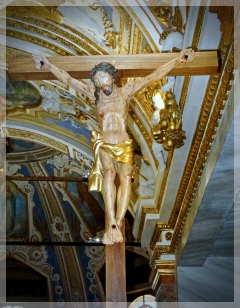
Locarno-Madonna del SassowIn any cathedral or art museum, we’ll find many pictures of Jesus and even rather graphic depictions of Him on the cross. None of them, however, tell us anything about His appearance because they were created long after His time. Still, in a world where we seem to memorialize everything with pictures, you’d think one of Jesus’ followers would have sketched Him while blessing the children, giving the Sermon on the Mount, or feeding the multitude! 1st century rabbis in Judah, however, vehemently objected to the depiction of human figures because the second commandment prohibited making a “graven image.” With its Jewish roots, this prohibition carried into the early church and inhibited early Christian art.

At first, Jesus was represented indirectly by symbols such as the peacock, lamb, dove, and anchor. One of the most common was the ichthus (fish) because the Greek word served as an acronym “Jesus Christ, Son of God, Savior.” While making the sign of the cross dated from sometime in the second century, because of its connection with the horrific death of criminals, the cross did not became a symbol of Christianity until the 4th century; crucifixes and other depictions of the crucifixion did not occur until the 6th.

One earlier depiction of Jesus’ crucifixion, however, does exist. Crudely scratched into a stone wall, it was discovered in 1857 during an excavation of the Paedagogiumon (a school for the training of slaves) on Rome’s Palatine Hill. Dating from around 200 AD, it shows a man (or boy) worshiping a figure on a cross; the figure, however, has the head of an ass. The inscription reads, “Alexamenos worships his God.” This derisive graffiti gives us an idea of the way early Christians were ridiculed for worshiping a man who had been executed as a criminal.

Along with claims of onolatry (donkey worship), the early Christians had to deal with several other disparaging, malicious, and false accusations such as incest, cannibalism, and drinking the blood of infants. Roman orator Marcus Cornelius Fronto (c. 100-160) wrote that Christians were “initiated by the slaughter and the blood of an infant” and that Christianity was “foolish” because, “they worship a crucified man, and even the instrument itself of his punishment” and “are said to worship the head of an ass.”

This was the world—a world that misunderstood, slandered, ridiculed, hated and persecuted them—of the early Christians. And yet, they proceeded in faith and spread the gospel. I wonder how the 21st century church would do in similar circumstances! As for Alexamenos, the fellow mocked by that ancient graffiti—more graffiti was found on a wall in an adjacent room. In Latin it said, “Alexamenos is faithful.”  In the face of opposition, we must be the same!

Think back on those early days when you first learned about Christ. Remember how you remained faithful even though it meant terrible suffering. Sometimes you were exposed to public ridicule and were beaten, and sometimes you helped others who were suffering the same things. You suffered along with those who were thrown into jail, and when all you owned was taken from you, you accepted it with joy. You knew there were better things waiting for you that will last forever. So do not throw away this confident trust in the Lord. Remember the great reward it brings you! [Hebrews 10:32-35 (NLT)]

Copyright ©2021 jsjdevotions. All rights reserved.