ADAPTING AND CONFORMING

If the world hates you, remember that it hated me first. The world would love you as one of its own if you belonged to it, but you are no longer part of the world. I chose you to come out of the world, so it hates you. Do you remember what I told you? “A slave is not greater than the master.” Since they persecuted me, naturally they will persecute you. And if they had listened to me, they would listen to you.” [John 15:18-20 (NLT)]

A century of dike-building, agricultural development, and population growth has destroyed much of Florida’s wetlands and threatened the survival of dozens of animals like Florida panthers, Snail Kites, and Wood Storks. The White Ibis, however, is an exception. Having adapted to the new urban landscape, large groups of ibis happily graze the lawns of subdivisions, parks, and golf courses. They’ve found it easier to poke at the soil for a predictable buffet of grubs, earthworms, and insects than to forage in the remaining wetlands for aquatic prey like small fish, frogs, and crayfish. Once wary of humans, these urbanized ibis pay little or no attention to people as they follow one another across our lawns.
While conforming to a world of diminishing wetlands may be beneficial to the ibis, the Bible makes it clear that Christ’s followers are not to conform to the world around us. As the salt of the earth, we are to bring a distinctive taste, look, and smell to the world rather than take on the flavor of the world in which we live. Nevertheless, like the ibis, Christ’s church appears to be acclimating and adjusting to the world surrounding it.

In an effort to fill the pews and keep the coffers filled, we’re seeing His church adapting and conforming to today’s culture. Social media, politics, fashion, popular music, celebrities, advertisements, movies, television, politics, and politicians seem to be infiltrating and influencing our attitudes, worship, instruction, and doctrine. We’re beginning to shape values, use words, understand events, and determine right and wrong through the eyes of the world rather than the Bible. Jesus, however, was anything but popular, politically correct, or entertaining and His Church was never meant to be cool, trendy, fashionable, or fun to an unbelieving world; it is meant to be like Christ!

Just as the Israelites were not to succumb to the influence of the pagan nations around them, we are to remain apart and distinct from the corrupting influences of the world around us. While sinners should be welcome in the church, sin should not. Nevertheless, afraid of offending anyone—we creatively reinterpret or ignore Scripture, turn a blind eye to sin, or refuse to speak of sin at all. Are we seeking the world’s approval or God’s?

If we go back to the beginning of the Church, it’s estimated there were only about 1,000 Christ followers in the Roman Empire. By AD 100, however, there were about 7,500. By AD 150, there were 40,000 believers and, by 350, 34 million people (more than half the Roman Empire) followed Christ! Although the early church grew by about 40% each decade, the numbers are going in the opposite direction today. According to the Pew Research Center,  90% of Americans identified as Christian just 50 years ago but, in 2023, that number was only 64%! While adapting to the world around them may be working for the ibis, it doesn’t seem to be working for today’s church. In actuality, the church the looks and acts like the world around it, is not Christ’s church.

The early church didn’t grow because it lived as Rome did—it grew because it lived as Jesus did. The early believers had an uncompromising faith that transformed the pagan world around them. Let us do the same!

Don’t copy the behavior and customs of this world, but let God transform you into a new person by changing the way you think. Then you will learn to know God’s will for you, which is good and pleasing and perfect. [Romans 12:2 (NLT)]

Copyright ©2024 jsjdevotions. All rights reserved.

OH COME, IMMANUEL (5) – THE SECOND ADVENT

The Lord of Heaven’s Armies says, “The day of judgment is coming, burning like a furnace. On that day the arrogant and the wicked will be burned up like straw. They will be consumed—roots, branches, and all. But for you who fear my name, the Sun of Righteousness will rise with healing in his wings. And you will go free, leaping with joy like calves let out to pasture. On the day when I act, you will tread upon the wicked as if they were dust under your feet,” says the Lord of Heaven’s Armies. [Malachi 4:1-3 (NLT)]

In the first Advent, Jesus came as a suffering servant in a manger. In His second Advent, Jesus will return in righteousness as the conquering King who makes all things right. His return means the final destruction of sin, injustice, hate, disease, death, decay and evil. Our God, however, is one of both mercy and judgement and Malachi’s promise of the Messiah included a warning about the coming day of judgment.
Jesus spoke of this coming judgment when He likened the division between believers and unbelievers to a shepherd who separates the sheep from the goats. True believers, however, don’t need to cower in fear at the prospect of judgment. Clothed in His righteousness, they will stand before Jesus forgiven of every single sin. As the faithful, they are the righteous sheep and destined for eternal life in the kingdom. The goats, however, are those who refuse to believe and they are destined for eternal punishment.

The early church thought Jesus would return within their lifetimes but 2,000 years have passed and He still hasn’t returned. Peter explained the delay: “A day is like a thousand years to the Lord, and a thousand years is like a day. The Lord isn’t really being slow about his promise, as some people think. No, he is being patient for your sake. He does not want anyone to be destroyed, but wants everyone to repent.” [2 Peter: 8-9]

Nevertheless, the day will come when Jesus returns to judge the living and the dead. He told us that we must be ready for that day. Just as a thief strikes an unsuspecting house by surprise, Jesus will catch an unbelieving world the same way. On that day, Almighty God will assess everyone according to their soul’s status and, when that happens, there will be no opportunity for last-minute repentance or bargaining.

It is in Christ’s return that we see the promises of God fully come to pass – promises to be with His people – promises that all things will be made new – promises of peace and security – promises of the full enjoyment of all that life was meant to be.

“God’s home is now among his people!” prophesied John in Revelation 21. “He will live with them, and they will be his people. God himself will be with them. He will wipe every tear from their eyes, and there will be no more death or sorrow or crying or pain. All these things are gone forever.” [21:3-4]

This season of Advent is more than a time of preparation to celebrate Christmas; it is a time of preparation to focus our hearts, wills, and minds on Christ’s return—not as the end of the world—but as the beginning of the life as God intended it to be lived—a time when peace and justice will prevail and there will be no death, sorrow, or tears.

2,000 years ago, the people of Judah longed for the promised Messiah and, recognizing mankind’s need for a savior, God answered their prayer with Jesus. As Christians in the 21st century, we long for Messiah’s return and, someday, God will make good on that promise, as well.

The question to ask ourselves during this season isn’t whether we’re ready for Christmas. The question we should be asking is whether we’re ready for that glorious day when Jesus returns.

“Men of Galilee,” they said, “why are you standing here staring into heaven? Jesus has been taken from you into heaven, but someday he will return from heaven in the same way you saw him go!” [Acts 1:11 (NLT)]

Don’t let your hearts be troubled. Trust in God, and trust also in me. There is more than enough room in my Father’s home. If this were not so, would I have told you that I am going to prepare a place for you? When everything is ready, I will come and get you, so that you will always be with me where I am. [John 14:1-3 (NLT)]

Copyright ©2023 jsjdevotions. All rights reserved.

OH COME, IMMANUEL (4) – HE WILL RETURN

As my vision continued that night, I saw someone like a son of man coming with the clouds of heaven. He approached the Ancient One and was led into his presence. He was given authority, honor, and sovereignty over all the nations of the world, so that people of every race and nation and language would obey him. His rule is eternal—it will never end. His kingdom will never be destroyed. [Daniel 7:13-14 (NLT)]

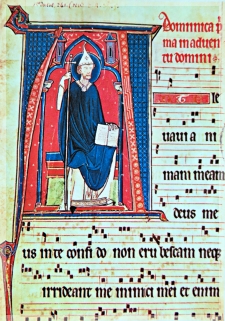
13th-century music manuscript

I began this series by saying that the Jews of the 1st century easily could have sung the words “O come, O come, Immanuel, and ransom captive Israel,” but those words weren’t sung by Jews. They were chanted in Latin over 1,200 years ago by Benedictine monks. In the 1800s, their words were translated into English, the verses rearranged, and the new version set to the melody of a 15th century French requiem mass processional.

The monk’s original version had seven verses and a verse a day was sung in the week before Christmas. Calling for God to come, each verse referred to a Messianic name found in the Hebrew Scriptures: Wisdom, Adonai (the Hebrew word for God), Root of Jesse, Key of David, Dayspring, King of the Gentiles, and Immanuel.

This Gregorian chant, however, was as much about the future as it was about the past. While celebrating our Savior’s birth, it also prepared the monks’ hearts for the day Jesus would return. You see, the first letter of each of the Latin names of God formed an acrostic. When put together in order, they spelled SARCORE but, when put together backwards, they spell Ero cras, which, in Latin, means “I shall be with you tomorrow.” While declaring the first Advent, this hymn is an urgent prayer expressing mankind’s longing for the second Advent when Jesus returns.

Scripture is neither vague nor equivocal on the promise of Christ’s return. His return is a major theme in the prophecy of both Old and New Testaments. 23 of the 27 New Testament books reference His return as do 17 books of the Hebrew Scriptures. According to Bible teacher David Jeremiah, references to Christ’s second coming outnumber references to His first by eight to one!

Jesus Himself promised His return. In Matthew 24:30-31, He spoke of a time people would, “see the Son of Man coming on the clouds of heaven with power and great glory. And he will send out his angels with the mighty blast of a trumpet, and they will gather his chosen ones from all over the world—from the farthest ends of the earth and heaven.”

On the night of His betrayal, Jesus promised His disciples, “I will come back and take you to be with me that you also may be where I am.” [John 14:3] After His ascension into heaven, two angels told the disciples, “This same Jesus, who has been taken from you into heaven, will come back in the same way you have seen him go into heaven.” [Acts 1:11]

Advent is far more than a time to look forward to celebrating Messiah’s birth and prepare for Christmas. It is as much a time to look forward to and prepare for Christ’s return! Many people missed His first coming but no one will miss His second!

And there will be strange signs in the sun, moon, and stars. And here on earth the nations will be in turmoil, perplexed by the roaring seas and strange tides. People will be terrified at what they see coming upon the earth, for the powers in the heavens will be shaken. Then everyone will see the Son of Man coming on a cloud with power and great glory. So when all these things begin to happen, stand and look up, for your salvation is near! [Luke 21:25-28 (NLT)]

Copyright ©2023 jsjdevotions. All rights reserved.

THE POTLUCK

All the believers devoted themselves to the apostles’ teaching, and to fellowship, and to sharing in meals (including the Lord’s Supper), and to prayer. [Acts 2:42 (NLT)]

It was while Jesus and the disciples were eating the Passover meal that the Lord instituted the Eucharist. The 1st century church followed His lead by celebrating the Eucharist in the context of a communal meal. The wealthier contributed the food and portions were set aside for the sick, poor, and widowed. Nourishing both body and soul while building a sense of community, these fellowship meals were known as agape or love feasts!

Although Luke wrote of the church sharing “their meals with great joy and generosity,” it didn’t go as smoothly in Corinth. Instead of gathering all the food together, dividing it among the participants, and eating together, people only ate and drank what they brought for themselves and some over-indulged in wine! The wealthy ate more and better than the poor and some even went hungry. Rather than building a sense of community by erasing the differences in social class, such rudeness and disparity caused division and hard feelings within the church and the Apostle Paul took the Corinthians to task for neither sharing nor caring when they gathered. [1 Cor 11:20-34] 2 Peter 2:13 and Jude 12 also refer to these fellowship meals when warning about the false teachers who attended such gatherings.

Although the practice of agape meals declined by the 4th century, something similar to the agape, love feast, or fellowship meal can be found in the modern church potluck. While “potluck” initially meant the meal an unexpected guest might get—the luck of whatever was in the pot—during the Depression years, it took on the meaning of a communal meal at which all attending brought a dish to share. Our northern church hosted mid-week Lenten potlucks but our Florida church always hosts a potluck the week before Thanksgiving Day.

Last week’s dinner got me thinking about the way a potluck resembles the Church. A potluck means a vast assortment of food prepared and served in any number of ways. Dishes will range from pierogis and baked ziti to empanadas and Swedish meatballs. Sides will include everything from Waldorf salad, deviled eggs, and baked beans to Jello, scalloped potatoes, Brussels sprouts, and macaroni salad. Desserts will range from peanut butter cookies and chocolate cake to lemon bars and apple pie. Although it seems an odd mix, if everyone brought the same food, the meal would be boring and, if everyone’s offerings were dumped into one pot, it would be even worse! By allowing each dish to reflect its own texture, color, and flavor, this strange assortment of food comes together to make a cohesive and delightful meal. While some may prefer apple pie to pumpkin or mac ‘n cheese to green bean casserole, everyone’s offerings are welcomed, appreciated, and respected.

That diversity of food reflects the diversity of people within the Church—the regions from which we come, our nationalities, and our diverse backgrounds, preferences, and traditions. Just as a potluck encompasses a variety of food, the church consists of a collection of unique people as different from one another as is ham from a vegan casserole! Each person brings their distinctive personality, ethnicity, interests, gifts, and politics. While we may have our preferences, everyone is welcomed, appreciated, and respected. When diverse individuals come together as a church, they become the body of Christ in the same way a potluck’s various dishes became a cohesive meal! It’s not their sameness that unites Christians—it’s their love of Jesus!

The Christian’s love for his neighbor along with the generosity, hospitality, and fellowship found in Christ’s church are seen in a potluck. Each dish is prepared with love and care and everyone brings much more than they possibly could consume themselves. Unlike the Corinthians, they bring excess food with the express purpose of sharing it (and any leftovers) with others! Everyone’s gifts are as welcome in the Church as they are at a potluck! No one eats alone at a potluck and no one is alone in the Church—we are blessed by our brothers and sisters in Christ. At a potluck, even when we don’t know someone at our table, by the time the meal is over, we will have dined with friends! In the same way, when we come to the Lord’s table, we are one in the Spirit with all who partake of the Eucharist.

A potluck, like the Church, nourishes both body and soul! While the agape or love feast is no longer a regular part of Christian worship, you’re sure to find both love and feast in Christ’s Church—especially at a potluck! Let us break bread together.

They worshiped together at the Temple each day, met in homes for the Lord’s Supper, and shared their meals with great joy and generosity—all the while praising God and enjoying the goodwill of all the people. And each day the Lord added to their fellowship those who were being saved. [Acts 2:46-47 (NLT)]

Copyright ©2023 jsjdevotions. All rights reserved.

PRAYING FOR BENIN

Don’t let anyone capture you with empty philosophies and high-sounding nonsense that come from human thinking and from the spiritual powers of this world, rather than from Christ. For in Christ lives all the fullness of God in a human body. So you also are complete through your union with Christ, who is the head over every ruler and authority. [Colossians 2:8-10 (NLT)]

voodoo dollWithout a globe, I allowed a random number to decide the nation for which I’d pray this week. Number 19 was Benin and I’m embarrassed to admit knowing nothing about this narrow strip of land in West Africa between Nigeria and Togo. These three nations once were part of the kingdom of Dahomey and it was in Dahomey that the ancient practice of voudon/vodun/vodou (commonly called voodoo) began. Now a republic, Benin is a severely underdeveloped nation, rife with corruption, where the life expectancy for men is just 60! A little over 40% of the population are Christian, nearly 30% Muslim, about 17% practice voodoo, and another 10% follow other indigenous/animistic religions. As a side note, ARDA (The Association for Religion Data Archives) stated that many of those identifying as Christian also practice voodoo.

Since my limited knowledge of voodoo comes from bad movies with zombies, hexes, and pins stuck into dolls, I did some research. The voodoo of movies and fiction bears little resemblance to real voudon beliefs or practices. Rich with proverbs, songs, and folklore, voudon includes belief in a universal energy, many spirits, a soul that can leave the body during dreams, spirit possession, and folk medicine. Nevertheless, even without the gruesome zombies, voodoo (no matter how you spell it) is incompatible with Christianity.

Voudon came to the New World with enslaved West Africans and is the only traditional African religion to survive here. While it’s the primary religion of a little over 2% of the Haitian population, ARDA noted that a much larger number of people identifying themselves as Christian continue to practice it. ARDA also found that a number of Christians in the Dominican Republic secretly practice witchcraft (brujería) or voodoo.

Converting isn’t easy and it’s not just voudon practitioners who have difficulty completely abandoning their culture’s traditions for Christianity. I had a Japanese friend who struggled to find a way to honor her ancestors without praying to them as she’d done for decades before converting.

Back in Paul’s day, the Colossians had difficulty preventing their new faith in Christ from becoming a mixed religion combining Christianity with elements of their Jewish roots and the popular philosophical movement of Gnosticism. What they ended up with were human traditions, circumcision, a requirement to observe both the Sabbath and the annual and monthly Jewish holy days along with dietary laws, the worship of angels, and even self-abasement—none of which were compatible with Christianity.

Rather than voodoo or Gnosticism, it’s belief in things like Kabbalah, tarot reading, astrology, manifesting, reincarnation, the spiritual energy of objects, psychic mediums, channeling, and crystals that have found their way into American Christians. Often called “new age,” there’s nothing new about them. While they may seem “spiritual” or self-affirming, they cut us off from God’s divine sovereignty, power, and purpose. Nevertheless, in 2018, Pew Research found that 61% of Americans identifying as Christian also believed in at least one of these things: reincarnation, astrology, psychics, or that spiritual energy can be in physical things.

Christianity doesn’t come with an ala carte menu. We don’t get to pick and choose individual dishes according to our preferences, make substitutions, or add a few extra sides because they’re intriguing, trendy, or promise earthly rewards. Christianity comes with a table d’hôte or prix fixe menu. Additions or substitutions aren’t allowed because the menu was set by God and Christ is all-sufficient.

Salvation is offered to everyone but, in Matthew 7, Jesus warned us that God’s gate isn’t wide enough for the addition of other beliefs! He continued with his caution when He said that some who expected to enter the Kingdom wouldn’t be allowed entrance; a similar warning is found in Luke 13. Those who identify as Christian but also follow voodoo or other non-Scriptural beliefs probably expect to enter through that narrow gate. I suspect they are mistaken and will find it shut tight.

As I prayed for Benin, I also prayed for all people who’ve combined false doctrine or pagan practices with their belief in Jesus. May they know and understand that the broad road leading to the wide gate is the road to destruction!

He replied, “Work hard to enter the narrow door to God’s Kingdom, for many will try to enter but will fail. When the master of the house has locked the door, it will be too late. You will stand outside knocking and pleading, ‘Lord, open the door for us!’ But he will reply, ‘I don’t know you or where you come from.’ Then you will say, ‘But we ate and drank with you, and you taught in our streets.’ And he will reply, ‘I tell you, I don’t know you or where you come from. Get away from me, all you who do evil.’” [Luke 13:24-27 (NLT)]

Copyright ©2023 jsjdevotions. All rights reserved.

FINDING COMMON GROUND

For you are all children of God through faith in Christ Jesus. And all who have been united with Christ in baptism have put on Christ, like putting on new clothes. There is no longer Jew or Gentile, slave or free, male and female. For you are all one in Christ Jesus. [Galatians 3:26-28 (NLT)]

rosaryPastor Chris recently shared a devotion she read in which the author gives his office globe a gentle spin each morning. After a moment or two, he places a finger on the globe, stops its revolution, and prays for the people wherever his finger lands. Chris said she’s adopted this practice but, to make it more than a quick uninformed prayer, she does some research on the country’s needs and religions to guide her petitions.

Sounding like an interesting prayer discipline, I thought I’d give it a try. I don’t have a globe to spin but, since my hairdresser just returned from visiting her family in Albania, I thought I’d pray for her native land (a nation about which I knew nothing). Located just north of Greece, the Association for Religion Data Archives [ARDA] reported that about 59% of Albanians identify as Muslim and nearly 38% as Christian with the Christians almost evenly divided between the Roman Catholic and Orthodox churches. Less than 2% of the population identify as Protestant or other.

Although about 97% of Albania’s population claims to believe in God, few would have dared admit that 50 years ago! In 1967, communist Albania officially became an atheist country with a constitutional ban on all religious belief. Participation in any religious ceremony was a punishable offense, clergy of all faiths were jailed or killed, believers were ruthlessly persecuted, and churches and mosques were turned into factories. Possession of a Bible or Quran was prohibited and even making the sign of the cross could land someone in jail. With the fall of communism, the ban on religious observance was lifted in December 1990 and, in 1991, thousands of Christian missionaries flooded into Albania.

I learned that a fair amount of ignorance and arrogance came with those missionaries and we can learn a valuable lesson from their mistakes. Thinking they were the first to bring the gospel to Albania, most missionaries didn’t know that Albania’s Christian roots went back to the first century when Paul brought the gospel to Illyricum and Titus went to Dalmatia. That was today’s Albania! Evidence of Christian families in the Albanian city of Durrës in 58 AD leads scholars to believe Paul and Titus also visited there.

The uninformed evangelists didn’t know that Christianity thrived in Albania for twenty centuries until God was outlawed in 1967 or that 40% of the nation had a Christian background. They didn’t know that some priests had continued to baptize, say the liturgy, and have prayer vigils in secret and that many suffered for doing so! The evangelical missionaries were completely unfamiliar with Orthodox Christian or Roman Catholic traditions. When people showed their foreign visitors the icons, missals, rosaries, and crosses they’d kept hidden (at great risk) for over 25 years, they were told to put away their idolatrous items and to stop being superstitious by making the sign of the cross! Rather than build on these believers’ displays of faith, uninformed missionaries rejected them outright.

The Orthodox priests often found the supposedly non-denominational Christian groups unwilling to work with them. Unfamiliar with their ancient traditions and liturgy, many of the evangelical missionaries viewed them with suspicion. Of course, it went both ways. The Orthodox, unfamiliar with denominational Protestants, Evangelicals, Mormons, Jehovah’s Witnesses, Christian Scientists, Adventists, and Unitarians, lumped them all together in one category of “heretical cults” and often resisted efforts to hand out their Bibles. Ignorance, arrogance, and prejudice on both sides impaired Christian witness.

On the plus side, some groups were sensitive to the history of Albania and successfully worked in conjunction with the local churches. Today, in an effort to combat misperceptions, exchanges are done between the Orthodox and Roman Catholic seminaries and the Evangelical Bible Institute in Albania.

If we ever hope to introduce Christ to the world and spread God’s word, Christians everywhere need to overcome their ignorance of other people, cultures, traditions, and faiths—even when they seem very different from ours. Saying he did everything to spread the blessings of the gospel message, the Apostle Paul told the Corinthians that he tried to find common ground with everyone in his effort to save them.[1 Cor. 9:22-23]  We can do nothing less! Rather than Christians competing with one another, we need to understand that we’re all on the same side—the side of Jesus!

There’s nothing like face-to-face contact and the developing of relationships for breaking down walls of prejudice. We have to start seeing one another as brothers and sisters from whom we can learn and grow. We shouldn’t let our arrogance or ignorance, and even our differences or different beliefs create walls that nourish fear or uncertainty of the other. As Christians we have to love the other through encountering them, and trying to understand who they are and what they believe.  [Fr. Luke A. Veronis] 

Always be humble and gentle. Be patient with each other, making allowance for each other’s faults because of your love. Make every effort to keep yourselves united in the Spirit, binding yourselves together with peace. For there is one body and one Spirit, just as you have been called to one glorious hope for the future. [Ephesians 4:2-4 (NLT)]

Copyright ©2023 jsjdevotions. All rights reserved.