
Moses remained there on the mountain with the Lord forty days and forty nights. In all that time he ate no bread and drank no water. And the Lord wrote the terms of the covenant—the Ten Commandments—on the stone tablets. [Exodus 34:28 (NLT)]
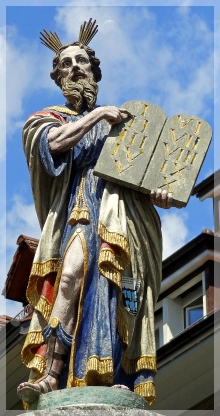 Although three places in Scripture tell us that the Lord proclaimed ten commandments and wrote them on stone tablets, those tablets weren’t numbered (especially not with Roman numerals)! The original languages of the Bible (Hebrew, Aramaic, and Greek) didn’t contain punctuation and the earliest manuscripts didn’t even have spaces between the words. While the words in Scripture are God-breathed, the punctuation was at the discretion of later copyists and translators. Without numbering, punctuation, or paragraphs, we can’t know for sure where one commandment ends and the other begins. As a result, while Jews, Roman Catholics, Protestants, and Orthodox Christians all observe the Ten Commandments, their commandments are not all the same!
For a Jew, rather than ten commandments, there are 613 throughout the Hebrew Scriptures. The first ten are called the Decalogue. While most Christians consider Exodus 20:2, “I am the Lord your God, who rescued you from the land of Egypt, the place of your slavery,” a preface to the Ten Commandments, it is the first one for a Jew and considered the most important because it establishes God’s authority for all that follows. Until that first commandment is accepted—that Adonai is one’s God—the rest wouldn’t be obeyed. The Jewish second commandment spans Exodus 20:3-6 and combines three prohibitions regarding idolatry: (1) no other gods, (2) no making of idols, and (3) no worship of idols. Commandments three through ten are the same as those recognized by most Protestants and Orthodox Christians.
Around 220 AD, the Christian Biblical scholar Origen of Alexandria numbered the commandments in the way familiar to most Protestant and Orthodox Christians. Skipping Exodus 20:2, He began with the prohibition of false gods “You shall have no other gods before me,” and continued with the second commandment prohibiting idols. The 10th commandment prohibited all coveting.
In the fifth century, however, Saint Augustine re-numbered the commandments so that the prohibitions about other gods and idols were combined into the first commandment. Making him short one commandment, Augustine then split Exodus 20:17 into two with coveting a neighbor’s wife the 9th commandment and coveting anything else of the neighbor’s the 10th. Although this required rearranging Scripture’s words, perhaps he reasoned that coveting your neighbor’s wife was vastly different than coveting his house or team of oxen. In any case, Augustine’s system was adopted by the church.
In 1054, the Christian church split into the Eastern Orthodox and the Roman. Orthodox Christians follow Origen’s numbering but include Exodus 20:2, “I am the Lord your God who rescued you from Egypt….,” in the first commandment. The Protestant Reformation of the 16th century further divided the church. Except for Lutherans, the Protestant church returned to Origen’s original numbering system. Perhaps because Luther was an Augustine monk for fourteen years, his version of the Commandments follows that of the Roman Catholic church with one notable exception. Returning to the original order found in Scripture, Luther’s 9th commandment prohibits coveting your neighbor’s house and the 10th prohibits coveting his wife, servant, animals, or anything else. In this way, Luther distinguished coveting the inanimate (house) from coveting the animate (wife, servant, etc.).
Who’s right? Only God know! Far more important than how the commandments are numbered, however, is what those commandments meant to the Israelites and what they mean to us today. The first three or four (depending on your denomination) have to do with mankind’s relationship to God and lay out our obligation to honor our Creator. The next seven or six (again depending on your denomination) have to do with the obligations we have to one another in family and society and lay out the foundation for building a community. Rather than disagreeing about how to number the Ten Commandments, we should make a greater effort to live the two spoken by Jesus!
 While reading about David and Goliath, I realized that it’s not just our seniors who can be undervalued or overlooked. It’s as wrong to disregard the youth in our midst as it is to discount the old. Likewise, just as some seniors may underestimate their gifts, the same could be said for those who still count the years rather than the decades! Age is just a number to God—He’s more interested in willing hearts than number of years!
 English philosopher Francis Bacon defined “old age” as “always 15 years older than I am.” He would have liked it here in southwest Florida because there always seems to be someone fifteen years older. Nevertheless, having recently celebrated my 77th birthday, it’s getting increasingly hard to find them! While I enjoy being told I look good, I don’t like hearing the “for your age!” ending that sentence! Hearing that qualified compliment, being called “Hon” or “Sweetie” by a waitperson or nurse less than half my age, or people assuming my grey hair means I’m computer inept and/or hard of hearing remind me of the subtle ageism in today’s society.
 What is a jot or a tittle? Found in the King James version, the words “jot” and “tittle” date from the 15th and 16th centuries. “Jot” comes from jota, an alternate spelling of the Greek iota (the smallest letter in the Greek alphabet) and, at the time, meant something very small. “Tittle” was a translation of keraia, a Greek word meaning “a little horn” that referred to an accent mark over a vowel. While those English words were good translations of the New Testament’s Greek, Jesus wasn’t speaking Greek when He gave the Sermon on the Mount. He was speaking Hebrew or Aramaic and the words He used weren’t iota and keraia. He would have used yod, which was the smallest Hebrew letter, and kots, meaning thorn, which was the little curve or flourish at the yod’s top distinguishing it from other letters. The tenth letter of the Hebrew alphabet, yod sounds like a “y” and looks a bit like an apostrophe.
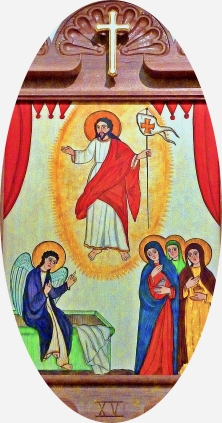 “Happy Easter,” said the Pastor as she welcomed us to worship. She was neither a week late nor four weeks early for Greek Orthodox Easter. While it’s no longer Easter Sunday and all the jelly beans, chocolate bunnies, and hard-boiled eggs have been eaten, it is Eastertide (“tide” just being an old-fashioned word for “season” or “time”). The Christian or liturgical calendar designates Eastertide as the fifty days from Easter/Resurrection Sunday to Pentecost (when we celebrate the outpouring of the Holy Spirit and the birth of the church).
 Today is Maundy (or Holy) Thursday—the day many Christians throughout the world will observe the institution of the Lord’s Supper/Eucharist/Holy Communion by coming to the Lord’s table. Regardless of what you call this sacrament, Jesus’ mention of a “new covenant” probably will be part of your service. Not a word commonly used today, what is a covenant and how does it differ from a contract?
