THE BOSS’S SON

Who, though in God’s form, did not regard his equality with God as something he [Jesus] ought to exploit. Instead, he emptied himself, and received the form of a slave, being born in the likeness of humans. And then, having human appearance, he humbled himself, and became obedient even to death, yes, even the death of the cross. [Philippians 2:6-8 (NTE)]
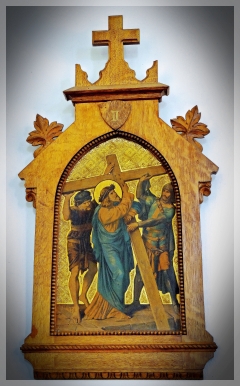
station of the cross II

My son is the third generation to run the family business. Although he is now its CEO, he didn’t begin that way. As his father had done before him, he started by sweeping floors and emptying trash.

The business expanded when my husband purchased a company in another town. With manufacturing processes that were unfamiliar, our son needed to learn new fabrication procedures and started working in the new facility. When he began, only his supervisor knew his relationship to the business’s new owner. He may have been the boss’s son but, to everyone else, he was just Jim, the new guy on the line. In his work shirt and steel-toed shoes, he looked like everyone else, kept the same hours, followed the same rules, and made the same money. What he didn’t do was pull rank or take advantage of his identity.

Although our son originally thought he could learn everything he needed by reading about it, a few days operating the machinery and getting his hands dirty told him there was nothing like first-hand experience! Now that he’s the boss, his employees recognize that he understands and appreciates the challenges they face in doing their jobs.

I tell this story to help us understand what it was like when Jesus put on human flesh and lived as a man. Clothed in work clothes, my son looked like every other hourly employee on the line. Although Jesus is often depicted with a halo, when He was clothed in human flesh, there was no halo and He looked like any other man. Instead of giving up coat and tie for overalls, Jesus gave up His immortal perfect form and took on the aches, indignities, and illnesses that come with a mortal body.

Just as my boy remained the boss’s son but gave up any status or privileges that came from that, Jesus remained God’s son but gave up the benefits that came with His divinity. Of course, Jesus gave up far more than did my son! He set aside the glory of heaven for life on earth and relinquished the divine life He had in heaven to be an itinerant rabbi in Galilee. Even though equal with His Father, Jesus chose to submit to Him as an earthly son does to his father.

Just as our boy never stopped being the boss’s son, Jesus remained fully God while fully man. Just as his co-workers didn’t know our boy’s real identity, people had trouble recognizing Jesus as God’s Son. While my son did what he did so he could learn the family business, Jesus did what He did to take away the sins of the world. Our son may have humbled himself by starting at the bottom but Jesus humbled himself by deliberately choosing to die a torturous death as a criminal on the cross!

My son knows what it means to be one of his employees and he’s a better boss because of it. Jesus knows what it’s like to be human and we are better because of that! Jesus knows what it is to hurt, be disappointed, suffer, struggle, get tired, thirst, feel hungry, bleed, hope, love and die. Because He lived as one of us, we can come to Him confidently and without fear; instead of condemnation, we will receive God’s grace and mercy!

Well, then, since we have a great high priest who has gone right through the heavens, Jesus, God’s son, let us hold on firmly to our confession of faith. For we don’t have a high priest who is unable to sympathize with our weaknesses, but one who has been tempted in every way just as we are, yet without sin. Let us then come boldly to the throne of grace, so that we may receive mercy, and may find grace to help us at the moment when we need it. [Hebrews 4:14-16 (NTE)]

Copyright ©2020 jsjdevotions. All rights reserved.

THE “TERRIBLE PETITION”

Blessings on the merciful! You’ll receive mercy yourselves. [Matthew 5:7 (NTE)]

Yes: if you forgive people the wrong they have done, your heavenly father will forgive you as well. But if you don’t forgive people, neither will your heavenly father forgive you what you have done wrong.’ [Matthew 6:14-15 (NTE)]

large striped swordtail butterflyWhen our pastor did a sermon series on “Dangerous Prayers,” he didn’t mention one many of us pray regularly: “Forgive us our trespasses as we forgive those who trespass against us.” After giving the disciples “The Lord’s Prayer,” Jesus elaborated on this single petition by categorically stating, “If you don’t forgive people, neither will your heavenly father forgive you what you have done wrong.”  The parable of the unforgiving debtor told in Matthew 18 leaves no room for ambiguity on this point. After the servant refuses to forgive the debt of a fellow servant, the angry king rescinds his forgiveness of the unforgiving man and sends him to be tortured in prison until the debt is paid. His debt (equivalent to several billion dollars today) was insurmountable and that torture would never end. Jesus warned his listeners that the same thing would happen to them if they withheld forgiveness.

Asking God to forgive us in the same way we extend forgiveness to others is dangerous. We are asking God to forgive us by the standard that we set—to deal with us as we deal with others! Called the “terrible petition” by St. Augustine, we’re actually asking God not to forgive us if we harbor any unforgiveness in our hearts! For some of us, could these words be a petition for condemnation rather than salvation, ones for death rather than everlasting life? If we’re unwilling to forgive, I suppose they are!

Paul’s words to the Ephesians tell us to get rid of bitterness, rage, anger, and harsh words and to “forgive one another, just as God forgave you in the king.” [4:31-32] Without a doubt, forgiveness is a difficult process and time is needed between our being hurt and our ability to forgive. The struggle to forgive, however, isn’t the sin; it’s the decision not to forgive, to hold onto our bitterness, that is!

Fortunately, forgiveness is a fruit of the Spirit! Jesus said that good trees produce good fruit and that every tree failing to produce good fruit would be cut down and burned. Clarifying that people are identified by their actions, Jesus warned that only those who actually did the will of the Father would enter the kingdom of heaven! From His words, it seems that profession of faith alone does not equal salvation. While salvation is not earned by works, our faith is evidenced by them: by our willingness to do the Father’s will! Can there be an unforgiven Christian? I don’t think so. But, if we refuse to forgive, are we true disciples of Christ or merely hypocrites who say we are?

No part of His teaching is clearer: and there are no exceptions to it. He doesn’t say that we are to forgive other people’s sins provided they are not too frightful, or provided there are extenuating circumstances, or anything or that sort. We are to forgive them all, however spiteful, however mean, however often they are repeated. If we don’t, we shall be forgiven none of our own. [C.S. Lewis]

Actually, good trees can’t produce bad fruit, nor can bad ones produce good fruit! Every tree that doesn’t produce good fruit is cut down and thrown on the fire. So: you must recognize them by their fruits. Not everyone who says to me, “Master, Master” will enter the kingdom of heaven; only people who do the will of my father in heaven. [Matthew 7:18-21 (NTE)]

Copyright ©2020 jsjdevotions. All rights reserved.

GRIEF IS PERSONAL

The thought of my suffering and homelessness is bitter beyond words. I will never forget this awful time, as I grieve over my loss. Yet I still dare to hope when I remember this: The faithful love of the Lord never ends! His mercies never cease. Great is his faithfulness; his mercies begin afresh each morning. I say to myself, “The Lord is my inheritance; therefore, I will hope in him!” [Lamentation 3:19-24 (NLT)]

gardenias“Once, when my feet were bare, and I had not the means of obtaining shoes, I came to the chief of Kufah in a state of much dejection, and saw there a man who had no feet. I returned thanks to God and acknowledged his mercies, and endured my want of shoes with patience.” The Persian poet Sadi wrote those words in 1258 AD and his words are the source of the adage, “I was unhappy about having no shoes until I met a man who had no feet.” When unsympathetic to what I considered my children’s trivial grievances, I often uttered those words or something similar.


While praying for a husband and wife who’d lost their son to COVID-19 and couldn’t even attend his funeral because they were hospitalized with the same virus, I remembered that old maxim. Thinking of all they’d suffered, I rebuked myself for the tears I’d shed over the small things I’ve lost to this pandemic. Then I remembered a book I read about loss that spoke of the importance of not comparing grief. We are one of a kind and the way we experience emotions, whether grief, love, or joy, differs from person to person. Our unique pasts, along with our hopes, dreams and expectations for tomorrow, profoundly affect how we experience today; what distresses one person may seem but a drop in the bucket to another.

What I’d missed when unsympathetic to my children’s complaints was that their grievances were real to them at the time. While missing senior skip, picnic and award days along with cancelled prom, parties and graduation seems heartbreaking for today’s high school seniors, it’s not the end of the world; but try telling that to an eighteen-year old whose prom dress remains unworn in her closet because of COVID-19. While some people grieve not being able to attend ball games or see their new grandbaby, others grieve not being able to visit their parent in a nursing home or attend a friend’s funeral. Some couples grieve the loss of their wedding and honeymoon, others grieve the loss of their jobs or homes, and still others grieve the loss of a loved one. We may grieve things like spontaneity, travel, feeling safe in stores, family gatherings, working as a team, worshiping together, or not seeing smiles because they’re concealed by masks. As we adjust to our incredibly abnormal “new normal,” we all grieve in one way or another and the things we grieve are as different as the ways we do it. While some grieve with tears, others are stoic; some grieve with busyness, others with lethargy; and some grieve with anger while others with dark humor.

Saying, “I was unhappy about having no shoes until I met a man who had no feet!” helps remind us to appreciate the value of what we have but it fails to acknowledge our feelings. We must never compare the things we grieve or the way we do it with other people’s grief because grief is experienced at 100%, whether it’s over missing one’s senior year of high school, losing a breast to cancer, not being able to visit one’s family, or losing a child to COVID. Our feelings are ours alone and the way we handle them is as unique as our fingerprints.

Because grief of any kind is a personal journey, we should respect our grief as well as that of others, even if ours seems trivial by comparison. If you are grieving right now, your sorrow is real. Rather than berating yourself for it, accept it. It is only by experiencing our grief that we can come to terms with whatever we’ve lost and move on to our new normal, whatever that may be. We have a God who understands sorrow; after all, even though He knew He’d raise Lazarus from the dead, Jesus wept at the man’s grave. We are told that there is, “A time to cry and a time to laugh. A time to grieve and a time to dance.” [Ecclesiastes 3:4] Let us not be hesitant to do both!

You have turned my mourning into joyful dancing. You have taken away my clothes of mourning and clothed me with joy, that I might sing praises to you and not be silent. O Lord my God, I will give you thanks forever! [Psalm 30:11-12 (NLT)]

God blesses those who are poor and realize their need for him, for the Kingdom of Heaven is theirs. God blesses those who mourn, for they will be comforted. [Matthew 5:3-4 (NLT)]

Copyright ©2020 jsjdevotions. All rights reserved.


A NEW SYMBOL OF LOVE

So now I am giving you a new commandment: Love each other. Just as I have loved you, you should love each other. Your love for one another will prove to the world that you are my disciples. [John 13:34-35 (NLT)]

Last week, I saw a video of a prayer service in the streets of a major American city. “Give a shout!” called the pastor and the crowd shouted back before raising their voices in song. In another time, I’d have been thrilled to see so many people gathered to praise Jesus, but these are not normal times. This was in a state where COVID-19 cases are on the increase and even those considered low risk have been asked to wear face coverings and refrain from gathering in groups greater than ten. Nevertheless, the crowd of several hundred stood tightly together and few wore face masks.

Franklin Roosevelt was wrong when he said, “The only thing we have to fear is fear itself!” There’s much we should fear; after all, Scripture tells us to fear God. Along with fearing God, the fear of both spiritual and physical danger can keep us safe. The minute David put his eyes on the naked Bathsheba, he was in spiritual danger but, instead of turning around in fear, he walked straight into the enemy’s trap. The good fear of physical danger is what gets us in the basement during a tornado warning or puts up shutters before a hurricane. It’s the fear that seeks shelter from lightning, looks both ways even after the light turns green, gets vaccinated, wears seat belts, and puts life jackets on toddlers when they wade in the ocean. It’s when we allow our fear of spiritual or physical danger to turn into preoccupation or obsession, when we lose perspective or faith, or when we become anxious, neurotic, hopeless, incompetent or incapacitated, that good fear goes bad.

Our bodies are not our own; like everything else we have, they belong to God. As His stewards, we are expected to take good care of them; a certain amount of fear helps us do that by assessing risks. There may be times we are called to risk our lives, as are firemen when entering a burning building. Needlessly risking health and safety, however, is not God’s intention for us. “You’re afraid!” is not an insult when it comes to COVID-19; we all should have a healthy fear of this virus. As Christians, we live by faith not fear, but that doesn’t mean we live foolishly or inconsiderately!

It’s not just the elderly or those with secondary conditions who are at risk. One of the mysteries of this disease is that relatively healthy young people, including small children and teens, can become critically ill or die. Everyone should have a healthy fear of this virus and respect it the same way we would a bear on the back deck: by keeping our distance! Moreover, our reckless actions have ramifications and can cause collateral damage. Every attendee at that prayer rally later interacted with family, friends, co-workers, and even strangers; their carelessness might cost someone else their health or even their life! Christians are called to love and that love should respect, honor, and value the lives of others as much as their own.

Ignoring scientific data, our state, like many others, is re-opening and some churches have followed suit. After all, empty pews often mean empty collection baskets. While our church, like many, wants to resume services, we readily admit to being afraid. We take the numbers and threat seriously and needlessly bringing ourselves or our church family into a risky situation is irresponsible. “Let the vulnerable stay home!” say some while other churches tell those over 65 they can’t attend. I don’t think the Lord who spoke of leaving the ninety-nine sheep to find the one who was lost, would agree. Every single life mattered to Him and it is the most vulnerable God has called us to serve!  Believing that the church should be a place of sanctuary not infection, our church is not yet meeting in person. It’s not a popular choice, but Jesus was never about being popular. He was about love—about doing the right thing—about caring for the health and safety of others.

Face masks and social distancing aren’t about politics; they’re about love! When Bishop Michael Curry was on the Today show last week, he spoke of choosing to live in the way of love which, he explained, is seeking the good of others as well as of self. After placing his two hands in the shape of a heart, he said there was a new symbol of love: a face mask! “I wear it to protect you and you wear it to protect me,” explained the Bishop. Me doing all I can to protect you from harm and you doing all you can to protect me exemplify Christian love! Right now, for many of us, along with wearing a face mask, that means continuing to worship together from a distance!

This is real love—not that we loved God, but that he loved us and sent his Son as a sacrifice to take away our sins. Dear friends, since God loved us that much, we surely ought to love each other. … We love each other because he loved us first. [1 John 4:10-11,19 (NLT)]

Copyright ©2020 jsjdevotions. All rights reserved.


THOUGHTS AND PRAYERS

Dear children, let’s not merely say that we love each other; let us show the truth by our actions. [1 John 3:18 (NLT)]

In another Pearls before Swine comic (drawn by Stephen Pastis), we see Goat, in the middle of the desert, on the phone with Rat. “My car broke down and I’m stranded in the middle of nowhere. Can you help me?” asks Goat. “Sure,” answers Rat, “I’m sending you thoughts and prayers.” In the last frame, Rat says to Pig, “It’s so much easier than getting up.”

Following Hurricane Harvey’s devastation in 2017, I saw a meme of an empty cargo truck with the words, “Don’t worry Texas! The first load of thoughts and prayers just arrived!” Let’s face it, thoughts and prayers don’t help people in the same way that donating blood, packing supplies, or sending money, clothing, food, or clean water do. But, as Rat said to Pig, sending thoughts and prayers is “so much easier than getting up!”

The old cliché doesn’t even make sense. Although we can think about someone, how do we send them our thoughts? Does it involve telepathy or clairvoyance? Sending anyone other than God our prayers seems an awful lot like idolatry and promised prayers frequently never materialize. I suspect that the Levite in the parable of the Good Samaritan told the injured traveler he was sending thoughts and prayers before departing and leaving the man half dead beside the road. Rather than promising thoughts and prayers, it was the Samaritan who compassionately served the man’s needs.

Jesus spent a lot of time in prayer but He also was a man who turned His thoughts and prayers into action! Rather than sending thoughts and prayers to the widow of Nain, He returned her son to life! Instead of sending thoughts and prayers to the man with the deformed hand, the ten lepers, or blind Bartimaeus, Jesus healed them! He didn’t send thoughts and prayers to His mother when she ran out of wine in Cana or to Martha and Mary when Lazarus lay in the tomb. When the disciples said the crowd was hungry, rather than telling them to send the people home with their thoughts and prayers, He said, “Feed them.” Whether an observant Jew, collaborating tax collector, Roman centurion, adulterer, demoniac, or Samaritan, Jesus never responded to their suffering simply by sending thoughts and prayers.

Since seeing that meme in 2017, I no longer say that I’m sending my thoughts and prayers but that doesn’t mean I’ve stopped thinking about and praying for those who are suffering. It’s that I know I am called to do more. Prayer without action is as incomplete as faith without works. While we may not be able to reach out and personally impact the lives of those for whom we pray, we can pray for those who are serving them. As we pray for others, we find our hearts and eyes are opened not only to their needs but also to the needs of those right in front of us—the people whose lives we can change. We can reach out and touch them in some small way, even if it’s with cans of soup for the food bank, shopping for a neighbor, or talking with someone whose skin is a different color than ours.

Right now, our fallen world is filled with pain, anger, disease, hate, hopelessness, and sorrow. Economic wreckage, racism, a pandemic, and political unrest have come together in a perfect storm that is raining chaos, fear, frustration and violence. In Sunday’s Op-Ed for The Washington Post, Presiding Bishop of the Episcopal Church, Michael Curry, said, “We must still choose love.” That love consists of more than sending thoughts and prayers. Instead of sending thoughts, I’m examining my own thoughts and attitudes to determine whether I am part of the problem or can become part of the solution. In addition to praying for the those who are hurting, afraid, angry, or troubled, I am praying that God will show us all how to participate in the healing so necessary in this troubled time. After asking what love looks like, the Bishop answered his own question: ”I believe that is what Jesus of Nazareth taught us. It looks like the Biblical Good Samaritan, an outsider who spends his time and money healing somebody he doesn’t know or even like.”

The following is a prayer for “the power of the Spirit among the people of God.” Written by a team of Lutheran and Episcopal prayer leaders, it is meant to unite believers in common prayer and revive us for a common mission. Let that mission be one of love.

God of all power and love, we give thanks for your unfailing presence and the hope you provide in times of uncertainty and loss. Send your Holy Spirit to enkindle in us your holy fire. Revive us to live as Christ’s body in the world: a people who pray, worship, learn, break bread, share life, heal neighbors, bear good news, seek justice, rest and grow in the Spirit. Wherever and however we gather, unite us in common prayer and send us in common mission, that we and the whole creation might be restored and renewed, through Jesus Christ our Lord. Amen.

This is real love—not that we loved God, but that he loved us and sent his Son as a sacrifice to take away our sins. Dear friends, since God loved us that much, we surely ought to love each other. No one has ever seen God. But if we love each other, God lives in us, and his love is brought to full expression in us. [1 John 4:10-12 (NLT)]

Copyright ©2020 jsjdevotions. All rights reserved.

THE LEIDENFROST EFFECT

I praise God for what he has promised. I trust in God, so why should I be afraid? What can mere mortals do to me? [Psalm 56:4 (NLT)]

leidenfrost effect

Two businessmen were touring a foundry. When they entered the smelting area with its vats of molten metal, their guide said it was possible to safely pour that hot metal over someone’s hand if the hand was first dipped into water. When he asked if either gentleman cared to give it a try, the first man said, “I’ll just take your word for it.” The second man agreed and dipped his hand in a tub of water. When the molten metal was poured over the wet hand, it streamed off without causing him pain or injury. Although the first man said he believed the guide, the second one showed his faith in the man by acting on his belief.

Because of something called the Leidenfrost Effect, you really can dip your hand into water and then pour a stream of molten metal over it without pain or injury; a tiny layer of steam would insulate and protect your damp hand from the hot metal. Just because we could do it, however, doesn’t mean we should. The effect is short lived and I don’t suggest trying it at home!

I understand the Leidenfrost Effect and have seen it demonstrated; in theory, I believe in it. In actuality, however, I’d never trust it enough to give it a try! I’m like the Israelites during the Exodus. Although they witnessed God’s power over and over again in the plagues God visited on Egypt and when they safely crossed the Red Sea, saw the defeat of Pharaoh’s army, drank sweet water that once was bitter, gathered both quail and manna from heaven, and saw water spring from a rock, they continued to doubt. In spite of God demonstrating the truth of His promises throughout their journey, the Israelites spurned the God of miraculous provision while camped at Kadesh by refusing to enter Canaan, the land He’d promised to them. How much proof did they need that God would be true to them? Sometimes, even seeing isn’t enough to truly believe and trust.

It’s easy to have faith when the outcome is known. Our challenge is to believe and trust when the outcome is unknown or there is an element of risk, such as third degree burns or formidable foes. Because the power to believe a promise depends on our faith in the one who makes the promise, I wouldn’t have trusted the factory guide enough to put my wet hand under molten metal and, without trusting that God would be true to His promises, the Israelites wouldn’t obey Him!

Unlike the Israelites, do we have faith in the One who guides us through life? In the end, the difference between intellectual belief and actual faith is a willingness to take action: to step out in obedience. We have more proof of God’s faith, love, and power in Scripture than all the YouTube videos about the Leidenfrost Effect. Yet, there are many who probably would place their damp hands under molten metal before trusting their unknown fate to a known God! Isaac Watts said, “I believe the promises of God enough to venture an eternity on them.” What about you? Who do you trust? In whose hands have you rested your fate?

God never made a promise that was too good to be true. [Dwight L. Moody]

For the word of the Lord holds true, and we can trust everything he does. [Psalm 33:4 (NLT)]

Let us hold tightly without wavering to the hope we affirm, for God can be trusted to keep his promise. [Hebrews 10:23 (NLT)]

Copyright ©2020 jsjdevotions. All rights reserved.