EXCUSES

The lazy person claims, “There’s a lion out there! If I go outside, I might be killed!” [Proverbs 22:13 (NLT)]

lions - serengettiAlthough ancient Israel did have lions, they rarely wandered the streets and today’s verse about the sluggard who uses preposterous excuses to avoid work reminded me of more than 45 years ago when I regularly hosted a support group for nursing mothers. Among the chairs in our family room was a large La-Z-Boy rocking recliner. On meeting nights, that chair should have been occupied by the mom with infant twins or the woman within days of giving birth but the women who usually made a bee-line for the comfy rocker were the ones I came to think of as “the excusers.” Although they arrived with a litany of new mother complaints and said they wanted advice, they always had a reason why every suggestion wouldn’t work. While not quite as far-fetched as claiming a stray lion was in the road, some of their excuses came close. Perhaps, operating under the mistaken belief that motherhood was undemanding and trouble-free or that their lives weren’t going to change substantially with a baby’s arrival, these young mothers found it easier to wallow in their misery in a La-Z-Boy than to make an effort to solve their problems and find a way to make their new normal work. Apparently, they weren’t familiar with Proverbs 19:20: “Get all the advice and instruction you can, so you will be wise the rest of your life.”

While pondering excuses, I wondered if mine are as flimsy as claiming a lion is in the street; we all invent excuses to justify both our actions and inaction. The dog may not have eaten our homework but we often try to exonerate ourselves with equally empty excuses. What ones do we use when we’re opposed to trying something new or we want to rationalize not doing something we should have done? What are our excuses when we haven’t prayed, read Scripture, shared our faith, given generously, been patient, made the doctor’s appointment, studied for the test, paid the overdue bill, exercised, attended church, or treated our neighbor with love? Behind every excuse is a real reason; while it can be laziness, it also can be fear, lack of commitment, immaturity, stubbornness, shame, or pride.

Our excuses might be able to fool others and, sometimes, they may even fool us, but they can’t fool God; He’s heard them all! Jesus didn’t offer flimsy excuses and neither should we!

He that is good for making excuses is seldom good for anything else. [Benjamin Franklin]

Nothing in all creation is hidden from God. Everything is naked and exposed before his eyes, and he is the one to whom we are accountable. [Hebrews 4:14 (NLT)]

Search me, O God, and know my heart; test me and know my anxious thoughts. Point out anything in me that offends you, and lead me along the path of everlasting life. [Psalm 139:23-24 (NLT)]

Copyright ©2020 jsjdevotions. All rights reserved.

PATIENT ENDURANCE

Patient endurance is what you need now, so that you will continue to do God’s will. Then you will receive all that he has promised. [Hebrews 10:36 (NLT)]

giesbach falls - switzerlandWhile France was in lockdown because of COVID-19, French marathon runner Elisha Nochomovitz ran a solo marathon on his 26-foot apartment balcony. Having to make around 3,000 laps meant Nochomovitz was unable to get momentum or gain any speed before he had to turn around again. Finding it harder than any other race he’d run, it took the runner six hours and 48 minutes (more than double his usual time) to complete the 26.2 miles. Struggling with self-doubt, he imagined an open window through which someone was telling him he couldn’t finish. Rather than listen, however, he closed that window. “In the end,” said the runner, “it’s only about the mind!” Nochomovitz showed endurance!

The book of Hebrews was written to a group of Jewish Christians some time before 70 AD. Although they’d successfully weathered previous adversity, including public ridicule, beatings, seizure of their property and even imprisonment, they seemed to be facing another wave of even more severe persecution. Beginning to lose heart, the Hebrews were listening to their minds’ voices shouting from the windows and telling them to quit and these early believers were contemplating leaving the Messiah Jesus and returning to Judaism.

Two weeks after Elisha Nochomovitz ran that balcony marathon, he ran another one. The endurance and confidence developed in his first run helped him in the next and, in spite of adding five miles to its length, he cut his time by two hours. Instead of listening to the inner voice of discouragement, Nochomovitz heard his neighbors cheering him on from their balconies.

After warning the uncertain Hebrews that turning their back on Jesus came dangerously close to apostasy, the letter’s writer told them that, “We are the faithful ones, whose souls will be saved.” [10:39] Reminding his readers of the endurance they’d developed during their first trials, he gave them a rundown of more than a dozen examples of faith from the Hebrew Scriptures. After holding up Jesus as the prime example of faithful endurance, the writer assured them of a cheering section of Biblical heroes whose lives proved that perseverance and endurance in a believer are doable!

The Christian life is more like a marathon than a short sprint and every challenge is an opportunity to increase our endurance. When we hear the voices of discouragement, doubt or fear, like Nochomovitz, we must shut the window on them. Let us look instead to the examples of those who’ve gone before us and hear the witnesses of faith cheering us forward to finish the race!

Therefore, since we are surrounded by such a huge crowd of witnesses to the life of faith, let us strip off every weight that slows us down, especially the sin that so easily trips us up. And let us run with endurance the race God has set before us. We do this by keeping our eyes on Jesus, the champion who initiates and perfects our faith. Because of the joy awaiting him, he endured the cross, disregarding its shame. Now he is seated in the place of honor beside God’s throne. Think of all the hostility he endured from sinful people; then you won’t become weary and give up. [Hebrews 12:1-3 (NLT)]

Copyright ©2020 jsjdevotions. All rights reserved.

THE RAINBOW

chicago rainbowI will never again curse the ground because of the human race, even though everything they think or imagine is bent toward evil from childhood. I will never again destroy all living things. As long as the earth remains, there will be planting and harvest, cold and heat, summer and winter, day and night. [Genesis 8:21-22 (NLT)]

Tears are the material out of which heaven weaves its brightest rainbow. [F.B. Meyer]

With everyone stuck inside because of the rain, the day had been challenging as my son and his wife tried to get in eight hours of Zoom meetings, conference calls, report writing and computer programming while keeping their two youngsters busy (and relatively quiet). The rain finally stopped shortly before dusk and, when my grand ran out onto the rooftop deck to celebrate her freedom, she stopped in amazement. There, above the city, a city plagued not just by COVID-19 but also by gang violence, shootings, racism, rioting, and poverty, was a beautiful ray of hope: a double rainbow.

Rainbows are among my favorite things. The glory of the Lord “looked like a rainbow shining in the clouds on a rainy day,” to Ezekiel and John described the Lord’s glory circling Him like a rainbow and glowing like an emerald in Revelation. The rainbow shows us God’s light in the darkness of our troubled world and is probably the closest thing we have to seeing His radiance while we’re on this side of the grass.

Scripture’s first mention of a rainbow is in Genesis 9. Once the floodwaters had receded and the earth was dry enough, God told Noah to leave the ark and release all of the animals. Even though God knew mankind’s heart was still inclined toward evil, He gave us another chance with His promises to never again destroy every living thing by flood and that the normal cycles of nature would continue as long as the earth existed. The rainbow provided Noah and future generations with a sign of God’s covenant.

After a rain storm, with its clouds, thunder, and lightning, we frequently are blessed with a rainbow: a beautiful reminder of God’s love, mercy and faithfulness. It reminds us of both God’s grace and our sinfulness; after all, it was mankind’s sin that caused the flood in the first place! Rather than saving us by putting us on an ark of cypress wood, God saved us by putting Jesus on a cross. The rainbow reminds us of our redemption and salvation; because of Jesus, we have an opportunity for a new beginning. God packed a whole lot of supernatural meaning into a natural phenomenon when He hung the rainbow in the sky!

Before Noah and his family left that ark, they’d been in close quarters with one another and all of those animals for a year. If we think sheltering in place is challenging, imagine doing it with four families and an enormous menagerie but without the internet, Amazon, Netflix or Door Dash. Today’s bad news, like rain, keeps showering down and we’re in a season that seems to have no end. The storm clouds of life can obscure God’s presence but, when we remember that He is in the storm with us, we might just see a rainbow! Like my grand, I love seeing rainbows; they remind me that God is faithful to His promises for “all generations to come.”

And when it rains on your parade, look up rather than down. Without the rain, there would be no rainbow. [G.K. Chesterton]

I am giving you a sign of my covenant with you and with all living creatures, for all generations to come. I have placed my rainbow in the clouds. It is the sign of my covenant with you and with all the earth. When I send clouds over the earth, the rainbow will appear in the clouds, and I will remember my covenant with you and with all living creatures. Never again will the floodwaters destroy all life. [Genesis 9:12-15 (NLT)]

Copyright ©2020 jsjdevotions. All rights reserved.

BEING AN INSTRUMENT

tiger swallowtail butterflyBlessed are the peacemakers, for they will be called children of God. [Matthew 5:9 (NIV)]

Lord, make me an instrument of Your peace;
Where there is hatred, let me sow love;
Where there is injury, pardon;
Where there is doubt, faith;
Where there is despair, hope;
Where there is darkness, light;
And where there is sadness, joy.
O Divine Master,
Grant that I may not so much seek
To be consoled as to console;
To be understood, as to understand;
To be loved, as to love;
For it is in giving that we receive,
It is in pardoning that we are pardoned,
And it is in dying that we are born to Eternal Life.

We’ve come to know this prayer as “The Prayer of St. Francis” and usually attribute it to Francis of Assisi (1181-1226), the founder of the Franciscan religious orders. The patron saint of ecology and animals, Francis often is portrayed surrounded by animals. Stories first recorded by Thomas of Celano in the 13th century tell of the gentle man taming a wolf that had been terrorizing the town and preaching to the birds, rabbits, and fish (who both listened and obeyed).

Francis, however, was much more than a man who loved animals; he loved Jesus above all things, preached a gospel of simplicity, repentance, and radical obedience to Christ’s teaching, and put into practice the gospel life he preached. His contemporaries claimed that Francis lived out the spirit of the Sermon on the Mount better than anyone other than the One who originally spoke those words. It’s easy to see how this prayer might have been penned by this godly man who endeavored to have the mind of Christ, but its origins are more recent.

Originally written in French and titled “A Beautiful Prayer to Say During the Mass,” the prayer was published anonymously in 1912 in a small French Catholic magazine. In 1915, a French marquis sent the prayer to Pope Benedict XV and, in 1916, it appeared in Italian in L’Osservatore Romano (the Vatican’s daily newspaper). In 1920, titled “Prayer for Peace,” its original French translation was printed on the back of a prayer card bearing the image of St. Francis. The prayer circulated through Europe and, in 1927, it was attributed to St. Francis in print by French Protestants. Translated into English in 1936, the prayer was widely disseminated and, wherever it went, the name of St. Francis went with it.

This peace prayer became popular in an era not much different from ours. We may be able to travel from New York to London in seven hours rather than five days but we still are without peace! In spite of advances in technology, science, communication, medicine, and transportation we continue to have wars, financial disparity, social inequality, prejudice, injustice, unemployment, poverty, and even a global pandemic. We desperately need to pray for peace today as much as they did a century ago!

The author of this prayer asked to be an instrument—a tool, implement, or conduit—of peace. He continued with the actions of sowing (not gathering) love, pardon, faith, hope, light, and joy. Rather than receiving consolation, understanding and love, he sought to console, understand, and love others and then finished with the acts of giving and pardoning. His prayer reminds us that it is the peace makers, not the peace experiencers, Jesus said would be called the children of God! Being a peace maker takes us out of our comfort zones and into the territory of conflict resolution, relationship restoration, and change. Yet, we can’t resolve, restore or change anything if we are part of the problem! What seeds are we sowing? Are we seeking to console, understand, and love? Are we willing to give and forgive? Let us be peace makers and instruments of peace!

Turn from evil and do good; seek peace and pursue it. [Psalm 34:14 (NIV)]

Make every effort to live in peace with everyone and to be holy. [Hebrews 12:14a (NIV)]

Copyright ©2020 jsjdevotions. All rights reserved.

DO WE WANT THE TRUTH?

Jesus answered, “You say that I am a king. For this I was born, and for this I have come into the world, to bear witness to the truth. Every one who is of the truth hears my voice.” Pilate said to him, “What is truth?” [John 18:37-38b (RSV)]

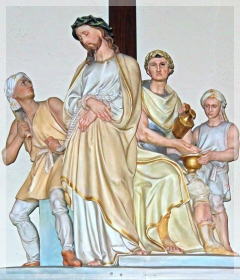
loretto - pilate washing his hands

In the movie A Few Good Men, while being questioned in court, Colonel Jessep asks, “You want answers?” When Lt. Kaffee answers, “I want the truth!” Jessep responds, “You can’t handle the truth.” What eventually follows, while revealing the facts, is really just the colonel’s version of the truth. So, what exactly is truth?

The question of truth has fascinated philosophers for centuries. We know that truth isn’t falsehood or lies but defining it is harder, especially since some people believe truth can be subjective: truth is what things seem to be, involves preference and opinion, can be arrived at by consensus, or that no ultimate standards exist. We’ve all heard of alternative facts and know that even the most accurate statistics can be manipulated, massaged, and misstated to say just about anything. Tyler Vigen illustrated that by finding correlations between totally unrelated things such as a 99.26% correlation between the divorce rate in Maine and the per capita consumption of margarine and a 98.51% correlation between total arcade revenue and the number of computer science doctorates awarded each year in the U.S.

Truth in Scripture, however, is absolute. Pastor John MacArthur explains that, “Truth is that which is consistent with the mind, will, character, glory, and being of God….Truth is the self-expression of God.” Since truth is related to the character of God, something eternal and unchanging, the nature of truth is fixed. It has no expiration date and, unlike a computer program, it’s not up for revision, correction or updating. Author Josh McDowell defines truth as, “That which is true at all times in all places for all people.”

Pilate asked Jesus, “What is truth?” Wouldn’t you love to have heard His answer to this profound question? Pilate, however, never waited for an answer because his was just a rhetorical question. Pilate didn’t care about the truth once he knew Jesus hadn’t incited rebellion against Rome. Wanting to do the expedient thing, he went back outside to tell the people that Jesus wasn’t guilty of a crime. Thinking the crowd that had welcomed Jesus’ arrival less than a week earlier would call for His release, the governor offered to free Him. Pilate ended up trading the life of the man he’d already found innocent for that of Barabbas, an insurrectionist and murderer! The truth was swapped for a lie!

In Latin, Pilate’s question would have been, “Quid est veritas?” Samuel Johnson, one of the greatest literary figures of the 18th century, made an anagram of Pilate’s question and came up with the answer: “Est vir qui adest,” meaning, “It is the man before you!” Indeed, truth stood right in front of Pilate and he never recognized it.

Perhaps, instead of asking Jesus what truth was, Pilate would have been better served to have asked Jesus who truth was!

Jesus said to him, “I am the way, and the truth, and the life; no one comes to the Father, but by me. [John 14:6 (RSV)]

Jesus then said to the Jews who had believed in him, “If you continue in my word, you are truly my disciples, and you will know the truth, and the truth will make you free.” [John 8:31-32 (RSV)]

Copyright ©2020 jsjdevotions. All rights reserved.

HE EXISTS

Then God looked over all he had made, and he saw that it was very good! And evening passed and morning came, marking the sixth day. [Genesis 1:31 (NLT)]

The Lord is good to everyone. He showers compassion on all his creation. [Psalm 145:9 (NLT)]

tri-colored heronPeople often argue against God’s existence because of evil and suffering. With so much that is wrong in the world, they question how there could there be a god. Christian apologist C.S. Lewis was once an atheist who reasoned that such a cruel and unjust world proved the absence of God until he questioned where he got the idea of what was good or evil, just or unjust. He realized that something cannot be wrong or evil unless there is standard for what is right or good. In a universe with no God, there would be no standard for justice or injustice, good or evil, right or wrong: simply personal preferences. That standard, Lewis realized, is rooted in God. As a result, the very argument he used against God’s existence provided Lewis with proof of His presence!

Nevertheless, acceptance of God’s existence in a world with evil leads people to question how this loving God of ours could allow so much of it in the world. Unable to see how a loving, good and powerful God can coexist in world so filled with pain and suffering, people often ascribe any evil that befalls to God but none of the good. Granted, bad things happen but, if they’re used as evidence against a good God, then all of the good things that occur must be considered as evidence for Him!

The preponderance of the evidence tells us that there are more years of rain than drought, more harvests than famine, more fair weather days than hurricanes, more love than hate, and pandemics are not a regular occurrence. On a more personal level, I’ve encountered evil, injury and pain and, if I were asked to make a list of the suffering in my life, I could. But, if asked to record the good things I’ve experienced, I couldn’t—simply because there would be far too many to list! I’ve avoided more accidents than I’ve been in, favorable circumstances have aligned more often than not, more good people than bad have touched my life, my joys outweigh my sorrows, and God has accompanied me through every dark valley I’ve traversed. Moreover, I’d probably have to cross off most (or all) of the items on the list of bad things because God redeemed them by bringing good out of the pain and suffering.

When life feels anything but good, it’s easier to focus on evil and suffering than to remember that God is good. Yes, we live in a fallen world but it’s not the world God intended; our good God did not create evil and suffering. When man chose to disobey in Eden, both moral and natural evil entered into what was a perfect world. God may allow evil but it is our free will that has made it possible. We can’t hold God responsible for our mistakes.

Non-believers and believers alike wrestle with how a good loving God can allow the presence of evil and suffering. Nevertheless, the existence of suffering doesn’t negate God. In fact, it is God’s existence that gives meaning to our pain and suffering! We’ll never fully understand it. Nevertheless, when I think about those two lists and all that God has done for me, I know that God exists and that He is good!

God judged it better to bring good out of evil than to suffer no evil to exist. [Saint Augustine]

For this is how God loved the world: He gave his one and only Son, so that everyone who believes in him will not perish but have eternal life. [John 3:16 (NLT)]

Whatever is good and perfect is a gift coming down to us from God our Father, who created all the lights in the heavens. He never changes or casts a shifting shadow. [James 1:17 (NLT)]

Copyright ©2020 jsjdevotions. All rights reserved.