NATIONAL DAY OF PRAYER – MAY 7, 2020

After Jesus said this, he looked toward heaven and prayed: “Father, the hour has come. Glorify your Son, that your Son may glorify you.” [John 17:1 (NIV)]
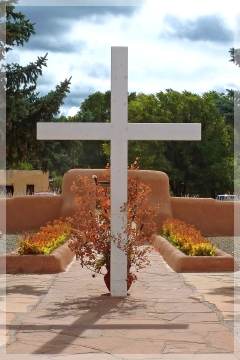
taos, NMThis pandemic may have may have postponed the Olympics but it hasn’t delayed the National Day of Prayer. Today’s observances, however, will look quite different from previous ones. There won’t be any prayer breakfasts or luncheons and large groups won’t assemble in parks, churches or on courthouse steps. Instead, churches will stream their services and religious leaders from across the county will participate in a national broadcast to be aired tonight from 8 to 10 PM ET (see their website or Facebook page for details). Because of the many “virtual” events planned, today’s observance actually could be this day’s largest prayer gathering.

The theme this year is “Pray God’s Glory across the Earth.” Since the Westminster Catechism says, “Man’s chief end is to glorify God, and to enjoy Him forever,” I understand why we’d want to pray God’s glory across the earth. Man was created to give glory to God and this year’s theme probably was chosen long before coronavirus so drastically impacted the lives of people throughout this nation. In all likelihood, prayer resources, promotional materials, and PSAs were finished and distributed by the time we’d heard of COVID-19. I wondered how we can pray God’s glory when our hearts are so broken but that’s precisely what Jesus did on the eve of His death and betrayal. John 17 tells us that Jesus didn’t pray with anxiety, doubt or fear. His prayer focused on the glory of God: the revelation of his character and presence. Jesus’ words show us that the purpose of prayer isn’t for us to get something from God; it is to give God the glory He deserves!

The National Day of Prayer task force asks us to pray today’s prayer together, yet individually, at noon your local time. Please join me today in saying the following prayer. Let us lift our voices as one people and pray God’s glory across the earth!

Lord, we exist to give You glory. We exist because of Your glory, and in Your glory, as our Creator, Redeemer, and Sustainer. We give you thanks and praise for every breath and moment You have given to us. We repent of our sin; for the shameful things we have done against You and for our silence when we did not speak up to proclaim Your Name, profess Your Word, or protect and practice Your will. We ask Your forgiveness.

We pray that the knowledge of the glory of the Lord will spread across our nation and the entire earth as we seek Your Kingdom and righteousness; as we walk in obedience to You, and in humble unity, love one another.

Jesus, the Bible says that You are “the knowledge of the glory of the Lord.” You have taught us to pray, commanded us to love, and commissioned us to share Your gospel of grace. Your glory fills our hearts and families, it overflows into our neighborhoods, workplaces, campuses, churches, entertainment, and media.

We give thanks for our military and ask that Your glory would spread to, and through them as they preserve freedom around the world. We pray for our government, that all of our leaders and laws would be filled with Your glory, that they would magnify Your Holy Word and honor Your will and ways. We pray that Your grace and glory would spread to bring hope to the hopeless, and love where there is hurt and hate.

God, use us as we pray your promise, that “the earth will be filled with the knowledge of the glory of the Lord as the waters cover the sea.” In Jesus Name, Amen! [Kathy Branzell, President, National Day of Prayer Task Force]

For the earth will be filled with the knowledge of the glory of the Lord as the waters cover the sea. [Habakkuk 2:14 (NIV)]

Ascribe to the Lord the glory due his name; worship the Lord in the splendor of his holiness. [Psalm 29:2 (NIV)]

Copyright ©2020 jsjdevotions. All rights reserved.

FAULTY MEMORIES

Be careful not to forget the Lord, who rescued you from slavery in the land of Egypt. You must fear the Lord your God and serve him. [Deuteronomy 6:12-13a (NLT)]

They refused to obey and did not remember the miracles you had done for them. Instead, they became stubborn and appointed a leader to take them back to their slavery in Egypt. [Nehemiah 9:17a (NLT)]

grey catbirdMany of us have friends and relatives whose memories are declining (and some of us may be those people). As my mother-in-law’s memory started failing, she rewrote history with what we called “wishful memories” and “selective forgetting.” Since her memories became rosier and happier as time passed, it really didn’t matter if nearly a century’s worth of memories were accurate or not; they were good ones. Happy to see her enjoying her version of the past, we ignored faulty memories that were of no consequence.

Research conducted by Northwestern University, however, reports that, regardless of age, our memories aren’t nearly as accurate as we think they are. The memory isn’t like a video camera that preserves the past in perfect unedited detail. Instead, it’s more like a movie that is continually edited; information from the present gets added to the past and then re-framed in the light of present circumstances. Our situation today seems to affect how and what we remember about our yesterdays. If we’re happy, the memory might become sweeter and, if we’re distressed, the memory may get a dash of sour added to it.

In addition, every time we remember something, it gets less accurate; instead of the actual event, we simply remember the last time we recalled it. Any mistakes in our last recollection inadvertently become truths in our next one. Details may be omitted while others are added and a story can change over time without our consciously meaning to do so.

God didn’t need university researchers to tell Him that mankind’s memory is faulty. Eve couldn’t even remember His one rule for Eden! Perhaps that’s why God had the various Biblical scribes and prophets repeat His words and works over and over again throughout Scripture. He knew that, with time, the Israelites would do a little wishful remembering and selective forgetting of their own. In fact, only a month after escaping Pharaoh, their 400 years of Egyptian slavery didn’t seem nearly so terrible to them. Instead, the hungry Israelites chose to remember how well fed they’d been as slaves. Even though God’s miraculous deliverance of His people out of Egypt is repeated in at least sixteen books of the Hebrew Bible (from Exodus through Psalms and all the way to Micah, Amos and Hosea), as the years passed, the Israelites began to remember their part in winning battles and forgetting that God gave them those victories. As the memories of God’s deliverance and provision faded, they started to believe they’d achieved everything on their own power and strength.

Since we must remember complex combinations of upper and lower case letters, numbers, and symbols for passwords and the names of pets, schools, and first grade teachers for security questions, we’ve probably written them down or safely stored them in the Cloud. Are we as diligent about remembering or safely saving God’s hand in our lives as we are those phrases and words? It’s not just for accessing our email or shopping on Amazon; it’s for our very lives that we need to correctly remember God and how His love, forgiveness, deliverance, and provision have saved and sustained us.

Let all that I am praise the Lord; may I never forget the good things he does for me. [Psalm 103:2 (NLT)]

Copyright ©2020 jsjdevotions. All rights reserved.

YES!

You see, my dear family, we don’t want to keep you in the dark about the suffering we went through in Asia. The load we had to carry was far too heavy for us; it got to the point where we gave up on life itself. Yes: deep inside ourselves we received the death sentence. This was to stop us relying on ourselves, and to make us rely on the God who raises the dead. He rescued us from such a great and deadly peril, and he’ll do it again; we have placed our hope in him, that he’ll do it again! [2 Corinthians 1:8-11 (NTE)]

blue flag irisI know I’m not invulnerable but I never thought of myself as particularly vulnerable until now. Since I am well over 65, I am officially vulnerable to COVID-19, as is my husband; that knowledge, along with the terrible toll being taken by this pandemic, has put me on edge. Knowing that it is just a matter of time before someone I love is taken down by this virus has unnerved me. That my prayer list is lengthening by the day doesn’t make it any easier. Before this, I rarely had been apprehensive about my health or that of my family, uneasy about our finances, or concerned about the family business. I’ve endured my share of trials, sorrow, illness, and uncertainty but this combination of circumstances is the “perfect storm” that has shaken me to my core.

As I prayed reassuring Bible verses this morning, I realized how much easier it is to talk the talk than actually walk the walk. I wondered if the Apostle Paul ever was shaken by circumstances. Throughout his ministry, he suffered trials and persecution. He was stoned, imprisoned, shipwrecked, beaten, betrayed, and abandoned and yet it seems as if God’s abundant grace sustained him throughout his life. In 2 Corinthians, Paul tells of a time he felt unbearably crushed by circumstances, so much so that he thought he’d die. As he came to realize his powerlessness, however, he stopped relying on himself and came to trust and depend on God. Delivered by God from whatever the trial was, Paul boldly stated that God would deliver him again.

Jumping ahead another ten years, however, we find Paul in a Roman prison. A few years earlier, he’d been released from his first Roman imprisonment (a house arrest) but now he was sitting in Rome’s Mamertine dungeon. Although he’d escaped a death sentence at his preliminary hearing, he fully expected to be found guilty at his final trial. Knowing his execution was imminent, there was no bold statement that God would deliver him. Nevertheless, in 2 Timothy, we don’t read the words of a man who is afraid or anxious; they are the words of a man who trusts God and lives by faith rather than sight. They are the words of a man who is calmly facing his future, whatever that may be, with confidence that God will bring him safely into His kingdom.

Rather than saying, “No!” to God, we see Paul saying an enthusiastic “Yes!” to all that will happen, whatever that may be. Like Paul, we must learn to rely solely on God and release our fears and anxiety to Him. To really do that, however, we also have to release our future – our hopes and dreams – to Him, as well. Let us trust in God: that He will give us the strength to endure whatever the future holds and that, in the end, He will bring us safely into His kingdom!

How to get through this? My prayer will be the words of former U.N. Secretary General Dag Hammarskjöld: “For all that has been, Thanks. To all that shall be, Yes.”

For I am already being poured out as a drink-offering; my departure time has arrived. I have fought the good fight; I have completed the course; I have kept the faith. What do I still have to look for? The crown of righteousness! The Lord, the righteous judge, will give it to me as my reward on that day – and not only to me, but also to all who have loved his appearing. … The Lord will snatch me clear from every wicked deed and will save me for his heavenly kingdom. Glory to him for the ages of ages, Amen! [2 Timothy 4:6-8,18 (NTE)]

Copyright ©2020 jsjdevotions. All rights reserved.

THE REAL QUESTION

So, my dear family, this is my appeal to you by the mercies of God: offer your bodies as a living sacrifice, holy and pleasing to God. Worship like this brings your mind into line with God’s. What’s more, don’t let yourselves be squeezed into the shape dictated by the present age. Instead, be transformed by the renewing of your minds, so that you can work out what God’s will is, what is good, acceptable and complete. [Romans 12:1-2 (NTE)]

agoseris (orange) - mountain dandelionLike Job, we want to know “Why?” Wanting to understand the inexplicable, there are some who claim this pandemic is a sign of the end times; indeed, it is a terrifying time. When Jesus spoke of the end times, however, He warned His disciples to be wary about the signs and not to be misled. When we start looking for signs, we begin reading meanings into things that aren’t necessarily there. While we know that chaotic and difficult times will pave the way for Jesus’ return, we also know that chaos, difficulty, and even pandemics have been characteristics of life since the exile from Eden. I don’t know if this is a sign of the end times but I am cautious of doomsday prophets who claim to know what God is doing. Let us remember Jesus’ own words: ”No one knows the day or hour when these things will happen not even the angels in heaven or the Son himself. Only the Father knows.” [Matthew 24:36] If neither Jesus nor angels knew, I doubt a mere mortal does! Whether or not the Australian wildfires, African locusts, and COVID-19 are precursors of things to come doesn’t change what’s happening or our reaction to them.

“Do you suppose,” said a friend, “that God got so sick and tired of our bickering, conflicts, and complaint that He’s sent us all to our rooms as punishment?” Indeed, there are some who say this pandemic is God’s judgment upon his sinful children. He’s used plagues before and it wasn’t just the Egyptians who suffered them at His hands. After the Israelites worshiped the golden calf, God sent a plague upon them; when they complained of no meat, He struck them with another plague; and, when they complained about Moses and Aaron, a plague that killed 14,700 quickly followed. When David sinned against God by taking a census, 70,000 innocent people died in a plague. Since God used plagues to discipline His children in the past, we might wonder if COVID-19 is His punishment for our sins. We simply don’t know and I would be cautious of anyone who claims to know the answer; Job’s friends got in trouble for that very thing! God made it clear to Job that the “why” is really not ours to know.

Perhaps, rather than sending us to our rooms as punishment, our loving Father has given us a “time out” for an attitude adjustment. Could this be God’s version of a “market correction” when, following a drop of 10%, the value of over-priced stocks are adjusted to more accurate levels? Instead of stocks, however, could this be a time to correct our priorities: a time to reevaluate their value and adjust them to more godly levels? When viewed in the light of this pandemic, many of the things we once thought important have become meaningless and some things we took for granted have become precious. Just as a stock market correction is a reminder for investors to reassess their holdings, this pandemic may be a time for us to reassess our priorities and values. What is worth keeping and what should we let go?

Jesus told us that wherever our treasure is, there will be our heart. Perhaps we’ve been sent to our rooms to examine our hearts: to see ourselves in a spiritual mirror to determine how much like Christ we look, how attached we’ve become to the things of the world, and determine who and what comes first in our lives.

None of us can divine God’s purpose; He didn’t tell Jesus or Job so I don’t think we can expect to know. Rather than asking “why?” theologian and author Timothy Keller says the question we should be asking is this: “Is God to whom I look to and trust in when bad things happen?”

You must keep all earthy treasures out of your heart, and let Christ be your treasure, and let Him have your heart. [Charles Spurgeon]

“Don’t let your hearts be troubled,” Jesus continued. “Trust God – and trust me, too! … I’m leaving you peace. I’m giving you my own peace. I don’t give gifts in the way the world does. Don’t let your hearts be troubled; don’t be fearful. … I’ve said these things to you so that you can have peace in me. You’ll have trouble in the world. But cheer up! I have defeated the world! [John 14:1,27,16:33 (NTE)]

Copyright ©2020 jsjdevotions. All rights reserved.

DUELING PROVERBS 

Don’t answer the foolish arguments of fools, or you will become as foolish as they are. Be sure to answer the foolish arguments of fools, or they will become wise in their own estimation. [Proverbs 26:4-5 NLT)

owlSince they’re not hard and fast rules, some proverbs are contradictory. Perhaps the most glaring contradiction (and one non-believers love to mention) is found in Proverbs 26:4-5. First, we’re told not to answer the foolish argument of fools but then we’re told to do that very thing!

Proverbs 26:4 reminds us never to stoop to the fool’s level, which can mean anything from answering vindictively or hurtfully to resorting to half-truths or misinformation. Foolish arguments often come from out of the blue. Unanticipated, we rarely are prepared with specifics, facts and evidence to answer intelligently. I recently had such a situation during a casual dinner conversation with a fervent global warming denier. I thought him a “fool” and his “facts” misleading and incorrect but, at the time, I wasn’t armed with decisive evidence of my own. Replying, “I’m not so sure about that,” I moved on to another, less controversial, topic. When we imitate the style of a fool, we become fools ourselves and, had I entered into a debate at that time, I would have looked as foolish as did he!

On the other hand, Proverb 26:5 tells us there are times when foolishness and absurdity must be brought to light and rebuked: that fools should be dealt with to prevent credibility being given to their words. While we can ignore the fool in trivial situations or on negligible issues, the fool should be answered on issues that matter, especially in a more public setting. For example, there were several of us together when one person made a sweeping and offensive generalization about a minority. In that case, his incorrect and offensive statement required an answer, both to correct him and to make clear his opinion was not shared. When remaining silent supports a fool’s position, his assertion should be answered, especially if there is a possibility of enlightening him.

The New Bible Commentary describes fools as “students who have accumulated knowledge but not acquired the ability to apply it: like someone who has a dangerous weapon but does not know how to use it.” We would be fools if we thought one proverb covers every situation. Life is complex and there is no one solution to every problem. How we respond to foolish, irrational, obtuse, fatuous, thoughtless, or futile arguments depends on the circumstances. The point of Proverbs is to teach discernment and the truly wise do more than recite proverbs; they know how and when to apply them. Regarding these two contradictory proverbs, Ecclesiastes tells us, there is “a time to for every activity under heaven.” If we’re not sure which time it is, the Apostle James reminds us to ask God for wisdom.

For everything there is a season, a time for every activity under heaven. … A time to be quiet and a time to speak. [Ecclesiastes 3:1,7b (NLT)]

If you need wisdom, ask our generous God, and he will give it to you. He will not rebuke you for asking. [James 1:5 (NLT)]

Copyright ©2020 jsjdevotions. All rights reserved.

NOT EVERYTHING IS A PROMISE

Their purpose is to teach people wisdom and discipline, to help them understand the insights of the wise. Their purpose is to teach people to live disciplined and successful lives, to help them do what is right, just, and fair. These proverbs will give insight to the simple, knowledge and discernment to the young. [Proverbs 1:2-4 (NLT)]

gulf fritillaryWhen claiming God’s promises, we must be cautious of thinking the words of Proverbs come with the same guarantee as do God’s promises. Rather than promises or fool-proof formulas, Proverbs are general life principles telling us how to live honorably, constructively, and successfully in the world. While they prove true far more often than not, they do not ensure success. For example, in spite of directing our children on a godly path and teaching them to seek God’s wisdom [Proverbs 22:6], they still may walk away from the faith and righteous living. Nevertheless, there’s a far better chance for that child to walk the right path, or return to it after straying, if his parents taught him God’s ways.

Proverbs 1:1 credits the wise King Solomon with its words but we know he wasn’t the only author. Although chapters 1 through 24 probably were written around 950 BC. during his reign, Proverbs 22:17 introduces a nameless sage whose thirty wisdom sayings continue though Proverbs 24:22 where we find “further sayings of the wise” similar in style to the previous section. The thirty proverbs in those chapters are markedly similar to sayings found in The Instructions of Amenemope, a book of Egyptian wisdom believed to have been written prior to Solomon’s time. Since Solomon made a successful alliance with Egypt and married one of Pharaoh’s daughters, it is likely that he was familiar with Egyptian wisdom. The king who wrote, “Intelligent people are always ready to learn. Their ears are open for knowledge,” [18:15] may well have read Amenemope’s words and modified the Egyptian advice by adding references to the God of the Israelites. On the other hand, the Egyptian texts could be misdated or two wise men penned remarkably similar texts independently; we don’t know.

Proverbs 25 credits King Hezekiah (716-687 BC) with compiling the next collection of Solomon’s proverbs. This was a time of spiritual renewal and, with over 3,000 of Solomon’s pithy sayings from which to choose, Hezekiah’s scribes may have gathered, edited, and added these to the previous collection. The dates of the last two chapters of Proverbs are unknown and they are attributed to men not mentioned elsewhere. Chapter 30 is credited to Agur, son of Jakeh and Chapter 31 to King Lemuel. While Agur clearly knew that God’s wisdom was greater than his own, Lemuel ascribes his wise instruction to his mother’s sage advice. Although Jewish tradition often attributes this last chapter to Solomon, several Aramaic spellings indicate non-Israelite schooling. Regardless of who laid pen to parchment, the voice of God is heard in all of Proverbs’ words. God’s wisdom has no boundaries and He may have inspired different people with His words.

The wisdom that starts with fear of the Lord is found in Proverbs. Noting that Jesus’ prayer said, “On earth as it is in heaven,” Eugene Peterson calls wisdom “the biblical term for this on-earth-as-it-is-in-heaven everyday living.” Like a handbook for righteous living, Proverbs’ wisdom gives us a guide for our daily lives. When taken to heart, its words can shape our thinking, attitude, and moral character so that we are better able to live according to God’s ideal. They may not be promises, but they are wise advice!

Fear of the Lord is the foundation of wisdom. Knowledge of the Holy One results in good judgment. [Proverbs 9:10 (NLT)]

Let the wise listen to these proverbs and become even wiser. Let those with understanding receive guidance by exploring the meaning in these proverbs and parables, the words of the wise and their riddles. Fear of the Lord is the foundation of true knowledge, but fools despise wisdom and discipline. [Proverbs 1:-7 (NLT)]

Copyright ©2020 jsjdevotions. All rights reserved.