
 The same Spirit gives great faith to another, and to someone else the one Spirit gives the gift of healing. … It is the one and only Spirit who distributes all these gifts. He alone decides which gift each person should have. [1 Corinthians 12:9,11 (NLT)]
Several years ago, what should have been my first ski run of the day became my last one of the season when a tumble down an icy slope left me with three broken ribs and tears in both my ACL and MCL. After the closing prayer at church that evening, the woman behind me said, “I see you’re in a lot of pain. May I lay hands on you and pray for you?” This woman believed she’d been gifted by the Holy Spirit with healing and I’d often seen her praying over others after church. Unsure about her supposed gift, I was in such pain and despair that I would have accepted any offer of relief. She accompanied me to the front of the church where a few others joined her as they laid hands on me and prayed.
I certainly needed prayer; my body hurt but so did my heart. Scheduled to depart in five days for a much anticipated tour of Belgium and the Netherlands, I suspected my injuries meant we’d have to cancel the trip. I also feared that I’d seen the last of my days skiing on the mountain.
While I can’t say whether those hands and prayers made an immediate difference, I know I felt far better leaving church than when I arrived. I still had torn ligaments and broken ribs, but my pain had eased and my spirits had lifted. The following day, we returned to the Midwest. Only time would heal my ribs but the orthopedic surgeon gave me a full leg brace and scheduled physical therapy. We took our trip and, in spite of my discomfort, had a wonderful time. Hoping to avoid the surgery that seemed inevitable, the next several months were spent in intense physical therapy. Fortunately, without needing surgical repair, I returned to the slopes and continued to ski, albeit with a leg brace and a little more caution, for several more years.
Was my excellent recovery because of the hands laid on me and prayers offered for me or the skill of my physician and physical therapist or both? Only God knows for sure, but I believe those petitions reached God’s ears and He acted on them. Through the healing prayers and touch of my brothers and sisters in Christ, God gave me the spiritual, emotional, and physical strength (along with good medical care) to recover fully.
Throughout the Bible we read of miraculous healings: Naaman was healed of leprosy, Elijah brought the widow’s son back to life, Peter and John healed a lame man, Paul healed the father of Publius, and physical healing was Jesus’ most common miracle. We have a God who hears our prayers and has the power to heal: our Jehovah Rapha. Today, however, miraculous healings seem few and far between.
Before that evening, I’d questioned whether the Spirit still bestowed the gift of healing on believers. Could someone’s touch really serve as a conduit for God’s healing grace? I no longer doubt; while the spiritual gift of healing may not always manifest in immediate or inexplicable recovery, it does exist.
While few of us may be gifted with healing, every one of us should be engaged in intercessory prayers for the sick. Nevertheless, no matter how strong our faith, the faith of those who pray for us or of those for whom we pray, healing does not always occur. Let us remember that healing is more than the mending of broken bodies; it is the mending of broken souls. God is more concerned with our spiritual salvation than our physical well-being and the restoration of our bodies may have to wait until we enter God’s glory. The healing of our souls, however, can happen right now!
 When the first group of exiles returned from Babylon, they rebuilt the altar and celebrated the Festival of Shelters. Seven months later, after laying a new foundation for the temple, the people again gathered for a celebration. Trumpets blew and cymbals clashed. They sang responsively with one chorus chanting, “He is so good!” and the other answering, “His faithful love endures forever!” In the midst of the crowd’s great shouts of praise, however, weeping could be heard.
 Around 67 AD, Peter wrote to the church at large to warn them about the danger of false teachers. In a stark contrast to the Messiah’s living water, they were likened to wells without water and Peter warned that they were dangerous, especially to those new to Jesus. The Apostle’s words reminded me of Jesus’ caution to the disciples about causing one of His “little ones” to fall into sin. “What sorrow awaits the one who does the tempting,” He warned while mentioning a fate involving a millstone. It’s bad enough when we sin but even worse if we drag others down with us. We can do that by preaching a false message, inviting them to share in our sinful behavior or, in a far more subtle way, by causing them to distrust the gospel message or turn from their faith.
 Depending on the Bible translation used, there are five strange words we might encounter when reading the Psalms: maskil, miktam, shigionoth, gittith and selah. Maskil is seen in the titles of thirteen psalms and once in a psalm’s text (47:7). Believed to be derived from the Hebrew word sakal, meaning to be prudent, understand or ponder, maskil may indicate a psalm of wisdom with instructions for godliness. It’s sometimes translated as a “contemplative poem,” “instruction,” or “skillful psalm.” It also could refer to the skillful construction of the psalm (like a sonnet with its 14 lines and fixed rhyme scheme). The Amplified Bible covers both bases by calling a maskil “a skillful song, or a didactic or reflective poem.” Since the maskil psalms don’t share a common theme or a unique form, maskil could just be a musical term relating to its performance and its exact meaning remains a mystery in the Psalter.
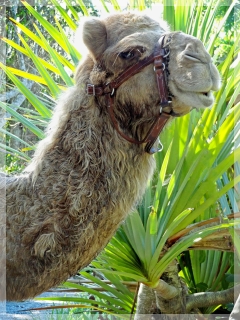 Jesus criticized the Pharisees for their meticulous tithing of herbs and spices while missing the more important aspects of the law. While both gnats and camels were forbidden food, in a wonderfully graphic hyperbole, He compared the way they poured their wine through a strainer to avoid accidentally swallowing a gnat (the smallest of prohibited “unclean” animals) while actually swallowing a camel (the largest)! Feeling self-righteous over their adherence to minor details, the Pharisees entirely missed the foundational principles of the Law: loving God and loving others.
 When Bartimaeus called out to Jesus, the crowd surrounding him kept telling him to be quiet. Not about to be deterred, the blind beggar just shouted louder. Another man in Jericho was as determined as Bartimaeus: the short and much disliked publican named Zacchaeus. When the little man couldn’t shove his way through to the front of the crowd to catch a glimpse of Jesus, he climbed up a tree (an extremely unseemly behavior for a man of his position).
 Devotions of the Heart