GOD SHOTS

Give thanks to the Lord of lords. His faithful love endures forever. Give thanks to him who alone does mighty miracles. His faithful love endures forever. [Psalm 136:3-4 (NLT)]

sunflowerAfter hearing people say, “It’s a miracle!” regarding the speedy development of the COVID-19 vaccines, I began to wonder what constitutes a miracle. In his book Systematic Theology, Wayne Grudem defines a miracle as “a less common kind of God’s activity in which he arouses people’s awe and wonder and bears witness to himself.” I’m not a theologian but his definition seems to qualify a miraculous event by its infrequency and awesomeness rather than its nature. By his definition, last month’s “great” conjunction of Jupiter and Saturn might qualify. It certainly was awesome and, since that hasn’t happened at night for nearly 800 years, it certainly qualifies as uncommon. It was, however, predictable and the two planets will be even closer together the night of December 25, 2874. I prefer Pastor Taylor Krug’s definition:  “A miracle is a particular event that occurs within the natural world that cannot be sufficiently explained with a perfect science and an exhaustive understanding of the cosmos.”

Yet, even with Krug’s definition, I can’t clearly draw the line between an amazing inexplicable incident and a sure-fire miracle. Sometimes people, places, and things intersect in extraordinary and mystifying ways. I have a friend who calls these profound happenings that defy explanation “God shots.” While writing about the SK8 church yesterday, I thought of the bizarre coincidences that brought us together.

Our association with the ministry began with a haircut. When my hairdresser closed shop, I picked a new salon from the phone book and took the first available appointment. Because of a last minute conflict, I had to reschedule and got a different stylist. We talked while she worked and our exchange took an unusual turn toward Jesus and our mutual faith. Then, for some odd reason, the conversation turned to our family business. Learning we make a product for skateboards, she told me about her involvement in a skateboarder ministry. The next morning, the coffee shop barista recognized our company logo on my husband’s cap and told us her dad had started a SK8 church. Almost immediately, her father came in to post a SK8 church notice on the bulletin board. We introduced ourselves and our association began—all because of a haircut at a randomly selected salon and a baseball cap. While not miraculous, I think that qualifies as a God shot.

During the years, we continued to see these God shots at SK8 church. Someone totally unrelated to the ministry or skateboarding was given a PlayStation he didn’t want. Rather than selling it, he brought it to the SK8 church. Why them and not EBay? Only God knows. The following afternoon, a woman with no connection to the church gave them her old car. What seemed like an odd donation actually was the timely answer to a prayer. You see, living at the church was a homeless young man who’d just gotten a job but had no way to get to it. A coincidence or the hand of God?

When the SK8 church wanted to build a skateboard bowl, they had the materials and workers one weekend but not the expertise. When the pastor called a professional boarder for technical advice, instead of giving advice, the pro drove from Missouri to Colorado the next day. He preached to the kids that night and directed the building project throughout the weekend. The God shot? He originally had a professional obligation for that weekend but it had been cancelled only minutes before the pastor’s call.

From our viewpoint, much of life seems incredibly random but we must remember that our sovereign God always is in control. He both causes things to happen as he did when a supposedly random arrow killed wicked King Ahab but He also allows things to happen, as He did when Joseph’s brothers sold him into slavery and Satan plagued Job. Whether the incredible speed with which these COVID vaccines were developed qualifies as miraculous, I don’t know but, without a doubt, God’s hand was in it. Thank you, Lord!

Praise the Lord! Give thanks to the Lord, for he is good! His faithful love endures forever. Who can list the glorious miracles of the Lord? Who can ever praise him enough? [Psalm 106:1-2 (NLT)]

O Lord my God, you have performed many wonders for us. Your plans for us are too numerous to list. You have no equal. If I tried to recite all your wonderful deeds, I would never come to the end of them. [Psalm 40:5 (NLT)]

Copyright ©2021 jsjdevotions. All rights reserved.

THE MIRACLE OF MIRACLES

And it came to pass, that, when Elisabeth heard the salutation of Mary, the babe leaped in her womb; and Elisabeth was filled with the Holy Ghost: And she spake out with a loud voice, and said, Blessed art thou among women, and blessed is the fruit of thy womb. [Luke 1:41-42 (KJV)]

Yesterday, I mentioned Dr. Frank Crane’s comments about the wonders of everyday life. After saying, “The miracle of miracles is life,” Crane adds, “The most amazing, baffling, mysterious thing in all the universe is a seed.” While cutting into an orange this morning, I looked at the seeds hidden in the juicy fruit and recalled his words. Think how a single orange seed can grow into an orange tree that produces countless flowers that almost miraculously transform into oranges that will then produce even more seeds. The amazing power and potential held in the core of one small seed is there because it was designed by God.

It was my granddaughter’s 17th birthday recently and, since I couldn’t be with her, I looked through old photos of her instead. I recalled the day I first saw her. Only a day old and small enough to fit in a Christmas stocking, Bree was in her mother’s arms. The sight of the two of them took my breath away. For some odd reason, I recalled Elizabeth’s greeting to the Virgin Mary, “Blessed is the fruit of thy womb.” I’d read and heard that phrase countless times yet I’d never really considered it. But there, right in front of me, was my daughter, the child who’d been the fruit of my womb, and she was holding her own child, the fruit of her womb. By extension, that infant also was the fruit of my womb along with my mother’s and grandmothers’ and the wombs of their mothers before them. That little girl’s DNA held fragments of people she’d never know. Both past and future were locked within her being. Remembering that sense of wonder I felt upon seeing her, I thought of Crane’s words about the miracle of miracles: the life within a seed. How does God pack soul, blood, hair, skin, teeth, eyes, bones, nerves, talent, heart, personality, imagination, sense of humor, fingernails, and the ability to love, laugh, and cry into the two microscopic cells that join to become a human being?

We just celebrated the miracle of Jesus’ incarnation when God took on human flesh. He became a fetus in a woman’s body—the fruit of her womb—and was born. In some miraculous way, the hand of God touched a virgin and impregnated her. How He did this is a matter beyond our comprehension and yet He did. As Christians, we attest to the virgin birth in both the Nicene and Apostles’ Creeds. There are, however, some people who accept all of Scripture’s miracles except for this one. Yet it really is no more amazing than God’s many other miracles. Parting the Red Sea, manna from heaven, Jericho’s destruction, turning water into wine, stilling a storm, the sun standing still, feeding a multitude, giving sight to the blind, walking on water, resurrecting the dead, and ascending into heaven all defy the laws of nature.

We don’t have to look to Scripture to be witnesses to God’s ability to do the unbelievable; just look at the miracle of miracles—life itself! The birth of a child, even when conceived the usual way, is miracle enough to convince me that the author of nature’s laws can rewrite them any time and any way He wants. The Human Genome Project spent thirteen years mapping all 3.1 billion base pairs in human DNA—the entire genetic blueprint of a human being—and yet they never found the innate sense of right and wrong that exists within each one of us from the moment we’re born or the very essence of humanity. What is the DNA of an immortal soul? My 23andMe report doesn’t say and the Human Genome Project still doesn’t know!

For us men and for our salvation he came down from heaven: by the power of the Holy Spirit he became incarnate from the Virgin Mary, and was made man. [Nicene Creed]

Behold, a virgin shall be with child, and shall bring forth a son, and they shall call his name Emmanuel, which being interpreted is, God with us. [Matthew 1:23 (KJV)]

Then said Mary unto the angel, How shall this be, seeing I know not a man? And the angel answered and said unto her, The Holy Ghost shall come upon thee, and the power of the Highest shall overshadow thee: therefore also that holy thing which shall be born of thee shall be called the Son of God. [Luke 1:34-34 (KJV)]

Copyright ©2020 jsjdevotions. All rights reserved.

THAT CHILD WAS GOD!

In the beginning the Word already existed. The Word was with God, and the Word was God. He existed in the beginning with God. … So the Word became human and made his home among us. He was full of unfailing love and faithfulness. And we have seen his glory, the glory of the Father’s one and only Son. [John 1:1-2,14 (NLT)]

For in Christ lives all the fullness of God in a human body. [Colossians 2:9 (NLT)]

nativityHe came as a baby! God Himself humbly came into the world as a helpless infant. Our nativity scenes and Christmas cards portray a serene Mary holding her peacefully sleeping child but babies are anything but calm and peaceful. They are messy and incredibly noisy little creatures who, when not sleeping, are crying, eating, drooling, peeing, or pooping (often all at the same time). That was God sleeping in the feed trough and nursing at Mary’s breast but He didn’t have a gold halo around his head. Looking the same as every other newborn, he was doing and feeling the same things every human baby feels. On the eighth day of His life, He was circumcised just like every other little Jewish boy and I’m sure He cried in pain! That crying baby was God!

Jesus came into the world without benefit of a sterile hospital birthing room and Mary didn’t rock Him to sleep in a soothing-motion bassinet or rocking cradle. She didn’t sit in a cushioned glider chair or have a nursing pillow when she fed him. He didn’t have super-absorbent, ultra soft, hypoallergenic disposable diapers covering his bottom nor did Mary use warmed sensitive-skin baby wipes to clean that bottom. In all likelihood God had diaper rash and, with no special baby shampoo, He cried when the soap got in His eyes. Mary carried Him in a simple sling rather than an ergonomically designed carrier. It was God incarnate who had the runny noses, sore throats, tummy aches, stubbed toes, and bruises that came with childhood.

Jesus had to be fed and then learn to feed himself; he probably spilled more than once. He had to learn how to crawl, walk, and run and must have bumped his chin and skinned his knees frequently. He had to be potty trained and, in all likelihood, had more than one accident. The One who was the Word had to learn the Hebrew alphabet and how to read. Picture God singing the Hebrew equivalent of the ABC song: “Aleph, Bet, Vet, Gimel, Dalet, Hey…” At Joseph’s side, Jesus must have gotten a few splinters and sore thumbs as He learned the carpenter’s trade. Fully God and fully human, Jesus got tired, dirty, and hungry just like every other child!

God, being God, could easily have come into the world full grown. Jesus could have skipped the indignities of babyhood and challenges of childhood but He didn’t. When God came into our world, He experienced every human emotion and physical sensation. He knew cold, pain, sorrow, loss, toil, discomfort, fatigue, and temptation as well as love, joy, comfort, and encouragement. Jesus was there when time began and yet the One who created mankind humbled Himself and experienced humanity. That baby—that little baby boy was God Himself!

How can God stoop lower than to come and dwell with a poor humble soul? Which is more than if he had said such a one should dwell with him; for a beggar to live at court is not so much as the king to dwell with him in his cottage. [William Gurnall]

Though he was God, he did not think of equality with God as something to cling to. Instead, he gave up his divine privileges; he took the humble position of a slave and was born as a human being. When he appeared in human form, he humbled himself in obedience to God and died a criminal’s death on a cross. [Philippians 2:6-8 (NLT)]

Copyright ©2020 jsjdevotions. All rights reserved.

CHRISTMAS EVE – THE CHRIST CANDLE

The people that walked in darkness have seen a great light: they that dwell in the land of the shadow of death, upon them hath the light shined… For unto us a child is born, unto us a son is given: and the government shall be upon his shoulder: and his name shall be called Wonderful, Counsellor, The mighty God, The everlasting Father, The Prince of Peace. [Isaiah 9:2,6 (KJV)]

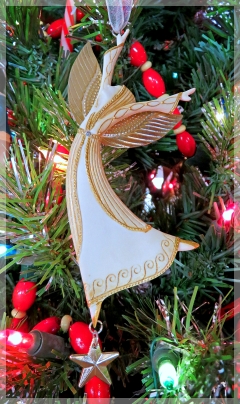
angel

No Christmas Eve seems complete without reading Luke’s account of Jesus’s birth. Although my husband and I usually read from the NLT, it will be from the King James tonight, which is the Bible translation we both knew as youngsters. Seventy plus years ago, the Sunday schoolers at my husband’s church recited Luke’s words every Christmas Eve and he always seemed to have the same verse: “And this shall be a sign unto you; Ye shall find the babe wrapped in swaddling clothes, lying in a manger.” Although many of the words and phrases of the KJV (like “espoused wife,” days that were “accomplished,” and being “of the house and lineage of David” or “sore afraid”) seem dated, it will be comforting to read the familiar and beautiful words found in this old translation.

We’ll also read the powerful words found in Isaiah 9—a promise that those walking in the darkness of God’s judgment will see the light of deliverance with the birth of a child who will fulfill God’s promise of a messianic King. It will be difficult to read the titles given to this child without wanting to sing the words so familiar from Handel’s Messiah: “Wonderful, Counsellor, The Mighty God, The Everlasting Father, The Prince of Peace.” Whether the child would be called both “Wonderful” and “Counsellor” or “Wonderful Counsellor” is a point of contention among translators. While the King James places a comma between the two words, many other translations don’t. Since the original Hebrew had no punctuation, we’ll never really know. Regardless of the punctuation, when we look at His names, it’s clear that the promised child would do more than bring light into the world.

The Hebrew word translated as wonderful is pele’ and it meant far more than just extraordinary. Astonishing to the point of being miraculous, pele’ was so marvelous that it required an act of God! The rest the child’s names are pretty self-explanatory. As a counsellor, he would guide the people from God’s perspective and with divine wisdom. He would have God’s might and power but care for His people as does a father for his children. A father, however, can’t do that forever but this promised child would guard and sustain his people eternally. The child’s final title is that of Prince of Peace. From the Hebrew word shalom, the peace of which Isaiah speaks is far more than absence of conflict or anxiety. It is a sense of wholeness, fullness, security, safety, balance, harmony, tranquility and calm—all of which the world so desperately needed then and still needs now.

The past four Sundays, we’ve lit the colored candles of hope, peace, joy, and love on our Advent wreath. Tonight, after lighting them, we will light the white candle that sits in the wreath’s center: the Christ candle. As we look at those five candles brightly burning, we’ll remember that Jesus truly is the “light of the world” and so very much more!

And the angel said unto them, Fear not: for, behold, I bring you good tidings of great joy, which shall be to all people. For unto you is born this day in the city of David a Saviour, which is Christ the Lord. [Luke 2:10-11 (KJV)]

I am come a light into the world, that whosoever believeth on me should not abide in darkness. [John 12:46 (KJV)]

Copyright ©2020 jsjdevotions. All rights reserved.

THE HALL OF FAITH

It was by faith that Rahab the prostitute was not destroyed with the people in her city who refused to obey God. For she had given a friendly welcome to the spies. [Hebrews 11:31 (NLT)]

red admiral butterflyThere are all sorts of halls of fame, honoring everything and everyone from astronauts to cowboys and hockey players, from blues music to rock and roll and country music. Even small town high schools have a wall of fame recognizing their outstanding graduates. The author of Hebrews selected a number of individuals to go in a Faith Hall of Fame. Pictured on its walls was an Old Testament all-star cast including Noah, Abraham, Joseph, Gideon, David, Samuel and Rahab. Hold it! What’s a prostitute doing in the company of kings, leaders, warriors, and prophets? It wasn’t their profession, however, that got these people selected for honor; it was their faith.

Considering that Rahab is an ancestress to Jesus, there are some who would prefer calling the pagan prostitute an innkeeper. Others, troubled by the implication of Joshua’s spies stopping at her house, would prefer the term innkeeper, as well. The Hebrew word used to describe her, however, was zonah, meaning harlot or prostitute. While Rahab’s house also may have served as an inn, she seems to have offered more than just a bed and breakfast to the men who stopped at her house. The reason the spies were there had nothing to do with Rahab’s profession; God led them to her as part of His plan. Moreover, it was a logical choice—her home was located in part of the city wall at the edge of the city and, with her steady stream of visitors, the spies’ presence could go unnoticed

Whether innkeeper, harlot, or both, Rahab knew all about the Israelites from her previous guests. She’d heard about their crossings of the Red Sea and the Jordan and their success in battle. When she told the spies, “The Lord your God is the God of heaven and earth,” she clearly recognized that the God of the Israelites, unlike the false gods of Canaan, was powerful. Recognizing the truth and acting on it, however, are two different things. This outcast woman took her life in her hands when she bravely defied the authorities and then relied on her enemies to save her. In faith, the prostitute became a traitor to her city and risked everything by trusting in a God about whom she knew very little. She bravely stepped out in faith and was rescued from a cursed city and a life of disgrace. In thanks for her assistance, she and her family were saved from Jericho’s devastation.

Rahab eventually married an Israelite, Salmon, and became the mother of Boaz, the man who married Ruth. Boaz and Ruth’s son (and Rahab’s grandson) was Obed who was Jesse’s father and Jesse was the father of David. Being King David’s great-great-grandmother places the once heathen harlot on Jesus’ family tree! Rahab’s history tells us that change is always possible and none of us need be stuck in a miserable shameful life. Regardless of the sins of our past, we can be saved and redeemed, forgiven and loved.

Rahab’s story of faith and redemption is just a preview of the grace of God seen in the New Testament. Our names never have to be recorded on a wall of shame; instead, our names can listed with the best of them in the great Faith Hall of Fame!

Free grace can go into the gutter, and bring up a jewel! [Charles Spurgeon]

By faith these people overthrew kingdoms, ruled with justice, and received what God had promised them. They shut the mouths of lions, quenched the flames of fire, and escaped death by the edge of the sword. Their weakness was turned to strength. They became strong in battle and put whole armies to flight. [Hebrews 11:33-34 (NLT)]

Copyright ©2020 jsjdevotions. All rights reserved.

EISEGESIS

Preach the word of God. Be prepared, whether the time is favorable or not. Patiently correct, rebuke, and encourage your people with good teaching. [2 Timothy 4:2 (NLT)]

snowy egretWhen writing about dance yesterday, Footloose came to mind. This 1984 movie was about a small Midwestern town that had banned dancing and rock music. A pivotal scene in the movie occurs when the young hero, played by Kevin Bacon, reads off several Bible verses in an attempt to convince the city council that God approved of dance. I used some of the same references in yesterday’s devotion. The young man, however, was way off base because the verses he cited were about sacred dance rather than social dancing. He didn’t want to worship the Lord; he wanted to have a senior prom!

Kevin Bacon’s character did something almost all of us do at one time or another: misinterpreted scripture by taking it out of context. We usually do this for one of two reasons. Either we come to the Bible with a preconceived notion of what it says or we come wanting to find a verse to support our viewpoint. In either case, we’ve drawn a conclusion before looking at all of the evidence.

For example, to support existing prejudice, rather than the sacred mark of protection it was, racists have interpreted the “mark of Cain” as the curse of black skin. To justify slavery of blacks, they wrongly interpreted Noah’s curse on Ham’s son Canaan as that of blackness and servitude. If we wanted to justify drunken revelry, I suppose we could cite Jesus turning all those jugs of water into wine at Cana. We wouldn’t mention the length of the feast, the number of people present, or that He was saving the groom’s honor. Jesus wasn’t promoting drunkenness at Cana any more than he was promoting gluttony when he turned a few fish and loaves into an excess of food for 5,000. Nevertheless, we could make it sound that way!

One of the most frequently misinterpreted verses is Jeremiah 29:11: “For I know the plans I have for you, declares the Lord, plans for welfare and not for evil, to give you a future and a hope.” The Hebrew word translated here as welfare was shalom, meaning peace, completeness, and soundness. While most updated translations use “welfare” or “peace” for shalom, some Bibles still render it as “prosper” and those are the translations used by prosperity gospel proponents. The completeness of the word shalom, however, wasn’t found in possessions or wealth; it was found in a relationship with God—the one who makes us complete. Moreover, a quick look at the context tells us this was not a promise made to everyone. It was made specifically to the Jewish people who had been exiled to Babylon and would remain there for seventy years. Rather than a promise of wealth and health for all, this was God’s promise to Judah that, at the end of their judgment, He would bring them back to their land where they would have a future and a hope.

We must be cautious of reading our own presuppositions into the text or of cherry-picking verses out of context to support our opinions. It comes down to two fancy words: exigesis and eisegesis. Exigesis is drawing the meaning out of the text through careful reading (which is good) but eisegesis is reading meaning into the text (which is bad)! The first is objective and seeks to find the true meaning while the second is subjective and seeks to make a point. Although he didn’t know it, Kevin Bacon’s character in Footloose committed eisegesis. While it made for a good story, his was faulty reasoning and bad theology. God has entrusted us with His truth; let us be good workers and handle His word wisely, honestly, and carefully.

Work hard so you can present yourself to God and receive his approval. Be a good worker, one who does not need to be ashamed and who correctly explains the word of truth. [2 Timothy 2:15 (NLT)]

Copyright ©2020 jsjdevotions. All rights reserved.