
But now we have been cut loose from the law; we have died to the thing in which we were held tightly. The aim is that we should now be enslaved in the new life of the spirit, not in the old life of the letter. [Romans 7:6 (NTE)]
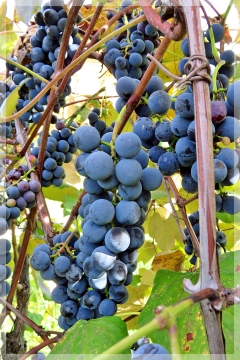 When explaining to some of John the Baptist’s followers why His disciples didn’t fast, along with the illustration of patching an old garment, Jesus compared His new way with winemaking. While many of us have sewn patches on clothing, few of us are experienced winemakers. Nevertheless, we know that today’s vintners ferment their wine in oak, stainless, concrete, or clay barrels rather than wineskins. Our only experience with wineskins may hearken back to college football games and ski trips when some fellows carried a wineskin filled with an alcoholic beverage hidden under their coats.
In the 1st century, however, wine often was fermented in large wineskins made from animal hide or bladders. Like new material sewn on old fabric, new wine in old skins also would be a failure. When unfermented juice was put into a skin and left to age, gasses would form. Although new wineskins were pliable enough to hold both wine and gasses as they fermented, old skins were hard and brittle. Without elasticity, the old skins would be unyielding as the new wine expanded during fermentation. Eventually, the old skins would burst and both wineskin and wine would be spoiled.
Thinking of new wine, today is Beaujolais Nouveau Day in France. Observed with music, fireworks and festivals, it celebrates the release of the first wine of the season. Bottled and sold just six weeks after harvest, Beaujolais Nouveau is intended for immediate drinking. I thought of this fruity red when Jesus concluded His two parables with these words in Luke 5:39: “But no one who drinks the old wine seems to want the new wine. ‘The old is just fine,’ they say.”
With Beaujolais Nouveau, people who prefer the old to the new are correct. In spite of its popularity, Beaujolais Nouveau rarely lives up to its promise and never is as rich as properly aged red wine. The result of shortcuts and additives, unlike other wines, it doesn’t even improve with age. Calling it “near wine,” wine critics have compared Beaujolais Nouveau to eating raw cookie dough.
Jesus, however, wasn’t talking about new wine; He was talking about the difference between the old religious legalism of the Pharisees and the new way of God’s grace found in Him. He cautioned that it is far easier to fall back into the old familiar ways than to take on anything new. Grace through faith was a radical idea and Jesus knew He couldn’t put new ideas into inflexible closed minds. For many people, it was easier to remain in a life governed by laws and regulations than to step out in faith and live according the Spirit.
Unlike Beaujolais Nouveau, the rich life found in Christ isn’t the result of shortcuts or additives. Following Him lives up to its promise and only gets richer and better with time. Like Beaujolais Nouveau, however, the message of hope and salvation Jesus brought into the world is worthy of celebration (and not just on the third Thursday of November)!
 You have stripped off the old human nature, complete with its patterns of behaviour, and you have put on the new one – which is being renewed in the image of the creator, bringing you into possession of new knowledge. In this new humanity there is no question of ‘Greek and Jew’, or ‘circumcised and uncircumcised’, of ‘barbarian, Scythian’, or ‘slave and free’. The king is everything and in everything! [Colossians 3: 9-11 (NTE)]
 While sorting through comic strips I’d saved, I came across an old Beetle Bailey (written by Greg and Mort Walker). In it, the inept General Halftrack approaches the chaplain and says, “I’d like to talk to God like you do, but when I try to talk to him, He doesn’t answer.” Chaplain Stainglass replies, “Maybe you’ve been calling the wrong number!” Indeed, sometimes the silence seems deafening when we call on God but I don’t think it’s because we’ve called the wrong number. The general simply may have hung up too quickly! Abraham determinedly pled for the city of Sodom, Hannah untiringly prayed for a son, Elijah persisted in praying for rain, and the Syrophoenician woman stubbornly begged Jesus to heal her daughter. They continued to call and God answered them all! Then again, maybe the General was so busy talking, that he didn’t hear God answer him!
 Thirty years ago, Al Franken played a character on Saturday Night Live named Stuart Smalley. Host of a fictitious self-help show called “Daily Affirmations with Stuart Smalley,” Stuart would look into in a mirror and affirm that he was good enough, smart enough, and that people liked him. A member of several twelve-step programs, Stuart often shared maxims like, “Denial Ain’t Just a River in Egypt!” along with affirmations that he was entitled to his share of happiness and (my personal favorite) that it is easier to put on slippers than to carpet the world.
 Since there are about 25 genealogy lists in the Bible, genealogy must be important to both God and His people. Genealogies were important to the Jews since priests and Levites could serve only if they were of pure ancestry. In Chronicles we saw how genealogies provide a connection between generations and the promises made to their ancestors. Matthew and Luke’s genealogies were important to Jewish believers because they showed that Jesus came from the Davidic line and important to Gentiles because Jesus’ Gentile ancestry shows that God sent His son for all people. What do they mean to Christians today?
 This is what the Lord says: “Because you have obeyed me and have not withheld even your son, your only son, I swear by my own name that I will certainly bless you. I will multiply your descendants beyond number, like the stars in the sky and the sand on the seashore. Your descendants will conquer the cities of their enemies. And through your descendants all the nations of the earth will be blessed—all because you have obeyed me. [Genesis 22:16-18 (NLT)]
 Devotions of the Heart