
Rejoice, O people of Zion! Shout in triumph, O people of Jerusalem! Look, your king is coming to you. He is righteous and victorious, yet he is humble, riding on a donkey—riding on a donkey’s colt. I will remove the battle chariots from Israel and the warhorses from Jerusalem. I will destroy all the weapons used in battle, and your king will bring peace to the nations. His realm will stretch from sea to sea and from the Euphrates River to the ends of the earth. [Zechariah 9:9-10 (NLT)]
 As one of three pilgrimage feasts requiring every Jewish man’s attendance in Jerusalem, Jesus and the disciples joined other pilgrims on their journey toward the city for the Passover celebration. By the time they passed through Jericho (where He healed the blind Bartimaeus and ate dinner with Zacchaeus), a large crowd was following Jesus. It was on a Sunday that He and His disciples left Bethany for the two-mile walk into Jerusalem. The roads would have been crowded as pilgrims streamed into the city in preparation for the festival. Having heard of Jesus’ miracles and the way He brought Lazarus out of the grave, many of those in the streets were anxious to see Him. ”Could this be the long-awaited Messiah?” they wondered.
Although Jesus seemed to have walked everywhere, when He was less than a mile from the city, He sent two disciples to fetch a donkey’s colt that would be waiting for them. When Jesus deliberately rode that colt into Jerusalem, He was presenting Himself as Israel’s promised king. The animal’s significance was not lost on the people and their questions about His identity were answered. Solomon rode a donkey when he was presented to Israel as David’s rightful heir and successor and Zechariah prophesied that the promised Davidic king—the Messiah—would come on a donkey, as well! Thinking this king would save them from Rome, rather than Satan, people called out “Hosanna,” a combination of two Hebrew words, yasha (meaning save) and na (meaning now). Although Jesus brought salvation, it wasn’t from Rome!
Believing Jesus was the promised heir to David’s throne, the people recited from Psalm 118: “Blessings on the one who comes in the name of the Lord! Hail to the King of Israel.” Traditionally, people honored a new king by throwing their coats where he would sit or walk and palm branches were considered symbols of joy, victory, and triumph. The crowd’s reaction to seeing Jesus on the colt was to cut palm branches from the trees and to lay both palms and their coats across the road in Jesus’ path. Others, thinking they were celebrating victory over Rome, waved branches of palms as He passed. They didn’t know the victory they were celebrating was Christ’s victory over sin and death!
While Jesus was entering Jerusalem from the east, it’s likely that Pontius Pilate (governor of Judea) was entering the city from the west and King Herod from the north. In contrast to Jesus’ humble but joyous procession, their entrances would have been solemn and regal. Jesus rode a donkey and was accompanied by twelve disciples. Pilate and Herod would have ridden in chariots and been accompanied by legions of soldiers and warhorses. Jesus and his followers were weaponless but the soldiers wore armor and carried swords. While the procession from the east was led by the Prince of Peace, the processions of Herod and Pilate, men known for their violence and cruelty, would have been a show of force to quell any thoughts of a rebellion during the Passover.
Of course, only Jesus knew that the crowd exclaiming, “Hail to the king!” would soon turn on Him—that the cries of blessings upon Him would become shouts to crucify Him! Only He knew that His royal welcome would end with His dying a criminal’s death on a cross. It wouldn’t be until after His resurrection that His Jewish followers would understand the full significance of His entry into Jerusalem on that Sunday, the 10th day of Nisan.
According to Exodus 12, the 10th of Nisan was the specific day on which people were to select their Passover lamb (a male without any defect or blemish). The family was to keep the lamb until twilight on the 14th day when it would be killed and eaten. Jesus, the Lamb of God, entered Jerusalem on Lamb Selection Day. When He and His disciples ate their Passover meal that Thursday evening, Jesus broke the bread and gave it to His disciples saying, “This is my body.” He then passed the cup saying, “This is my blood.” It wasn’t until later that the disciples understood the full meaning of Christ’s words. While they may have consumed leg of lamb that night as they commemorated Israel’s deliverance from bondage to Egypt, the bread and wine made it clear that the sinless Jesus was the true Passover lamb. He was the perfect sacrifice who would deliver all who believed in Him from their bondage to sin!
 A pastor friend told me about returning from a service project with some of his SK8 church youth including Brian, a young man new to the faith. When they stopped for lunch at a taco stand, a street person asked Brian for money. Trying to do what Jesus would want done, the new Christian offered to buy the hard-up man a burrito. It was when Brian ordered two bean burritos that his dining guest loudly complained, “I ain’t eatin’ no $%2#!* bean burrito—I want a steak one!” Brian had little money to spare but, since the man was getting vociferous, he ordered the steak burrito for his guest and a bean one for himself. Apparently, the vagrant wasn’t familiar with the proverbs about beggars not being choosers, half a loaf being better than none, and not looking a gift horse in the mouth!
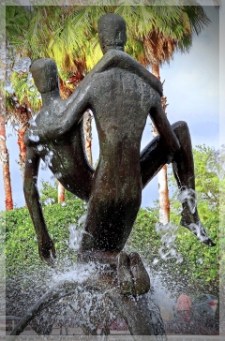 Back when I did weight training, I’d often find myself struggling with my last few reps. When I thought I couldn’t get the dumbbell up another inch and was about to give up, my trainer often gave me a little help so I could finish the rep. Disappointed that I couldn’t do it on my own, he’d remind me, “There’s nothing wrong with a little assisted lifting!”
 The Amalekites were a warlike nomadic tribe who frequently raided settlements to carry off plundered goods. About six weeks into the Israelites’ exodus from Egypt, these marauders made an unprovoked attack on the weary refugees while they camped at Rephidim. Moses commissioned Joshua to lead an army against their enemies the following morning. Joshua’s army, however, wasn’t made up of soldiers! Facing the veteran warriors of Amalek were men who less than two months earlier had been enslaved brick makers and field laborers! Worse, this unseasoned army was led by a general as inexperienced as were they. Nevertheless, Israel’s men set out to battle while Moses, his brother Aaron, and a man named Hur (who Jewish tradition believes was married to Miriam and brother-in-law to Moses) climbed to the top of a nearby hill to watch. As Israel fought their powerful foes, Moses extended his arms and held out his staff for all to see.
 Last week, after singing we’d come in the opening hymn, we promised to go in the closing one: I the Lord of Sea and Sky. Originally written for a Roman Catholic ordination mass in 1981, it has found its way into many Protestant hymnals. As I sang the refrain, “Here I am, Lord. Is it I, Lord?” I thought of Samuel and Isaiah, both of whom were called by God and both of whom responded by saying, “Here I am.” I wonder if I would have responded as positively as did they. Like Moses, would I have protested or, like Jeremiah, say my age disqualified me? Would I simply have run away as did Jonah? Although Moses, Jeremiah, and even Jonah eventually answered God’s call, I’m not so sure I would have (although three days in the belly of a fish might have convinced me)!
 As we came together in worship, each of us bringing the Lord our own private sins, sorrows, doubts, and fears, the hymn’s words, “Just as I am… I come, I come,” seemed a fitting way to start the service. Because its heartfelt words are so relatable, Just as I Am is one of my favorite hymns. Curious about its origin, I learned that its words were written by a Victorian hymn writer named Charlotte Elliott. The daughter of an evangelist, she suffered a serious illness at the age of 32 that left her an invalid for the rest of her life. Angry about what she perceived as uselessness because of her disability, Elliott became severely depressed and spiritually lost. After a visiting minister counseled her to come to Jesus, she asked how she could come to Him when all she had was her anger, sadness, questions, and broken body. The clergyman’s response was simple: “Come to Him just as you are.” Although she gave her life to Christ at that time, she continued to be plagued by depression.
