
And all the surrounding nations will ask, “Why has the Lord done this to this land? Why was he so angry?” And the answer will be, “This happened because the people of the land abandoned the covenant that the Lord, the God of their ancestors, made with them when he brought them out of the land of Egypt. Instead, they turned away to serve and worship gods they had not known before, gods that were not from the Lord. That is why the Lord’s anger has burned against this land, bringing down on it every curse recorded in this book. In great anger and fury the Lord uprooted his people from their land and banished them to another land, where they still live today!” [Deuteronomy 29:24-28 (NLT)]
 The money changing and selling of animals that so angered Jesus took place in the Court of the Gentiles, but what was a Court of the Gentiles doing in the Jewish Temple? The explanation starts around 590 BC, when Nebuchadnezzar deported the Jews from Judah to Babylon (as happened to Daniel, Shadrach, Meshach, and Abednego). Although many Jews like Zerubbabel, Ezra and Nehemiah returned, a large Jewish population remained in Mesopotamia. The economic hardship and incessant warfare experienced by those who returned to Judah caused many to emigrate later. Jews eventually settled in Rome, Egypt, Macedonia, Greece, and the great cities of Asia Minor. Historians believe that, by the middle of the first century AD, there were more Jews living outside of Judah than in it.
Bringing their faith with them wherever they settled, the Jews built synagogues that became community centers where Scripture was taught and discussed. These synagogues drew not just Jews but also Gentiles who may have come for the interesting philosophical discussions about God or to hear the Psalms chanted. In any case, Jewish beliefs began to spread to the Gentiles. A few converted but more (preferring to avoid circumcision and Jewish restrictions) just adopted the Hebrew God as their own. They would attend synagogue, observe some of the Jewish laws, and come to Jerusalem for religious festivals. Since Gentiles could not enter the Temple proper, when Herod the Great rebuilt the Temple in 20 BC, a large courtyard was erected to accommodate the non-Jews who wanted to observe Jewish traditions. It was here that Gentiles (and ritually unclean Jews) could come and worship.
Although the scattering (or diaspora) of the Jews came from droughts, famines and Judah’s conquest by Nebuchadnezzar, Alexander, Egypt, the Syrians, and Rome (among others), the Old Testament prophets’ words tell us this was punishment for their idolatry and unbelief. Nevertheless, that displacement is what helped spread Christianity. The Jews were no longer an isolated nation but a broad community of expats. Along with Hebrew, they spoke Greek (the language spoken by nearly everyone), the Hebrew Bible had been translated into Greek so that all could read it, and their synagogues had introduced the concept of one God to Gentiles throughout the area. The line dividing Jew and Gentile had started to blur.
Jews (and believing Gentiles) from all nations were present in Jerusalem for the Passover celebration when Jesus was crucified and resurrected. Many of those were in Jerusalem fifty days later for Pentecost when 3,000 were baptized in one day. Although Christianity began in Jerusalem as a subcategory of Judaism, once persecution started, these early followers of Jesus fled to Jewish communities in Syria, Asia Minor, Turkey, Greece, and Italy and it was to both Jew and Gentile that their message quickly spread. The Christian church may have begun in 33 AD, but the groundwork for its expansion had been laid long before then. God truly does work in mysterious ways.
 Seasoned travelers know the worst place to exchange their money is at the airport. With no easy option to get local currency, the unsuspecting tourist gets the worst exchange rates at the highest fees. Seasoned travelers also don’t buy suntan lotion or Dramamine onboard the cruise ship or a face mask and goggles at the ski shop on top of the mountain. Knowing their customers are desperate for their products, those shops tend to gouge them with inflated prices.
 Imagine the anguish of the woman with the blood disorder. Because Levitical law declared that anyone who touched her would be considered unclean, she’d been cut off from friends and family for twelve years. Sexual union would defile her husband so she couldn’t marry and, if she’d been married, her husband would have divorced her. Because her defilement would spread to anything she touched (be it food, cups or cushions), she was isolated in her own home. While the anemia, pain, stress, and public humiliation she endured because of her disorder must have been awful, perhaps the agony of being a pariah and unable to physically connect with people was even worse. It was her responsibility to make sure she didn’t defile others by touching them so she shouldn’t have been anywhere near a crowd. She certainly shouldn’t have touched a man (or his clothing) and could have been severely punished for her previously action. No wonder she tried to sneak unnoticed through the crowd to touch Jesus’ robe.
 Two members of our small group attended Easter service at a Christian church in another town. Imagine their shock when the pastor began his sermon by saying he didn’t believe in the resurrection. Thinking his statement had been made for shock value, they patiently waited for him to make a case for Christ and defend the truth of Easter. Unfortunately, he only offered a feel good message about new beginnings. I was reminded of their story when another pastor mentioned his experience when a youth pastor. After one of the teens complained that he talked too much about Jesus, he was called into the senior pastor’s office and told that Jesus just should be a “side dish” in the church youth group!
 “It wasn’t worth it!” I grumbled while applying cortisone over four painful red bumps on my foot. When walking around the lake at the botanic gardens, I’d spotted an osprey in a nearby tree. To get a good shot, I had to step off the paved trail into what I knew to be fire ant territory. Having had previous encounters with these stinging insects, I knew better than to stand there in sandals, but I did it anyway; the picture wasn’t worth the price I was paying for my poor decision.
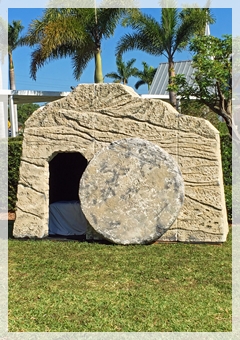 Yesterday I mentioned the wooden cross and rustic nail on my desk that serve as reminders of the terrible price Jesus paid for our salvation. Although early Christian symbols included a dove, ship, lyre, anchor, and fish, the cross has become the universal symbol for Christianity. While Coca-Cola’s logo, Nike’s swish and McDonald’s golden arches may come close, I doubt there is any so recognizable sign in the world. Nevertheless, a gruesome instrument of Roman torture seems an odd symbol for a faith that preaches such things as reconciliation, sacrifice, forgiveness, hope, love, and peace. While I’d never wear a miniature gallows, guillotine, or electric chair on a chain around my neck, I do wear a cross. Although it symbolizes everything that happened to Jesus on that dark Friday two thousand years ago, the cross would be meaningless if the tomb had not been empty Sunday morning.
 Devotions of the Heart