
Yes, each of us will give a personal account to God. [Romans 14:12 (NLT)]
 In 539 BC, thousands of Medes and Persians were digging outside Babylon’s walls. Thinking they were futilely trying to undermine the city’s impregnable walls, Babylon’s King Belshazzar was unconcerned. While carousing with 1,000 of his nobles, he gave orders to bring out the gold and silver cups that Nebuchadnezzar had looted from Jerusalem’s temple 47 years earlier. The revelers were drinking to their false Babylonian gods with vessels dedicated to the one true God when a human hand appeared and started writing on the plaster wall. No longer so arrogant, the frightened Belshazzar called for his astrologers and diviners but, when the pagans were incapable of deciphering God’s message, Daniel was called to interpret the words.
The three words on the wall were MENE, meaning numbered, TEKEL, meaning weighed, and PARSIN, meaning divided. The words meant Belshazzar’s days as king were coming to an end, his reign had been weighed and found deficient, and that Babylon would fall and be divided. Even though I don’t rule an empire, I wondered if those three words might apply to me, as well.
Numbered—yes, our days are numbered. That we don’t know how many days are allocated to us doesn’t mean they are limitless. While Belshazzar’s number was up (he died that very night), he wasted his last day in blasphemy, idolatry, and drunken revelry. How will we choose to spend our remaining days?
Weighed—like Belshazzar, our lives will be weighed (on God’s scales, not ours). Of course, no mortal can ever balance on His perfect scales. Nevertheless, God will hold us accountable at the Judgment Seat of Christ. Have we been good stewards of His gifts? Have we served selflessly or selfishly? Belshazzar dishonored God with gold and silver goblets; have we dishonored Him with our own form of idolatry? Do we love fame, wealth, home, career, possessions or beauty more than Him? Would God find us wanting because we’ve been short on grace, forgiveness and love?
Divided—like Belshazzar’s, our personal kingdom will be divided when we’re gone. After the government and bill collectors get their share, our heirs will divide the rest. All of those possessions we worked so hard to obtain and thought so important in this life will be divided among those we leave behind. Much of what we thought so valuable will end up at flea markets, resale shops, on eBay or in a landfill.
I’m not a pagan king, hosting a drunken orgy and committing sacrilege while his nation is under attack but those three words—numbered, weighed, and divided—hit home when I read them this morning. They are a vivid reminder to look carefully at my priorities. Much of my life can be described as stuff and nonsense. How about yours? Are our days spent wisely? Do we appreciate every day with which we are blessed? Will we be found lacking? Do we honor God with our words and actions? What will remain of us when we’re gone? While things are meaningless and will disappear, memories of us and the influence we’ve had on others will continue. Will the kingdom we leave to others consist of stuff that’s divided or love that multiplies?
Numbered, weighed, and divided: what do they mean to you?
 Someone was missing from yesterday’s story of Shadrach, Meshach, and Abednego and the fiery furnace: their good friend Daniel. When Nebuchadnezzar’s giant statue was erected on the plain of Dura, word was sent to all of his officials to assemble there for the statue’s dedication. We know Shadrach, Meshach, and Abednego were there because Daniel reported that they got tossed in a fiery furnace for refusing to bow to an idol. But what of Daniel? He’s the one who chronicled the event: the one who wrote that all of the high officers, officials, governors, advisers, treasurers, judges, magistrates, and provincial officials were present. Daniel gives no explanation for his absence at the dedication of the king’s golden statue.
 One night King Nebuchadnezzar had a disturbing dream and asked the court’s wise men to interpret it. Whether he couldn’t remember it (as happens with dreams) or, being obstinate, wanted to test the soothsayers and astrologers, we don’t know, but the king expected them to tell him the dream’s meaning without his revealing its content. Indignant at their failure to do so, he ordered the execution of all of Babylon’s counselors (which included Daniel, Shadrach, Meshach, and Abednego). Daniel approached the king and asked for time so that he could discover the dream’s meaning.
 After Nebuchadnezzar’s first invasion of Judah, he returned to Babylon with the temple’s treasures and some of Judah’s nobility as captives. The best and brightest of the young men were to learn the literature and language of Babylon so they could serve the king. In spite of being captives, they were housed in the palace and given the king’s choice of food. While this would appear to be a pretty good gig for prisoners of war, the boys were probably castrated and made eunuchs as was typically done for palace officials (and prophesied by Isaiah in 2 Kings 20:18).
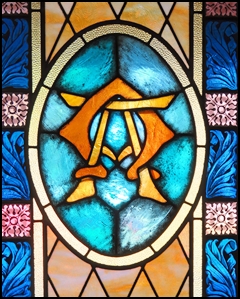 In the book of Revelation, when Jesus says He is the Alpha (the beginning), He also says He is the Omega (the end). He’s not talking of alphabets but rather the absolute beginning, revealed in Genesis, and the absolute end, revealed in Revelation. God had the first word when He spoke the universe into existence and He will have the last word when the world as we know it ends.
 Having forgotten the Greek alphabet he learned as a fraternity pledge, my husband asked the meaning of the symbols on the lecterns in the church sanctuary. On the left was A for alpha and, on the right, was Ω for omega: the first and last letters of the Greek alphabet. In Hebrew, those letters would have been aleph and tau. Among Jewish rabbis, using the first and last letters of the alphabet was a common way to express the whole of something, from its beginning to its end. Today’s equivalent expression would be “from A to Z” or “from soup to nuts.” Those Greek letters refer to three verses in Revelation in which Jesus claims to be the Alpha and Omega. They tell us that that, as part of our Triune God, Jesus was there at the beginning and He will be there at the end.
 Devotions of the Heart