AN AMBASSADOR IN CHAINS 

And pray for me, too. Ask God to give me the right words so I can boldly explain God’s mysterious plan that the Good News is for Jews and Gentiles alike. I am in chains now, still preaching this message as God’s ambassador. So pray that I will keep on speaking boldly for him, as I should. [Ephesians 6:19-21 (NLT)]
lupineSince the beginning, Satan has been determined to impede God’s plan. He started in Eden and continued by attempting to cut off the promised line of the Messiah with the killing of Israel’s infant boys in Egypt, Haman’s evil plans to exterminate every Jew in the Persian empire, and Herod’s slaughter of boys under two in Judah. When that failed, Satan sought to derail Jesus’ mission to mankind by tempting Him in the wilderness and Scripture tells us that wasn’t his last attempt to stop the Lord. Having failed with Jesus, Satan has been trying to interfere with the church’s mission to spread the gospel ever since.

Satan may have thought he’d found the perfect man to defeat the early church in the Pharisee Saul—a powerful man who hated both Christ’s followers and Gentiles. He rejected Jesus as the Messiah, approved of the stoning of Stephen, and devoted himself to persecuting and terrorizing Christians. That, of course, was before Saul met Jesus on the road to Damascus. In a little bit of God-ordained poetic justice, the Saul who had been doing Satan’s work by persecuting the church transformed into the Apostle Paul whose mission became that of building the church!

Satan probably thought he’d obstruct Paul’s mission with an assassination attempt, several shipwrecks, assorted arrests, beatings, stonings, and floggings, along with several stints in prison. Paul, however, managed to turn every hindrance into an evangelism opportunity; he even preached to his guards! Once Paul was put under arrest in Rome in 60 AD, Satan may have thought he finally stopped the evangelist in his tracks. Rather than being imprisoned as a common criminal, however, Paul was confined to house arrest. Although he was chained and under guard, he was allowed to live in a rented house at his own expense. In spite of his captivity, Paul “welcomed all who visited him, boldly proclaiming the Kingdom of God and teaching about the Lord Jesus Christ.” [Acts 28:31] Rather than discouraging other believers, Paul’s unstinting faith during imprisonment encouraged them and it was during these years that Paul wrote his letters to the Ephesians, Philippians, Colossians, and Philemon. When Paul wasn’t writing to the church, it seems that he spent his solitary time praying for it!

After a few years of freedom, Paul was re-arrested and imprisoned around 65 AD. Confined to a Roman prison that time, he was cut off from the world except for a few visitors. As the apostle faced death, he wrote his final epistle, 2 Timothy and, like his other letters, it is filled with faith, sound doctrine, encouragement, endurance, and love.

While Satan thought Paul’s hardships and suffering would stop him from preaching the gospel, Paul used his hardships and suffering to spread it. When Paul was free, he saw himself as an ambassador for Christ and, when imprisoned, he simply saw himself as an ambassador in chains. Moreover, knowing Paul’s situation, his words about forgiveness, rejoicing in suffering or trouble, and finding joy in all circumstances are all the more meaningful to his readers today. Rather than stopping his ministry, Paul’s imprisonments helped keep his ministry alive because of his letters. His words are as essential to the church today as they were when written nearly 2,000 years ago!

Satan couldn’t stop God’s plan for the Messiah, couldn’t stop Jesus from His mission as the Lamb of God, and couldn’t stop Paul. Satan can stop the church only if the church allows him. Paul didn’t. Will we?

And I want you to know, my dear brothers and sisters, that everything that has happened to me here has helped to spread the Good News. For everyone here, including the whole palace guard, knows that I am in chains because of Christ. And because of my imprisonment, most of the believers here have gained confidence and boldly speak God’s message without fear. [Philippians 1:12-14 (NLT)]

Copyright ©2022 jsjdevotions. All rights reserved.

SMELL THE ROSES

But the Lord said to her, “My dear Martha, you are worried and upset over all these details! There is only one thing worth being concerned about. Mary has discovered it, and it will not be taken away from her.” [Luke 10:41-42 (NLT)]

barred owlsMy father always had a fixed itinerary for everything he did and, for him, a schedule, once made, was set in stone. Unless it was on his agenda, he never stopped to “smell the roses.” Whenever we vacationed, he had a list of sites to visit and things to accomplish for each day. For example, as soon as we arrived at the Japanese Tea Garden in San Francisco’s Golden Gate Park, he got out his list and, without even pausing to view the flowers or drink any tea, crossed off the park, and announced, “Well, that’s out of the way; now we’re off to the top of the Mark!”  Once there, our cursory look out its windows at the city went much the same way and we rushed off the next destination on his itinerary. Had we visited in Jerusalem in Jesus’ time, rather than stopping to listen to Him speak from the hillside, we’d have rushed off to see the Pool of Siloam or Jacob’s well in Sychar!

I thought of my father’s version of sightseeing when visiting the bird sanctuary. We were oohing and aahing at a mother owl feeding her owlets only a few feet away. As a young man approached, we started to point them out but, without even turning his head, he quickly strode past. This swamp is one of southwest Florida’s “must see” destinations but, apparently, like my father, the fellow was anxious to cross it off his list and get on to the next thing. He missed an “Aha” moment (along with the herons, wood storks, alligators and blue flag iris) and will probably tell people his walk wasn’t worth the entrance fee.

Being the promised Messiah was a heavy assignment and Jesus knew he had a limited time on earth, yet we never read of him being in a hurry, rushing somewhere, or not stopping when someone called to him. Rather than grab a quick falafel at a first century fast-food stand, He stopped and dined in people’s homes. He didn’t rush by those who needed healing. While on the way to Jairus’ house to heal the man’s daughter, he paused long enough to heal a bleeding woman. He was never too busy to answer questions and he seized any opportunity to share God’s love and forgiveness. After chatting with the woman at the well, he interrupted his travels to stay with the Samaritans for two more days. Although large crowds followed him, he always found time for prayer and little children. He taught, preached, and healed, but he never was too busy to stop.

Our lives should be more than a “to do” list of events, destinations, and achievements. Granted, we need plans and goals, but we should be willing to adjust our schedules and revise our plans. Rather than think of life’s interruptions as distractions, we could consider them as opportunities presented by God. He gave roses a lovely aroma for a reason; perhaps it’s so we’ll stop to smell them! At the age of 56, my father, a man who never stopped to smell those roses, died of a massive coronary. There’s a lesson to be learned from his sudden death—the time to smell the roses is now! If we don’t, we’ll miss out on more than just a few “Aha!” moments when on vacation. We may miss precious opportunities with family, friends, and God. Isn’t that what Jesus was telling Martha so long ago?

As we journey through life, Lord, slow us down and stop us when necessary. Don’t allow us to become so intent on some distant objective that we forget to cherish the scenery, people, and opportunities we encounter along the way. May we always welcome interruptions that allow us to serve you, share your love, or appreciate your bountiful gifts.

Never lose an opportunity of seeing anything that is beautiful; for beauty is God’s handwriting—a wayside sacrament. Welcome it in every fair face, in every fair sky, in every fair flower, and thank God for it is a cup of blessing. [Ralph Waldo Emerson]

Look here, you who say, “Today or tomorrow we are going to a certain town and will stay there a year. We will do business there and make a profit.” How do you know what your life will be like tomorrow? Your life is like the morning fog—it’s here a little while, then it’s gone. [James 4:13-14 (NLT)]

Copyright ©2022 jsjdevotions. All rights reserved


JOHN THE BAPTIST – Part 2

On the following day, John saw Jesus coming towards him and said, “Look, there is the lamb of God who will take away the sins of the world! This is the man I meant when I said, ‘A man comes after me who is always in front of me, for he existed before I was born!’ It is true I have not known him, yet it was to make him known to the people of Israel that I came and baptised people with water.” [John 1:29-31 (PHILLIPS)]

mourning doveWe don’t know if John the Baptist recognized Jesus as his distant cousin when the two men met on the banks of the Jordan. Although they were the same age and their mothers were related in some way, with John in the desert and Jesus in Nazareth, it’s not likely they knew one another. If they did, Jesus probably seemed nothing more than an ordinary person to John at the time.

When Jesus walked toward him that day, however, John knew he was seeing someone who was more than a carpenter from Nazareth. In the same way that Elizabeth knew Mary was “the mother of my Lord” when the unborn John leapt in her womb, John recognized Jesus’ true identity as the Son of God. John seemed to have no doubt about Jesus when he testified to seeing the Spirit descend on Him like a dove and, throughout John’s ministry, he continued to point out Jesus as the “Lamb of God.”

After Jesus’ baptism, the gospel of John tells us that both John and Jesus carried on baptizing ministries. Perhaps out of jealousy, some of John’s disciples complained that more people were going to Jesus than coming to John. Again, John made it clear that he knew their different roles when he compared himself to the best man and Jesus to the bridegroom. “He must become greater and greater, and I must become less and less.” [3:30]

More than a year later, what happened to John’s confidence in Jesus’ identity? The man who once had been so sure about Jesus sent his disciples to ask, “Are you the Messiah we’ve been expecting, or should we keep looking for someone else?” [Mt 11:3] Languishing in Herod’s dungeon, John probably wondered why the conquering king from David’s line hadn’t released him. Why hadn’t Jesus taken the throne from Herod and Rome? Where was the end-time outpouring of the Spirit, the winnowing fork that would separate the chaff from the wheat, and the one who would burn the chaff with “never-ending fire”?

In truth, Jesus wasn’t the Messiah that John and his disciples were expecting; nevertheless, He was the Messiah! John, however, didn’t understand that Jesus had to teach, heal, suffer, die, resurrect, and ascend before returning a second time and executing final judgment. At first, it seems that Jesus ducks John’s question with a summary of his miracles but John understood. The miracles Jesus listed fulfilled the messianic promises in Isaiah; they were proof that He was the Messiah. Jesus’ final message for John is a beatitude that encouraged the Baptizer (and the rest of us) not to stumble in our faith just because Jesus doesn’t fit our expectations.

While we may not be languishing in a dungeon as was John, we may be in languishing in grief, infertility, depression, illness, addiction, chronic pain, money issues, infidelity, or family problems. Just as Jesus didn’t meet John’s expectations, He doesn’t always meet ours. He didn’t free John from Herod’s prison and He may not free us from ours and, like John, we may have doubts. Faith and doubt, however, are not antonyms and doubt and unbelief are not synonyms! We can be people of faith and still have questions; like John, we never should be afraid to ask those questions. John went to Jesus for the answers and, like him, we should look to the words and works of Jesus Christ for our ours. We’ll discover, as did John, that the Lord’s credentials will hold up to the toughest of questions!

Jesus gave them this reply, “Go and tell John what you see and hear—that blind men are recovering their sight, cripples are walking, lepers being healed, the deaf hearing, the dead being brought to life and the good news is being given to those in need. And happy is the man who never loses faith in me.” [Matthew 11:4-6 (PHILLIPS)]

Copyright ©2022 jsjdevotions. All rights reserved.

RELISHING EVERY BITE

Then He said to me, “Son of man, eat what is in front of you. Eat this book, then go and speak to the people of Israel.” So I opened my mouth, and He fed me this book. And He said to me, “Son of man, eat this book that I give you and fill your stomach with it.” So I ate it, and it was as sweet as honey in my mouth. [Ezekiel 3:1-3 (NLV)]

strawberriesSince it was Easter, along with the oatmeal raisin cookies I made for Sunday treats, I brought a bowl of pastel-wrapped Hershey candy for the little ones. As I placed the candy on the hospitality table, I recalled the last time I had chocolates at church. It was several years ago at our Colorado mountain church. Even though it wasn’t Easter or Valentine’s Day, along with Bibles, the pew book racks were filled with chocolate kisses that morning.
When the pastor asked us to eat a candy, we all quickly and quite happily accommodated him. He then asked us to eat another one. That time, however, he instructed us to do everything deliberately and slowly. Rather than tearing off the wrapper, we were to look closely at it before pulling the plume and gradually unwrapping the candy. Instead of  immediately popping the kiss into our mouths, we were to examine it carefully before placing the chocolate gently on our tongues. Rather than a few quick bites, we were to savor the texture and flavor as it gradually melted in our mouths. Even though the second kiss was identical to the first, the experience of eating it was entirely different. Since this was church and not a chocolate tasting, our pastor went on to compare our two experiences with the way we can read the Bible. He suggested that we need to be as attentive in our Bible reading as we were in the second candy-eating experience.

Are we as unaffected by reading the Bible as we are by a quick bite of candy or do the words actually touch and change us? By pointing out that we can simply consume food and be done or dine and have an experience, the Slow Food movement tries to bring mindfulness to the table! Although both ways of eating will provide calories, only one will be a memorable and affecting experience. We need to bring that sort of presence and mindfulness to our Bible reading as well. We should savor God’s Word the way we would a Lindt bar of dark chocolate and caramel with sea salt, a full-bodied vintage Cabernet, a juicy ripe summer peach, or home-grown strawberries. God’s word should dissolve into our lives, fill us, and impact the way we live.

Lectio Divina (Latin for “divine reading”) is a fancy term for treating scripture not as a text but as the living word of God. An ancient exercise, it became a regular practice in monasteries by the 6th century. Not being Benedictine monks, we could think of it as the “Slow Bible Movement.” As with food, the quality of the Bible study is more important than the quantity consumed. A few verses read and reflected upon so that we respond to and rest in the message is far better than a whole chapter read and forgotten within a few hours. Unwrapping the meaning of a verse takes more time than tearing off a candy wrapper. Rather than quickly scarfing down verses, let’s slowly savor the words we read. We should reread them, ponder them, find something that speaks directly to us, and then respond to it. Our response then leads us to contemplation and prayer as the verses sink into us. In the Slow Bible Movement, we relish what we’ve read and allow it to refresh and renew us as we carry God’s word forward in our hearts.

In Ezekiel’s vision, God fed him a scroll filled with His message for the Israelites. Even though the scroll was filled with words of sadness, they were as sweet as honey to the prophet because they were God’s words. What food is to our bodies, God’s Word is to our souls and we can’t live well without either one. Moreover, like Ezekiel and Jeremiah, we’ll never be able to share the message of God’s Good News until we’ve consumed it and allowed it to change our lives. We can snack or dine, gulp or savor; the choice is ours.

Your words were found and I ate them. And Your words became a joy to me and the happiness of my heart. For I have been called by Your name, O Lord God of All. [Jeremiah 15:16 (NLV)]

Copyright ©2022 jsjdevotions. All rights reserved.

TEND THE GARDEN – EARTH DAY 2022

Then God blessed them and said, “Be fruitful and multiply. Fill the earth and govern it. Reign over the fish in the sea, the birds in the sky, and all the animals that scurry along the ground.” … The Lord God placed the man in the Garden of Eden to tend and watch over it. [Genesis 1:28,2:15 (NLT)]

It is terrible to hear the young birds calling for food after the old ones have been killed to get the feathers for rich women to wear. I am not going to have my birds sacrificed that way. [Rhett Green (Corkscrew Swamp Audubon Warden from 1912 – 1917)]

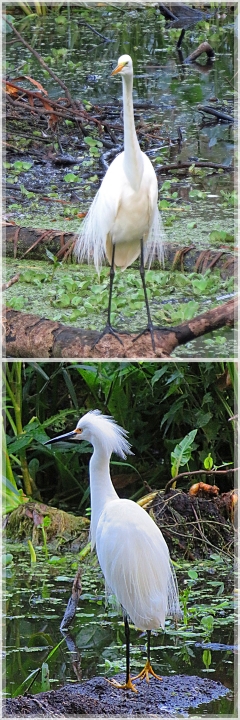
great egret - snowy egret - corkscrew sanctuaryThe wading birds of southwest Florida are absolutely beautiful, especially this time of year when they’re wearing their mating plumage. We’ve lived here eleven years and I still haven’t tired of their beauty as I encounter them daily in our ponds. 115 years ago, however, I would have been hard put to see any of these beautiful creatures anywhere. In the late 1800s, bird feathers became the fashion craze in women’s hats. Along with a plethora of plumes, some hats even featured an entire exotic bird! By 1900, more than five million birds were being killed every year and plume hunters had nearly wiped out the entire egret population. It wasn’t just the egrets with their white mating plumes—herons, roseate spoonbills, flamingoes, and peacocks were among the fifty North American species being killed for their plumage. No bird was safe.

After killing the birds and stripping them of their plumage, poachers would leave their carcasses to rot. They also left abandoned nests with eggs that would never hatch or baby birds unable to fend for themselves. For the hunters, poaching was profitable; they could easily bag 100 birds on a good day and the plumes sold for as much as $32 dollars an ounce. Merely for the sake of fashion, the bird population in rookeries was decimated throughout Florida and the southeast U.S. Fortunately, because of a grass roots campaign by two Boston socialites, organizations like the Audubon Society, and both state and national legislation, the carnage of these beautiful creatures has stopped.

We were called to be good stewards of the earth, but we still show little regard for God’s creation. Last fall, U.S. Fish and Wildlife Service delisted 11 species of birds from the endangered species list—not because they no longer were at risk but because they had become extinct! In 2021, Birdlife International reported that nearly 1,500 of the 11,000 species of birds face the threat of extinction with another 1,000 species considered “vulnerable.” We’re not wearing fancy feathered hats but loss of habitat, climate change, wind farms, cell towers, pesticides, cats, and even windows pose threats to them. It’s not just birds that are in danger; our local papers are filled with reports of blue-green algae, red tide, fish kills, Florida panther loss, starving manatees, diminishing wetlands, and endangered sea turtles! Worldwide, we face plenty of other pressing environmental issues including oil spills, water pollution, global warming, fossil fuel dependency, a diminishing rain forest, and the loss of open land (to name just a few).

When I look at the birds with their beautiful plumage, I thank God for their creation and for the people who took action to save them. Although God did the creating, it is up to us to do the maintaining. In Genesis, we read that God gave mankind permission to govern the earth and reign over all the animals along with the responsibility of tending and watching over His garden. The Hebrew word used for “tend” was shamar and it means more than keeping the land cultivated and free of weeds. It means keeping watch, preserving, guarding, and protecting. Have we tended God’s beautiful garden and made it thrive or have we run roughshod over it without regard for His creation?

Today is Earth Day. Observed by over a billion people every year, it has become the largest secular observance in the world. Concern for our environment, however, is not a secular concern—it is a sacred responsibility given to us by God. Let us remember that every day is Earth Day!

Lord, grant us the wisdom to care for the earth and till it. Help us to act now for the good of future generations and all your creatures. Help us to become instruments of a new creation, Founded on the covenant of your love. [The Cry of the Earth]

The earth is the Lord’s, and everything in it. The world and all its people belong to him. [Psalm 24:1 (NLT)]

Copyright ©2022 jsjdevotions. All rights reserved.

FLYING AWAY

Oh, that I had wings like a dove; then I would fly away and rest! I would fly far away to the quiet of the wilderness. [Psalm 55:6-7 (NLT)]

mourning doveEaster is over and “season” here in southwest Florida is winding down. More people are departing than arriving as our seasonal visitors return north, transport trucks laden with cars are moving up the interstate, and we finally can get a table at our favorite restaurant! It’s been said that there is no escape from death or taxes but we usually try to flee from just about every other unpleasant thing. Thinking their lives would be better here, our snowbirds came south to escape sub-zero temps, heating bills, and shoveling snow. While the climate here is nicer, our tropical paradise doesn’t come with a guarantee and none of us can flee from life’s uncertainties and problems.

Rather than escaping from winter weather, Naomi and Elimelech fled from Bethlehem to escape a famine. Instead of trusting God, they ran away to Moab, a pagan nation hostile to Israel. They intended staying briefly but remained for ten years during which time their sons broke Jewish law by marrying Moabite women. Moab, however, didn’t turn out to be the sort of get-away for which they hoped; sadly, Elimelech and both sons died. A widow with no sons in a hostile and pagan land was in worse straits than a family in their homeland during a famine. Having literally fallen out of the frying pan into the fire, Naomi decided to flee from Moab. At least this time, she went in the right direction—back to Bethlehem and the God of Israel!

We’re not much different from Naomi and some of our snowbirds; we want to escape to a place where life will be better, simpler, happier, easier, less costly, or more fun. Like Naomi, however, we’re likely to be disappointed because the baggage we’ve packed contains more than our clothes. Tucked in with the sunglasses and beach attire are things like problems at work, disappointments, worries, responsibilities, lack of faith, ill health, guilt, unmet deadlines, family strife, or financial problems. If we can’t physically flee from our troubles, some people try escaping through things like procrastination, alcohol, shopping, drugs, busyness, codependency, or denial. Disregarding the bills doesn’t get them paid, ignoring the lump won’t make it disappear, and taking a vacation, moving to a new house, or having another baby won’t fix a broken marriage. There is no way to escape from life’s problems, obligations, or consequences. We carry that baggage with us wherever we go.

In Naomi and Elimelech’s day (the time of the judges), famine was a test of faith but the couple missed what God planned for them by fleeing from their challenge. If we simply suffer through our troubles and allow them to be our master, we lose hope and become bitter, as did Naomi. Having resigned herself to being an embittered penniless widow with no grandchildren, upon her return to Bethlehem the woman whose name meant pleasant called herself Mara, meaning bitter. Rather than running from or resigning ourselves to our troubles, we can endeavor to change them by trusting God—exactly what Naomi and Elimelech failed to do. Instead, it was the Moabite woman Ruth who showed more faith in Israel’s God than did her in-laws. Trusting in Him, she bravely faced the challenges of widowhood by gleaning in the fields of Boaz. Ruth, however, wasn’t alone in those fields; God was at her side! No matter how bleak the situation may seem, there’s no need to flee when we remember that God is with us in our troubles.

Good people must never expect to escape troubles; if they do, they will be disappointed, for none of their predecessors have been without them. [Charles Spurgeon]

The Lord hears his people when they call to him for help. He rescues them from all their troubles. The Lord is close to the brokenhearted; he rescues those whose spirits are crushed. The righteous person faces many troubles, but the Lord comes to the rescue each time. [Psalm 34:17-19 (ESV)]

Don’t be afraid, for I am with you. Don’t be discouraged, for I am your God. I will strengthen you and help you. I will hold you up with my victorious right hand. [Isaiah 41:10 (NLT)]

Copyright ©2022 jsjdevotions. All rights reserved.