PATIENCE

But the Holy Spirit produces this kind of fruit in our lives: love, joy, peace, patience, kindness, goodness, faithfulness, gentleness, and self-control. [Galatians 5:22-23 (NLT)]
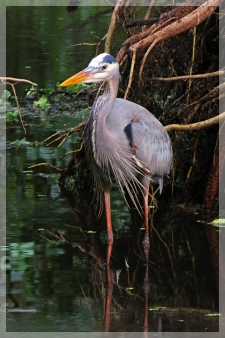
great blue heronAs we continued our brief study on prayer, one person shared that his prayer frequently is for patience. Agreeing, I admitted often praying, “Lord, please give me patience…and give it to me now!” While patience is a fruit of the Spirit, I have a problem getting it to grow in the garden of my life.

Without a doubt, we live in a fast-paced world and perhaps we’ve grown more impatient because of that. For example, a good download speed is 100 Mbps which allows for the receipt of 12.5 MB per second. A byte is the equivalent of one typed character so that’s like 12.5 million letters in one second (or four complete King James Bibles)! Nevertheless, we complain when we see that download circle spin for even a few seconds!

We no longer need to visit the library or bookstore for a book, the encyclopedia for an answer, or Blockbuster for a movie. Our apps mean we skip the checkout lines and our DVRs allow us to skip the commercials! Grocery shopping takes only a few minutes thanks to Instacart and DoorDash allows us to skip the groceries altogether! We pay bills, do our banking, plan travel, and shop with a few clicks of a mouse and what we order today appears on our doorstep tomorrow! We literally live in a world of instant pots, grams, chargers, coffee, rice, carts, and gratification. Patience may be a virtue but it seems as rare as handwritten letters and phone booths. Its rarity, however, doesn’t mean it’s unnecessary!

I thought about patience this morning while walking in a nearby park. We were mesmerized while watching a beautiful Great Blue Heron ((Ardea herodias) hunt for breakfast. With a height of four feet and a wingspan of nearly seven feet, the Great Blue is an impressive bird. When foraging, it stands still for long periods of time with only his head moving while patiently scanning the water for prey. When a heron wades through the water, it seems to glide. Its long legs move so deliberately and gracefully there’s not even a ripple in the water. At the Great Blue stalks its food in the wetlands, this statuesque bird is a model of focus, diligence, and purpose. Watching a heron hunt is like seeing something in ultra-slow-motion. But, when its next meal comes swimming past, the heron moves with lightning speed, uncoils its long neck, and plunges its sizable beak and head into the water. On occasion it comes up empty-beaked but, more often than not, its patience pays off and the bird emerges with a fish, frog, snake or other unlucky critter. While I’ve gotten plenty of photos of a heron hunting and several of one enjoying its catch, I’ve never gotten one of the bird actually getting its meal. You see, the heron’s patience exceeds my own. No matter how long I stalk the bird for the perfect shot, I give up before it does! Were I a heron, I surely would go hungry!

Watching the heron today was a beautiful reminder to slow down and exercise patience as we move through life. It’s easy to lose faith when things don’t move along at the pace we want them to go but life isn’t meant to be measured at megabits per second. Unlike Siri, God isn’t at our beck and call with answers to every question. Moreover, unlike UPS, He doesn’t give us a tracking link to check on a prayer’s progress and know its delivery date. God works in His time and way and what seems like a delay on His part is just our unrealistic expectations concerning God’s perfect plan.

God speaks to us through his creation and nature (like God) takes its own sweet time to accomplish its purpose. Indeed, “For everything there is a season.” It takes time for seeds to germinate, seedlings to flower, and flowers to bear fruit. It takes time for nests to be built, eggs to hatch, and eaglets to fly. It takes time for bees to pollinate, seasons to change, caterpillars to become butterflies, saplings to become tall oaks, tadpoles to become frogs, and for the heron to stalk its meal! May God’s beautiful world remind us to slow down and savor the moments and people with whom we are blessed.

Lord, please give us patience—for other people’s sentences to be completed, for projects to be finished, for questions to be answered, and for problems to be solved. Give us patience to let our children mature, for friendships to grow, and for skills to develop. May we have patience for tempers to cool and relationships to mend, patience with our own shortcomings and those of others, patience for healing to occur, and patience for prayers to be answered. Teach us how to wait!

Adopt the pace of nature: her secret is patience. [Ralph Waldo Emerson]
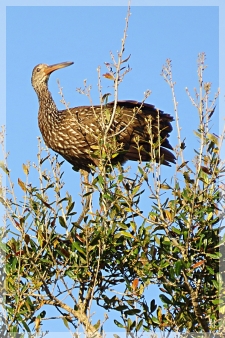
Since God chose you to be the holy people he loves, you must clothe yourselves with tenderhearted mercy, kindness, humility, gentleness, and patience. [Colossians 3:12 (NLT)]

Copyright ©2023 jsjdevotions. All rights reserved.

LISTENING

Come, let us worship and bow down. Let us kneel before the Lord our maker, for he is our God. We are the people he watches over, the flock under his care. If only you would listen to his voice today! [Psalm 95:6-7 (NLT)]

limpkinLooking like a cross between a heron and an ibis, the limpkin (Aramus guarauna) is common along Florida’s fresh water canals, wetlands, and swamps. While they’re lovely to look at, they’re not lovely to hear. Often referred to as the wailing or crying bird, limpkins have a loud piercing “banshee” scream that usually is heard at night, dawn, and dusk. During courtship, a male limpkin makes repetitive long, loud, rattling calls while a female replies with slightly lower (but still disturbing) screams.
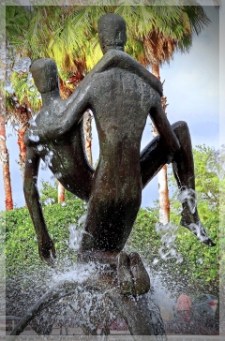
It’s mating season and, as the limpkins establish their territory and seek their mates around our lakes, the male limpkins are wailing away. On this morning’s walk, I encountered three of these screamers high in trees near the water. Although they continually called out, they never seemed to pause long enough from their wailing to hear an answer. While the three males continued their haunting screams, I encountered a female limpkin quietly walking along the shoreline. I wondered if she simply was waiting for the men to quiet down long enough so she could return their call.

My family is doing a seven-day prayer study which began with the statement, “Prayer is conversation with God.” As we shared our prayer habits via email, one person wrote that some days he simply asks God, “What’s your will for me today?” He added, “The hard part of any conversation is being willing to listen and be receptive to what is being said.” As I thought of his words, I realized our similarity to the screeching limpkins—how we often call out to God without pausing to listen for His response. We ask what to do or where to go but don’t listen for His answer (perhaps because we’re not that anxious to obey).

While there is no rigid format either to prayer or conversation, there are guidelines to a good conversation which also apply to prayer. Conversation and prayer are about building a relationship and both require a balance between talking and listening. It’s neither prayer nor conversation when we come only to talk. Moreover, there’s a big difference between actively listening and simply waiting until we can speak again. We must listen with the intention of understanding and, when we ask questions, we’re supposed to wait for the answers! My mother often reminded me that God gave us two ears and only one mouth because we were to listen twice as much as we spoke.

Just as there’s no need to impress others with big words scattered throughout the conversation, we don’t need a special vocabulary to speak with God. He knows what we mean and, when we can’t find the right words, the Spirit fills in for us. In the same way, just as unnecessary details and long explanations can bog down a conversation, they can bog down our prayers. Since God is all-knowing, He already knows the details! A good conversation is one where we are honest and God expects nothing less than complete honesty in prayer, as well.

We may be guarded in conversation but there are no secrets with God. While we should be prudent about revealing personal information in conversation, we can be totally vulnerable and open in prayer. Scripture shows people expressing the whole range of emotions in their prayers—everything from anger, outrage, disappointment, confusion, sadness, and fear to joy, confidence, awe, delight, acceptance, and gratitude.

No president, royalty, pope, prime minister, or Nobel Prize winner has ever welcomed me into a conversation. People like Bill Gates, Greta Thunberg, Max Lucado, Volodymyr Zelensky, Taylor Swift, Tom Hanks, Simone Biles and Joyce Meyer haven’t asked me to give them a call. While I may not be on speaking terms with the rich, powerful, or famous, I am with God—the Creator and Sustainer of the Universe! He invites all of us to call any time and He’s never too busy to take our call. As for those well-known and influential people, if we ever did speak with one of them, we probably would listen carefully to what they had to say. Can we do any less when we converse with God?

To have God speak to the heart is a majestic experience, an experience that people may miss if they monopolize the conversation and never pause to hear God’s responses. [Charles Stanley]

I love the Lord because he hears my voice and my prayer for mercy. Because he bends down to listen, I will pray as long as I have breath! [Psalm 116:1-2 (NLT)]

Be still, and know that I am God! [Psalm 46:10 (NLT)]

Copyright ©2023 jsjdevotions. All rights reserved.

ASSISTED LIFTING (Rephidim – Part 2)

When Moses’ father-in-law saw all that Moses was doing for the people, he asked, “What are you really accomplishing here? Why are you trying to do all this alone while everyone stands around you from morning till evening?” [Exodus 18:14 (NLT)]

Back when I did weight training, I’d often find myself struggling with my last few reps. When I thought I couldn’t get the dumbbell up another inch and was about to give up, my trainer often gave me a little help so I could finish the rep. Disappointed that I couldn’t do it on my own, he’d remind me, “There’s nothing wrong with a little assisted lifting!”

Earlier this week, when writing about Israel’s victory against the army of Amalek at Rephidim, I didn’t tell the whole story. While Joshua and his men fought in the valley, Moses, Aaron, and Hur observed from a hilltop. Standing tall, Moses raised his arms and extended his staff for all to see. That staff was Israel’s banner and, as long as Moses kept the staff raised high in the air, the Israelites advanced. But, as the day wore on, the eighty-year-old began to tire. His arms grew heavy and, most likely, his back began aching and his legs started cramping. Whenever Moses’ fatigued arms started to fall, the Amalekites began to succeed. As the battle ebbed and flowed, its outcome seemed to depend as much on Moses and that raised staff as it did on the men’s skill with swords. Aaron and Hur, however, found a rock on which Moses could sit. Then the two men stood beside Moses and did some “assisted lifting” of their own by holding up his arms until Israel claimed victory at sunset.

Later, while still camped at Rephidim, Moses got another lesson in assisted lifting. From sunrise to sunset, he dealt with both the spiritual and interpersonal concerns of Israel. Scripture tells us there were 600,000 Israelite men. When we add women, children, and the “mixed multitude” that joined them in their escape from Egypt, more than two million people were traveling together. With those many people (described by Moses as “stiff-necked”), imagine the number of questions, concerns, grievances, and quarrels that came to his attention every day. When Jethro (Moses’ father-in-law) visited the Israelite camp, he observed his son-in-law’s demanding routine. Seeing how overwhelmed Moses was by his enormous responsibilities while others did nothing, Jethro warned Moses that working that way was unsustainable. He sagely advised him to delegate some of his duties among Israel’s leaders.

Jethro suggested that Moses continue to act as the people’s representative before God and as God’s voice to the people. As an intermediary between God and Israel, Moses would intercede for Israel and pass along God’s words to them. But, when it came to mediating people’s everyday (often petty) disputes with one another, Jethro suggested that Moses chose qualified men and subdivide the work of judging among them. Only the most difficult cases would come to Moses. After getting divine approval, Moses heeded his father-in-law’s advice and got some much-needed assisted lifting!

God doesn’t expect us to bear every burden alone. Moses couldn’t do it all by himself and, even though we often think we can, neither can we. Although God will provide assistance, his provision often comes in the advice and help we receive from others. Whether we take that help, however, is entirely up to us. Fortunately, Moses didn’t think himself too strong to be helped with his staff, too wise to be counseled by his father-in-law, or too indispensable to delegate work to others!

Rather than a barbell or even a shepherd’s staff, the heavy weight we’re asked to lift consists of the responsibilities, complications, predicaments, and challenges of life. At some time or another, like Moses, we all will need some assisted lifting. May we never be too proud to accept it.

Thank you, Lord, for the many ways you provide us with the assisted lifting that gives us the strength and ability to succeed.

Two people are better off than one, for they can help each other succeed. If one person falls, the other can reach out and help. But someone who falls alone is in real trouble. Likewise, two people lying close together can keep each other warm. But how can one be warm alone? A person standing alone can be attacked and defeated, but two can stand back-to-back and conquer. Three are even better, for a triple-braided cord is not easily broken. [Ecclesiastes 4:9-12 (NLT)]

Copyright ©2023 jsjdevotions. All rights reserved.

JEHOVAH-NISSI (Rephidim – Part 1)

But you have raised a banner for those who fear you—a rallying point in the face of attack. Now rescue your beloved people. Answer and save us by your power. [Psalm 60:4-5 (NLT)]

May he grant your heart’s desires and make all your plans succeed. May we shout for joy when we hear of your victory and raise a victory banner in the name of our God. [Psalm 20:4-5 (NLT)]

The Amalekites were a warlike nomadic tribe who frequently raided settlements to carry off plundered goods. About six weeks into the Israelites’ exodus from Egypt, these marauders made an unprovoked attack on the weary refugees while they camped at Rephidim. Moses commissioned Joshua to lead an army against their enemies the following morning. Joshua’s army, however, wasn’t made up of soldiers! Facing the veteran warriors of Amalek were men who less than two months earlier had been enslaved brick makers and field laborers! Worse, this unseasoned army was led by a general as inexperienced as were they. Nevertheless, Israel’s men set out to battle while Moses, his brother Aaron, and a man named Hur (who Jewish tradition believes was married to Miriam and brother-in-law to Moses) climbed to the top of a nearby hill to watch. As Israel fought their powerful foes, Moses extended his arms and held out his staff for all to see.

When going into battle, opposing armies would carry banners or standards that served as rallying points before battle, encouraged the warriors as they fought, and announced when the battle was won. Representing their tribe or leader, the banners usually depicted animals, birds, or pagan gods. Made of fabric, wood, or metal, they were fastened onto a long pole or staff so they could be seen from a distance. Marauders like the Amalekites probably had such a banner. The Israelites, however, weren’t an experienced army and had no flag or standard under which to rally.

Moses’ staff was the closest thing Israel had to a banner. Although it looked like an ordinary shepherd’s tool, to the Israelites it symbolized God’s intervention. Through God’s power, it had transformed into a snake, turned water into blood, produced hail, and infested Egypt with frogs, gnats, flies, and locusts. When Moses raised it over the Red Sea, the waters parted and, when Moses struck a rock with it, water gushed out. That staff, associated with God’s miracles, became Israel’s banner. As long it remained in sight, Israel’s novice army believed God was with them and victory was possible. That symbol of God’s faithfulness, presence, and power remained in the men’s sight on the hilltop until Israel was victorious over the army of Amalek.

After their victory, Moses built a memorial altar and called it Yahweh-Nissi (Jehovah-Nissi), which meant “The Lord is Our Banner.” By not calling it “The Staff is Our Banner” or “Our Banner Brought Us Victory,” it was clear that Moses knew it wasn’t the staff, Joshua’s battle strategy, or Israel’s military might that defeated the Amalekites. The name Yahweh-Nissi acknowledged that it was God’s presence and power that gave them their triumph. God, and God alone, was the author of their victory.

Indeed, the Lord is our banner. Unlike the Israelites, we’re not being attacked by an army of marauding warriors but, like them, the enemy attacks us every day with desire, discontent, despair, anger, and guilt. We face our battles under God’s banner—one of encouragement, courage, hope, love, faith, power, and might. If we keep our eyes focused on the Lord, victory is ours. Because of Yahweh-Nissi, we don’t have to fight our battles on our own strength – we have His!

In that day the heir to David’s throne will be a banner of salvation to all the world. The nations will rally to him, and the land where he lives will be a glorious place. [Isaiah 11:10 (NLT)]

Copyright ©2023 jsjdevotions. All rights reserved.

… AND GOING (Part 2)

Then I heard the Lord asking, “Whom should I send as a messenger to this people? Who will go for us?” I said, “Here I am. Send me.” [Isaiah 6:8 (NLT)]

I, the Lord of sea and sky, I have heard my people cry
All who dwell in dark and sin My hand will save.
I, who made the stars of night, I will make their darkness bright.
Who will bear my light to them? Whom shall I send?
Here I am, Lord. Is it I, Lord? I have heard you calling in the night.
I will go, Lord, if you lead me. I will hold your people in my heart.
[Dan Schutte]

elephantLast week, after singing we’d come in the opening hymn, we promised to go in the closing one: I the Lord of Sea and Sky. Originally written for a Roman Catholic ordination mass in 1981, it has found its way into many Protestant hymnals. As I sang the refrain, “Here I am, Lord. Is it I, Lord?” I thought of Samuel and Isaiah, both of whom were called by God and both of whom responded by saying, “Here I am.” I wonder if I would have responded as positively as did they. Like Moses, would I have protested or, like Jeremiah, say my age disqualified me? Would I simply have run away as did Jonah? Although Moses, Jeremiah, and even Jonah eventually answered God’s call, I’m not so sure I would have (although three days in the belly of a fish might have convinced me)!

Being a prophet was a little like being God’s press secretary. Acting as His spokesperson, the prophet conveyed God’s words and message to the people. Unlike a press conference, however, negative news didn’t get a positive spin and there was no quibbling about the meaning of words. Prophets didn’t speak off-the-record, dissemble, beat around the bush, or use alternative facts and half-truths. With no need to be re-elected, God never worried about approval ratings and His prophets spoke only the unadulterated and often unpopular truth.

While a bearer of glad tidings is popular and welcome, indicting people for their sins  or bringing a message of judgment and destruction was no way to win a popularity contest in Judah, Israel, and the surrounding nations. As the frequent bearers of reproach, dire warnings, and sad tidings, prophets often were ignored and persecuted. Nevertheless, Isaiah and the others reported for duty and took on a task that few would want.

God’s prophets answered His call because they trusted and loved Him. They knew He didn’t bring the Israelites to the edge of the Red Sea only to have them drown in the waters or be captured by the Egyptian soldiers nor did He send them through the wilderness only to have them die from starvation or lack of water before arriving in Canaan. God didn’t put Noah and the animals on that Ark without bringing them to dry land, He didn’t have Joshua march around Jericho without giving him victory, and He didn’t send David out to meet Goliath without those five smooth stones for his sling! Confident that God would provide all they needed, those prophets answered His call.

The pastor’s choice of opening and closing hymns had us both coming and going that day. The hymns were a vivid reminder that it’s not enough just to come to Jesus; He also expects us to go out into the world for Him. He calls us to service—to be His messengers and spread His word, light, and love to the world around us. When He calls, do we answer or do we pretend we don’t hear? Do we trust God to provide whatever we need or do we doubt and reject Him? Even though God warned his prophets that most people wouldn’t listen to them, let alone heed their words, they heeded His call by saying, “Here I am. Send me.”  Will we do the same?

We are not diplomats but prophets, and our message is not a compromise but an ultimatum. A.W. Tozer]

But you will receive power when the Holy Spirit comes upon you. And you will be my witnesses, telling people about me everywhere—in Jerusalem, throughout Judea, in Samaria, and to the ends of the earth. [Acts 1:8 (NLT)]

Copyright ©2023 jsjdevotions. All rights reserved.

COMING … (Part 1)

Then Jesus said, “Come to me, all of you who are weary and carry heavy burdens, and I will give you rest. Take my yoke upon you. Let me teach you, because I am humble and gentle at heart, and you will find rest for your souls. For my yoke is easy to bear, and the burden I give you is light.” [Matthew 11:28-30 (NLT)]

Just as I am, without one plea,
but that thy blood was shed for me,
and that thou bidd’st me come to thee,
O Lamb of God, I come, I come.

Just as I am, and waiting not
to rid my soul of one dark blot,
to thee, whose blood can cleanse each spot,
O Lamb of God, I come, I come.

elephantAs we came together in worship, each of us bringing the Lord our own private sins, sorrows, doubts, and fears, the hymn’s words, “Just as I am… I come, I come,” seemed a fitting way to start the service. Because its heartfelt words are so relatable, Just as I Am is one of my favorite hymns. Curious about its origin, I learned that its words were written by a Victorian hymn writer named Charlotte Elliott. The daughter of an evangelist, she suffered a serious illness at the age of 32 that left her an invalid for the rest of her life. Angry about what she perceived as uselessness because of her disability, Elliott became severely depressed and spiritually lost. After a visiting minister counseled her to come to Jesus, she asked how she could come to Him when all she had was her anger, sadness, questions, and broken body. The clergyman’s response was simple: “Come to Him just as you are.” Although she gave her life to Christ at that time, she continued to be plagued by depression.

After a sleepless night filled with doubts and feelings of uselessness, the distressed woman “gathered up in her soul the grand certainties, not of her emotions, but of her salvation: her Lord, His power, His promise.” [Lutheran Hymnal Handbook] Remembering the words said to her twelve years earlier, “Come to Him just as you are,” Charlotte Elliott wrote the hymn we know as Just as I Am. By the grace of God, this woman who came to Jesus just as she was (with broken body and troubled heart) ended up writing about 150 hymns, many of which as still in use today!

Not a one of us comes to the Lord without sin, doubts, pain, scars, weaknesses, and a whole lot of troubling history. John and James had big egos and short-tempers, the Pharisee Saul/Paul hated Gentiles and persecuted Christians, and Mary Magdalene had been possessed by seven demons! For twelve years, the woman with the bleeding disorder was considered unclean and the leper who knelt before Jesus literally was untouchable. Nicodemus was so afraid that he came with his questions in the dark of night. The woman at the well lived with a man not her husband and had been used and discarded by several men before that! The blind men who came to Jesus were nothing but beggars and Zacchaeus and Matthew came to Him as corrupt collaborators. We don’t know the sins of the man hanging on the cross beside Jesus and we can only imagine the baggage carried by the prostitute who washed Jesus’ feet with her tears and dried them with her hair. Yet, they all came to Jesus just as they were and He welcomed them all!

It’s never been a question of whether or not we’re good enough to come to Jesus—none of us are worthy to stand in His presence. Nevertheless, “Come as you are!” is how He invites us to come to Him. In spite of our flaws, sins, doubts, anger, depression, limitations, illness, regrets, or checkered pasts, Jesus loves us as we are and welcomes us with open arms. But, while He welcomes us as sinners, He doesn’t welcome our sins. Our Lord expects us to leave them behind with all the other worldly baggage that weighs us down. It is when we humbly and repentantly come to Jesus just as we are that, by the power of the Holy Spirit, He will make of us what we should be!

Just as I am, though tossed about
with many a conflict, many a doubt,
fightings and fears within, without,
O Lamb of God, I come, I come.

Just as I am, thou wilt receive,
wilt welcome, pardon, cleanse, relieve;
because thy promise I believe,
O Lamb of God, I come, I come.
[Charlotte Elliott (1835)]

Jesus replied, “I am the bread of life. Whoever comes to me will never be hungry again. Whoever believes in me will never be thirsty. … I am the light of the world. If you follow me, you won’t have to walk in darkness, because you will have the light that leads to life.” John 6:35, 8:12 (NLT)]

Copyright ©2023 jsjdevotions. All rights reserved.