HE HUMBLES

Uzziah sought God during the days of Zechariah, who taught him to fear God. And as long as the king sought guidance from the Lord, God gave him success. … But when he had become powerful, he also became proud, which led to his downfall. [2 Chronicles 26:5,16 (NLT)]

peacockWhen writing about pride earlier this week, I remembered the Bible’s stories of proud men who got their comeuppance. 2 Chronicles 26 tells of Uzziah who, as long as he “sought guidance from the Lord, God gave him success.” His mighty army defeated the Philistines, Arabians, and Meunites (who then paid him an annual tribute) and, under his rule, Jerusalem’s walls were fortified, wilderness forts were established, water cisterns were dug, and something like catapults were erected on the walls to defend the city. With Uzziah as king, Judah prospered and the powerful king’s fame spread “far and wide.” Sadly, along with prosperity, power, and fame came pride. Believing he was above the law, the proud king entered the sanctuary and usurped the high priest’s role by offering incense. When priests warned him about his sacrilege, the proud king raged at them and immediately was stricken with leprosy—a disease that meant the “unclean” man lived the rest of his life in isolation and never again could enter the Temple. All the blessings, accomplishments, and prosperity of his reign were overshadowed by Uzziah’s one act of pride, insolence, and arrogance.

It is in the book of Daniel that we meet the proud Babylonian King Nebuchadnezzar. He was so full of pride that he erected a 90-foot golden statue of himself and then demanded that people fall down and worship it as a sign of loyalty to him. When the king had a disturbing dream about a tree that grew tall and then was cut down, he called upon Daniel to interpret its meaning. Daniel explained that Nebuchadnezzar was the tree and would be cut down by losing his kingdom. He then would live like an animal until he repented of his pride and learned that Heaven, not man, rules. Although Daniel advised the king to acknowledge God’s rule and govern with justice, his words fell on deaf ears.

About a year later, as Nebuchadnezzar looked down from his rooftop at the majestic splendors of Babylon, he proudly congratulated himself on his mighty power that accomplished such great things. Before the words were even out of his mouth, a voice from heaven pronounced judgment upon him and the king developed what is known as boanthropy, a psychological disorder in which one becomes delusional and thinks they’re a cow. The high and mighty king was driven from society and lived and ate like an animal for the next seven years. It was not until the once proud (but now repentant) king raised his eyes to heaven and acknowledged that God is the ruler over mankind that his sanity returned and his kingdom was restored.

For forty days and nights, the Philistine giant Goliath had proudly sauntered out to taunt the Israelite troops. Dressed in his bronze helmet, coat of mail, and leg armor while armed with spear, javelin, and sword, he challenged them to fight. Calling himself the Philistine champion and Israel’s army mere servants of Saul, the arrogant warrior thought himself invincible. What the Philistine didn’t know (but David did) was that, in taunting Israel, the braggart had insulted the God of Israel. When the nine-foot Goliath saw David walk toward him, he was filled with disdain for the apparently weaponless youth. In his smugness and conceit, he never considered the possibility that the boy was armed with sling, stones, and the power of Jehovah. When David ran toward him, the giant never saw what hit him. What a humiliating end for the warrior! He was felled by a single stone and beheaded by a shepherd boy wielding the giant’s own sword! Goliath’s demise is a perfect example of the old saying that “pride comes before a fall!”

Pride leads us down a dangerous path and, as we’ve seen from Scripture, pride inevitably leads to humiliation. It’s not just kings and giants who are proud rather than humble and fail to acknowledge from whom their gifts come and to whom they should submit. All that we possess in the way of power, strength, riches, intelligence, possessions, ability, talent, and even health are gifts from God—and He can take them away as easily as He gives them! Let us be humble.

No matter how dear you are to God, if pride is harbored in your spirit, He will whip it out of you. They that go up in their own estimation must come down again by His discipline. [Charles Spurgeon]

The Lord detests the proud; they will surely be punished. … Pride goes before destruction, and haughtiness before a fall. First pride, then the crash—the bigger the ego, the harder the fall. Better to live humbly with the poor than to share plunder with the proud. [Proverbs 16:5,18-19 (NLT)]

Copyright ©2023 jsjdevotions. All rights reserved.

PRIDE BLINDS

Sin whispers to the wicked, deep within their hearts. They have no fear of God at all. In their blind conceit, they cannot see how wicked they really are. [Psalm 36:1-2 (NLT)]

prickly pear cactusI enjoy stopping for a short stroll on the boardwalk of a local nature preserve that is home to well over 100 gopher tortoises (a protected species) and a wide assortment of native plants. The boardwalk is low to the ground and has no railing because it’s not there to protect people from the alligators and snakes of the swamp; it’s there to protect the animals and their dry scrub habitat from people! Several signs are posted about not stepping off it onto the fragile landscape. When I spotted an absolutely beautiful prickly pear cactus in full bloom, I was disappointed it was out of decent photo range. Since mine had been the only car in the parking lot, I was tempted to disobey the posted signs. “I really want that photo! Who’d know? What harm could I do?” I asked myself. If I’d seen someone else stepping off the boardwalk, however, I would have admonished them for their lack of environmental concern! Recognizing sin’s whisper in my ear, I stayed put. Nevertheless, I realized how tempting it is to think my desires are more important than anything or anyone else.

It’s easy to get so caught up in the importance of ourselves—our projects, possessions or purpose—that we forget it’s not really about us. Last year, a town north of us had a severe water shortage and asked residents to water lawns only once a week—yet, despite the city’s pleas, people disregarded the restrictions. Apparently, their landscaping took priority over the needs of their community. When no water comes out of the fire hydrants, however, the color of their grass will be of no importance.

I regularly see drivers run red lights, fail to yield right of way when entering roundabouts, and multi-task by texting, applying make-up, eating, and reading while driving. Apparently, their desire to get somewhere on their timeline takes precedence over anyone else’s safety. Of course, the few seconds they may save will be lost in an accident!

Why do we disobey laws (or God) so easily? What was it that made me (even briefly) think I deserved a photo denied to any but those with the finest camera and telephoto lens? The answer C.S. Lewis might give is pride. Calling it the “complete anti-God state of mind,” he considered pride the underlying cause of every other vice.

Competitive in nature, pride causes people to look down on things and other people. Could it be pride that makes people decide their lawns are more important than their city’s water supply or their destination is more important than the safety of their fellow drivers? Is it pride that causes us to think God’s commands, government regulations, traffic laws, community requirements, ethical principles,  moral standards, and even the rules of common courtesy apply to everyone else but not to us? Is it pride that makes us forget about doing unto others as we would have done to us? Could it be pride that makes us think that we deserve bigger, better, faster, fancier, sooner, or more than the other guy? It certainly was pride that allowed me to briefly think I deserved a photo op denied to others!

Pride means more than enmity between people; it is enmity to God. Faced with one infinitely superior to him, it was Satan’s pride that caused him to rebel and fall from heaven. It is our pride that makes us rebel, as well. We foolishly think that we’re better, smarter, richer, prettier, wittier, grander, saintlier, and more deserving than anyone else. We’re not!

It is pride which has been the chief cause of misery in every nation and every family since the world began. …Pride is spiritual cancer: it eats up the very possibility of love, or contentment, or even common sense. [C.S. Lewis]

“Scoffer” is the name of the arrogant, haughty man who acts with arrogant pride. [Proverbs 21:24 (ESV)]

Haughty eyes, a proud heart, and evil actions are all sin. … Mockers are proud and haughty; they act with boundless arrogance. [Proverbs 21:4,24 (NLT)]

(A week later, I came across another cactus right beside the walking path in the Botanic Garden. Thank you, God!)

Copyright ©2023 jsjdevotions. All rights reserved.


PERSISTENT PRAYERS

One day Jesus told his disciples a story to show that they should always pray and never give up. [Luke 18:1 (NLT)]

mourning doveIt is in the Talmud (a compilation of ancient Jewish teachings and history) that we find the legend of Honi ha-Ma’agel (the Circle Maker). After three years of drought in the land, the man prayed for rain. When none came, Honi drew a circle in the dirt and vowed not to leave it until God had pity on his people and sent rain. When God sent a light rain, the circle maker informed God that wasn’t the kind of rain for which he prayed and stated his desire for rain enough to fill the cisterns. When God answered with torrents of rain, Honi again complained that, “Not for such a rain I prayed.” After the circle maker informed God he wanted a “rain of goodwill, blessing, and graciousness,” God provided a rain that satisfied Honi. In fact, it rained so much that the people finally asked Honi to pray the rain away! While Honi’s behavior is a great example of chutzpah (audacity and impudence), I’m not sure it’s a good example of proper prayer.
Every week since Russia invaded Ukraine nearly a year ago, the pastor has opened her Saturday evening worship service with a prayer for peace in Ukraine (as well as in our hearts). Regardless of how long it takes, until there is a peaceful settlement or God instructs her to stop praying for Ukraine, she will continue starting every service this way. What she is not doing, however, is drawing a circle in the chancel area, placing a bed and porta-potti in it, arranging for Uber Eats and Grub Hub deliveries, and moving into that circle until God brings peace to the war-torn nation!

While I join in the pastor’s persistent prayers for peace, like her, I don’t draw a circle and refuse to leave it until God answers my prayers on my terms and time line. Rather than an example of perseverance in prayer, the demanding Honi seems a bit like a spoiled child who refuses to leave the store until his parents buy the toy he wants. In fact, the Talmud says the rabbis compared Honi to a son who “importunes” (pesters, annoys, plagues, or harasses) his father to do his will. They even considered excommunicating the circle maker for dishonoring God in such an impertinent way.

No matter how persistently we pray, drawing a circle and challenging God to produce results on demand seems dangerously close to testing the Lord. Requiring something of God to prove Himself is the very thing Satan tempted Jesus to do in the wilderness. By challenging Jesus to jump off the Temple, the enemy wanted to manipulate a situation that would oblige God to intervene. Satan wanted Jesus to prove the truth of God’s word by forcing God’s hand. Honi’s actions weren’t that much different.

Nevertheless, finding Honi’s story similar to Jesus’ parable about the persistent widow and dishonest judge, there are some who think we should follow the circle maker’s example. The widow in the parable tenaciously pestered the corrupt judge for justice against the man who harmed her. Worn down by her persistent pleas to right the wrong, the beleaguered judge eventually granted her request. Jesus, however, wasn’t comparing the unjust judge to God; He was contrasting them! The corrupt judge had no fear of God or concern for people. Since he was more likely to be persuaded by a bribe than compassion or a desire for justice, the widow’s only recourse was to relentlessly hound him until she received what she deserved. In contrast, rather than corrupt, cruel, or hardhearted, God is righteous, merciful, and loving. Jesus explained that God “will surely give justice to his chosen people who cry out to him day and night.”

Presenting ultimatums or harassing, beleaguering, and nagging the Lord is unnecessary because our just and compassionate God always hears and answers our prayers. While Jesus calls for persistence in prayers and perseverance in faith until His return, there is a fine line between boldly praying with perseverance and impertinently praying with cheek, impudence, stipulations, or a sense of entitlement.

The story of Honi is not Biblical and, if praying the way Honi did were important, we’d find such an example in Scripture. After all, Elijah didn’t have to make a circle before God answered his prayers for both drought and rain. The power of our prayers does not come from standing in a circle or making brazen demands—it comes from the God who hears our prayers and answers them according to His will and timing. In the meantime, until peace comes to Ukraine or God tells us to stop, please join the pastor and me as we persevere in our prayers for peace.

The earnest prayer of a righteous person has great power and produces wonderful results. Elijah was as human as we are, and yet when he prayed earnestly that no rain would fall, none fell for three and a half years! Then, when he prayed again, the sky sent down rain and the earth began to yield its crops. [James 5:16b-18 (NLT)]

Copyright ©2023 jsjdevotions. All rights reserved.

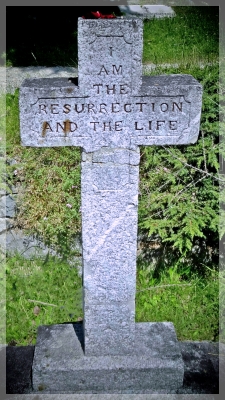
FROM DEATH TO LIFE

“I am the resurrection and the life,” replied Jesus. “Anyone who believes in me will live, even if they die. And anyone who lives and believes in me will never, ever die.” [John 11: 25-26 (NTE)]

Matterhorn Memorial - Zermatt

Courtesy of technology, we recently attended an Illinois church service while sitting at our computers in Florida. The choir, accompanied by pipe organ and trumpet, began with Jesu, Joy of Man’s Desiring and ended with Joyful, Joyful We Adore Thee. The trumpet’s bright piercing sound and the organ’s lilting accompaniment in the first song and the uplifting words in the final one makes them popular choices for joyful occasions like weddings, Christmas, and Easter. Although we were rejoicing, we weren’t celebrating nuptials, Christ’s birth, or His resurrection. Instead, we were rejoicing in a life well lived and celebrating the life of a friend who recently went home to God.

During the service, several people spoke of this Christian man’s faith, character, modesty, generosity, humility, compassion, honesty, reliability, thoughtfulness, wisdom, and curiosity. A leader both in his community and church, he built consensus rather than caused discord, bore the fruit of the Spirit, and truly lived his life as a follower of Christ. Although he played the trumpet in college, he never blew his own horn or called attention to himself. Nevertheless, he was a shining light in a world filled with darkness. Our lives were blessed by his presence and he will be deeply missed by all who knew him.

As much as his family and friends mourn his absence, the service was one of unparalleled joy because, while here on earth, he followed Jesus with his heart, soul, body, and mind. We could be joyful because we know death is not the end of our lives—just of our lives in these perishable bodies. As Christians, we have hope of something greater that goes far beyond life and death.

In contrast, I can’t feel joy at any funeral or memorial service for a non-believer. While songs may be sung, they’re more likely to be My Way or Over the Rainbow than Abide with Me or It is Well with My Soul. After sharing memories and listing accomplishments, the person giving the eulogy will say reassuring things about the deceased being in a better place, with the angels, or watching over us—none of which are based in reality. Unbelievers are not going home or into the arms of God, they won’t be “looking down” at their loved ones, and there won’t be a happy reunion in heaven with friends and family. The only way an unbeliever lives on is in photographs and people’s memories; sadly, even those will fade and be lost over time. There is little comfort in the passing of a non-believer.

While there are different opinions in Christ’s church about what happens immediately after death, there is unanimity in His church about what eventually happens—we will come face to face with God and our entire lives will be examined. Jesus’ life, death, and resurrection mean that His followers aren’t afraid of God’s judgment on the day. Regardless of our failures and sins, we are recipients of God’s grace and forgiven for our wrongs. Because of God’s mercy and grace, all of His adopted children have a confirmed reservation waiting for them in heaven.

Because the only way to heaven is faith in Jesus and there is no return from the depths of hell, there is no comfort or joy in the passing of a non-believer. On the other hand, in spite of our sorrow, we can rejoice when Christ’s followers depart this world because we know their destination, that our separation is only temporary, and that we will meet again in God’s good time. That’s why, at their passing, we can raise our voices and joyfully sing, “Joyful, joyful, we adore You, God of glory, Lord of love; Hearts unfold like flowers before You, Opening to the sun above.”

Morality may keep you out of jail, but it takes the blood of Jesus Christ to keep you out of hell. [Charles Spurgeon]

I’m telling you the solemn truth: anyone who hears my word, and believes in the one who sent me, has the life of God’s coming age. Such a person won’t come into judgment; they will have passed out of death into life. [John 5:24 (NTE)]

Copyright ©2023 jsjdevotions. All rights reserved.

PRAYERS – Chronicles (Part 2)

Then if my people who are called by my name will humble themselves and pray and seek my face and turn from their wicked ways, I will hear from heaven and will forgive their sins and restore their land. [2 Chronicles 7:14 (NLT)]

Easily missed in Chronicles’ nine chapters of genealogy is Jabez (whose name meant distress or sorrow). Described as more honorable than his brothers, Jabez prayed: “Oh, that you would bless me and expand my territory! Please be with me in all that I do, and keep me from all trouble and pain!” [4:9-10] The Chronicler tells us God granted Jabez’s request and the man whose name meant distress apparently had a trouble-free life!

Those two verses are the only mention of Jabez in the entire Bible yet his short prayer inspired a bestseller in 2000 and countless sermons since. Amazon describes the words of Jabez as “a timeless prayer that produces timely results!” and promises that readers of the book can “discover how they can release God’s miraculous power and experience the blessings God longs to give each of us.” Some people seem to think that the Chronicler tell us about Jabez because he had the right combination of words to guarantee blessings and a trouble-free life. We, however, do Jabez a disservice in assuming he was asking for material blessings like power, land, health, and wealth. He may have been asking God for spiritual blessings—that God to be with him in his words and actions. Rather than expand his land, perhaps this honorable man prayed to enlarge his area of spiritual influence. Rather than avoiding physical pain, he may have prayed to be free of the heartache of seeing others (perhaps his brothers) disobey God.

While we don’t know if Jabez’s prayer was one of self-interest or selflessness, we do wonder why the Chronicler included the words of this historically insignificant man in his genealogy. It is in remembering that Chronicles’ purpose was to remind the exiles of God’s faithfulness that we discover the reason for the prayer’s inclusion. It’s not the words Jabez prayed that were important; it’s that this honorable man actually prayed and that, hearing his prayer, God answered him!

Throughout his account of Judah, the Chronicler continually tells of prayers offered and God’s faithfulness in answering them. He reports that the warriors of Reuben, Gad, and the half-tribe of Manasseh cried out to God for help during battle. Because they trusted Him, God answered their prayer, fought for them, and gave them victory. The Chronicler recounts how God provided battle strategies and victory to David and how He responded to the prayers of other kings like Solomon, Rehoboam, Asa, and Abijah. He tells how Jehoshaphat’s prayer saved him from the Arameans. When Jehoshaphat asked God to save Judah from a trio of enemy armies, God promised they wouldn’t even have to fight because the battle was His! Indeed, as the people sang praises and thanks to God in anticipation of victory, their enemies fought among themselves and none survived. All Judah had to do was collect the plunder. The Chronicler tells us how the prayers of Hezekiah and Isaiah rescued the people of Jerusalem from Assyria. Saying that Hezekiah prospered because “he sought his God wholeheartedly,” he adds that, when the seriously ill king prayed for relief, God healed him. After humbling himself before the Lord, even the evil Manasseh is reported to have had his prayers answered!

The Chronicler told of the answered prayers of Jabez and the many others as a way of urging the post-exilic people of Judah to seek the Lord as previous generations had done. God’s answers to the prayers of their ancestors reassured this new generation that Jehovah was the covenant God of Israel who could be trusted to hear the prayers of His people!

The Chronicler didn’t include the prayer of Jabez because of a “name it and claim it” prosperity theology nor was it included because Jabez’s words released “God’s miraculous power.” The Chronicler included this prayer for the same reason he included all those others. He didn’t believe in the power of a prayer’s words but rather in the power of our God to know our needs, hear our prayers, and answer them, in His timing and way, with blessings and forgiveness!

Give thanks to the Lord and proclaim his greatness. Let the whole world know what he has done. Sing to him; yes, sing his praises. Tell everyone about his wonderful deeds. Exult in his holy name; rejoice, you who worship the Lord. Search for the Lord and for his strength; continually seek him. Remember the wonders he has performed, his miracles, and the rulings he has given, you children of his servant Israel, you descendants of Jacob, his chosen ones. [1 Chronicles 16:8-13 (NLT)]

Copyright ©2023 jsjdevotions. All rights reserved.

TWO VIEWPOINTS – Chronicles (Part 1)

For everything that was written in the past was written to teach us, so that through the endurance taught in the Scriptures and the encouragement they provide we might have hope. [Romans 15:4 (NIV)]

Bryce CanyonWhile both Kings and Chronicles relate the history of the Israelite monarchies and cover much of the same time period, they are quite different because they relate more than events—they relate Israel’s relationship with God. Continuing the nation’s history begun in Samuel, Kings was written for the captives during their exile in Babylon. Completed around 560 BC, the author shuttles between the kings of Israel and Judah until Israel’s captivity. Judah’s history continues to the Babylonian conquest and Jerusalem’s destruction; its history ends with Jehoiachin’s release from prison during captivity. Kings’ purpose was to explain how and why God’s children ended up in exile by showing how their kings failed to follow the law as written in Deuteronomy. They’d built shrines, worshiped in “high places,” made sacrifices away from the temple, defiled the Temple with idols, and rejected God’s prophets while embracing false ones. Reflecting the author’s decidedly negative viewpoint of both kingdoms’ leadership, only four of the thirty-nine kings following Solomon (all from Judah) got good reviews with another five kings getting mixed ones. Of the remainder—all “did what was evil in the Lord’s sight.” The book of Kings clearly answered the people’s question of why they were suffering in exile

In contrast, while roughly covering the same time period as Samuel and Kings, Chronicles was written after Cyrus’ decree and Judah’s return from exile (around 450-430 BC). Because only Judah returned, little is said of the northern kingdom. Since the question of what caused the exile had been answered in Kings, the Chronicler attempted to answer the exiles’ new question: “What now?” This post-exilic generation needed to know if and how they fit into God’s plan.

Seventy years had passed since Judah was taken captive and the returning exiles faced the daunting task of reconstructing both Jerusalem and the Temple, reclaiming the land, and building homes while surrounded by enemies. Many of those returning had never seen, let alone worshiped, in the Temple. Chronicles’ purpose was to encourage and sustain the people in the difficult times ahead as they rebuilt what had been destroyed. By showing them God’s faithfulness in the past, it reassured them of God’s faithfulness in the future. With a decidedly positive outlook, Chronicles taught a new generation about the importance of the Temple, worship that comes from the heart, God’s patience and forgiveness, the need for repentance, and the blessings of obedience. Because they needed to know their connection with the past and where they fit in God’s plan, Chronicles begins with nine chapters of genealogy. Going all the way back to Adam, it linked this post-exilic generation with Abraham and David and God’s promises to them.

Because Kings wanted to show how disobedience brings disaster, it sometimes omitted mentioning some good done by the bad kings, such as the evil Manasseh repenting and returning to God at the end of his life. On the other hand, the Chronicler often reframed Israel’s history in a more positive light by making little or no mention of bad acts like David’s sin of adultery, Absalom’s rebellion, and Solomon’s worship of idols. In spite of their differences in perspective, however, both histories are valid and, rather than contradicting each other, they complement one another. Neither history, however, is complete without the other!

The Hebrew name of the book we call Chronicles was dibre hayyamim meaning “the words (events) of the days (years).” When translated into Greek, it became Paraleipomena meaning “the things omitted (concerning the Kings of Judah).” That name, however, implied that it was little more than an addendum to Samuel and Kings. Even though Jerome renamed it Chronicles (meaning “annals, records, or histories”) in the fourth century, people still dismiss Chronicles as little more than an appendix or condensed version of Kings and scholars agree that Chronicles is the most neglected book in the Bible. Ignoring Chronicles because we read Kings, however, is like skipping John’s gospel because we read Matthew’s! All Scripture is important because all of it is God’s word; let us give each book the attention it deserves. With its emphasis on proper worship, repentance, prayer, and obedience to the Word of God, Chronicles is as relevant today as it was 2,500 years ago.

All Scripture is God-breathed and is useful for teaching, rebuking, correcting and training in righteousness, so that the servant of God may be thoroughly equipped for every good work. [2 Timothy 3:16-17 (NIV)]

 Copyright ©2023 jsjdevotions. All rights reserved.