
Each one must give as he has decided in his heart, not reluctantly or under compulsion, for God loves a cheerful giver. [2 Corinthians 9:7 (ESV)]
 In the midst of all the tedious and repetitive regulations regarding sacrificial offerings in Leviticus, we find evidence of God’s love and mercy. For several sacrifices, a distinction was made between offering requirements for the wealthy and the poor. Called korban oleh v’yored, there was a sliding scale for sacrifice based on a person’s economic position. In Luke’s gospel, for example, we learn that Mary and Joseph brought two birds as their sacrifice after Jesus’ birth. Had the family been wealthier, they would have brought a one-year-old lamb and a pigeon or dove and, had they been poorer, they would have brought only two quarts of choice flour.
We see Jesus applying the same principle in the gospels of Mark and Luke. While in the Temple, He watched people put their offerings in the offering box. The wealthy put in large sums but then a poor widow put in two copper lepta. The smallest of Roman coins, those two lepta were worth about 1/64th of a denarius (which was a day’s wage for a laborer). Put another way, those two coins were worth less than 10-minutes of work! Rather than commending the wealthy for their large donations, Jesus called over His disciples and told them, “Truly, I say to you, this poor widow has put in more than all those who are contributing to the offering box. For they all contributed out of their abundance, but she out of her poverty has put in everything she had, all she had to live on.” [Mark 12:43-44]
While others certainly had given more than the widow, her gift was far more valuable than the gifts of the wealthy. The woman’s offering was greater than all the others both in proportion and in the spirit in which she gave. The wealthy gave from their abundance but they didn’t sacrifice any of their abundance, while the poor woman sacrificed all she had.
The purpose of the many tithes, offerings, and sacrifices in Leviticus was to strengthen man’s relationship with God, not to impoverish him. Our sacrifices are to be offered lovingly, humbly, obediently, joyfully, and willingly; that can’t be done if we can’t afford what we’re offering. Rather than suggesting we sell our homes, clean out our savings, 401(k)s, and investment accounts and give it all to the church, I’m saying our giving should be proportional to our gifts. Do we really give according to our income? What if God made our income proportional to our giving?
When a nearby church embarked on a massive building program several years ago, Pastor Ted asked the members to prayerfully reach deep into their pockets to pay for the new sanctuary. Each was asked to give only as he or she was able and the pastor reminded them that the amount given would vary considerably among his parishioners. For an elderly widow, an extra twenty-five cents a week might constitute a greater sacrifice than a $25,000 check from a retired CEO.
The Magi arrived in regal robes and offered expensive gifts of gold, frankincense, and myrrh to Jesus. Neither the little drummer boy nor the littlest angel from Charles Tazwell’s story were at the nativity. Nevertheless, had they been there, the drummer boy’s best “Pa rum pum pum pum” and the littlest angel’s “treasure” box with its robin egg, butterfly, two white stones, and half-chewed dog collar would have been as valuable as those lavish gifts from the Magi. God in His grace does not discriminate against the poor or the rich. The ancient sliding scale of sacrifice God gave Israel tells us that the pleasing aroma of sacrifice has nothing to do with the size of the sacrifice but rather with the heart that accompanies it.
Not, how much of my money will I give to God, but how much of God’s money will I keep for myself? [John Wesley]
 Earlier this week, I wrote of the Levites’ failure to protect Judah from idolatry but one Levite stands out in his loyalty to God and commitment to the temple: Jehoiada the priest. When Judah’s King Ahaziah died, his mother, Queen Athaliah seized Judah’s throne. The daughter of Ahab and Jezebel, she was as evil as her parents and tried to kill all of her son’s heirs. Unknown to her, Ahaziah’s infant son Joash was hidden by his aunt and survived. Raised by the high priest Jehoiada, the boy’s existence was kept secret while the priest plotted to put him on the throne. When the boy was seven, Jehoiada made a pact with five army commanders who covertly travelled throughout Judah to summon the Levites and leaders to a meeting at the Temple.
 The Levites (descendants of Jacob’s son Levi) were set aside for religious service. While all priests were Levites, not all Levites were priests. The most sacred tasks, like offering the sacrifices and conducting ceremonies, were reserved for the priests (kohanim) who were descendants of Aaron; the rest of the Levites supported the priests in their duties.
 Evil is anything that contradicts the nature of God and it’s easy to see Satan’s presence in malevolent acts like terrorism, genocide, slavery, torture, and human trafficking. The enemy, however, is usually far more subtle. Evil also includes things like anger, pride, fretfulness, immorality, pettiness, selfishness, deceit, envy, spite, unforgiveness, hatred, hypocrisy, envy, jealousy, greed, and unkindness. Although we’re more likely to find them in our hearts than genocide or murder, they’re not as easy to recognize. Because it’s easier to see the evil done by others than it is to face the evil in our hearts, we don’t spot Satan when he comes slithering into our lives.
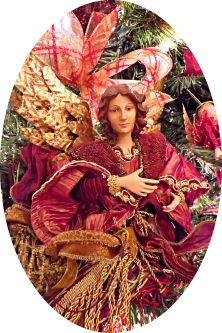 Angels taking on bodily form and appearing to people certainly wasn’t an everyday occurrence. Although they are God’s messengers, the message angels bring can be good news or bad. While they may help God’s people as they did for Elijah and Daniel, angels also execute God’s judgment as they did when striking down the firstborn males in Egypt. I suspect Gabriel looked fiercer and more powerful than the elegant sweet angels hanging on our Christmas trees. When he arrived unannounced in the empty Temple sanctuary, Zechariah was overwhelmed with fear and, when he suddenly appeared in an empty room in Nazareth, Mary was troubled and perplexed. Not knowing whether he was on a mission of judgment or mercy, it’s no wonder both Zechariah and Mary were fearful. Gabriel began his visits by telling them both not to be afraid.
 In all probability, you’re not having more than 5,000 guests for dinner today and they won’t be dining al fresco on a hillside. Nevertheless, John’s description of that miraculous meal sounds a bit like Thanksgiving dinner at any number of homes today. There will be lots of people and more than enough to eat but, instead of all the leftovers being gathered in baskets, we’ll pack them into storage containers made by Rubbermaid, Glad, Tupperware, and Pyrex.
 Devotions of the Heart