
Put me on trial, Lord, and cross-examine me. Test my motives and my heart. [Psalm 26:2 (NLT)]
Search me, O God, and know my heart; test me and know my anxious thoughts. Point out anything in me that offends you, and lead me along the path of everlasting life. [Psalm 139:23-24 (NLT)]
When we go to our meeting with God, we should go like a patient to his doctor, first to be thoroughly examined and afterwards to be treated for our ailment. [Ole Hallesby]
 As much as David wanted to hold to God’s standards, he knew he was flawed and so he asked the Lord to point out whatever He found offensive. We know we should do the same but I’m not sure we actually do so. While we can lie to ourselves and even to God, we know He won’t lie to us. If we ask Him to tell us where we’ve gone wrong, His answer, while loving and gentle, will be brutally honest! Could it be that we don’t ask because we really don’t want Him to tell?
In our evening prayers, are we willing to ask God if we’ve done what should have been done that day? Are we eager to hear His truthful answer if asking whether we’ve acted with integrity in all our affairs, been sincere in our communications, or damaged Jesus’ name in our conduct? Do we really want to hear Him point out our hypocrisy or expose the true motives behind our words and actions? Are we ready to hear Him mention our laziness, overindulgence, and contentiousness or to show us how we excused ourselves for our failings but not others for theirs? At day’s end, do we ask if we’ve honored Him with our words and served Him by acting as His hands and feet? While those are the kind of questions we should be asking, I suspect we don’t ask them as frequently as we should simply because we’re not anxious to hear His answer.
Because they can’t peer into our hearts, other people’s assessments of us usually are inaccurate and, because we’re experts at rationalizing, justifying, and even deceiving ourselves, our self-assessment is equally unreliable. Like the Psalmist, we must earnestly ask God to put us on trial and be happy to hear His answer (whatever it may be)! Moreover, once we hear His answer, let us be ready to make a change!
The function of prayer is not to influence God, but rather to change the nature of the one who prays. [Soren Kierkegaard]

 Along with proclaiming the Word of God, the young Church was committed to ensuring that there were no needy among them. As a result, many of the early believers voluntarily sold their property and shared their wealth with the rest of the church community. Barnabas, for example, sold a field he owned and generously brought the money to the apostles for those in need.
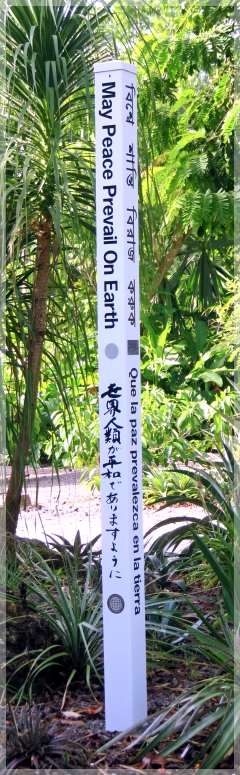 COVID kept us from the Botanic Gardens for well over a year. When we finally returned to one of our favorite places, we came upon a peace pole planted among the palms, bamboo and bromeliads. Although a similar pole is in the city park downtown, I don’t remember seeing one here when last we visited. These poles are just two of the more than 250,000 that have been erected in over 180 nations. Symbolizing the oneness of humanity, the words “May Peace Prevail on Earth” are written in eight different languages. The languages chosen for this pole were English, Arabic, Bengali, Chinese, Hawaiian, Hindi, Japanese, and Spanish—the languages of people who, like us, live at the 26th parallel north. Peace poles stand as a visual reminder to pray for peace on earth and to think, speak and act in the spirit of harmony and peace.
 A popular mystery writer, frequently on the best seller list, now writes most of his books in collaboration with another author. Several years ago, after reading one of his joint efforts, I stopped reading his work entirely. While I never expected a literary masterpiece, the mystery was unrealistic, implausible, and the chapters unconnected. Although it’s said that he sets the plot line and there is an intense back-and-forth between the authors, it didn’t seem that way to me. It was as if the two authors alternated chapters and, at the end of their chapter, each deliberately threw in some farfetched character or event as a way of challenging the other to make sense of it. Having a plot outline certainly didn’t mean continuity or structure in their book.
 Devotions of the Heart