LOST IN THE MAZE

Your word is a lamp to guide my feet and a light for my path. [Psalm 119:105 (NLT)]

scarecrowAlthough we usually visit my daughter’s family in New Mexico in October, my broken ankle canceled our plans. The only bright spot in the cancelation is that I won’t have to participate in the dreaded family tradition of navigating through the corn maze at the pumpkin farm! I say “dreaded” because I’m so directionally challenged that I’d have trouble finding my way out of a box. Actually, after our first outing, I’m surprised any of us ever again ventured into another corn maze.

For our first venture, we chose what was reported to be the best (and largest) maze in the area—a 16-acre corn field that had been transformed into an intricately designed labyrinth. Although we had a small map, we soon became convinced that it was for an entirely different maze. Between the trail’s fiendish twists and turns and its 6-foot walls of corn stalks, we soon were totally lost. We had no idea where we were, let alone where we’d been or where we were going. Hot, thirsty, and tired, the little ones started to whine and complain and we adults weren’t much better. What was supposed to be a fun family outing was turning into a miserable afternoon.

While pausing to finish the last of our water, my husband happened to glance down at the stakes placed along the pathways. Connected by twine, they kept people from taking shortcuts or straying off the convoluted trail into the corn. Seeing that some stakes had a barely noticeable tiny arrow drawn on their  ends, we tried following the markings. Finding that they never led us into dead ends or left us walking in circles, we continued following those arrows all the way to the exit. Even though the solution to our problem was right in front of us, in our frustration, we hadn’t seen it.

While wandering through that maze, we were like a flock of sheep without a shepherd—and a flock without a shepherd is just a herd of lost sheep (maybe even dead ones since they’ve been known to follow one another off cliffs or into deep water)! While we may be smarter than sheep, like them, we need guidance and our Shepherd is the Lord. While it’s easier to follow His lead when all is going well and the path seems straightforward, it grows more difficult when the path He’s laid out for us is a complicated or challenging one. In God’s world, however, there are no shortcuts and sometimes we have to navigate through what seems a hopeless maze. Think of the convoluted routes taken by the Apostle Paul on his four mission trips, the less than straightforward route to Canaan God gave Moses, and the many years and challenges encountered by David before he became king. The paths on which God placed them were filled with twists, turns, and even a few dead ends.

Although our Shepherd will never abandon us, it sometimes seems as if He has. Feeling hopelessly lost, we find ourselves unsure of where to go or what to do as we wander through a maze of difficulties or major decisions. Rather than tiny arrows drawn on wooden stakes, God guides us through our journey with His word. Without it, we can find ourselves as lost as my family was in that corn field. Whether the path God puts us on is a complex maze or a straightforward four-lane freeway, He has provided us with all the guidance we need in Scripture. Far more accurate than our useless map and easier to understand than those arrows, His word can be trusted to lead us through our troubles to hope, safety, sustenance, strength, and peace.

 All Scripture is inspired by God and is useful to teach us what is true and to make us realize what is wrong in our lives. It corrects us when we are wrong and teaches us to do what is right. God uses it to prepare and equip his people to do every good work. [2 Timothy 3:16-17 (NLT)]

Copyright ©2021 jsjdevotions. All rights reserved.

THE APOLOGY

She fell at his feet and said, “I accept all blame in this matter, my lord. Please listen to what I have to say.” [1 Samuel 25:24 (NLT)]

roseWhile visiting my son last summer, I was walking in his neighborhood when a car raced out of a blind driveway and, without even slowing to look for cars or people, sped down the street. If I hadn’t paused briefly by the gate to get a flower photo, I would have had an intimate encounter with the vehicle. After thanking God that I hadn’t become road kill, I continued down the road and turned onto the walking path. I was a little disconcerted when a car approached and stopped but, when the driver lowered his window and called out to me, I realized it was the driver of the speeding car. After offering an earnest apology, he explained he’d been late for a meeting but added that his tardiness was no excuse for his recklessness. Ashamed of his behavior, he’d returned to make sure I was OK. Assuring him I was fine, I wished him well. I was both shocked and touched by the unexpected apology. While unnecessary, it was much appreciated since I knew the driver probably lost another ten minutes by turning around to find me and apologize.
The story of David, Nabal, and Abigail highlights the importance of apologies. David and his men were hiding from King Saul in the wilderness when they came across Nabal’s shepherds and flock of sheep. Rather than stealing any animals for themselves (as might be expected by a hungry army), David’s men formed a line of protection around the flock so that no harm would come to them or the shepherds.

When sheep shearing time arrived, David sent ten men to Nabal to request provisions for David’s troops. This was not an inappropriate request. By accepting David’s protection, Nabal’s shepherds had obligated their master to make provision for the men. With 3,000 sheep and 1,000 goats, Nabal was a wealthy man and some of that wealth was because David’s men had guarded it! Moreover, Israelite law and tradition demanded that hospitality be offered to travelers. While an honorable man would have met his obligations, Nabal (whose name meant “fool”) lived up to his name and refused the request with rudeness and contempt. When the men reported Nabal’s boorish response, the angry David gathered 400 of his men and set out to kill every man in Nabal’s household.

In the meantime, a servant reported his master’s rashness in offending David to Nabal’s wife Abigail. Knowing an apology can do a lot to diffuse a difficult situation, the wise woman quickly packed up an enormous quantity of food and wine and went to meet David. After humbly apologizing for her husband’s boorish behavior, she offered the provisions to David’s men. Considering Nabal’s personality, this probably was not the first time Abigail had to apologize for her husband’s foolish and offensive conduct. Her heartfelt apology averted the senseless tragedy that would have occurred had David carried through his attack. Upon learning of his wife’s generosity, Nabal suffered a stroke and died ten days later. In what could be called poetic justice, David ended up marrying the lovely and wise widow.

An apology isn’t just saying we’re sorry, especially when, as often is the case, it includes justification for our poor behavior. A true apology is like the driver’s and Abigail’s. It is offered with a humble heart, admits being in the wrong, expresses regret, and makes restitution for any offense. “Blessed are the peacemakers,” said Jesus; one of the ways we make peace is with an apology!

Never ruin an apology with an excuse. [Benjamin Franklin]

Fools make fun of guilt, but the godly acknowledge it and seek reconciliation. [Proverbs 14:9 (NLT)]

Turn away from evil and do good. Search for peace, and work to maintain it. [Psalm 34:14 (NLT)]

Copyright ©2021 jsjdevotions. All rights reserved.

HEEDING THE SIGNS

sandhill cranesSo you, too, must keep watch! For you don’t know what day your Lord is coming. [Matthew 24: 42 (NLT)]
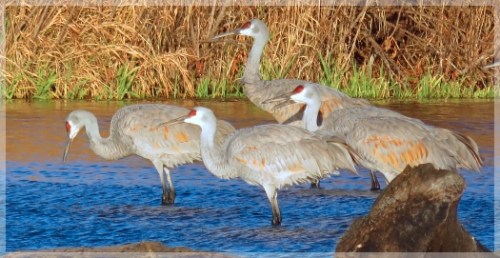
Yesterday, when writing about the migratory birds’ staging area near our northern home, I remembered the year they weren’t in a rush to depart. Autumn that year had been unseasonably mild with temperatures hovering in the 60s and we’d returned north in November to celebrate my mother-in-law’s birthday. The day we headed out to the park, however, the weather had taken a sharp turn toward winter. The day’s high of 37° occurred before sunrise and the season’s first snowfall was expected that night. While walking through the park that cold fall day, we were surprised to see hundreds of Sandhill Cranes and Canada Geese still in the marsh. Apparently, the mild fall weather and still plentiful food caused them to recklessly delay their departure south. The marsh soon would freeze and food would be scarce, not just in the park, but all along their migration route. Seemingly oblivious to the danger, the birds were like the people of Noah’s day or the inhabitants of Sodom and Gomorrah—having a rollicking good time right up until disaster rained down on them. By the time they realized what was happening, it was too late! I hoped it wouldn’t be that way with the birds.

Looking at the upheaval of the last two years, many are reaching for their Bibles and wondering if we’re seeing signs of the apocalypse. We read of death by “the sword and famine and disease and wild animals,” in Revelation 6:8. Luke 21:9-10 records Jesus speaking of wars, insurrections, earthquakes, famines, plagues, and “terrifying things.” As much as that sounds like today, it probably sounds a great deal like much of mankind’s troubled history. Our century is not the only one troubled by pandemics, conflict, catastrophe, natural disasters, violence, scarcity, and loss. Jesus, however, said that no one (not even He) knows the day or hour of His return. Nevertheless, just as the sudden drop in temperature and wintery wind warned those birds of winter’s approach, these could be warning signs of things to come and the Bible tells us to be vigilant.

As with the flood and Sodom’s destruction, swift and sudden judgment will accompany Jesus’ return. Jesus compared His second coming to the surprise arrival of a thief in the night and both believers and unbelievers won’t know when that thief will appear. While unbelievers have good reason to fear that day, Christians don’t. To carry the thief metaphor further, we aren’t afraid of the thief because we’re well insured. Our acceptance of Jesus gives us assurance of salvation; our sins are mercifully forgiven and we have everlasting life. We’ve read the book and know how the story ends!

When we returned to the park two days later, the marsh was frozen but the birds were gone. They’d seen the signs and made the right decision; unbelievers should do the same.

Live as if Christ is coming in the next 10 minutes. Plan as if He is not coming for 1,000 years. [Roger Barrier]

Since everything around us is going to be destroyed like this, what holy and godly lives you should live, looking forward to the day of God and hurrying it along. On that day, he will set the heavens on fire, and the elements will melt away in the flames. But we are looking forward to the new heavens and new earth he has promised, a world filled with God’s righteousness. And so, dear friends, while you are waiting for these things to happen, make every effort to be found living peaceful lives that are pure and blameless in his sight. [2 Peter 3:11-14 (NLT)]

Copyright ©2021 jsjdevotions. All rights reserved.

BIRDS OF A FEATHER

clam pass floridaJust as our bodies have many parts and each part has a special function, so it is with Christ’s body. We are many parts of one body, and we all belong to each other. [Romans 12:4-5 (NLT)]

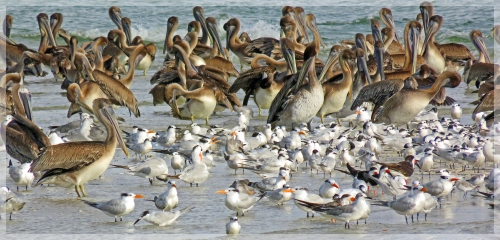
Even though we now live in the land of forever summer, I know autumn is upon us—and not just because nearly everything from lattes, tea, and donuts to English muffins, gelato, and Cheerios comes in pumpkin spice! The migratory birds (both feathered and human) have begun to arrive. Birds of a feather really do flock together as evidenced by the number of brown pelicans and terns gathering by the hundreds on the beach. Soon other birds like belted kingfishers, sandpipers, and grebes will arrive en masse.

Flocks of birds also signaled autumn when we lived in the north—only  they were leaving rather than arriving! A nearby park served as a “staging area” for Canada Geese and Sandhill Cranes, which means that the normal bird population swelled as hundreds of geese and cranes congregated there to gorge themselves in preparation for their challenging flight south. Once they’d eaten their fill, it was a magnificent sight to watch as these beautiful birds took to the sky in unison to continue their journey south.

Without knowing a thing about aerodynamics, wingtip vortices, updrafts, or reducing drag, those birds know enough to conserve their energy by flying in a V-formation that reduces wind resistance and takes advantage of wind currents. The lead bird does most of the work and, when he tires, he moves back and lets others take their turns. The V-formation also allows the birds to see the rest of the flock, preventing them from crashing into one another and enabling them to spot a bird in trouble. It’s been said that when a goose gets injured or falls behind the group, at least two others from the flock will join it. These beautiful creatures instinctively know there is strength in unity and safety in numbers.

As it is for those birds, the journey we are on is not a solo one. As Christians, we also are members of a flock. Unlike the birds, we don’t look like one another or sing the same song, but we all are on a journey that is not meant to be a solo one. Church is more than the place we meet for Sunday services; it’s the Christian’s version of a “staging area.” It’s where we meet others in the flock, gain strength by feeding on God’s word, and help one another as we move forward.

As part of Jesus’ flock, we depend on one another as much as do those migratory birds. We need our flock to reduce the drag when we encounter a head wind, refresh us when we grow tired, urge us on when we lag behind, and lift us when we’ve fallen. We break bread together, share resources and responsibilities, and teach and learn from one another. Our brothers and sisters in Christ not only encourage, comfort, and pray with and for us, but they also hold us accountable for our behavior. Like those migrating birds, we need the flock as much as it needs us.

Some Christians try to go to heaven alone, in solitude. But believers are not compared to bears or lions or other animals that wander alone. Those who belong to Christ are sheep in this respect, that they love to get together. Sheep go in flocks, and so do God’s people. [Charles Spurgeon]

Let us think of ways to motivate one another to acts of love and good works. And let us not neglect our meeting together, as some people do, but encourage one another, especially now that the day of his return is drawing near. [Hebrews 10:24-25 (NLT)]

This makes for harmony among the members, so that all the members care for each other. If one part suffers, all the parts suffer with it, and if one part is honored, all the parts are glad. All of you together are Christ’s body, and each of you is a part of it. [1 Corinthians 12:25-27 (NLT)]

Copyright ©2021 jsjdevotions. All rights reserved.

STATS

Does this sound as if I am trying to win human approval? No indeed! What I want is God’s approval! Am I trying to be popular with people? If I were still trying to do so, I would not be a servant of Christ. [Galatians 1:10 (GNT)]

canna - bandana of the evergladesA pastor friend who’s led dozens of mission trips used to evaluate his mission’s success by the number of new believers gained during the trip. If the latest mission’s altar call stats did not exceed the previous mission’s numbers, he felt it was a failure. Like him, we tend to be number people who measure our success or failure quantitatively. Business success is gauged by the balance sheet, bottom line, and price-earnings ratio; financial success by income, the value of our investment portfolio, and the size of our house or the price of our car. Regardless of the sport, with their assorted BAs, RBIs, Yds, Gs, PPRs, FT%s, and GOAT points, stats seem to evaluate every athlete’s success. Social success is assessed by the number of holiday cards we send or receive, how many “friends” we have on social media, and how many “likes” we got on our latest post. Intellectual success is measured by IQ, SAT, ACT and GPA numbers. A pastor assesses his success by Sunday’s attendance (or the offering), the teacher by the standardized test results of her students, and the author by his book’s ranking on the best seller list. I’m no different; I often check my website’s stats to see the number of followers, visitors, and views.

When we quantitatively assess our lives, it’s way too easy to find people with better numbers than ours. Moreover, when the numbers aren’t stellar, we often think we’re failures. God, however, isn’t an accountant or statistician. He measures success by standards completely different than those of the world. His standards are qualitative—the quality of our obedience, faith, and love.

That pastor friend eventually came to understand that God looks at a mission’s success far differently than man. Regardless of the number of new believers gained, when the pastor obediently follows God’s direction to lead a mission—to spread God’s word and share His love—he has been a good and faithful servant. When we hear God’s call and whole-heartedly respond to the best of our ability, regardless of the statistics, we have not failed. Success is when we go where He sends us and do what He tells us to do.

Let’s stop playing the numbers game and judging ourselves quantitatively by the world’s standards. Rather than comparing our scores to those of other people, there is only one person to whom we should compare ourselves and that is Christ. He sets the standard for our behavior and, while that standard is observable, it is not measurable. We’re successful if the fruit of His Spirit is visible in our lives—if we demonstrate love, joy, peace, patience, goodness, kindness, gentleness, faithfulness, and self-control. In God’s book, we’re successful when we become the sort of people Jesus wants us to be.

We should do what we do in order to gain God’s approval instead of prestige and approval from other human beings. … Are we motivated by the approval of people or the applause of God? [Phil Harper]

You should each judge your own conduct. If it is good, then you can be proud of what you yourself have done, without having to compare it with what someone else has done. For each of you have to carry your own load. [Galatians 6:4-5 (GNT)]

Copyright ©2021 jsjdevotions. All rights reserved.

THE UNFORGIVABLE SIN

So I tell you, every sin and blasphemy can be forgiven—except blasphemy against the Holy Spirit, which will never be forgiven. Anyone who speaks against the Son of Man can be forgiven, but anyone who speaks against the Holy Spirit will never be forgiven, either in this world or in the world to come. [Matthew 12:31-32 (NLT)]

blue jayWhen speaking to the Pharisees, Jesus delivers what could be called the ultimate good news/bad news scenario. The good news is that, no matter how evil, vicious or long-lasting the sin, any sin (even blasphemy) is forgivable. The good news, however, comes with a “but” when Jesus says blasphemy against the Spirit will never be forgiven.

Reading Jesus’ words—words said by the One whose blood was shed so our sins would be forgiven—is perplexing. If Jesus could forgive the many unnamed sins of those he healed, the soldiers who gambled for his clothing at the foot of the cross, and Peter’s three denials, what sin is so great that even His blood would not cover it? What exactly is blasphemy against the Spirit and how does it differ from speaking against the “Son of Man” (who we know to be Jesus)?

This good news/bad news scenario was delivered right after Jesus made it clear that there was no neutral ground when it came to Him—either people were with Jesus on God’s side or without Him on Satan’s side. He was directly speaking to Pharisees—people clearly not on Jesus’s side! They hated Him, were plotting His death, and just had denied proof of Christ’s divinity by attributing His healing miracles to Satan. Theirs wasn’t an act so horrendous that Jesus could not forgive them. Rather, their sin was one of attitude. What was unforgivable was their continual rejection of Jesus and their deliberate choice of Satan over Him.

As shocking as it seems, Jesus even says that blasphemy against Him can be forgiven. The Apostle Paul, for example, freely admitted to blaspheming the name of Christ while persecuting Christians. Yet, he experienced God’s mercy and forgiveness because he did so in ignorance and unbelief. If, however, after encountering the living Jesus on the road to Damascus, being supernaturally blinded, meeting Ananias, and having the scales fall from his eyes so that he knew the truth, Paul had never repented and come to believe in Christ, like the Pharisees, he would have committed the unforgivable sin. It would have become unpardonable blasphemy against the Spirit only if, after seeing the Truth incarnate, Paul continued to disparage, attack, and reject Jesus. Fortunately for us, after seeing the truth, Paul did repent and his “blasphemy” was forgiven.

Even scholars and theologians disagree on the exact meaning of this difficult text and I am neither scholar nor theologian. Nevertheless, the unpardonable sin appears to be what those Pharisees exhibited: a deliberate. obstinate, resolute, and tenacious resistance to the Spirit’s pursuit and voice. Even the demons recognized Jesus as the Son of God but the religious leaders, people who knew the prophecies and witnessed His miracles first-hand, blatantly refused to acknowledge Him. They didn’t even bother to dispute the miracles; they chose instead to dispute the source of Jesus’ power by attributing the works of God to Satan. That was unforgivable.

Some theologians think this warning applies only to those people of the 1st century who, like the Pharisees, actually witnessed the irrefutable proof that Jesus was empowered by the Holy Spirit and then denied the overwhelming evidence of His divinity. Only God knows for sure. The important thing for us to understand is that, like the unbelieving Pharisees, people freely choose how they will spend eternity and, like Paul, no matter how shameful the sin, when we sincerely seek God’s forgiveness through Christ, we can be certain that He will forgive us.

Even though I used to blaspheme the name of Christ. In my insolence, I persecuted his people. But God had mercy on me because I did it in ignorance and unbelief. Oh, how generous and gracious our Lord was! He filled me with the faith and love that come from Christ Jesus. This is a trustworthy saying, and everyone should accept it: “Christ Jesus came into the world to save sinners”—and I am the worst of them all. But God had mercy on me so that Christ Jesus could use me as a prime example of his great patience with even the worst sinners. Then others will realize that they, too, can believe in him and receive eternal life. [1 Timothy 1:13-16 (NLT)]

Copyright ©2021 jsjdevotions. All rights reserved.