
The next day, on the Sabbath, the leading priests and Pharisees went to see Pilate. They told him, “Sir, we remember what that deceiver once said while he was still alive: ‘After three days I will rise from the dead.’ So we request that you seal the tomb until the third day. This will prevent his disciples from coming and stealing his body and then telling everyone he was raised from the dead! If that happens, we’ll be worse off than we were at first.” Pilate replied, “Take guards and secure it the best you can.” So they sealed the tomb and posted guards to protect it. [Matthew 27:62-65 (NLT)]
Easter means you can put the truth in a grave, but you can’t keep it there. [Anne Lamott]
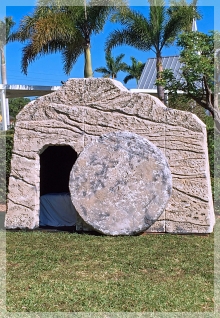 Several years ago, an entertainment network did a story on the highlights of Charlotte, North Carolina. Since the Billy Graham Library was considered a point of interest, it was visited by the show’s co-host Kristy Villa and her film crew. Commenting on the many crosses she saw throughout the property, Villa asked, “I see all the crosses, but where is Jesus?” Her guide simply replied, “He’s in Heaven,” adding, ”He is also present in the lives of those who believe in Him and follow Him as their personal Lord and Savior.” Villa exclaimed, “Oh, that’s right! Some worship a crucifix, but Christians worship a risen Christ.” Indeed, Christ’s story doesn’t end with a dead man hanging on a cross. Nevertheless, rather than an empty cross, our emphasis should be on His empty tomb!
Confucius, founder of Confucianism, was buried in his hometown of Qufu in China and the body of Muhammad, founder of Islam, can be found in the Mosque of the Prophet in the Saudi Arabian city of Medina. Gautama Buddha, founder of Buddhism, was cremated following his death. His cremains were divided into eight portions, taken throughout Central Asia, China, and Japan, and placed in different stupas (dome-shaped shrines). Today, the Buddha’s cremains (including his teeth and a finger bone) can be found in shrines throughout Asia. Bahá’u’lláh, founder of Bahá’í faith, was buried near his home in Bahji, Israel, and the remains of the Báb, a central figure in Bahá’í and founder of Bábisma, was interred at the Shrine of the Báb in Haifa, Israel. After his death, Joseph Smith, founder of the Morman church (LDS), was buried in the family cemetery in Nauvoo, Illinois. When Cyrus Teed, founder of Koreshanity, failed to resurrect, his decomposing body was buried on Estero Island; two years later, a hurricane washed his tomb out to sea. All of these men—people who claimed to know the truth revealed by God—are dead but their remains are still here.
Let us never forget that Jesus’ story didn’t end with His crucifixion! The cross couldn’t stop Jesus and the tomb couldn’t contain Him. Pilate’s best efforts to secure the tomb were worthless. A Roman seal, large boulder, and a sixteen-man Roman guard were not enough to keep Jesus shut in that tomb! Both cross and tomb are empty and His body’s remains are nowhere to be found! With His death and resurrection, Christ triumphed over both sin and death. Alleluia!
I know the resurrection is a fact, and Watergate proved it to me. How? Because 12 men testified they had seen Jesus raised from the dead, then they proclaimed that truth for 40 years, never once denying it. Every one was beaten, tortured, stoned and put in prison. They would not have endured that if it weren’t true. Watergate embroiled 12 of the most powerful men in the world—and they couldn’t keep a lie for three weeks. You’re telling me 12 apostles could keep a lie for 40 years? Absolutely impossible. [Charles Colson]
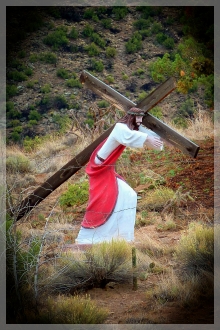 Last February, we celebrated love with the secular holiday Valentine’s Day. We may have given or received flowers, candy, or a card—tokens of someone’s love for us or our love for them. Seven weeks later, however, the flowers are dead, the candy is eaten, and the card in the recycling bin. The day dedicated to “love” is forgotten until next February when the ads for jewelry and flowers remind us.
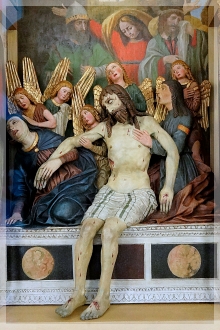 Although the common position for prayer was standing, Jesus fell to His knees that night in the garden of Gethsemane. Luke describes Him as praying so intensely that His sweat dropped like blood. Having used the word hósei, meaning “as if it were, like, as, as though, or much like,” Luke may have meant Jesus sweat so profusely that it dripped from Him like blood. Nevertheless, Luke was a doctor who paid great attention to detail; he may have described hematidrosis, a rare medical condition in which the capillaries rupture causing blood to seep into the sweat glands and then out onto the skin. It’s caused by high blood pressure, a bleeding disorder, or extreme distress or fear, such as facing abuse, torture or death on the cross! Whether Jesus’ sweat poured off his body as if it were blood or He literally sweat blood, the Lord’s prayer was so intense that an angel came and strengthened Him.
 Fowlers are professional bird catchers. In ancient Israel, they supplied the market with wild pigeons and doves destined for sacrifice, small birds (like quail) for food, and doves and other birds for caged pets. Since most of us get our poultry at the grocery, we’re probably unfamiliar with the fowler and his methods. To capture birds, fowlers spread nets or set traps and snares on the ground, camouflage them with natural materials, and cover them with grain. Tempted by the food, the birds leave the safety of the sky and come down to the ground where they are caught.
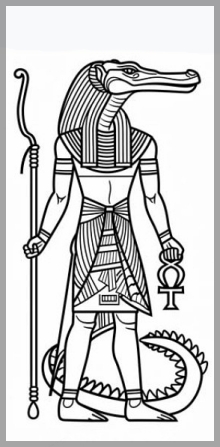 Over a period of 3,000 years, ancient Egypt’s pantheon of gods numbered between 1,400 and 2,000. During that time, some faded in prominence and new gods appeared. Often depicted as part human and part animal, Egypt’s gods had names, unique back-stories, and their own domain and expertise. Each god/goddess was responsible for a certain part of daily life, from motherhood to music, record keeping to funerals, and cosmic order to hunting. While the ten plagues God sent Egypt through Moses and Aaron may seem somewhat arbitrary to us in the 21st century, every one of them was a direct attack on one or more Egyptian god. They were the ultimate “smack-down” between God Almighty and Egypt’s deities.
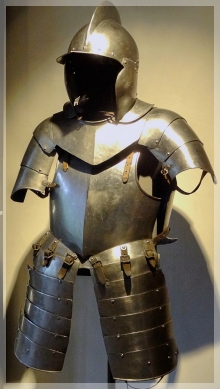 A Latin word, lorica originally meant armor or breastplate. Because of an ancient practice of inscribing a prayer on the armor or shields of knights who then recited the prayer before combat, lorica came to mean a prayer of protection.
 Devotions of the Heart