
Dear brothers and sisters, when troubles of any kind come your way, consider it an opportunity for great joy. For you know that when your faith is tested, your endurance has a chance to grow. So let it grow, for when your endurance is fully developed, you will be perfect and complete, needing nothing. [James 1:2-4 (NLT)]
 “May the Holy Spirit give us grace to not begrudge the pedagogy of God,” wrote John Piper in the day’s devotion. A somewhat archaic word and not one I regularly use, I thought of a pedagogue as an old, boring, stodgy, and authoritarian teacher who never changed his lesson plan or lectures. Unsure what Piper meant, it seemed wise to consult the dictionary. “Pedagogy” comes from two Greek words: pais, meaning child, and agogos, meaning leader. A paidagogos was a slave who led the boys to and from school, taught them manners, and tutored them after school.
Pedagogy eventually came to mean the method and practice of teaching—how knowledge and skills are taught and learned—and a pedagogue is a teacher or educator. While God is neither boring nor stodgy, He is older than time and an authoritarian (but loving) teacher with some unique, innovative, and often challenging teaching methods or pedagogy.
I don’t know about boys in ancient Greece, but I imagine they were like boys today: often less than enthusiastic about spending time in a classroom, learning their lessons, and being taught restraint, civility, and good behavior. Like schoolboys, we often are less than enthusiastic about learning the lessons God is teaching us, especially since His lessons rarely are as easy as learning the alphabet or simple arithmetic. Granted, He does provide us with a syllabus in Scripture so we have a general outline of His policies, expectations, and rules. Nevertheless, we don’t get an individual syllabus explaining our specific assignments, exam dates, projects, and deadlines. Some of God’s lessons seem bizarre or unreasonable while others are heartbreaking or near impossible; much of the time, we can’t see their purpose at the time. Like the teacher who gives pop quizzes, doesn’t allow make-up exams, and won’t accept late papers, it’s easy to begrudge the way God teaches us.
I’m reminded of a scene from the movie Peggy Sue Got Married in which the middle-aged Peggy Sue goes back in time to high school. When asked to solve a problem in algebra class, she responds, “I happen to know that, in the future, I will not have the slightest use for algebra, and I speak from experience.” Like Peggy Sue, once out of school, I had no need to know about coefficients, variables, constants, or exponents. Nevertheless, I didn’t know that when I took algebra more than sixty years ago; had I taken another career path, I might have needed that information!
We are finite beings and can only see what is right before us. God, however, is infinite and can see far into our future both here and in the hereafter. When He teaches us lessons about patience, humility, loss, conflict resolution, pain, worry, pride, fear, trust, obedience, persistence, and faith, we rarely know for what purpose we’re in His schoolroom or when we’re going to need the skill we’re being taught. God’s pedagogy only makes sense when we look back in time. It is then that we realize the benefit we’ve gained from His extraordinary and often bizarre teaching methods. Indeed, as John Piper said, “May the Holy Spirit give us grace to not begrudge the pedagogy of God.”
I never had a trial I wanted to have, but I never had trial I wasn’t glad I had. [Jack Hyles]
Life is a succession of lessons which must be lived to be understood. [Helen Keller]
 I still go online to read the newspaper from what was our hometown for over fifty years. Last week, it was filled with news about the events of Fiesta Days. With its Car Show, Big Wheel Race, Duck Derby, Beach Bash, Street Fair, Music Fest, Art Show, Parade, Fireworks, and Carnival (complete with rides and funnel cakes), the festival is one of summer’s highlights.
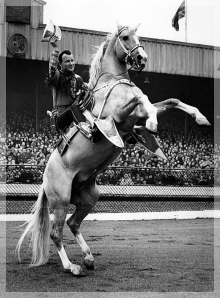 Several “Nancy” comics written and drawn by Guy Gilchrist have inspired my writing. Curious about the cartoonist, I was not surprised to learn that he is a Christian; that was not always true. As a boy, he was poor, lonely, abused, and searching for someone and something in which to believe. Missing a dad, he found a father figure in an unlikely place—television—and in a remarkable person—a radio, television and movie star by the name of Roy Rogers. When the young cartoonist was unsure how to behave, he’d look to the singing cowboy and ask himself, “What would Roy do?” He knew his cowboy hero always took the right course of action. Although Rogers was publicly vocal about his faith, Gilchrist didn’t know his hero was a Christ follower until many years later.
 When written by Guy Gilchrist, “Nancy” used to appear in the comics of our local paper. The slightly chubby, somewhat mischievous, eight-year-old girl with the red skirt and hair bow often prayed. In one comic, Nancy starts with a litany of thanks to God for always being there, showing her the way, filling her heart, and giving her just what she needs before she even knows she wants it. “You are an amazing God!” she offers in praise before closing her prayer with, “Could you throw me a couple answers before my math test tomorrow?”
 My summer beach novel began with a man having a heart attack on a commuter train. For the next several pages, I was privy to the thoughts of his fellow passengers who were annoyed by the train’s unscheduled stop for medical aid. Because they’d be delayed, they saw the man’s collapse as a tremendous inconvenience to them. As passengers disembarked to find another way into the city, their thoughts were not of the dying man and his wife but of themselves and how they’d been inconvenienced.
 Isaiah heard the Lord ask, “Whom shall I send as a messenger to this people?” and responded, “Here I am. Send me.” When God commissioned him to be His messenger/prophet, Isaiah was acting as a scribe and had a family. Nevertheless, without hesitation, his was an unqualified, “Send me!” Isaiah didn’t know exactly what God wanted him to do or how he was supposed to do it. Even after God told him that the people wouldn’t listen, Isaiah never wavered. Many of Scripture’s heroes, however, weren’t as eager to do God’s work.
