STEALING

You shall not steal. [Exodus 20:15 (ESV)]

Jesus once said that Satan was a thief. Satan does not steal money, for he knows that money has no eternal value. He steals only what has eternal value—primarily the souls of men. [Zac Poonen]  

Brown PelicanThe patient Cormorant had been diving and resurfacing empty-beaked for several minutes before finally emerging victorious with a large fish crosswise in its beak. The fish thrashed in the cormorant’s beak while the bird tried to re-position its meal so it could be swallowed head first. A Brown Pelican suddenly crashed into the water and, after a great deal of wing flapping and water splashing, it was clear the Cormorant was no match for the larger bird. While the Pelican threw back its head and swallowed the unlucky fish, the unfortunate cormorant swam away still hungry.

Apparently, food theft (kleptoparasitism) is common among birds and it’s not limited to stealing one another’s fish dinner. Some species harass other birds until they spit up swallowed food and several species conduct high-speed chases in the sky and grab food from other birds in midair. Bird theft isn’t even limited to food. Blue Jays and Black Crows frequently pilfer the nests of other birds for shiny things with which to adorn their own nests while Magpies and Eagles will steal building material as well. At first, it seems like the birds are exploiting the hard work of others but they’re just doing what birds do naturally. Living in a competitive world with limited resources, they’ve developed remarkable skills needed for survival.

Fortunately, we don’t have to steal fish or mice from another person’s mouth or snatch bits of foil, moss, or twigs from someone’s home to survive. Unlike the birds and other animals, God created us in His image. As such, He gave us a different set of rules for living. Nevertheless, the Pelican’s behavior caused me to consider the simple commandment not to steal—a prohibition important enough to be mentioned numerous times throughout the Bible. Is this commandment limited to things like not cheating on taxes, shop lifting, snatching purses, embezzling, and robbing banks or is there something more?

Essentially, most of us are honest; nevertheless, we steal—by using worktime to check social media or personal email, padding an expense account, getting paid under the table, taking more than our share, or cutting in line. We’re stealing when we do a slip-shod job and call it “good enough,” fail to return something borrowed or found, pay unfair wages, or take advantage of someone else’s hardship, kindness, or ignorance. We steal the truth whenever we tell a lie and steal God’s glory when we take credit for His blessings. We rationalize our little cheats and don’t think of them as stealing, but they are.

Worse, we can steal someone’s reputation when we gossip, we can steal their hope when we deny them an opportunity or encouragement, we can steal their joy with a few poorly chosen words, and we can steal their dignity when we treat them in a demeaning manner. When we snub, humiliate, abuse, deny, and ignore or when we’re over-bearing, selfish, rude, negative, and unforgiving, we’re stealing something far more valuable than money. We’re stealing things like self-respect, innocence, courage, delight, confidence, dreams, and opportunities. This sort of stealing is neither a misdemeanor nor a felony; nevertheless, it is a sin.

Owe no one anything, except to love each other, for the one who loves another has fulfilled the law. For the commandments, “You shall not commit adultery, You shall not murder, You shall not steal, You shall not covet,” and any other commandment, are summed up in this word: “You shall love your neighbor as yourself.” Love does no wrong to a neighbor; therefore love is the fulfilling of the law.  [Romans 13:8-10 (ESV)]

 Copyright ©2024 jsjdevotions. All rights reserved.

ADAPTING AND CONFORMING

If the world hates you, remember that it hated me first. The world would love you as one of its own if you belonged to it, but you are no longer part of the world. I chose you to come out of the world, so it hates you. Do you remember what I told you? “A slave is not greater than the master.” Since they persecuted me, naturally they will persecute you. And if they had listened to me, they would listen to you.” [John 15:18-20 (NLT)]

A century of dike-building, agricultural development, and population growth has destroyed much of Florida’s wetlands and threatened the survival of dozens of animals like Florida panthers, Snail Kites, and Wood Storks. The White Ibis, however, is an exception. Having adapted to the new urban landscape, large groups of ibis happily graze the lawns of subdivisions, parks, and golf courses. They’ve found it easier to poke at the soil for a predictable buffet of grubs, earthworms, and insects than to forage in the remaining wetlands for aquatic prey like small fish, frogs, and crayfish. Once wary of humans, these urbanized ibis pay little or no attention to people as they follow one another across our lawns.

While conforming to a world of diminishing wetlands may be beneficial to the ibis, the Bible makes it clear that Christ’s followers are not to conform to the world around us. As the salt of the earth, we are to bring a distinctive taste, look, and smell to the world rather than take on the flavor of the world in which we live. Nevertheless, like the ibis, Christ’s church appears to be acclimating and adjusting to the world surrounding it.

In an effort to fill the pews and keep the coffers filled, we’re seeing His church adapting and conforming to today’s culture. Social media, politics, fashion, popular music, celebrities, advertisements, movies, television, politics, and politicians seem to be infiltrating and influencing our attitudes, worship, instruction, and doctrine. We’re beginning to shape values, use words, understand events, and determine right and wrong through the eyes of the world rather than the Bible. Jesus, however, was anything but popular, politically correct, or entertaining and His Church was never meant to be cool, trendy, fashionable, or fun to an unbelieving world; it is meant to be like Christ!

Just as the Israelites were not to succumb to the influence of the pagan nations around them, we are to remain apart and distinct from the corrupting influences of the world around us. While sinners should be welcome in the church, sin should not. Nevertheless, afraid of offending anyone—we creatively reinterpret or ignore Scripture, turn a blind eye to sin, or refuse to speak of sin at all. Are we seeking the world’s approval or God’s?

If we go back to the beginning of the Church, it’s estimated there were only about 1,000 Christ followers in the Roman Empire. By AD 100, however, there were about 7,500. By AD 150, there were 40,000 believers and, by 350, 34 million people (more than half the Roman Empire) followed Christ! Although the early church grew by about 40% each decade, the numbers are going in the opposite direction today. According to the Pew Research Center,  90% of Americans identified as Christian just 50 years ago but, in 2023, that number was only 64%! While adapting to the world around them may be working for the ibis, it doesn’t seem to be working for today’s church. In actuality, the church the looks and acts like the world around it, is not Christ’s church.

The early church didn’t grow because it lived as Rome did—it grew because it lived as Jesus did. The early believers had an uncompromising faith that transformed the pagan world around them. Let us do the same!

Don’t copy the behavior and customs of this world, but let God transform you into a new person by changing the way you think. Then you will learn to know God’s will for you, which is good and pleasing and perfect. [Romans 12:2 (NLT)]

Copyright ©2024 jsjdevotions. All rights reserved.

NOTHING CAN SEPARATE US FROM HIS LOVE

And I am convinced that nothing can ever separate us from God’s love. Neither death nor life, neither angels nor demons, neither our fears for today nor our worries about tomorrow—not even the powers of hell can separate us from God’s love. No power in the sky above or in the earth below—indeed, nothing in all creation will ever be able to separate us from the love of God that is revealed in Christ Jesus our Lord. Romans 8:38-39 NLT

queen butterflyI read a devotion that suggested substituting our own personal anxieties and concerns for the troubles listed by Paul in Romans 8. Perhaps your version would read: “And I am convinced that nothing can ever separate me from God’s love. Neither old age nor loss of loved ones, neither cancer nor dementia, neither my anxiety about my wayward child nor my reservations about finances—not even the powers of terrorism and hate can separate me from God’s love. No hurricanes, earthquakes, pandemics, or wars—indeed, nothing in all creation will ever be able to separate me from the love of God that is revealed in Christ Jesus our Lord.”
Then again, maybe widowhood, heart disease, migraines, foreclosure, floods, stroke, bullies, loneliness, crime, hunger, depression, fires, addiction, divorce, hard times, debt, anger, betrayal, homelessness, violence, or tornadoes would be on your list. Regardless of how you fill in the blanks, Paul’s words remain true and bear repeating. Nothing—absolutely nothing—can separate us from God’s love as shown in Jesus Christ.

Paul wasn’t saying that Christians have no enemies or won’t suffer. In fact, his words were written to the Roman church, a church that underwent tremendous persecution and hostility for centuries. Within a few years of his letter, Nero would blame Christ’s followers for the burning of Rome and, for the next 300 years, Christians would be mercilessly persecuted. Depending on the whims of whoever was emperor, they’d be expelled from their homes, see their property confiscated, be required to perform pagan rituals, watch their churches destroyed, have worship prohibited, endure brutal persecution, or suffer monstrous methods of execution. Not even the Apostle Paul escaped—he was executed in Rome on Nero’s orders.

While we’re not about to be crucified, torn apart by dogs, beheaded, hung on poles, coated in tar, or burned alive by Nero, we all encounter threats from both physical and spiritual enemies daily. Belief in Christ doesn’t shield us from enemies; it means that those enemies, even ones as evil and powerful as Nero, can’t turn God against us. Even Satan is powerless against God! Whether visible or invisible, nothing can take us from God’s love for us; even death can’t separate us from His love! Because God loved us enough to sacrifice His only Son for our salvation, we can be sure of His unchanging and everlasting love and confident that He will provide us with everything we need in the face of the day’s challenges.

What troubles would you substitute for Paul’s in Romans 8? No matter what they are, rest assured in the promise that the battle already is over and overwhelming victory is ours through Christ our Lord!

Nothing can separate you from God’s love, absolutely nothing. God is enough for time, God is enough for eternity. God is enough! [Hannah Whitall Smith]

 One of the greatest evidences of God’s love to those that love him is, to send them afflictions, with grace to bear them. [John Wesley]

What shall we say about such wonderful things as these? If God is for us, who can ever be against us? Since he did not spare even his own Son but gave him up for us all, won’t he also give us everything else? … overwhelming victory is ours through Christ, who loved us. [Romans 8: 31b-32,37b (NLT)]

Copyright ©2024 jsjdevotions. All rights reserved.

CRUTCHES

I heard an unknown voice say, “Now I will take the load from your shoulders; I will free your hands from their heavy tasks. You cried to me in trouble, and I saved you.” [Psalm 81:5b-7a (NLT)]

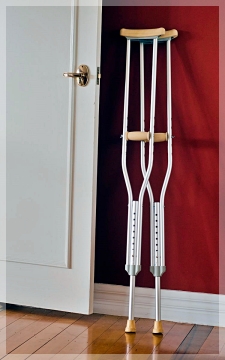
crutches“He’d always looked at religion as a crutch for people who were too scared to do life by themselves,” is the way author Chris Fabry described a character in his book June Bug. That description made me think of Karl Marx’s frequently paraphrased statement: “Religion is the opium of the people.” Sigmund Freud had an equally low opinion of religion and described it as a form of wish fulfillment. Thinking of religion as little more than a man-made coping mechanism for dealing with the harsh realities of life, Fabray’s character, Marx, and Freud disparaged it along with things like crutches and pain relievers.

As the body’s early warning system, physical pain is what tells us there’s something wrong with our body. But, when excessive pain interferes with our quality of life, it needs to be dealt with. Pain relievers work with our body’s cells, nerve endings, nervous system, and brain to mitigate the pain we feel. While I’ve never taken opium, between assorted broken bones, sprains, torn ligaments, compressed nerves, and surgeries, I’ve used a variety of prescription pain medications to ease my pain and promote the healing process.

As for God being my opiate—while prescription medications help me through my physical pain, it is God who leads me through the dark valleys of grief, fear, loss, betrayal, doubt, pain, and depression that assault us in this earthly life. Like pain meds, God can be habit-forming, but the similarities end there. Unlike pain meds, His long-term use is highly recommended, no prescription is necessary, and He has no dangerous side effects. While I was thrilled to say good-by to pain meds, I never want God out of my life! He has lessened the anguish, sorrow, loneliness, and heartache of my life better than any drug ever could. He is the only prescription for the sin sick soul!

Moreover, many of those ailments and surgeries I’ve experienced required me to use crutches, a knee scooter, or a cane in order to make up for my loss of strength, range of motion, stability, coordination, and endurance. When I’ve been left with only one leg on which to stand, those devices helped me balance and stand steady by broadening my support base.

Just as crutches reduce the weight load on a weak or injured leg, a relationship with God certainly reduces the burdens of life. Like crutches, my faith in God supports me; it gives me strength and stability and keeps me from falling. God holds me steady when I’m unsure, keeps me in balance when I’m over-whelmed, and enables me to walk through the rough patches without stumbling! When I step away from Him and fall, He lifts me up again! God is even better than a crutch because, when I can go no further, He’s been known to pick me up and carry me! I will happily live in God dependence, using God as a crutch rather than live in independence only to trip and fall.

While Marx and Fabry’s character look at pain meds and walking aids with disdain, I look to them with gratitude! I don’t take offense at someone thinking of my faith in God as a crutch or drug. When properly prescribed and used, painkillers and crutches help us cope with the challenges of living with broken bodies. While they are man-made and imperfect, God isn’t! It is His hand that touches me and brings healing to my heart and soul as well as my body! I’m more than willing to admit that I’m too scared to do life by myself. It is because of God that I can cope with the challenges of living in a broken world!

As for Freud’s wish fulfillment—God has given me more than I possibly could have wished for in even my wildest dreams. He’s done more than merely fill my cup with enough; because of God, my cup “runneth over” with peace, purpose, love, and joy!

Now all glory to God, who is able, through his mighty power at work within us, to accomplish infinitely more than we might ask or think. [Ephesians 3:20 (NLT)]

The Lord helps the fallen and lifts those bent beneath their loads. … The Lord is righteous in everything he does; he is filled with kindness. The Lord is close to all who call on him, yes, to all who call on him in truth. [Psalm 145:14,17-18 (NLT)]

 Copyright ©2024 jsjdevotions. All rights reserved.

ENLARGING

Hear me when I call, O God of my righteousness: thou hast enlarged me when I was in distress; have mercy upon me, and hear my prayer. [Psalm 4:1 (KJV)]

Mornings, I read a short devotional from Streams in the Desert, a devotional by L.B. Cowman. Compiled between 1918 and 1924 and first published in 1925, it consists of portions of inspirational sermons, tracts, church bulletins, hymns, devotions, and poetry Mrs. Cowman collected through the years. Each day’s reading begins with a portion of Scripture and a recent devotion began with Psalm 4:1: “Thou hast enlarged me when I was in distress.”  Because the devotional uses the King James Translation and I usually read the NLT, I didn’t recognize this verse; nevertheless, I had a good idea what it meant.

My morning’s prayer had begun much like David’s—with a plea for God to hear my prayer. It then went something like, “O Lord, please not again! I can’t go through this another time. How much more can I take?” Apparently, based on the day’s verse, God heard me, but I wasn’t so sure I liked His answer. It sounded a lot like, “This is a growth opportunity and you can take all that is given to you!” I certainly wasn’t pleased with the devotion’s explanation that the psalmist was “declaring that the sorrows of life have themselves been the source of life’s enlargement.”

Curious about the verse, I turned to my NLT Bible and found a vastly different translation: “Free me from my troubles.” While I’d rather be freed from my troubles than be enlarged by them, Scripture’s purpose isn’t to accommodate our preferences; it is for our edification, enlightenment, and growth. Confused by the different tenses and dissimilar translations, I turned to a lexicon to determine the meaning of this verse in its original Hebrew.

The psalmist used the word rachab  which clearly meant to enlarge, grow wide or large, broaden, or make room for. Throughout Scripture it was used in the sense of extending or enlarging one’s understanding, heart, steps, territory, borders, and mouth. Rather than escaping from troubles, this verse is about growing large enough to handle them! Moreover, while my NLT uses the present tense, most word-for-word translations use the past. Preserving the tense and word usage found in the original Hebrew writings, Young’s Literal Translation reads, “In adversity Thou gavest enlargement to me; Favour me, and hear my prayer.”

Psalms 3 and 4 are believed to have been written by David during his son Absalom’s rebellion. If so, David was about 61 years old and God had given him a great deal of trials and enlarging in the more than 45 years since being anointed by Samuel. This psalm is David’s vote of confidence in God’s future grace because of God’s past grace. The troubled king knew that the God who enlarged, expanded, and strengthened him in the past could do so again. He asked God that, hearing his prayer, He would repeat His mercy.

God has the power to divinely deliver us from our trials. More often than not, however, He doesn’t because there is purpose in those trials. The good news is that, while God may not free us from the challenges, He never will abandon us in them! Because of God’s past grace in the trials of yesterday, like the psalmist, we can count on God’s future grace in the trials of today and tomorrow. Indeed, my past troubles have enlarged me. They matured my faith, strengthened me, grew my understanding of God’s will, multiplied my prayers, intensified my trust, expanded my capacity to endure, and developed the ability to find joy in all circumstances. No matter what I face, when I remember God’s past mercies, like David, I can lie down in peace, confident that God will keep me secure in His loving arms!

Let God enlarge you when you are going through distress. He can do it. You can’t do it, and others can’t do it for you…. Life’s trials are not easy. But in God’s will, each has a purpose. Often He uses them to enlarge you. [Warren Wiersbe]

Many people say, “Who will show us better times?” Let your face smile on us, Lord. You have given me greater joy than those who have abundant harvests of grain and new wine. In peace I will lie down and sleep, for you alone, O Lord, will keep me safe. [Psalm 4:6-8 (NLT)]

Copyright ©2024 jsjdevotions. All rights reserved.

THE PARABLE OF THE PENCIL

But now, O Lord, You are our Father. We are the clay, and You are our pot maker. All of us are the work of Your hand. [Isaiah 64:8 (NLV)]

pencilWhen writing about giving God the glory and how we are but instruments of God’s grace in the world, I recalled a quote by Mother Teresa having to do with being God’s pencil. Wanting to quote it correctly, I Googled it. Along with the quote, I came across several versions of a parable about a pencil. Of unknown origin, it has been around for more than twenty years. Nevertheless, the parable was new to me and this is my version of “The Parable of the Pencil.”

Just before putting the pencil in its box, the Pencil Maker said there were several things it needed to know if it were to become the instrument He created it to be. “First, don’t ever try to be a stapler, scissors, paper clip, or ruler. Always remember you are a pencil and have been created with a definite purpose—to draw a line forming shapes, letters, and words that leave a definite message.”

The Pencil Maker continued, “Although small, you can accomplish great things, but only if you allow yourself to be held in someone’s hand.” Although He warned the pencil that there would be times of painful sharpening, the Maker explained that sharpening was the only way for it to become a better pencil. “Sometimes you’ll make mistakes,” he said, “but that’s to be expected so you’ve been equipped with an eraser just for such occasions.”

“Right now,” said the Pencil Maker, “your exterior is fresh and shiny and you’re quite beautiful. But, with use, your paint will chip, your wood get nicked, and you’ll grow smaller.” Explaining that the pencil’s quality wasn’t determined by its appearance, he added, “The most important part of you is the quality of the graphite on your inside.” After cautioning the pencil that, when too much pressure was applied, its tip might break, he added, “Don’t worry, you can be re-sharpened.”

The Pencil Maker finished up by telling his creation, “You are to leave your mark on every surface you touch. This can be hard work and you may grow tired. But,” he added, “regardless of your condition, you are expected to keep writing. It is for this purpose that you were made.” Understanding its maker’s instructions, the pencil promised to follow them and joyfully went into the box with purpose in its heart.

Of course, we’re not pencils and God is the one who made us but, like the pencil, we’ve been created with a particular purpose, role, and calling in the world. Rather than a student, it is God’s hand that holds us. The only way to achieve the great things He’s planned for us is by surrendering to His will. Rather than a pencil sharpener, it will be problems and difficult circumstances that sharpen and shape us. Like the pencil, we will err but we, too, can correct our mistakes and learn from them. Just as the pencil’s outward appearance is unimportant, so is ours. It’s what’s inside that counts! Rather than graphite, God cares about the quality of our hearts! While undue stress and strain can damage (and almost break) us, that only occurs when we step out of God’s will. Finally, like a pencil, we are to leave our mark on every situation and person with whom we interact. When we stay in God’s will and allow His hand to direct and move us, that mark will be His!

God used Mother Teresa to make His mark on the world and her life spoke volumes about God’s love. Like her, we’ve been given a purpose by our Maker—let us be the pencil in His hand and make that mark!

I am like a little pencil in his hand. That is all. He does the thinking. He does the writing. The pencil has nothing to do with it. The pencil has only to be allowed to be used. [Mother Teresa of Kolkata]

Do not give any part of your body for sinful use. Instead, give yourself to God as a living person who has been raised from the dead. Give every part of your body to God to do what is right. [Romans 6:13 (NL)]

May God give you every good thing you need so you can do what He wants. May He do in us what pleases Him through Jesus Christ. May Christ have all the shining-greatness forever! Let it be so. [Hebrews 13:21 (NLV)]

Copyright ©2024 jsjdevotions. All rights reserved.