
And her husband Joseph, being a just man and unwilling to put her to shame, resolved to divorce her quietly. But as he considered these things, behold, an angel of the Lord appeared to him in a dream, saying, “Joseph, son of David, do not fear to take Mary as your wife, for that which is conceived in her is from the Holy Spirit.” [Matthew 1:19-20 (ESV)]
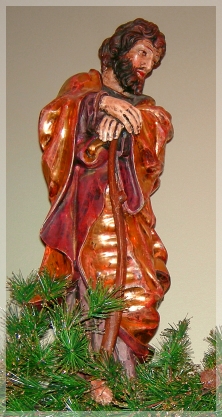 While putting away our nativity, I looked at the figure of Joseph. For the man who played a pivotal role in the Christmas story, once Christmas is packed away, Mary’s husband rarely gets a second thought until the next December. Neither Mark nor John mention the man who served as step-father to Jesus and the author of Hebrews didn’t even list him in its “Hall of Faith.”
Unfamiliar with 1st century Jewish marriage customs, we probably take Joseph’s presence at the nativity too lightly. Rather than an agreement between two people, marriage at the time was an agreement between two families. Before the prospective bride was consulted, the groom (or his father) approached her father and the men would negotiate the price [mohar] to be paid for the girl. Once the mohar had been paid, the first of two ceremonies, the betrothal, was held and the couple were legally married. Following the betrothal, the bride remained in her father’s house, gathered her trousseau, and prepared for married life while the groom prepared living accommodations for his wife and arranged for the wedding feast. Although married, the couple were prohibited from having sex. It wasn’t until about a year after the betrothal that a colorful procession led the woman to the house of her groom, more vows were made, and the marriage finally was consummated.
During her betrothal, the bride could not belong to another man. Should the groom learn that she lied about her virginity, he could dissolve the marriage contract through a certificate of divorce and, if caught in the act of adultery, she could be killed.
Matthew tells us Joseph was dikaios, meaning righteous and just. Expressing a righteousness rooted in a covenant relationship with God, dikaios emphasizes moral integrity and obedience to the Law. Can you imagine this honorable man’s reaction to his bride’s pregnancy? Remember, within days of Gabriel’s visit to her, Mary hurried to the home of Zechariah and Elizabeth where she stayed for three months. When she told Joseph of her pregnancy, did he wonder what his bride had been up to while away in the hill country? Consider his distress at what seemed a betrayal. Imagine his disappointment at Mary’s preposterous explanation that probably seemed like an outlandish lie. Knowing he wasn’t the father, Joseph had every legal right to divorce her and demand the mohar’s return; in fact, Mary’s infidelity could cause her to be stoned!
Although an angel appeared to Joseph in a dream to reassure him that Mary’s baby was, indeed, conceived by the Holy Spirit, Joseph was an ordinary builder—not a priest like Zachariah or a prominent rabbi like Shammai. I suspect this was his first angelic visit and he must have questioned the validity of his dream. Imagine his confusion and consider his torment as he struggled with his choice. If he divorced Mary, Joseph could deny responsibility for her shameful pregnancy and maintain his good reputation but, if he stayed with Mary, he assumed responsibility for the pregnancy and took on her disgrace. His choice regarding Mary’s scandalous pregnancy affected both of their families, as well.
Nevertheless, Joseph valued God’s call over his reputation and remained betrothed to Mary. Moreover, despite everyone else assuming they had sex, both Matthew and Luke tell us that Joseph refrained from intercourse with Mary before Jesus’ birth. The young man honored God’s plan over his own wants and needs. It was not until after Jesus’ birth that their marriage finally was consummated.
Right after the Magi’s departure, the new father had a second visit from an angel. Told to flee to Egypt because the child’s life was in danger from Herod, Joseph immediately obeyed. Although he must have had misgivings about leaving his homeland, Joseph kept Mary and Jesus safe and they became refugees in a pagan country. They only returned when, once again, an angel of the Lord directed his way.
While Joseph seems to disappear after the second chapters of both Matthew and Luke, his role in Jesus’ life certainly didn’t stop. It was in his home that “Jesus increased in wisdom and in stature and in favor with God and man.” [Luke 2:52]
Can you imagine what it was like for this righteous (but ordinary) man to be tasked by God with the responsibility of being guardian to the Messiah—the one who would “save his people from their sins”? What was it like to hold the Son of God in his calloused hands or to teach Him to walk, handle tools, and read the Torah? Consider the weight of responsibility upon Joseph’s shoulders. The last we hear of him is when he and Mary temporarily “lost” the twelve-year-old Jesus on their return from celebrating the Passover in Jerusalem. I can’t imagine his panic at having lost the Messiah! Although Joseph almost certainly died before the Lord’s crucifixion, we don’t know when, where, or how. What we do know is that Joseph was, indeed, a dikaios man—a man who was willing to follow God’s guidance and do His will regardless of the consequences.
Joseph reminds us that those who appear hidden or in the shadows can play an incomparable role in the history of salvation. [Pope Francis]
 The tradition of New Year’s resolutions goes back over 4,000 years to the ancient Babylonians (whose new year began in mid-March with the spring equinox). During their 12-day celebration called Akitu, they either crowned a new king or reaffirmed their loyalty to the old one. To ensure the gods’ favor, they promised to return borrowed items and pledged the repayment of all their debts.
 As a teen and young adult, it was easy to be critical of my parents and their parenting. Vowing I’d never say or do some of the things they did, I was sure I’d never make any of their mistakes. Once I became a mother, however, I became far more forgiving and much less judgmental. Turns out, I made some of the same mistakes my parents did (and plenty more of my own).
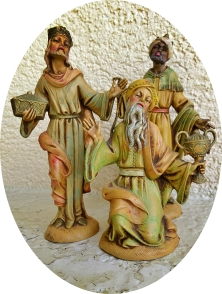 For centuries, access to the written Word of God was limited to just a few. The printing press wasn’t invented until 1439 and, at the time, only about 20% of the population could read. As a result, churches were decorated with paintings, stained glass windows, statues, carvings, and mosaics depicting biblical stories or illustrating theological concepts. For people who couldn’t read the book, religious art told the story. Consider how the Stations of the Cross in Roman Catholic churches illustrate the events of Good Friday. Sometimes, a picture really is worth a thousand words! While most nativity scenes are inaccurate, our depictions of the nativity don’t have to be historically exact to be meaningful.
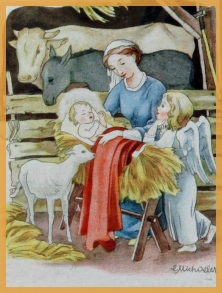 The earliest known portrayal of Jesus’ birth is a bas relief on a Roman sarcophagus from around 385. It depicts the swaddled Christ child in the manger flanked by an ox at His head and an ass at His feet. Why are they present instead of Joseph and Mary? In 1223, Francis of Assisi brought some hay and a manger to a cave and celebrated Mass there on Christmas Eve. Even though Mary and Joseph weren’t present, an ass and an ox were! In 1291, Pope Nicholas IV commissioned Arnolfo di Cambio to create a permanent nativity. While there are statues of Mary and Jesus, Joseph, and three Magi, the sixth statue shows the heads of an ox and an ass rather than shepherd or angel. Besides the baby Jesus, the ass and the ox are the most ancient and consistent elements in depictions of the nativity. Why do these two animals, neither of which is mentioned in the gospels, have such a prominent place in our nativity scenes, Christmas cards, and carols?
 It was a web day at the park and I don’t mean the world-wide kind. It was one of those days when the morning dew, mist, and light cooperated in such a way that we saw beautiful intricate spider webs hanging everywhere. Looking as if they were made of strands of silver rather than proteinaceous silk extruded from a spider’s spinnerets, it seemed like the spiders had decorated all the trees in celebration of Christmas.
 Devotions of the Heart