
Be imitators of me, as I am of Christ. [1 Corinthians 11:1 (ESV)]
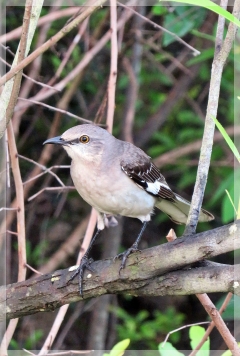 Hearing the bird’s shrill harsh scream, I looked up expecting to see a blue jay. To my surprise, it was a mockingbird. Of all the beautiful songs it can imitate, I wondered why the mockingbird chose the strident call of the jay. Then, remembering how many blue jays inhabit our neighborhood, I realized their raucous “jaaaaay” is what the mockingbird frequently hears so that has become part of his song.
It’s not just mocking birds and parrots who mimic what they hear and see. Years ago, a retired friend told me about spending Christmas with his son’s young family in Minnesota. By December 26, he grew tired of hearing the three youngsters squabble over their new toys and this grandpa decided to enjoy some peace and quiet while shoveling the snow. When his young grandson insisted on helping, he gave the youngster a small child-sized shovel but the boy complained that he wanted the big one. Telling him it would be too heavy, Grandpa refused and started shoveling. When the child kept whining about using the big shovel, my friend used a few ill-chosen words before letting the boy give it a try. Of course, once he started with it, the child cried that it was too heavy. “$@#!&)%!” said Grandpa, “I told you so!” There were a few more profanities when the boy grew bored and started to toss snowballs. Eventually, however, the shoveling was finished. While taking off their coats in the house, the youngster proudly announced to his parents, “We just shoveled the whole $@#!&)% driveway!” You can’t blame him for the bad language; like the mockingbird, he was imitating what he’d heard!
Children never have been very good at listening to and obeying their elders but they are experts at imitating us. It’s been said that we should live in such a way that we wouldn’t be ashamed to sell our parrot to the town gossip (or have our youngsters answer questions like those asked by Art Linkletter in his 1960s show Kids Say the Darndest Things.)
Children mimic more than our words; they model our behavior, as well. For years, the kids and I watched my husband give two hard shakes to the handle after locking the front door to his business. Although he’d turn toward the car, before taking a step, he’d turn back around and give that door handle at least one more hard shake—just to make sure it was good and locked. When we returned north last May, I chuckled as I watched my son do the identical thing after locking the front door of the same business! Both our words and behavior get recycled to the next generation.
Children will imitate both the positive and negative aspects of our behavior. They can learn to be polite, considerate, positive, helpful, truthful, and modest or they can learn to be rude, selfish, negative, uncooperative, deceitful, and arrogant. Do we model the right kind of behavior—not just for youngsters but also everyone we encounter? As Christ’s followers, we should—regardless of how provoked, aggravated, or tired we may be.
My father-in-law, whose given name was Paul, was called “Bill” for most of his 96 years. When asked why, he explained that everyone called him “Bill” because he walked just like a man named Bill. Whose walk do we imitate? To be worthy of the name of “Christian,” we should be imitators of Christ and walk and speak as would He. Do we?
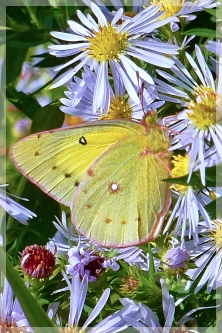 In Letters to Malcom, C. S. Lewis wrote, “We, or at least I, shall not be able to adore God on the highest occasions if we have learned no habit of doing so on the lowest. … Any patch of sunlight in a wood will show you something about the sun which you could never get from reading books on astronomy. These pure and spontaneous pleasures are ‘patches of Godlight’ in the woods of our experience.”
 I think the worst thing my parents could say was that they were disappointed in me. Knowing I hadn’t lived up to their high expectations, I’d hang my head in shame as they added, “We expected far better from you.” I never wanted to disappoint them but, unfortunately, like every child, I often did.
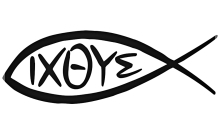 Fish play a prominent role in Scripture, especially in the New Testament. Jesus preached from a fishing boat, the first disciples were fishermen, and Jesus called them to be fishers of men. It was at His instruction that Peter found tax money in the mouth of a fish and the disciples netted two miraculous catches of fish. Jesus multiplied a few fish and loaves into food enough to feed thousands not once but twice! He compared the Kingdom of Heaven to a fishing net and, after His resurrection, Jesus even ate fish twice with the disciples. The frequent mention of fish in the New Testament, however, doesn’t fully explain how the fish symbol (ixthus/icthus) came to be one of the most recognized symbols of Christianity today.
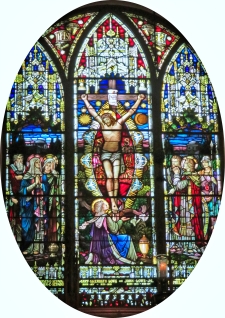 Pope Francis recently visited Singapore and, when speaking to young people at an interfaith meeting, he is reported to have said “All religions are paths to God.” After comparing the various religions to “different languages that express the divine,” he added, “There is only one God, and each of us has a language to arrive at God. Some are Sheik, Muslim, Hindu, Christian, and they are different paths [to God].” While the pontiff was encouraging interfaith dialogue, his words are troubling. I will not presume to know the Pope’s meaning or intention with his comments. Nevertheless, I find it important to address how the world understood the pontiff’s message.
 When I saw a wildflower that looked like a helicopter’s rotors, I showed it to the park’s naturalist for identification. Not as impressive as Scarlet Hibiscus or as colorful as Butterfly Weed, she found the plant unworthy of name or notice and wrote it off as “just a weed!” What some people call “weeds,” I think of as wildflowers and a little research told me it was the floret of Egyptian Crowfoot Grass (Dactyloctenium aegyptium). Native to Africa and widely distributed throughout the tropics and subtropics, it is one of the most drought-resistant of grasses.
 Devotions of the Heart