
And what more should I say? For time would fail me to tell of Gideon, Barak, Samson, Jephthah, of David and Samuel and the prophets, who through faith conquered kingdoms, administered justice, obtained promises, shut the mouths of lions, quenched the power of fire, escaped the edge of the sword, were made strong out of weakness, became mighty in war, put foreign armies to flight. [Hebrews 11:32-34 (NTFE)]
 Hebrews 11 lists the great examples of faith found in the Hebrew Scriptures. Every story, however, has a supporting cast and, while we may not remember or even know their names, they played an important role in everyone’s story. We know Moses is one of those heroes of faith but what of the midwives Shiphrah and Puah? If they hadn’t defied Pharaoh’s orders to kill newborn Hebrew boys, Moses wouldn’t have lived long enough to be found by Pharaoh’s daughter let alone lead Israel to the Promised Land!
We know the promised Messiah was to come from David’s line but that line nearly became extinct in 841 BC when Judah’s king Ahaziah died and his mother, Athaliah, seized the throne for herself. To secure her position, the queen mother murdered Ahaziah’s children (her grandchildren) and the rest of the royal family! The Davidic line remained only because Athaliah’s sister, Jehosheba, rescued Ahaziah’s infant son Joash. At great risk, she kept the boy hidden for six years until the time was right for him to be named king.
We recall the names of Esther and her uncle Mordecai but probably not that of Hegai, the eunuch in charge of the king’s harem. Without his coaching and assistance, Esther never would have captured the heart of Xerxes, become queen, and been able to save the Hebrew nation from extinction. We revere the name of David but probably don’t know the names of his thirty-seven “mighty men” listed in 2 Samuel 23. We know of Jeremiah but not Ebed-melech, the court official who risked his life to rescue the prophet from the cistern where he had been left to die.
What of those heroes of faith whose names we don’t know—people like the slave girl who told Naaman about the Samarian prophet who could heal him of leprosy? It was her testimony that introduced the Syrian warrior to the one true God of Israel. What of the king’s cup-bearer who told Pharaoh that Joseph could interpret his dream? Without his action, the story of Israel could have ended in Genesis! We only know her as the widow of Zarephath but this nameless woman fed Elijah the last of her oil and bread during a time of famine. We know Gideon but not the names of his 300 valiant men who bravely fought 135,000 Midianites. When outnumbered by 450 to 1, most soldiers would have fled, but those nameless men belong in the “Hall of Faith” along with Gideon!
The New Testament is not without its unnamed heroes of faith—consider the boy who gave his lunch, the widow who gave her two mites, and the four friends so committed to the paralytic’s healing they cut a hole in the roof and lowered him down to the Lord! What of the nameless shepherds and Magi who worshipped the newborn king? We don’t know the names of the woman at the well, the hemorrhaging woman, the Ethiopian eunuch, the repentant thief on the cross, or the Syrophoenician woman who was determined to have Jesus heal her daughter, but they were just as much heroes of faith as were Moses and Abraham.
Every story, play, or movie has both major roles and a supporting cast. While we may have the lead role in our own personal story, we are just supporting actors in the Kingdom’s story. Nevertheless, we are as essential to God’s scenario as were Shiphrah and Puah, Gideon’s 300 and David’s 37, the woman at the well, and those four faithful friends! For the most part, those supporting actors didn’t even know their own importance; nevertheless, acting in faith, they simply followed God’s direction. Let us take the small (but essential) roles God has given us and play them as well as all the unsung heroes of faith did!
There are no small roles, only small actors. [Konstantin Stanislavski]
 Several years ago, I purchased a beautifully drawn coloring book featuring scenes from the Colorado mountain town that had been part of our lives for thirty-five years. Since it was a gift for one of my grands, I asked the artist to sign the book. She added these words to her signature: “Don’t be afraid to color outside the lines!” Was the artist’s advice limited to her book or was it about something more?
 In the Gospel stories of the two miraculous catches of fish, experience told the disciples that fishing in the light of day was the wrong time and casting a net from the right side of the boat was the wrong way to do it. Nevertheless, that’s exactly how Jesus told them to fish. If we look at those stories more figuratively, we see that night time was man’s time and the boat’s left side was man’s way. Those miraculous catches, however, tell us that the right time is whenever God says it is and the right way is however God says it’s to be done!
 Do these verses mean I can’t wear my pearl earrings, diamond wedding ring, or gold cross to church? Do I have to say “farewell” to Nordstrom’s and start shopping solely at outlets and discount stores? Although my hair is short, it’s hard to believe my grand’s lovely French braids are inappropriate at church or anywhere else. What did Paul and Peter mean with their admonitions about women’s attire and modesty?
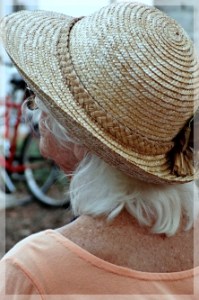 I grew up attending the Episcopal Church at a time when women covered their heads during worship and the men worshipped bare-headed. While not a hard and fast rule in the denomination, it was a time-honored tradition. Women wearing head coverings in Episcopal and Catholic churches began to wane in the 70s and, by 1983, the Roman Catholic church no longer had rules regarding headwear for men or women. The last time I attended an Episcopal or Catholic church, the women were hatless and some of the men wore baseball caps! Although culture plays an important role in the way we dress and behave in church, how do we interpret Paul’s words today? Should I dig out my mantilla and must our pastor toss out his ball cap?
 Jeopardy introduced me to the word “performative” but, in an article about how scandals are hurting organized religion, the New York Times introduced me to another new word, “orthopraxy.” While “orthodoxy” means correct belief, doctrine, or teaching, “orthopraxy” has to do with correct practice, behavior, or action. Orthodoxy says, “Hear my words!” but orthopraxy says, “Watch my behavior!” With the flood of scandals throughout the Christian church, it’s easy to point our fingers at the disgraced Christian celebrities, megachurch pastors, and Roman Catholic priests whose orthodoxy didn’t match their orthopraxy—people who espoused devotion to God and adherence to His word while disregarding it in their own lives. Let’s remember, however, that whenever we point a finger at someone, three other fingers point at us! Although the Times article was about the disconnect between orthodoxy and orthopraxy in the church at large, there’s often a disconnect between the two in our personal lives, as well.
 Devotions of the Heart