
MARIA’S SON

blue flag iris - blue-eyed grass - pansyLook carefully then how you walk, not as unwise but as wise, making the best use of the time, because the days are evil. Therefore do not be foolish, but understand what the will of the Lord is. [Ephesians 5:15-17 (ESV)]

So teach us to number our days that we may get a heart of wisdom. [Psalm 90:12 (ESV)]

Maria, an elderly woman, used to come to our Tuesday Bible study but stopped when she could no longer drive. Last Christmas, her son gave her a beautiful gift: the promise to drive her to Bible study every week. This was no small gift; she lived nearly an hour from her son and a half hour away from church. By the time you add the son’s driving time to and from his house to hers, to and from her house to the church, the hour of class, and the time it took to get his mother (and her walker) in and out of the car four times, this gift was nearly a five hour obligation every week. Maria’s health eventually failed and, today, we learned that she went home to Jesus.

I didn’t know Maria or her son but I do know about time. I spent enough hours shuttling my daughter to and from dance classes to know that a mere hour between drop off and pick up is not enough time to accomplish anything in the way of running errands. By the time you get to Costco or Target you have to turn around and come back. Time is a precious commodity and, once spent, can never be recovered. Maria’s son spent his hours as would Jesus—in loving service. Can we say the same thing?

We have plenty of labor saving devices: food processors, instant pots, microwaves, automatic sprinklers, power drills, washers, dryers, dishwashers, pressure cookers, power mowers, computers, and even a virtual assistant in Alexa. In theory, with all these modern conveniences, we should have plenty of time. Yet, when I speak with others, a common complaint is a lack of time. What do we do with all the time we save?

Rather than a shortage of time, perhaps the problem is in our priorities. Since God gave us the Sabbath, I don’t think He has a problem with rest and recreation. Nevertheless, He didn’t put us here just to have a good time. He’s trusted us with the gift of time; could it be that He’s also testing us to see what kind of stewards we are of that gift?

Forbidden to reap their harvest right up to the edge of their fields and or strip their vineyards bare, the Israelites were to deliberately leave produce for the poor. The way we use our time is a little like harvesting it. Rather than leaving wheat and grapes in the field, perhaps we should deliberately leave some time in our lives for the needs of our families and our brothers and sisters in Christ.

What would Jesus do with our spare minutes? How can they be gleaned for God’s purposes? How can we use our time to magnify God and further His kingdom? Where can we spend it to improve the lives of others? The answer may be as easy as taking someone to Bible study.

One gives freely, yet grows all the richer; another withholds what he should give, and only suffers want. [Proverbs 11:24 (ESV)]

Do not be conformed to this world, but be transformed by the renewal of your mind, that by testing you may discern what is the will of God, what is good and acceptable and perfect. [Romans 12:2 (ESV)]

Copyright ©2018 jsjdevotions. All rights reserved.

IGNORANCE OF THE LAW

And you must love the Lord your God with all your heart, all your soul, and all your strength. And you must commit yourselves wholeheartedly to these commands that I am giving you today. Repeat them again and again to your children. Talk about them when you are at home and when you are on the road, when you are going to bed and when you are getting up. [Deuteronomy 6:5-7 (NLT)]

red shouldered hawkKnowing it was important for both the leaders and the people to be reminded of their rights and duties, Moses instructed the people that every seven years the Book of the Law was to be publicly read to the entire nation (including children and foreigners). This reading was to be done following the Feast of Shelters  during the Sabbath year.


Whether the Book of the Law was the entire Pentateuch or just Deuteronomy, we don’t know. We do know, however, that public reading of it is only mentioned four times in the Old Testament! The first public reading was done by Joshua following the Israelite defeat of Jericho and Ai. More than 500 years later, King Jehoshaphat sent out two priests with copies of the law to teach the people. The Book of the Law was misplaced sometime after that. When it was found during temple repairs more than 230 years later, King Josiah read it to the people of Judah. 200 years later, after Jerusalem’s wall had been rebuilt. Nehemiah gathered the people to hear Ezra read God’s law. It was then, nearly 1000 years after first commanded, that the Book of the Law finally was read during the Feast of Shelters.

The Israelites didn’t start out ignorant of God; Moses and Joshua gave them a good start. Although the people were instructed to commit themselves to the law and teach their children, generation after generation strayed further and further from God and His word. The Israelites broke God’s law, sometimes deliberately and sometimes in ignorance. Nevertheless, breaking God’s law came at a high cost; without a firm foundation in God’s word, both the northern and southern kingdoms were defeated and collapsed.

For the most part, the Israelites were Scripture illiterates. Today, however, we have no excuse for not knowing God’s word. The Barna Group’s research shows that 87% of Americans have at least one Bible in their homes (the average number being three). I was encouraged to learn that half of Americans are considered “Bible users” until I realized that simply meant they read, listened to or prayed with the Bible three to four times a year! That sounds more like Bible referrers than users to me. Worse, one third of Americans never even open a Bible!

As Christians, have we committed ourselves wholeheartedly to God’s word or are we becoming Scripture illiterates? The Israelites lost their way without His word; we don’t want to make the same mistake.

I will show you what it’s like when someone comes to me, listens to my teaching, and then follows it. It is like a person building a house who digs deep and lays the foundation on solid rock. When the floodwaters rise and break against that house, it stands firm because it is well built. But anyone who hears and doesn’t obey is like a person who builds a house right on the ground, without a foundation. When the floods sweep down against that house, it will collapse into a heap of ruins. [Luke 6:47-49 (NLT)]

Copyright ©2018 jsjdevotions. All rights reserved. 

GATEKEEPERS

“For my house shall be called a house of prayer for all peoples.” The Lord God, who gathers the outcasts of Israel, declares, “I will gather yet others to him besides those already gathered.” [Isaiah 56:7b-8 (ESV)]

cardinal

In the Old Testament, the Levites acted as gatekeepers. Among their many duties, they maintained decorum, enforced the laws of ritual cleanliness, directed worshippers to the correct area, and prohibited entry to anyone considered defiled or unclean (such as lepers, eunuchs, or Gentiles). The gatekeepers placed a large stone between the Court of the Gentiles and the Women’s Court to remind the unclean they would die if they passed it; if they entered into the Temple area, they would be dragged out and killed.

Gatekeepers who determine one’s fitness to worship remind me of my response to Jimmy, about whom I’ve previously written. A man with what could be called a colorful past, Jimmy started attending our Florida church last March. I admitted in “It Takes All Kinds” that I was less than enthusiastic when my husband invited him to church after meeting him in the park. A bit of a character, Jimmy is a recovering addict/alcoholic and, while not homeless, he lives on the fringe of society. Although I knew my misgivings were unchristian, as I got to know him, I quickly learned they also were unfounded. After starting to attend our church, he began coming to Bible study, bringing his well-worn Bible with him, and often joined our group for fellowship after class. Early this summer, when Jimmy asked to be baptized, ten others from our church joined him in the Gulf of Mexico for that sacrament.

During the summer, Jimmy went north to be with family but kept in touch with our pastor. He wrote about meeting a man in the park who was new to recovery. When the fellow asked Jimmy how he managed to stay sober, his reply was simple and to the point: Jesus! Our new Christian became a witnessing disciple. Jimmy recently returned to Florida and was warmly welcomed by all when he joined us for Sunday worship; I felt honored to take his hand during prayers.

The story is told of a homeless man, disheveled and dirty, who entered a church Easter morning. The service had just started and the pews were jam packed. As the man walked up the aisle in search of a seat, people avoided eye contact and no one made room for him in the pews. Once at the front of the church, the man sat down on the floor near the altar rail. As an usher, dressed in a black suit with a boutonniere in his lapel, made his way up the aisle, the parishioners were sure that he would quietly ask the man to leave (as any good gatekeeper would do). Instead, to the surprise of the congregation, the usher handed the man both program and hymnal and sat down beside him.

Although more and more churches now use security people to protect personnel and worshippers, we no longer have Levites to keep the unclean out of worship. If we did, our churches would be empty because we’re all soiled by sin! While we don’t have official gatekeepers, let us all be cautious of being unofficial ones. What would have happened to Jimmy if we had gatekeepers in our churches? What of his new friend? The best part of any man is what’s found in his heart and we’ll never know what’s in his heart until we take the time to know the man.

May the church be the place of God’s mercy and love, where everyone can feel themselves welcomed, loved, forgiven and encouraged to live according to the good life of the Gospel. And in order to make others feel welcomed, loved, forgiven and encouraged, the church must have open doors so that all might enter. And we must go out of those doors and proclaim the Gospel. [Pope Francis]

Do not neglect to show hospitality to strangers, for thereby some have entertained angels unawares. [Hebrews 13:2 (ESV)]

And the King will answer them, “Truly, I say to you, as you did it to one of the least of these my brothers, you did it to me.” [Matthew 25:40 (ESV)]

Copyright ©2018 jsjdevotions. All rights reserved.

OUTSIDE THE BOX

Lowdermilk Park - Naples FLI appeal to you, dear brothers and sisters, by the authority of our Lord Jesus Christ, to live in harmony with each other. Let there be no divisions in the church. Rather, be of one mind, united in thought and purpose. [1 Corinthians 1:10 (NLT)]

Now I say to you that you are Peter (which means ‘rock’), and upon this rock I will build my church, and all the powers of hell will not conquer it. [Matthew 16:18 (NLT)]

Since she is new to town, I invited Alice to our church. “What denomination?” she asked. When I told her we were non-denominational she thought I meant we were a church of whatever the individual wanted to believe and asked, “Do you mean Unitarian?” I assured her we’re Bible-based Christians but, unable to wrap her mind around the concept, she rattled off a set of questions. No hierarchy, bishops or diocese? No formal liturgy? No membership requirements or official canons or procedures? Who tells you what to believe? To whom are you accountable?

In Letters to the Church, Francis Chan asks the reader to imagine someone on a desert island, having no experience with Christianity, with only the Bible as reference. Asking first how this person might picture church and worship, he then asks the reader how his church and worship stack up to those first century expectations. Here in Florida, we attend two different churches and one fits Alice’s expectations: denominational, organizational hierarchy, church campus, sanctuary, chapel, liturgy, hymnals, pews, pulpit, choirs, choir director, organ, meeting rooms, video screens, stained glass, sound system, and several services. While Alice would identify it as a traditional church, that marooned person and the Apostle Paul probably wouldn’t recognize it.

Because I love the liturgy and hymns, we do attend that church Saturday nights. The church to which I invited Alice, however, is the church I think of as home. Less than a year old, while the early church met in homes, we meet in a city park and, since we’re in Florida, we can meet there all year long. Although non-denominational, we do have a core set of Bible-based beliefs and, to maintain doctrinal, financial, and leadership accountability, we belong to several Christian organizations. We have no formal liturgy, prayer books, hymnals, sound system, or choir (although the birds usually sing throughout the service). Rather than stained glass, we have palm trees, sea grapes, blue sky, and the Gulf of Mexico decorating our sanctuary. When we meet for Bible study, we rent a room in a community center. By today’s standards, our “outside the box” church is anything but traditional but I think the Apostle Paul would easily recognize it.

Last week, our similarity with the 1st century church came to mind when we met together at the community center for an early Thanksgiving dinner. Everyone brought a dish to share and, along with more than enough food, there was laughter, joy, and plenty of fellowship. I think Paul would have recognized Christ’s church as the sixty of us ate dinner, prayed and, in true early church tradition, partook of communion as a family.

Whether we are part of a traditional or unconventional church, let us remember that Christ’s church is not about a building but rather a group of believers. A church structure without a family of believers is not a church whereas a family of believers without a building is one! Christ’s church, regardless of where or how it worships, exists wherever two or three are gathered together!

For where two or three gather together as my followers, I am there among them. [Matthew 18:20 (NLT)]

Copyright ©2018 jsjdevotions. All rights reserved

WHO’S IMPORTANT?

So God created human beings in his own image. In the image of God he created them; male and female he created them. … Then the Lord God formed the man from the dust of the ground. He breathed the breath of life into the man’s nostrils, and the man became a living person. [Genesis 1:27,2:7 (NLT)]

SK8 Church Steamboat COOur family business makes products used in skateboards and many boarders are familiar with our name. After skiing one day, as my husband got on the bus, he was greeted by a boarder who spotted our company logo on his cap. “Yo, dude!” he called. Pointing to the cap, he asked, “You know those people?” When my husband replied he was “those people,” the fellow responded as if he’d met a celebrity and excitedly introduced my spouse to his pals. Soon they all were in an animated discussion of trucks, decks, wheels, and grip tape. The woman next to me, curious about the commotion in the back of the bus and not wanting to miss a celebrity sighting asked, “Is that someone famous? Is he important?” I replied, “He’s no one,” adding, “It’s just a skateboard thing.”
Later, I realized I’d given the wrong answer and not just because my husband is incredibly important to me. The better answer would have been, “He’s not famous but he is important.” Then, I should have added that she and I were just as important, as was everyone else on that bus, because we’re all important to God! I could have told her that real importance and value have nothing to do with fame, wealth, possessions or power. It has nothing to do with how we look, what we’ve done, where we work, what others think of us, or even what we think of ourselves.

Whether or not we were planned by our parents, we’re not accidents; God knew us all before we were born! Made in His image, we are God’s handiwork and precious in His sight. It was his breath that filled our lungs with life and His spirit that lives within us. Our names are etched on the palm of His hand, He’s promised to strengthen and help us, and He knows everything about us, including the number of hairs on our heads. If God carried an iPhone, our pictures would be on it and our numbers would be listed in His “favorites.” We are so loved by God that He sacrificed His only Son for us! As Christians, Jesus counts us among His friends and we’ve been adopted by God. As His children, we are recipients of a priceless inheritance. As followers of Christ, the God of the Universe has taken up residence in our hearts. Now that’s what I call important!

God does not love us because we are valuable. We are valuable because God loves us. [Fulton J. Sheen]

You made all the delicate, inner parts of my body and knit me together in my mother’s womb. Thank you for making me so wonderfully complex! Your workmanship is marvelous—how well I know it. You watched me as I was being formed in utter seclusion, as I was woven together in the dark of the womb. You saw me before I was born. Every day of my life was recorded in your book. Every moment was laid out before a single day had passed. How precious are your thoughts about me, O God. They cannot be numbered! I can’t even count them; they outnumber the grains of sand! And when I wake up, you are still with me! [Psalm 139:13-18 (NLT)]

Copyright ©2018 jsjdevotions. All rights reserved.

LOVE LIKE A CHILD

And do everything with love. [1 Corinthians 16:14 (NLT)]

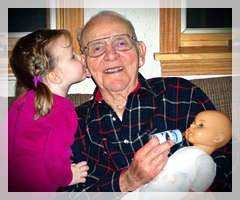
GrandpaI actually thought the prayer’s words that Sunday asked God to show us what children can teach us about love. Looking through old photos of my children and grands later that day, I thought about the ways children love. Unconcerned with decorum (or potential lawsuits), they’re demonstrative: touching freely and unabashedly. They cuddle and climb on laps, hold hands, and spontaneously give hugs and kisses. They burrow under the covers with us and aren’t bothered by morning breath or bed head. It doesn’t matter if they’re soaking wet from the sprinkler or their faces are covered with jelly or chocolate nor do they care if we’re sweaty and dirty from working in the garden or dressed in our finest for a night on the town. Children know that touch, whether a high-five or hug, is an important part of love.

Children don’t need words to express their love—rather than talking about it, they show it. In his nineties, Grandpa was frail, nearly deaf, and partially blind by the time the first great-grand arrived. Nevertheless, they didn’t need to talk; the little one knew how to speak with love and the two of them communicated silently, playing games only they understood. Another grand sought out a shy child in her pre-school who wouldn’t speak at all. The girls became fast friends because they didn’t need words to communicate. Perhaps children don’t need discussion because they know that loving actions speak far louder than do words.

Children love with gifts and service and the adults they love become the recipients of a wide assortment of shells, dandelions, painted rocks, pot holders, feathers, rubber band bracelets, drawings, beaded jewelry and pinch pots. As for service: my grands have been known to fight over who gets to help me water the plants, set the table, wipe my counters, dust the furniture or help fold the laundry. Children know that giving of self is a fundamental part of love.

Children love unconditionally and with forgiving hearts. Both of our foster daughters continued to love (and defend) the parents that failed them time and time again. They’d wait all afternoon for the promised visit that never happened only to faithfully wait again the following week. They loved even when the love was undeserved and forgave what seemed unforgivable (and I pray they still do). Children love without judgment.

Children love with generosity and without embarrassment. Last year, when the cousins were at our house, the eldest boy introduced the little ones to the dress-up box. After helping them into princess and pirate get-ups, they wanted him to dress up, too. There was just one costume that fit him and the little guys begged him to wear it. Without complaint, the fourteen-year old donned a Cinderella dress for his young cousins and allowed them to accessorize it with a lady’s hat, purse, and beads. He did this with a smile because children love generously, unselfconsciously, and with joyful laughter.

It wasn’t until I was done with this devotion that I re-read the words to that Sunday’s prayer and discovered it asked God to show us what children can teach us about Him. I thought of the story about a little girl who was busily drawing a portrait. When the teacher asked who it was, she replied, “God.” Reminding her that no one knows what God looks like, the girl said, “They will when I’m done!” God is love and children certainly know how to love; perhaps the face the little girl drew was that of a child. Indeed, children can teach us a great deal about both love and God.

Dear friends, since God loved us that much, we surely ought to love each other. No one has ever seen God. But if we love each other, God lives in us, and his love is brought to full expression in us. … God is love, and all who live in love live in God, and God lives in them. [1 John 4:11-12.14b (NLT)]

Copyright ©2018 jsjdevotions. All rights reserved.