WHEN PUSH COMES TO SHOVE

Here’s another old saying that deserves a second look: ‘Eye for eye, tooth for tooth.’ Is that going to get us anywhere? Here’s what I propose: ‘Don’t hit back at all.’ If someone strikes you, stand there and take it. If someone drags you into court and sues for the shirt off your back, giftwrap your best coat and make a present of it. And if someone takes unfair advantage of you, use the occasion to practice the servant life. No more tit-for-tat stuff. Live generously. [Matthew 5:38-42 (MSG)]

water lilyThe billboard’s message read, “When push comes to shove, don’t!” It was sponsored by a nonprofit foundation that uses a variety of media sources to encourage positive values, good role models, and a better life. “Hard to argue with a goal like that,” I thought before discovering that some people took exception to their peaceful message. Re-tweeting it, one rock musician told his fans just to “shove harder.”

Recently, the management of our home association sent an email regarding the previous night’s annual meeting. Being out of town, we’d missed it but, apparently, pushes had come dangerously close to shoves. Because it had deteriorated into arguments, shouting and name calling, the management company found it necessary to inform the home owners that such future behavior would not be tolerated. They warned that, if it recurred, the meeting immediately would be adjourned. I was shocked that such an email was found necessary. These weren’t enemy nations or small children on a playground; neighbors and adults, they all knew better.

When we think we’re not being heard, we tend to get louder and, instead of communicating, we end up with a shouting match. Feeling a bit “holier than thou” while reading about the contentious meeting, the Spirit’s convicting voice reminded me I’m not much different. Last month, my husband took a quick trip. When dropping him off at the airport, I’d asked where he wanted to be picked up and we agreed on the lower/arrivals level. Upon his return, he called to say he was waiting at the far end of the terminal by the Jet Blue door. I parked there and waited and waited. I finally gave him a call and we both heatedly asked where the other was. Back and forth it went—him saying he was right there and me insisting he wasn’t, our voices getting just a little louder with each exchange. My husband eventually paused and asked whether I was at arrivals or departures. “Exactly where you told me: on the lower level at arrivals!” I replied. “Oh,” he quietly said, “I’ll be right there!” You guessed it; he’d been waiting upstairs. If, instead of accusing one another of being wrong, one of us had simply asked where the other was, we could have avoided a rather tense homecoming! Granted, we didn’t call one another names but, on a smaller scale, we were no different than our irate neighbors.

In today’s angry world, rather than have a civil discussion, people frequently intimidate, attack, and demonize anyone who thinks differently. What happened to being able to disagree without being disagreeable? For a civilized people, we seem to have lost all civility. Epictetus said, “We have two ears and one mouth so that we can listen twice as much as we speak.” He also said, “It is impossible for a man to learn what he thinks he already knows.” Of course, in some cases, that man (or woman) doesn’t want to learn anything that goes contrary to what he desires.

We are called to be peace makers and we do that by being humble, patient, and using our ears twice as much as we do our mouths. Not pushing back when push comes to shove doesn’t mean we lie down and allow someone to walk all over us. Not pushing back means we continue to stand, but we stand with civility, kindness, patience, and love. Another billboard sponsored by the same group says, “Always be a little kinder than necessary.” If we were, there might not be so many pushes, shoves, and angry tweets!

Post this at all the intersections, dear friends: Lead with your ears, follow up with your tongue, and let anger straggle along in the rear. God’s righteousness doesn’t grow from human anger. So throw all spoiled virtue and cancerous evil in the garbage. In simple humility, let our gardener, God, landscape you with the Word, making a salvation-garden of your life. [James 1:20-21 (MSG)]

Copyright ©2019 jsjdevotions. All rights reserved.

TWO IN ONE

For in Christ lives all the fullness of God in a human body. [Colossians 2:9 (NLT)]

So the Word became human and made his home among us. He was full of unfailing love and faithfulness. And we have seen his glory, the glory of the Father’s one and only Son. [John 1:14 (NLT)]

white ibisThe early church encountered difficulty in trying to reconcile the humanity and divinity of Jesus. In the 5th century, one group, from Alexandria, referred to the Virgin Mary as Theotokos, the one who gave birth to God, while the group from Antioch insisted that she was merely Anthropotokos, the one who gave birth to the human nature. Trying to bring about a compromise but pleasing no one, the bishop Nestorius suggested that the term Christotokos, the one who gave birth to Christ. The controversy, however, wasn’t about Mary; it was about the nature of Jesus. Did Mary give birth to a man who also was God or did Mary give birth to a man who later became God? The debate continued until 451 when the Chalcedonian Creed was adopted which confirmed the two natures of Christ (human and divine) in one person.

Creed or not, two natures in one being is a difficult concept to grasp. Infinite, God always has been and always will be, but the man Jesus had a beginning in Bethlehem and an end in Jerusalem. God is omnipresent but, when the boy Jesus was at the Temple, He couldn’t also be with his family on the way back to Nazareth, let alone everywhere at once. God is omnipotent but Jesus wasn’t all-powerful. He grew tired, thirsty and hungry, had to walk from village to village, and was cruelly crucified. God is immutable, meaning He never changes, but Jesus started as an embryo and matured into a grown man. He went from babbling to talking and from crawling to walking. His features changed as He lost his baby teeth and got molars and His voice deepened during adolescence. Self-sufficient, God has no needs but we know that baby Jesus needed to be fed, bathed, rocked and dressed. God never sleeps but we know Jesus did. God is omniscient; He sees and knows all but Jesus didn’t know the date of the End Times and, when the woman with the blood disorder touched his robe, He had to ask who touched him. Surely, as a little boy He asked Mary, “Why?”

Nevertheless, Jesus wasn’t two people; from the moment of His conception, He had two distinct natures perfectly united into one being. Inseparable, neither nature was diluted by the other. Jesus was fully man and, at the same time, fully God. Because our thinking is limited by the rules of this world as we know them, we can’t truly comprehend how He could be neither one nor the other but fully both in one body. How can finite man ever understand an infinite God? Nevertheless, we’re called to believe what we can neither imagine nor comprehend.

Can you conceive of anything more awesome than a God who chose to become man, who combined His divinity with our humanity, who connected with man by becoming one of us and yet remained God, who loved us so much that He took on our nature and died for our salvation? Thank you, Jesus!

Though he was God, he did not think of equality with God as something to cling to. Instead, he gave up his divine privileges; he took the humble position of a slave and was born as a human being. When he appeared in human form, he humbled himself in obedience to God and died a criminal’s death on a cross. [Philippians 2:6-8 (NLT)]

We all with one accord teach men to acknowledge one and the same Son, our Lord Jesus Christ, at once complete in Godhead and complete in manhood, truly God and truly man, consisting also of a reasonable soul and body; of one substance with the Father as regards his Godhead, and at the same time of one substance with us as regards his manhood;… [Chalcedonian Creed]

Copyright ©2019 jsjdevotions. All rights reserved.


THE POTTERY SHOP

“Go down to the potter’s shop, and I will speak to you there.” So I did as he told me and found the potter working at his wheel. But the jar he was making did not turn out as he had hoped, so he crushed it into a lump of clay again and started over. Then the Lord gave me this message: “O Israel, can I not do to you as this potter has done to his clay? As the clay is in the potter’s hand, so are you in my hand.” [Jeremiah 18:2-6 (NLT)]

hibiscusIn January, there will be an Empty Bowls event in our town. Attendees will purchase a bowl and then fill it with soup and bread donated by local restaurants. The money raised will help feed the more than 36,000 food insecure people in our county. To make that event possible, 4,500 one-of-a-kind bowls are made by local potters. Then, with the help of local volunteers, the bowls are painted and fired. Recently, several of us from church gathered to decorate some of those bowls. While we painted, I thought about the potters who made our bowls—how they formed and reformed their creations until they were just right. Varying in shape and size, no two bowls were exactly the same and, by the time they are painted, each will have a personality of its own. When their purchasers are done eating soup from them, they will be put to different uses. The ones embellished with paw prints or bones probably will be used by pets, and the others may be used for popcorn, nuts, cereal, loose change, or even soup!

In words found in Jeremiah and Isaiah, we see God portrayed as the potter and mankind as His clay (rather fitting since Adam was made from dust on the ground and clay comes from the ground). Picture God forming us in His heavenly pottery shop. As with the bowls we painted, each of His creations would be carefully crafted and one-of-a-kind. While our bowls were made of the same kind of clay, God would choose the best type of clay for each one of us. For those who will be severely tested in life, He would chose a clay that withstands high heat but, for those who will have to be especially adaptable, He would chose a clay that is more easily worked.

Once He’d selected the type of clay, God would knead and shape us. While the bowls we painted were all thrown on a potter’s wheel, God might choose to pinch us into shape, or roll long threads of clay and layer them. For one person, He’d combine flat slabs of clay but, for another, He might select a unique mold or use His wheel. No matter the technique chosen, God would continue shaping and re-shaping us until we were formed the way He wanted us. If we got lopsided, He’d prop us up and, if we tore, He’d put us back together. Because clay is malleable and capable of change, God can continue to fine-tune His creations. We might not enjoy all of that pinching, squeezing, molding and scraping, but it is for our own good.

The parallel ends here because the bowls we painted, having been dried and fired, couldn’t be reshaped. God, however, is never done working on us and we continue to be a work in progress until our dying day. Nevertheless, I picture Him with a paintbrush, making each of us beautiful in our own unique way. Moreover, just as the bowls we painted couldn’t complain that, rather than being painted with flowers they wanted polka dots or preferred candy apple red to sour apple green, we really have no voice in how our potter formed and embellished us. God is sovereign over his people; the creation doesn’t get to argue with the Creator!

How foolish can you be? He is the Potter, and he is certainly greater than you, the clay! Should the created thing say of the one who made it, “He didn’t make me”? Does a jar ever say, “The potter who made me is stupid”? [Isaiah 29: 16 (NLT)]

And yet, O Lord, you are our Father. We are the clay, and you are the potter. We all are formed by your hand. [Isaiah 64:8 (NLT)]

Copyright ©2019 jsjdevotions. All rights reserved.

NO SCISSORS ALLOWED

And I solemnly declare to everyone who hears the words of prophecy written in this book: If anyone adds anything to what is written here, God will add to that person the plagues described in this book. And if anyone removes any of the words from this book of prophecy, God will remove that person’s share in the tree of life and in the holy city that are described in this book. [Revelation 22:18-19 (NLT)]

lilyThere is much in Scripture, such as the subjugation of women, that I find troubling and would just as soon skip reading . For example, there’s no mention of their handmaid slaves’ consent when Sarah, Rachel or Leah offer them as surrogates to their husbands! Scripture may call them righteous because of their faith but Lot readily offered up his virgin daughters to a crowd of lustful men and Abraham twice gave Sarah to another man to save his own skin and benefitted financially both times he did it! There’s a word for a man who does that and it isn’t usually righteous. Then there was the Levite who pushed his concubine out the door to be raped by a gang of men. Many would consider David’s tryst with Bathsheba to be rape and even he tolerated the rape of his own daughter!

The amount of blood shed throughout the Old Testament is disturbing as well; picture the Levites killing 3,000 of their fellow Israelites at God’s command or Simeon and Levi killing all the men in Shechem because of one man’s crime and then plundering the city and taking the women and children captives. It’s difficult to read about Israelites killing everyone in Jabesh-gilead (except for 400 virgins) just to provide wives for the tribe of Benjamin or of the wholesale slaughter of people in places like Jericho and Amalek. Nevertheless, as much as I’d like to skip over these and other troubling passages, they are part of Jewish history and our faith’s roots.

Apparently, one of our nation’s founding fathers, Thomas Jefferson, found parts of the New Testament equally disconcerting. Instead of struggling to understand and praying to believe, he simply eliminated anything he found “contrary to reason.” Believing the gospels’ authors to be untrustworthy reporters, Jefferson wrote his own gospel by taking a penknife to his Bible, cutting up passages, and then pasting them together with other ones on a blank piece of paper. Leaving behind the parts he didn’t believe or like in mutilated Bibles, Jefferson created his own version of Christ’s life and philosophy. By including Christ’s death and burial but omitting His resurrection, rather than the Son of God, Jesus became little more than an altruistic philosopher. Titling it The Life and Morals of Jesus of Nazareth, Jefferson believed his version of the New Testament collected “the most sublime and benevolent code of morals which has ever been offered to man.” Boston University professor Stephen Prothero has a more accurate description of Jefferson’s Bible: “scripture by subtraction.”

Unlike Jefferson, we must never make the mistake of subtracting those parts of Scripture we don’t like and yet nearly all of us do. We tend to read only those parts we find comforting, believable, or easy to understand. I certainly prefer reading Psalms or John to the carnage of Judges or deciphering the cryptic visions in books like Revelation, Ezekiel, and Daniel. While we don’t take a scissors and glue to our Bibles, we do read selectively which, in actuality, is not much different than what Thomas Jefferson did with his penknife and paste.

Echoing the warning found in Deuteronomy, the book of Revelation has some pretty stern words about adding to or subtracting from Scripture’s words. Every word in the Bible is there for a purpose: to explain, convict, correct, and train. Let’s treat them all with the respect they deserve and never use either literal or figurative scissors on God’s holy word.

We must not select a few favorite Bible passages to the exclusion of others. Nothing less than a whole Bible can make a whole Christian. [A. W. Tozer]

All Scripture is inspired by God and is useful to teach us what is true and to make us realize what is wrong in our lives. It corrects us when we are wrong and teaches us to do what is right. God uses it to prepare and equip his people to do every good work. [2 Timothy 3:16-17 (NLT)]

Copyright ©2019 jsjdevotions. All rights reserved.

HATTIE’S ADVICE

Instead, be kind to each other, tenderhearted, forgiving one another, just as God through Christ has forgiven you. [Ephesians 4:32 (NLT)]

As I sorted through the papers that my mother-in-law had saved through the years, I came to a letter written to her in 1936 by her soon to be mother-in-law, Hattie. Hoping the young couple liked the mixer she’d given them, Hattie sent best wishes for a “long happy wedded life.” Wondering why such a mundane letter had been saved for 83 years, I read on. “May there be lots of love, joy and contentment in your home,” she continued, “forgiving each other as God forgives you.” Praying that my in-laws would have a long and “sweet contented life,” Hattie signed the letter “One who wishes you well in everything, Mother.”
Hattie’s prayers were answered; my in-laws were together for 68 years and, at least from my view-point, they did, indeed, live a “sweet contented” life. Could the secret to their marriage be hidden in Hattie’s advice to be forgiving? Is that why my mother-in-law had saved the letter?

I think of the story of a man who, when told by the doctor that he had an incurable case of rabies and but a few days to live, immediately got out paper and pen and started writing. When asked if he was composing his last will and testament, the man said he was making a list of everyone he wanted to bite! With an attitude like that, if the rabid man were married, I doubt that his was a happy marriage or that he lived a “sweet contented life.”

As I pondered my ability to forgive, I began to wonder how willing I was, not just to offer forgiveness, but also to ask for it. I’m not one to serve “cold shoulder and hot tongue” for dinner, give the “silent treatment,” or bring up past offenses but (and that’s a really big “but”), I also am not one who readily admits her failings. When I’ve committed the relationship sins of sharpness, impatience, pettiness, or indifference, I tend to assume forgiveness rather than apologize. Although my husband and I readily forgive one another, I think our relationship suffers if one or the other of us falls short and doesn’t admit it and apologize.

When we accept Jesus, all of our sins (past, present and future) are forgiven on a judicial or “positional” basis which means we will not suffer eternal damnation. Nevertheless, we should never take God’s forgiveness for granted or treat it as something we deserve. We must confess our sins for what could be called “relational” forgiveness in order to restore our relationship with Him.

Author and theologian Frederick Buechner calls unconfessed sins an abyss between us and God, adding that, once confessed, they become the bridge. I think Buechner’s abyss/bridge metaphor applies to our earthly relationships, as well. The prodigal’s father had already forgiven his son before the boy’s return but it was not until his son admitted the error of his ways that their relationship was restored. A certain amount of forgiveness is assumed in a family—husbands and wives forgive one another as do parents and children simply because love forgives. But, we must never take either the grace of God or the gift of forgiveness lightly.

Lord, give us forgiving and humble hearts. May we always be as willing to apologize and admit our errors as we are to accept both your forgiveness and that of others.

Few things accelerate the peace process as much as humbly admitting our own wrongdoing and asking forgiveness. [Lee Strobel]

If we claim we have no sin, we are only fooling ourselves and not living in the truth. But if we confess our sins to him, he is faithful and just to forgive us our sins and to cleanse us from all wickedness. If we claim we have not sinned, we are calling God a liar and showing that his word has no place in our hearts. [1 John 1:8-10 (NLT)]

Copyright ©2019 jsjdevotions. All rights reserved.

NO LOST CAUSES

And while he was still a long way off, his father saw him coming. Filled with love and compassion, he ran to his son, embraced him, and kissed him. [Luke 15:20 (NLT)]

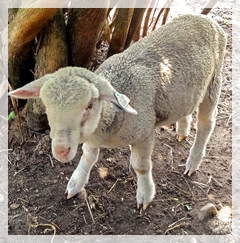
lambI was re-writing and updating my prayer list when I came to the names of several prodigals. Some of their names have been on that list for nearly two decades; during that time, they’ve been in and out trouble, jail, and rehab. Having wasted most of their lives, each one of them one would qualify as the poster child for lost causes. I thought of not adding their names to my new list. “After all, what’s the point?” I wondered.

I then thought of the parable of the prodigal son—a young man with plenty of opportunities who squandered his money and broke his father’s heart. When life got really tough and the pigs were living better than he, the boy finally repented and returned home to the welcoming and forgiving arms of his father. Like the prodigal son, when they were in financial or legal difficulties, the prodigals on my prayer list often returned home for a warm bed, financial and legal assistance, and even another trip to rehab. Unlike the prodigal son, however, they never managed to truly repent and always returned to their old friends and way of life.

What if there was another chapter to Jesus’s story of the prodigal son? What if, after cleaning up, getting some good meals in his belly, and obtaining a few coins in his pocket, the boy had returned to his life as a wastrel? How would his father have reacted? What would his father have done if his son, after wasting everything again, had returned home a second time? Would his father have rejoiced and thrown his arms around the boy? What if it happened again and again? Would his father eventually have stopped looking for his lost son? In anger, would he eventually have barred the gates and turned his back on his child?

I think not. Jesus’s parable was about forgiveness and hope, God’s grace and mercy, and His lavish love for his children. I think the father would have continued to run to his child and welcome him back every time he returned. Although God won’t enable His prodigals in their sinful ways, I believe He will receive them every time they come home, forgive them when they repent, and shed tears if they relapse and return to their old ways.

Our Heavenly Father will continue to forgive and welcome them (and us) back again and again until they (and we) finally get it right. With God there are no lost causes, only lost children. If God hasn’t given up hope, neither will I. For all of His lost sheep, I will continue to pray that they eventually find their way home and into the arms of their loving Father.

I’ve wandered far away from God, Now I’m coming home;
The paths of sin too long I’ve trod, Lord, I’m coming home.
I’ve wasted many precious years, Now I’m coming home;
I now repent with bitter tears, Lord, I’m coming home.
I’m tired of sin and straying, Lord, Now I’m coming home;
I’ll trust Thy love, believe Thy Word, Lord, I’m coming home.
Coming home, coming home, Nevermore to roam,
Open wide Thine arms of love, Lord, I’m coming home.
[“Lord, I’m Coming Home” by William J Kirkpatrick]

He does not punish us for all our sins; he does not deal harshly with us, as we deserve. For his unfailing love toward those who fear him is as great as the height of the heavens above the earth. He has removed our sins as far from us as the east is from the west. The Lord is like a father to his children,    tender and compassionate to those who fear him. For he knows how weak we are; he remembers we are only dust. [Psalm 103:10-14 (NLT)]

Copyright ©2019 jsjdevotions. All rights reserved.