THE FEAST OF EPIPHANY – JANUARY 6

Jesus was born in Bethlehem in Judea, during the reign of King Herod. About that time some wise men from eastern lands arrived in Jerusalem, asking, “Where is the newborn king of the Jews? We saw his star as it rose, and we have come to worship him.” [Matthew 2:1-2 (NLT)]

magi

Assuming you don’t worship in the Orthodox Church, today is known as the Feast of Three Kings or Epiphany. Since the church year for Orthodox Christians follows the Julian calendar, tonight is their Christmas Eve and Epiphany won’t be until January 19th. For those of us using the Gregorian calendar, however, today often is the day the Christmas tree is taken down, the nativity sets boxed up, and the holiday decorations are tucked away until next December.

Epiphany, however, isn’t about decorations or eating the last of the Christmas cookies. The word “epiphany” means to show, make known, or reveal. Those “ah-ha” moments when we have a flash of insight or understanding are often called epiphanies. (I frequently prayed for epiphanies when studying algebra and geometry.) When the travelers to Emmaus (in the gospel of John) suddenly recognized the resurrected Jesus, they had an epiphany as did Saul when Jesus revealed Himself on the road to Damascus. Today’s Epiphany celebration is about the coming of the wise men with gifts to visit the Christ child. Their visit revealed Jesus to the world as Lord and King, not just to the Jews, but also to the Gentiles.

When the long awaited Messiah was born, angels sent the birth announcement to lowly shepherds rather than religious leaders. The king was born, not in a palace, but in a stable. The newspaper didn’t list His birth but a star led the way. The baby gifts were brought not by Jews but by Gentiles: pagans who traveled from Persia, Arabia or India for several months to find this newborn king. They didn’t present the family with typical baby gifts and their offerings certainly weren’t what a poor carpenter’s family would expect to receive. Their offerings, however, were standard gifts to honor a king or deity in the ancient world. Gold, the metal of royalty, symbolized His kingship and acknowledged His right to rule. Frankincense, used in worship and the anointing of priests, symbolized the role Jesus would take as our High Priest. Myrrh, a spice used for embalming, was an odd gift for a child but the magi were familiar with the prophecies that told of the Messiah’s suffering. This was the perfect offering for the One who would be a sacrifice. Perhaps the greatest gift the magi brought was the one that didn’t come in a box: their worship!

As we put away the last of the holiday decorations, let’s not put away the message of Christmas. May the living Christ remain in our hearts: our King, God, and Savior—the One who lived and died so that we might die and live.

Born a king on Bethlehem’s plain, Gold I bring to crown Him again,
King forever, ceasing never Over us all to reign. …
Frankincense to offer have I. Incense owns a Deity nigh.
Prayer and praising all men raising, Worship Him, God on high. …
Myrrh is mine: Its bitter perfume Breaths a life of gathering gloom.
Sorrowing, sighing, bleeding dying, Sealed in the stone-cold tomb.
[“We Three Kings” by John Henry Hopkins, Jr.]

They entered the house and saw the child with his mother, Mary, and they bowed down and worshiped him. Then they opened their treasure chests and gave him gifts of gold, frankincense, and myrrh. [Matthew 2:11 (NLT)]

Copyright ©2020 jsjdevotions. All rights reserved.

PRAY, SEND, GO

The Lord now chose seventy-two other disciples and sent them ahead in pairs to all the towns and places he planned to visit. These were his instructions to them: “The harvest is great, but the workers are few. So pray to the Lord who is in charge of the harvest; ask him to send more workers into his fields. Now go.” [Luke 10:1-3a (NLT)]

daisyThe story is told of a minister who made this announcement just before passing out the offering plates: “The good news is that God has all of the funds necessary to fund His church’s ministry.” As the congregation started to return their checks and cash to their wallets, the pastor added, “But the bad news is that it’s still in our pockets!”

Having been called by the Holy Spirit to serve, a young woman in our church shared her plans to become a missionary. Just as being a teacher, nurse, plumber or electrician is a career choice, so is being a missionary. Unlike those other careers, however, as a missionary, she has to provide the funds for her paycheck! Like everyone else, missionaries need a salary and insurance along with money for travel, ministry tools, professional support, and even retirement. A love for Jesus and a desire to obey His call won’t put food on the table or pay rent!

When Jesus told his disciples to count the cost of discipleship, He reminded them that builders don’t start construction without calculating the cost and being sure they have enough money to finish the project. This woman is doing that by working with an evangelical Christian mission organization to determine her funding needs. This charitable agency requires her to have a full year’s salary raised or pledged before she goes abroad. Technically, she will be their employee, but the monthly checks she receives from them will come from the funds that she has raised, and she is actively seeking financial partners for her ministry. Perhaps a missionary’s biggest obstacle is raising the funds needed to go out and share God’s word.

We rarely think about the business side of ministry and certainly not of Jesus and money. Nevertheless, in their three years together, Jesus and His disciples had financial needs. After all, they’d quit their jobs to follow the Lord. I suppose, miracle worker that He was, Jesus easily could have multiplied their few provisions or had Peter catch fish with gold coins in their mouths every morning, but that’s not how He did things. Scripture tells us they all shared a common purse and that Judas was in charge of it. From where did that money come? Luke tells us that Mary Magdalene, Joanna, Susanna, and “many others” provided for them out of their financial resources. When Jesus sent seventy-two of his followers out into the countryside, He told them to take nothing with them. They were to live on the kindheartedness of those they visited. Even Jesus depended on the generosity of others; he rode a borrowed donkey into Jerusalem and was buried in a donated tomb. Generosity fueled by the faith of His followers is how Jesus started His ministry and how we must continue it.

When Jesus sent out those seventy-two, He used three verbs: go, pray, and send. While all of us are called to share the gospel message, not all of us are called to go out and do missions work as a career. All of us, however, can pray both for more workers and for their funding. Some of us (perhaps many) also are capable of sending those workers to the harvest. The good news is that we have the funds to further spread Jesus’s message by financing those who do go. The bad news, however, is that the funds probably are still in our pockets!

“Everyone who calls on the name of the Lord will be saved.” But how can they call on him to save them unless they believe in him? And how can they believe in him if they have never heard about him? And how can they hear about him unless someone tells them? And how will anyone go and tell them without being sent? [Romans 10:13-15a (NLT)]

Copyright ©2020 jsjdevotions. All rights reserved.

KARMA

Don’t be misled—you cannot mock the justice of God. You will always harvest what you plant. Those who live only to satisfy their own sinful nature will harvest decay and death from that sinful nature. But those who live to please the Spirit will harvest everlasting life from the Spirit. So let’s not get tired of doing what is good. At just the right time we will reap a harvest of blessing if we don’t give up. [Galatians 6:7-9 (NLT)]

maccawCutting in and out of traffic, the sports car sped around us and raced through a red light. A few minutes later, we saw it pulled off to the side of the road with a policeman at the driver’s side window. While the driver deserved the ticket, what happened was not karma. Nevertheless, when seeing someone suffer the consequences of their bad behavior, people often say, “It was karma—what goes around comes around!” Granted, what goes around often comes back around but the word “karma” is not a word that should be in our Christian vocabulary.

Although Christianity says we will harvest what we’ve planted, karma is not a Christian concept. Karma tells us that every good or bad action will result in a comparable good or bad consequence. Because the full reward or penalty doesn’t happen in this lifetime, it’s necessary to return to life again to reap the consequences of previous actions. The behavior during this and previous lives determines one’s destiny (and form) in future lives. Not only do people get what they deserve in karma, but they also get whatever their past life deserves! This life’s cancer, poverty, or paralysis is the result of a previous life’s transgressions or offenses (and we don’t even remember what they were)!

Karma requires reincarnation and there is no such thing as reincarnation in the gospel message. We die once and we’re judged once; our eternal reward or punishment is determined in a single lifetime. We’ll be reborn, but that rebirth is in this life, not in some future life. Yes, there will be an afterlife—but it will be as us (not something or someone else) and it only will be in one of two places: heaven or hell.

As Christians, we sow in this world and reap both in this world and the next. Because there are consequences to our actions, we often reap what we sow in this lifetime, but not completely. We live in a fallen world where the wicked can prosper, the righteous can suffer, and not every reckless driver gets a ticket. Nevertheless, a final day of judgment is promised in Revelation. It is God, however, not karma, who ensures that righteousness is rewarded and sin punished. While there will be rewards for good works and judgment for failures, there will be no condemnation to hell for the Christian. Rather than a pronouncement of doom, our judgment will be more like an assessment of value. What did we do with the gifts with which we’d been blessed? While I don’t understand how this judgment will work or what rewards we might receive or forfeit, I do know that it won’t be in some future life as an insect, dog, pauper or prince.

Thankfully, because of God’s mercy, Christians don’t receive what they ought to get; as sinners, what we deserve is death! Thankfully, because of God’s grace, we also get what we don’t deserve: salvation, forgiveness of sins, abundant life, the Holy Spirit, and an eternity in heaven!

We have one and only one opportunity to get it right and live according to God’s plan. Let’s not waste it!

Each person is destined to die once and after that comes judgment… [Hebrews 9:27 (NLT)]

For we must all stand before Christ to be judged. We will each receive whatever we deserve for the good or evil we have done in this earthly body. [2 Corinthians 5:10 (NLT)]

Copyright ©2020 jsjdevotions. All rights reserved.

RENEW – NEW YEAR’S DAY

But this is the new covenant I will make with the people of Israel after those days,” says the Lord. “I will put my instructions deep within them, and I will write them on their hearts. I will be their God, and they will be my people. … And I will forgive their wickedness, and I will never again remember their sins. [Jeremiah 31:33,34b (NLT)]

Come, let us use the grace divine, and all with one accord,
in a perpetual covenant join ourselves to Christ the Lord;
Give up ourselves, thru Jesus’ power, his name to glorify;
and promise, in this sacred hour, for God to live and die. [Charles Wesley]

queen butterflyJohn Wesley had an excellent alternative to making a New Year’s resolution that’s unlikely to be kept. Believing that Christians should reaffirm their covenant with God, in 1755, he introduced a covenant service to the Methodist Societies. By 1775, this service was usually held on New Year’s Eve (and called a Watch Night Service) or New Year’s Day. This was a service of renewal in which believers would gather for self-examination and reflection and then renew their covenant with God by dedicating themselves wholly to Him. The practice of a covenant renewal service held on the Sunday nearest January 1st continues in some Methodist churches today and is a practice that has crossed denominational lines.

A covenant is a promise between two (or more) parties to perform certain actions. The covenant of the New Testament between God and man is that He will restore fellowship with and forgive the sins of those whose hearts are turned to Him; it is a covenant of salvation by grace through faith. Our part of this promise is our faith in Jesus and a giving up of self so that He can fill us with His Spirit; it is the taking of His yoke and a commitment to follow Him. Unlike a resolution to eat healthier or exercise more, it is God’s power, not our good intentions, that keeps this covenant in place.

I don’t know if you’re making any resolutions today, but let us all join together in renewing the covenant of grace—to be God’s people, trusting in His word, empowered by Him to be His hands and feet, seeking to bring His light into this dark world. Our prayer can be as simple as, “O Lord, I dedicate my life to you and will serve you in every way I can!”

Lord, I am no longer my own, but Yours. Put me to what You will. Rank me with whom You will. Let me be employed by You or laid aside for You, exalted for You or brought low by You. Let me have all things. Let me have nothing. I freely & heartily yield all things to Your pleasure and disposal. And now, O glorious and blessed God, Father, Son, and Holy Spirit, You are mine and I am Yours. So be it. Amen. [John Wesley]

Now may the God of peace—who brought up from the dead our Lord Jesus, the great Shepherd of the sheep, and ratified an eternal covenant with his blood—may he equip you with all you need for doing his will. May he produce in you, through the power of Jesus Christ, every good thing that is pleasing to him. All glory to him forever and ever! Amen. [Hebrews 13:20-21 (NLT)]

Copyright ©2020 jsjdevotions. All rights reserved.

THE LEAST OF THESE

And the King will say, “I tell you the truth, when you did it to one of the least of these my brothers and sisters, you were doing it to me!” [Matthew 25:37-40 (NLT)]

zebra longwing butterflyMy friend called to make sure I’d be at an event and then asked, “Do you have a minute?” When people ask that, we all know they really mean twenty minutes. With a to-do list as long as my arm, I had a minute to spare but not twenty. Nevertheless, I’ve been praying for this woman and her family for several years. I knew she needed to unburden her heavy heart, so I said, “Yes.” Twenty minutes later, she asked to meet for lunch the following day. Again, I really didn’t have the time, but I knew she needed guidance, encouraging words and reassurance about some difficult decisions she’d made. She needed a friend!
When we read the parable in Matthew 25, we’re told not to ignore “the least of these.” When reading that verse, we are likely to think about those who are homeless, infirm, disadvantaged, impoverished, disabled, hungry or abused. But, there are suffering people everywhere and they can be suburban grandmas, wealthy businessmen, co-workers, neighbors, or in our book club, Bible study or yoga class. Sometimes, one of “the least of these” lives right next door or just down the street. While their needs are vastly different from those who are indigent or disabled, they often are just as pressing. Moreover, their needs won’t be eased by donating food, clothing or money. Serving the least doesn’t always mean providing necessities for the indigent, visiting prisoners, or even welcoming strangers. It means being present when you’re needed; giving someone an opportunity to share their loneliness, sorrow, fear, or distress; sitting silently and listening; encouraging and supporting; and praying both for and with someone. While we can schedule the day we work at the resale shop or pack groceries at the food bank, times like these are rarely on our busy calendars. Nevertheless, they are just as important.

Writing a check to a good cause would have taken far less time than the time I spent with my friend, but it would have done nothing to lift her spirits or help her find her way. Do I still have the long “to do” list? Yes. I know, however, that the time I spent with her was time spent sharing God’s love and compassion; it was time doing for Him. Moreover, I’m confident that God will somehow provide me with the time I need to complete my other tasks. He always does!

To be glad instruments of God’s love in this imperfect world is the service to which man is called. [Albert Schweitzer]

Don’t just pretend to love others. Really love them. [Romans 12:9 (NLT)]

And God will generously provide all you need. Then you will always have everything you need and plenty left over to share with others. [2 Corinthians 9:8 (NLT)]

Copyright ©2019 jsjdevotions. All rights reserved.

DEFYING NATURE

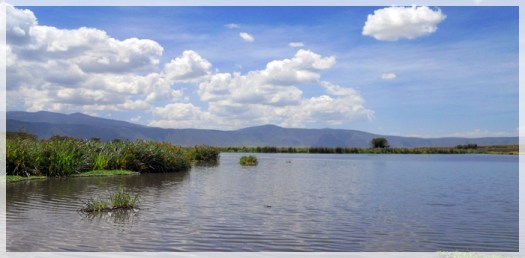
ngorongoro crater

At the blast of your breath, the waters piled up! The surging waters stood straight like a wall; in the heart of the sea the deep waters became hard. … The finest of Pharaoh’s officers are drowned in the Red Sea. The deep waters gushed over them; they sank to the bottom like a stone. [Exodus 15:8,4-5 (NLT)]

Skeptics love questioning the miracle of the Red Sea. Either they provide a natural explanation or deny it ever happened. Unfortunately, sometimes we even find believers doing the same thing. A miracle is usually defined as something that violates the laws of nature, but God wrote those laws! “Miracles are not contrary to nature,” said Augustine, “but only contrary to what we know about nature.” As Christians, we base our faith on a miracle—the resurrection of Jesus—so a belief in God’s powerful ability to defy nature’s laws is essential to our faith.

How can the waters part for the Israelites and then come surging down on the pursuing Egyptians? For decades, scientists have tried to find a natural explanation using various computer models. In spite of Moses giving a good description of where their crossing occurred, land and water are not static and the topography of the area has shifted over 3,500 years. Not knowing exactly where it happened, many suggest that, instead of it being the Red Sea, the crossing actually took place further north in a shallow lake called the Reed Sea. They explain that a wind temporarily drained this shallow marshy area just enough to allow the Israelites to safely cross. The Hebrew word used to describe the seabed was yahbashah which means dry land, not the muck or mud of a damp marsh. Moreover, while the Egyptians with their heavy chariots might have gotten bogged down in the mire, that can’t explain how an entire army was drowned in a few feet of water.

Other skeptics have argued that a volcano or earthquake north of Egypt produced a tidal wave or tsunami that parted the Red Sea. A tidal wave happens suddenly which hardly supports Moses’ description of the gradual retreat of the waters during the night or the fortuitous return of the waters in time to drown the Egyptians.

Scientists also have estimated that a steady 63 mph wind from the east could have swept the water back to the western shore to create a land bridge. Winds of just 45 mph make driving hazardous and can knock down a person weighing 100 pounds. A wind of 63 mph would make the crossing nearly impossible. Moreover, Moses described two walls of water, one on each side. I’m not a scientist but two opposing walls of water would seem to imply winds blowing in opposite directions and I can’t see how anyone could get anywhere in that kind of crosswind! When considering the width of the path required for about two million Israelites (along with sheep, goats, and cattle) to cross a seabed in just part of one night, it needed to be at least one mile wide. It’s hard to believe that any natural wind could do that.

Even if some of these explanations are partially or totally correct, there is no explanation for what would seem to be the most amazing coincidence in all of history: that the Israelites arrived at some body of water at the exact moment a tsunami or gale force winds occurred that caused the waters to recede, that the land remained dry just long enough for them to cross, and that the waters gushed back at precisely the moment the Egyptians were in the seabed! That so-called coincidence would require the miraculous power of Almighty God!

Scientists admit they can’t explain everything but even a valid scientific or medical explanation doesn’t negate a belief in the hand of God. While her doctors might say that Pearl’s recovery from metastasized cancer is a result of oncology advances, they originally thought she’d not live a year. While John’s doctors could say his ability to walk after having his pelvis crushed is the result of their skills as orthopedic surgeons, they initially thought he wouldn’t live, let alone walk! I know how thoroughly Pearl’s body was attacked by cancer and I’ve seen John’s x-rays; I have no doubt that without our prayers and God’s intervention, modern medicine would have failed them both. In spite of a medical explanation for their recoveries, they are nothing short of miraculous.

Skeptics and atheists have trouble believing in miracles because a belief in miracles necessitates believing in the hand of someone or something that can cause them: God. I’ve seen His wonderful work firsthand; our God is a God of miracles and that’s explanation enough for me!

I will meditate on your majestic, glorious splendor and your wonderful miracles. [Psalm 145:5 (NLT)]

He does great things too marvelous to understand. He performs countless miracles. [Job 9:10 (NLT)]

Copyright ©2018 jsjdevotions. All rights reserved.