
We were crushed and overwhelmed beyond our ability to endure, and we thought we would never live through it. In fact, we expected to die. But as a result, we stopped relying on ourselves and learned to rely only on God, who raises the dead. And he did rescue us from mortal danger, and he will rescue us again. We have placed our confidence in him, and he will continue to rescue us. [2 Corinthians 1:8-10 (NLT)]
 600 war chariots and at least 1,200 soldiers were fast approaching and the Israelites were trapped between the mountains and the Red Sea. Panicking, they immediately blamed Moses for their predicament. No longer regarding Moses as the man who freed them from years of suffering slavery, he was now the fool who’d led them to certain death in the wilderness. In despair, the Israelites second-guessed their decision to leave Egypt. Facing such a formidable army and sure they were to die, the miseries of slavery now appealed to them. Ungrateful, unarmed, on foot, and with no place to turn, they lost heart. Failing to recall God’s powerful hand in releasing them from Pharaoh’s tyranny just a few weeks earlier, they immediately conceded defeat.
Have you ever felt like the Israelites: between a rock and a hard place, with no place to turn? When that happens, we usually do what they did: panic, find someone to blame, lose heart and want to quit because the circumstances seem greater than our God. Assuring the people that God would fight for them, Moses said, “Watch the Lord rescue you today.” I’m not sure he had any idea how the Lord planned on doing that but Moses trusted the God he knew for a solution he didn’t know.
Following God’s instructions, Moses raised his hand over the waters, the Red Sea parted as blowing winds turned the sea into dry land, and the Israelites walked across the seabed. Although we know that all the Israelites safely made it across, they didn’t know that’s what would happen! Can you imagine the faith it took when the first of them stepped onto the dry seabed with a wall of water positioned on each side? Were they fearful the waves would come rushing at them without warning? Did they literally run for their lives as they crossed? We know the rest of the story: Pharaoh and his army gave chase, their chariots got stuck, Moses raised his hand once again, the waters surged over the Egyptians and none of them survived.
Seeing God’s tremendous power, the Israelites were filled with awe and again put their faith in Moses and the Lord. What a great ending to their story, but we know it doesn’t end there. That won’t be the last time they complain, the last time they think slavery in Egypt a better option than freedom in the Promised Land, the last time they rebel against Moses’ leadership, or the last time they stop having faith in the Lord. Sadly, it won’t be the last time they forget God’s faithfulness, power and might!
Sometimes God brings us to what seems to be an impossible situation: to that spot between a rock and a hard place or an army and the deep blue sea. Those barriers are put before us so that we have nowhere to turn but to God. While He may not have parted the Red Sea for us, there have been many times that He’s led us safely through a whole sea of troubles. Unlike the Israelites, may we never forget His power and faithfulness in those trying times. Let us always be willing to trust our unknown future to our known God.
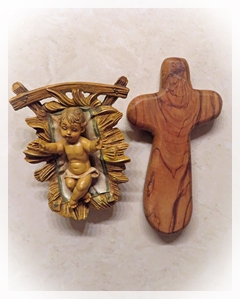 Pew Research reports that while 90% of Americans celebrate Christmas, more than half of them celebrate it only as a cultural holiday! While they’ll decorate their house with lights and wreaths, trim a tree, send cards, and exchange gifts, Christmas is just an excuse for good food, parties, family gatherings, and presents. While they’re not indifferent to Santa, gifts, merriment, or decorations, like the people of 1st century Palestine, they are indifferent to the Christ child. The shepherds saw the star and sought the babe in the manger and a caravan from the East brought Him gifts, but we don’t read of any townspeople visiting Joseph and Mary. What of the priests and scribes who told Herod where the Messiah would be born? They knew the prophecies but didn’t join the Magi in their quest to find the One who would fulfill those prophecies. Lowly shepherds and men from a faraway land recognized Jesus as the Messiah but most of God’s chosen people ignored the greatest event in all of history.
 “I didn’t know Van was racing,” I said as he skied through the gates and sped across the finish line. “He isn’t,” explained his wife. “He’s just a forerunner.” While the focus is on the racers at a ski race, there wouldn’t be any race without the forerunners. Before the race begins, forerunners ski the course, set the line, allow the officials to test their systems, and assess course conditions. While proficient enough to race the course well, they are not in the competition. Although it’s an honor to be a forerunner, forerunners don’t get a number, nobody knows their names, and only the judges care about their times. It’s the races’ winners who get the accolades. Understanding that the race is not theirs to run, forerunners are happy just to prepare the way!
 Yesterday’s devotion about Mary made me wonder about Joseph. Other than having the right lineage, why did God chose this carpenter to raise His one and only Son? Mary and Joseph were betrothed and engagement in 1st century Palestine was a serious commitment. A legally binding relationship, betrothal usually lasted ten to twelve months. Although the bride continued to live at home and the couple did not have marital relations, their engagement ended only through death or a divorce-like proceeding.
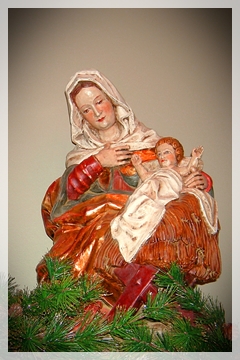 Ignoring the fact that most of us in the room couldn’t qualify as virgins, are well-past child-bearing age, and our genealogies don’t link us to the tribe of Judah and the line of David, the pastor leading our women’s Bible study asked if we were the kind of women God would chose to give birth to His son.
 You must have the same attitude that Christ Jesus had. Though he was God, he did not think of equality with God as something to cling to. Instead, he gave up his divine privileges; he took the humble position of a slave and was born as a human being. [Philippians 2:5-7 (NLT)]
 Devotions of the Heart