ORGANIZING PRAYERS

I urge you, first of all, to pray for all people. Ask God to help them; intercede on their behalf, and give thanks for them. [1 Timothy 2:1 (NLT)]
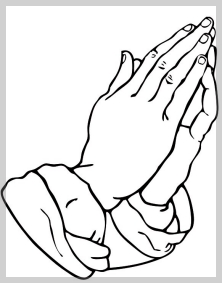
While there are no hard and fast rules about prayer except to believe in it and do it, some people use acronyms to help organize their prayers. The PRAY method stands for Praise, Repent, Ask, and Yield while the ACTS method formats prayer into Admiration (praise), Confession, Thanksgiving, and Supplication (asking God for what is needed). A TACOS prayer structure is Thanks, Adoration (or Applause), Confession, Others, and Self. Rather than an acronym, I was taught “The Hand of Prayer” as a girl. Beginning with the thumb, the order was Praise, Thanksgiving, Confession, Intercession (prayer for others), and Petition (prayer for oneself).

Regardless of how we do it, we should remember that only after we’ve put God first in our prayers, are we to pray for others and ourselves. I, for one, admit that I often speed through praise and thanks along with confession and repentance to get right to the asking. Worse, I find that my personal petitions frequently preempt and outweigh my intercessory prayers.

There is nothing wrong with praying for ourselves. In the Lord’s Prayer, we were taught to ask for our daily needs, forgiveness of sins, and deliverance from temptation. The Psalms are filled with pleas for God to intervene in the psalmists’ lives. Hannah, Jabez, David, Paul and even Jesus prayed for themselves. Praying for ourselves brings us into an intimate relationship with God and invites His blessings into our lives. The problem arises when we come to God just for those blessings without acknowledging Him or praying for others. Remembering our “God blesses” for others didn’t end with adulthood!

Before he became Pope Francis, Cardinal Bergoglio is said to have created the “Five Finger” prayer approach to help little ones remember their many “God blesses.” His method helps us remember to offer our prayers for others, as well. Because it’s nearest to the body when hands are folded in prayer, the thumb reminds us to pray for the people who are nearest and dearest—our family and friends. The index or pointing finger is a reminder to pray for those people (e.g. teachers, counselors, doctors, and pastors) who point us in the right direction. As the strongest and tallest, the middle finger is a prompt to pray for those in power and authority (even the ones with whom we disagree). Because it is the weakest digit with the least amount of dexterity, the fourth (or ring) finger reminds us to pray for the weak and powerless (e.g. the homeless, vulnerable, impoverished, and suffering). It is only when we get to the pinky that we pray for ourselves and our own needs. That little finger is a vivid reminder of how small we are in relation to God and how small our needs are in relation to the needs of others.

It is both a responsibility and a privilege to lift others’ needs to God in prayer. Abraham interceded for the people of Sodom, Job for his friends, Moses for the Israelites, the early church for the imprisoned Peter, Daniel for his captive nation, Paul for the readers of his letters, and Jesus for His disciples. John Calvin said, “To make intercession for men is the most powerful and practical way in which we can express our love for them.” When we pray with our five fingers, we have four fingers reminding us to do just that!

We are never more like Christ than in prayers of intercession. [Austin Phelps]

Pray in the Spirit at all times and on every occasion. Stay alert and be persistent in your prayers for all believers everywhere. [Ephesians 6:18 (NLT)]

Share each other’s burdens, and in this way obey the law of Christ. [Galatians 6:2 (NLT)]

Copyright ©2025 jsjdevotions. All rights reserved.

PROOF

Seeing their faith, Jesus told the paralytic, “Son, your sins are forgiven.” But some of the scribes were sitting there, questioning in their hearts: “Why does he speak like this? He’s blaspheming! Who can forgive sins but God alone?” [Mark 2:5-7 (CSB)]

white campionBy forgiving people’s sins, Jesus was placing Himself in the role of God because only God can forgive sins. Had Jesus not been God, it would have been blasphemy. When He raised the dead, multiplied food, stilled storms, and healed incurable diseases, Jesus was doing other things that only God could do. His incredible claim that He could bring Himself back from the dead, something only God could do, was another way Jesus claimed His divinity. The undeniable proof of His claim came Easter morning when Jesus demonstrated power over both life and death. The tomb was empty and people saw the risen Christ—they heard Him speak, watched Him eat, saw His wounds, and touched Him. The forty days the resurrected Jesus remained on earth, however, is about more than proof of his claim to be God; it’s about proof of our relationship to God.
Let’s return to the disciples in that locked room Easter morning. The man they thought was going to redeem Israel was dead and His body was missing. Were they any less confused, disappointed, frightened, or troubled by those events than the two Christ followers returning to Emmaus that day? Not only were the disciples perplexed, they probably were guilt-ridden, as well. Peter, John, and James had failed to stay awake and pray with Jesus in Gethsemane and Mark tells us they all deserted Him that night. After promising he’d never deny Jesus, Peter did just that three times! Jesus’ closest companions were nowhere to be found the following day when the crowd shouted “Crucify Him!” and it was a stranger who carried His cross. The only disciple at the crucifixion was John. Rather than any of the disciples, it was Joseph of Arimathea and Nicodemus who boldly risked their positions in the high council to see that Jesus got a proper burial.

When Jesus appeared to His disciples on Easter, thinking Him a ghost, they were startled and frightened. Once they knew it was the Lord, I’m not so sure they stopped being afraid of Him. But, instead of a reprimand for their doubt, Jesus simply showed them His hands and feet. Rather than shaming them for their cowardice, He spoke of forgiveness. While they may have anticipated a rebuke for their incomprehension and confusion, Jesus patiently explained the Scriptures’ prophecies and how He fulfilled them. When He appeared to Thomas, rather than scolding the doubter, Jesus told him to believe and offered proof. When Jesus appeared to the seven beside the Sea of Galilee, He didn’t admonish them for returning to their livelihood. Instead, He provided them with an enormous catch and made breakfast! Rather than confront Peter about his betrayal, Jesus restored their relationship and spoke to him of love. We know the Lord also spent time with his family but, rather than exacting retribution from the ones who thought him a religious fanatic, He forgave them; His half-brothers (two of which wrote epistles) joined His followers. Moreover, when Jesus finally ascended into Heaven, He didn’t leave His followers alone; He gave them His Holy Spirit!

The Resurrection tells us that Jesus defeated sin, Satan, and death and proves that He was God. The forty days the resurrected Christ spent on earth, however, tells us that the God who lived as a man for over thirty years was like the man who died and rose as God. It demonstrates that He was as gentle, patient, loving, and forgiving after the resurrection as He was before. He calmed the disciples’ fears, answered their questions, eased their doubts, knew their concerns, forgave their failures, and loved each one of them. A God of relationship, Jesus continues to know, see, hear, love, and forgive us today.

What was from the beginning, what we have heard, what we have seen with our eyes, what we have observed and have touched with our hands, concerning the word of life—that life was revealed, and we have seen it and we testify and declare to you the eternal life that was with the Father and was revealed to us—what we have seen and heard we also declare to you, so that you may also have fellowship with us; and indeed our fellowship is with the Father and with his Son, Jesus Christ. [1 John 1:1-3 (CSB)]

And we have seen and we testify that the Father has sent his Son as the world’s Savior. Whoever confesses that Jesus is the Son of God—God remains in him and he in God. And we have come to know and to believe the love that God has for us. [1 John 4:14-16]

Copyright ©2025 jsjdevotions. All rights reserved.

EASTER ISN’T OVER

Christ died for our sins, just as the Scriptures said. He was buried, and he was raised from the dead on the third day, just as the Scriptures said. He was seen by Peter and then by the Twelve. After that, he was seen by more than 500 of his followers at one time, most of whom are still alive, though some have died. Then he was seen by James and later by all the apostles. Last of all, as though I had been born at the wrong time, I also saw him. [1 Corinthians 15:3-8 (NLT)]

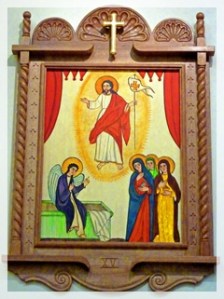
Station XVFound in almost every Roman Catholic church (and some Protestant and Orthodox ones), are the Stations of the Cross—a series of fourteen icons or carvings on the walls—each of which depict a moment in the Passion of Christ. Created to help people contemplate the events leading up to Christ’s crucifixion, they start with His death sentence from Pilate and end with His dead and battered body being laid in the tomb. Because Good Friday and Jesus’ death aren’t the end of the story, some churches have begun adding the resurrected Christ as a 15th station.

More recently, the idea of “Stations of the Resurrection” has taken hold in both Roman Catholic and Protestant traditions. While the Stations of the Cross depict just one day in the life of Christ, the Stations of the Resurrection illustrate the 50 days of Eastertide. There is no official list of “stations” but they usually begin with the angel speaking to the women at the empty tomb. They continue through the days Jesus remained on earth showing events like Jesus on the road to Emmaus and His appearance to the disciples on Easter, as well as His appearances to Thomas, the disciples on the shore, and the 500 mentioned by Paul. After portraying Jesus’ Ascension on the 40th day, the “stations” conclude either with the Holy Spirit’s descent on the 50th day (Pentecost) or Jesus’ appearance to Paul on the road to Damascus.

Having spent the season of Lent spiritually preparing for Good Friday and Easter Sunday, we shouldn’t need the Stations of the Cross or those of the Resurrection to help us remember Christ’s suffering, death, and rising from the dead. Nevertheless, once we put away the Easter baskets, we may not give Easter another thought until the following year. Easter, however, is more than one day; it is a liturgical season called Eastertide. Lasting for seven weeks, it concludes with Pentecost. Why not spend these weeks reading about and meditating on those 50 days in the gospels and Acts. Imagine the shock of finding an empty tomb. What was it like for Cleopas when he realized the stranger with whom he’d walked, talked, and broken bread was the resurrected Messiah? If you’d been one of His frightened followers hiding in a locked room, how would you react to seeing Jesus miraculously appear? Visualize seeing the scars on His hands and feet. What was it like to have breakfast with Him on the beach and to walk with Him, hear His voice, and witness His miracles once again? Can you imagine watching Jesus ascend into Heaven? Picture what it was like that 50th day on Pentecost when the disciples were filled with the power of the Holy Spirit. Consider how Peter, the one who denied Christ three times, became the one who boldly proclaimed Him “Lord and Messiah.” The Easter story doesn’t end at Easter, or even at Pentecost; it continues to unfold today!

Christ’s resurrection is the most powerful world-shaping event in history. It is why we are freed from our sins and live in hope not fear! The good news of Easter is so good that we should continue to celebrate Christ’s resurrection long after the rest of the world (having eaten the last of the Peeps and chocolate rabbits) is thinking about the next holiday. Remembering Easter and the events that followed should be an important part of our spiritual lives—not just for the 50 days of Eastertide—but all year long. As Augustine of Hippo said, “We are an Easter people and Alleluia is our hymn of praise!” Let us be Easter people all year long. Alleluia!

 God raised Jesus from the dead, and we are all witnesses of this. Now he is exalted to the place of highest honor in heaven, at God’s right hand. And the Father, as he had promised, gave him the Holy Spirit to pour out upon us, just as you see and hear today. … So let everyone in Israel know for certain that God has made this Jesus, whom you crucified, to be both Lord and Messiah! [Acts 2:32-33, 36 (NLT)]

Copyright ©2025 jsjdevotions. All rights reserved.

THE LORD’S TABLE – Maundy Thursday

You prepare a table before me in the presence of my enemies; You anoint my head with oil; my cup overflows. [Psalm 23:5 (CSB)]

The cup of blessing that we bless, is it not a sharing in the blood of Christ? The bread that we break, is it not a sharing in the body of Christ? [1 Corinthians 10:16 (CSB)]

While touring an historic house, the elaborately set dinner table reminded me of the large formal dinner parties we had in our younger (and more energetic) days. I’d start preparing the table in advance by adding extra leaves to the table, gathering the extra chairs, and ironing out the creases in the damask tablecloth. From the cupboard in the basement, I’d haul up the crystal salad plates, my mother’s Lenox china, and the hand-painted Bavarian service plates and Czechoslovakian dessert plates that were my grandmother’s. I’d spend hours polishing the silverware and serving pieces. The service plates were set out, the silverware laid, the crystal wine and water goblets carefully placed at each setting, and the napkins artfully folded. I’d set out the silver candlesticks, put in fresh candles, get flowers from the florist, and create what I hoped would be the perfect Martha Stewart-worthy table setting. There was plenty more work to do in the kitchen. I’d spend days perusing recipes, planning the menu, making lists, purchasing food, and preparing it all. I loved doing it because I loved the people for whom I did it. Nevertheless, as nice as my guests were and as much as they enjoyed themselves, I’m not sure they truly appreciated how much effort went into everything that on that table.
As I approached the Lord’s Table for communion last week, I wondered if I genuinely appreciate all that Jesus did to prepare His table of blessings for me. Do I truly value His gift of body and blood? It cost Him far more than a few days of work and the price He paid was greater than any I ever paid for lobster, prime rib, artisan cheese, or vintage wine. I thought of Him washing the feet of the disciples and of His anguish as he prayed alone in the garden. I thought of His disappointment at Judas’ betrayal, Peter’s denial, and the disciples’ desertion. I thought of His silence in front of Caiaphas and Pilate, His flogging and mocking at the hands of the Roman soldiers, His arduous walk to Golgotha, and His suffering on Calvary. He may have been God but He was in a man’s body and suffered and died as a man for you and for me. Yet, Jesus welcomes us, sinners all, to come to His table and share in His gifts.

There always was plenty of laughter at my table but coming to the Lord’s table is a sacred occasion and not to be taken lightly. While my guests didn’t have to make any preparations to come to our feast, we should prepare for the Lord’s feast by seriously examining ourselves and then by repenting and forgiving where repentance and forgiveness are needed. Coming to the Lord’s Supper is a solemn time to remember, reflect, recommit, and reconnect with Jesus.

I’d like to think my guests never left my table hungry or thirsty; nevertheless, I know they were hungry and thirsty by the next morning. When we come to Jesus’ table, our hunger and thirst will be forever satisfied because we are filled with the Bread of Life and the living water of the Lord!

Jesus Christ, host of this meal, you have given us not only this bread and cup, but your very self, that we may feast on your great love. Filled again by these signs of your grace, may we hunger for your reign of justice, may we thirst for your way of peace, for you are Lord forevermore. Amen. [Lutheran Book of Worship]

“I am the bread of life,” Jesus told them. “No one who comes to me will ever be hungry, and no one who believes in me will ever be thirsty again. … I am the living bread that came down from heaven. If anyone eats of this bread he will live forever. The bread that I will give for the life of the world is my flesh.” [John 6:35,51 (CSB)]

Copyright ©2025 jsjdevotions. All rights reserved.

WHAT ABOUT JUDAS?

As they were at the table eating, Jesus said, “I tell you the truth, one of you eating with me here will betray me.” Greatly distressed, each one asked in turn, “Am I the one?” He replied, “It is one of you twelve who is eating from this bowl with me. For the Son of Man must die, as the Scriptures declared long ago.” [Mark 14:18-21 (NLT)]

In my last post, I pondered why Jesus chose the men he did as his apostles. As we enter Holy Week and the events leading to the Lord’s arrest and crucifixion, I wonder specifically about Judas Iscariot. We don’t know what Jesus saw in Judas when he was chosen as one of the twelve or even what was in Judas’ heart in the beginning of Jesus’ ministry. We only know that discontent, ambition, and greed had entered his treacherous heart by the end.

Since all of His disciples abandoned Jesus that night in the garden, perhaps all twelve had the potential to be His betrayer. Peter not only fled, but he also denied Jesus—three times! The zealot Simon easily could have become disappointed in Jesus when it became clear that overthrowing Rome was not part of the Lord’s plan. Matthew’s past was shady and, like Judas, he could have been tempted to steal from their money bag and sell out the Lord. We have James and John: the angry men who wanted to call down fire on a Samaritan village because it wouldn’t welcome Jesus. The brothers had hoped for honored places by the earthly throne of Jesus. Could their disappointment in Jesus’ response to their request along with all His talk about being a servant have caused the brothers to think about betrayal? The disciples were twelve ordinary men—perhaps, any one of them could have chosen to be the betrayer.

As they gathered around the table that last night, Jesus told His disciples that He’d be betrayed by one of them. Rather than asking Jesus, “Who?” one by one the men asked, “Am I the one?” It seems that each disciple thought himself capable of betrayal. After all, throughout their three years with the Lord, they all must have had moments of disillusionment, doubt, fear, and confusion. Nevertheless, only one man allowed Satan to enter his heart.

Like Judas, we all harbor darkness in our hearts—each of us is capable of unspeakable evil. We can choose to be faithful or unfaithful, true or false, friend or foe. We can be true to Jesus or betray Him—the choice is ours.

Still, it’s difficult to understand why Jesus kept Judas around until that last night. Knowing what was going to happen, how could Jesus wash his feet and break bread with him? Later in the garden, when Judas greeted Him with a kiss, how could Jesus call him “friend?” Our Lord never asks us to do something He hasn’t done Himself. Perhaps, Jesus’ relationship with Judas was His way of demonstrating the sort of behavior He wants from all of His disciples—love, mercy, and forgiveness for our enemies, even for those who betray us! Let us remember the words He spoke from the cross: “Father, forgive them, for they don’t know what they are doing.” [Luke 23:34]

So now I am giving you a new commandment: Love each other. Just as I have loved you, you should love each other. Your love for one another will prove to the world that you are my disciples. [John 13:34-35 (NLT)]

Copyright ©2025 jsjdevotions. All rights reserved.

WHY THEM?

Now at this time Jesus went off to the mountain to pray, and He spent the whole night in prayer to God. When day came, He called His disciples and selected twelve of them, whom He also named apostles (special messengers, personally chosen representatives): Simon, whom He also named Peter, and his brother Andrew; and [the brothers] James and John; and Philip, and Bartholomew [also called Nathanael]; and Matthew (Levi, the tax collector) and Thomas; and James the son of Alphaeus, and Simon who was called the Zealot; Judas [also called Thaddaeus] the son of James, and Judas Iscariot, who became a traitor [to the Lord]. [Luke 6:12-16 (AMP)]

We know Jesus prayed all night before choosing His Apostles. What made Him select those twelve men for His inner circle? Perhaps Andrew and John, having previously been disciples of John the Baptizer, were primed for the arrival of the Messiah but why did Jesus choose Andrew’s brother Simon/Peter and John’s brother James? Jesus called John and James the “Sons of Thunder,” implying they were bold, rash, and quick to anger. Why would Jesus choose them rather than men more even-tempered and less impetuous? For that matter, why four fishermen instead of students of the Torah? You don’t have to know how to cast a net to go fishing for people!

Smelling better than a fishermen but carrying the odor of corruption with him, as a tax collector, Matthew was forbidden to testify in court. Nevertheless, he was chosen to testify for Christ!  Why did Jesus select Simon the Zealot? Zealots were agitators who wanted to overthrow the Roman government. Did Jesus need a radical activist in His entourage? A zealot’s sworn enemies were people like Matthew—Jews who collaborated with Rome. Yet, Jesus selected them both!

At least Jesus’ choice of Bartholomew (also called Nathanael) made more sense; Jesus called him “a man of integrity” when they first met. That Thomas was a twin or Philip came from Bethsaida hardly seem reasons for their selection. While we know both James’ (known as ”the younger” or “the lesser”) and Judas/Thaddaeus’ fathers’ names and that that Judas Iscariot was from Karioth, we don’t know why Jesus chose them either.

While Acts tells us the remaining eleven set qualifications for Judas Iscariot’s replacement, we don’t know why Jesus chose this odd assortment of men to be His inner circle of twelve. None of them were theologians or scholars; most probably were fishermen. Other than Matthew’s record keeping skills, it’s hard to see any special skills they brought to Jesus’ ministry. After all, you don’t have to know how to cast a net to go fishing for people! Why these nobodies rather than someone noteworthy or well-known? While it was prayer that determined Jesus’ selection, what about these twelve caused God to select them as the core of Christ’s church?

Twelve men, remarkably unexceptional—twelve men just like you and me. Jesus, however, wasn’t looking at their CVs; He was looking at their hearts! Rather than expertise, experience, or accomplishments, He was looking for possibility. He didn’t care who they’d been or what they’d done in the past; what mattered was who they could become and what they could do in the future. Jesus provided them with all they needed to become the people they needed to be.

The Apostles didn’t have funding, organization, church buildings, choir, websites, apps, hymnals, or even the New Testament and yet, that first Pentecost, the remaining eleven and Matthias (who replaced Judas) brought 3,000 into the new church through the power of the Holy Spirit. Because they believed in the risen Christ, twelve ordinary men accomplished the extraordinary through the power of the Holy Spirit. Just think what we could do if only we would try!

Jesus came near and said to them, “All authority has been given to me in heaven and on earth. Go, therefore, and make disciples of all nations, baptizing them in the name of the Father and of the Son and of the Holy Spirit, teaching them to observe everything I have commanded you. And remember, I am with you always, to the end of the age.” [Matthew 28:18-20 (CSB)]

Copyright ©2025 jsjdevotions. All rights reserved.