TWO MISTAKES

After the festival was over, while his parents were returning home, the boy Jesus stayed behind in Jerusalem, but they were unaware of it. Thinking he was in their company, they traveled on for a day. [Luke 2:43-44 (NIV)]

He asked her, “Woman, why are you crying? Who is it you are looking for?” Thinking he was the gardener, she said, “Sir, if you have carried him away, tell me where you have put him, and I will get him.” [John 20:15 (NIV)]

spiderwortEvery year, Jesus and His family went to Jerusalem to celebrate the pilgrimage festival of Passover. Entire villages would travel together and the city was jam packed with worshipers when they departed for Nazareth. The men probably traveled apart from the women and children. Jesus, being twelve and no longer a little boy but not yet a man, could have been with either group. Perhaps Mary thought Him with the men while Joseph thought He was with the children. They didn’t know Jesus wasn’t there until they stopped that night. Moving with the crowd, his parents had mistakenly presumed His presence.

Sometimes, we get so caught up in the crowd’s movement that we fail to make sure Jesus is with us on our journey. We forget that it is the sheep who follow the shepherd and not the other way around. It took Joseph and Mary three days before they found Jesus in His Father’s house doing His Father’s business. Let us learn from them and look there for Him first. Be reassured; it’s never too late to turn back. If we seek Him, He will be found!

On the other hand, some people thought Jesus was absent when He was right in front of them. Never expecting to see a risen Christ, the tearful Mary Magdalene thought Jesus was the gardener. The two walking to Emmaus were unable to recognize the risen Christ because they were in a heated discussion (the Greek word was syzetein  meaning “strong debate”) about the meaning of the crucifixion and the empty tomb. Focusing on their sorrow, fear, doubt and confusion, Mary and the travelers didn’t realize they were in His presence!

Even though Jesus is right beside us, there are times in our lives we can’t recognize Him because we’re not looking for Him. Rather than seeking a resurrected Jesus, Mary just wanted to anoint a dead body and the two travelers were looking for answers rather than the Savior. Let’s never settle for anything less than seeing the risen Christ.

There are two mistakes we can make about Jesus: we can think He’s present when we’ve gone off without Him and we can think He’s absent when He’s right beside us. Let’s not make either mistake!

And surely I am with you always, to the very end of the age. [Matthew 28:20b (NIV)]

Those who know your name trust in you, for you, Lord, have never forsaken those who seek you. [Psalm 9:10 (NIV)]

For I am convinced that neither death nor life, neither angels nor demons, neither the present nor the future, nor any powers, neither height nor depth, nor anything else in all creation, will be able to separate us from the love of God that is in Christ Jesus our Lord. [Romans 8:38-39 (NIV)]

Copyright ©2020 jsjdevotions. All rights reserved.

DEADLINES

The king said to me (the queen also was sitting beside him), “How long will you be gone, and when will you return?” So it pleased the king to send me, and I set him a date. [Nehemiah 2:6 (NSRV)]

wiggens pass sunset“Work expands to fill the time available for its completion,” is what’s known as Parkinson’s Law. Writing those words in 1955, Parkinson wasn’t talking about deadlines; he was taking aim at the British Civil Service and government bureaucracies that become less efficient as they increase in size. Nevertheless, later studies have shown that without strict time constraints, we tend to waste time and work takes longer than necessary to complete.

When this pandemic began, all sorts of obligations were cleared from my calendar and, with nowhere to go and nothing to do, I was sure lots of writing would get done. How wrong I was! Like others who found themselves with excess time and no deadlines or sense of urgency, instead of getting more done, I’m accomplishing less.

When Jerusalem fell to Babylon, the Temple was destroyed and the city left in shambles. After Zerubabbel led the first group of exiles back, it took twenty years to rebuild the Temple. Seventy years after its completion, however, the city walls were still in ruins. When Nehemiah asked King Artaxerxes permission to return to Jerusalem to rebuild the city, the King asked how long he would be gone. Given Nehemiah’s weighty responsibilities in court, it’s logical to assume that the king would not agree to a lengthy absence. As the king’s cup-bearer, Nehemiah’s presence was essential to the king. His duties included being the chief financial officer and bearer of his signet ring. As the king’s wine taster, his job was to sample royal beverages to test for poison.

Before making his request, Nehemiah must have carefully considered both the amount of time necessary for such a task and the length of time the king would allow his absence. Although we don’t know Nehemiah’s answer, the king found it reasonable and the men agreed upon a time frame. With no target date, the wall hadn’t been repaired in over ninety years; with a deadline, the project was completed in a record 52 days!

Although Scripture mentions Nehemiah returning to Babylon twelve years later, it’s difficult to think the king would have agreed to be without his cup-bearer for that length of time. It’s more likely that a specific deadline, perhaps as brief as two months, had been set and Nehemiah returned promptly after the wall’s completion. Having shown his excellent leadership qualities, it probably was then that Artaxerxes appointed Nehemiah Judah’s governor and sent him back to Jerusalem. If the King originally had agreed to a twelve year absence, I suspect the wall may have taken nearly that long to complete!

Deadlines motivate us; they keep us from growing lethargic or unconcerned. Let us never forget that we all live with two deadlines: our own personal expiration date and the world’s. Although we know that both cutoff dates will occur, we don’t know when. Let us never grow lax and apathetic or lose a sense of urgency about doing the Lord’s work. Viewing every day as a gift, we must use our time wisely and enthusiastically to glorify God and bring about His Kingdom. Let us live this day to the fullest as if it were our last. After all, it very well could be!

But about that day and hour no one knows, neither the angels of heaven, nor the Son, but only the Father. … Therefore you also must be ready, for the Son of Man is coming at an unexpected hour. [Matthew 24:36,44 (NSRV)]

You therefore, beloved, since you are forewarned, beware that you are not carried away with the error of the lawless and lose your own stability. But grow in the grace and knowledge of our Lord and Savior Jesus Christ. To him be the glory both now and to the day of eternity. Amen. [2 Peter 3:17-18 (NSRV)]

Copyright ©2020 jsjdevotions. All rights reserved.

SAVORING THE PSALMS

Your eternal word, O Lord, stands firm in heaven. Your faithfulness extends to every generation, as enduring as the earth you created. Your regulations remain true to this day, for everything serves your plans. [Psalm 119:89-91 (NLT)]

spreading dogbane

Because she enjoyed saying the psalms in unison during church, my friend wanted to read the entire book of Psalms. Viewing it as a project, she read at least five psalms a day. But, rather than savoring them individually as she might a Mother’s Day card from her son, she sped through them as she would a novel and what should have been a pleasure was a disappointment.

The unique beauty of a diamond ring isn’t discernible until it’s taken out of the display case, placed on black velvet, and viewed from all angles through a jeweler’s loupe. To truly appreciate the gem, however, it helps to know something about diamonds; it’s the same with the Psalms. Because they’re poetry, they’re best viewed and appreciated one at a time. While we don’t need to know the 4 C’s of gemology, knowing something about the psalms’ poetic structure helps us understand and appreciate these ancient songs of worship.

Written and collected from the time of Moses (1440 BC) to the Israelites’ return from their Babylonian captivity in 450 BC, the psalms express the full range of human emotion from the greatest joy to the deepest despair. Their passion goes from brutal and graphic appeals for an enemy’s destruction to jubilant cries of praise and thanksgiving (sometimes in the same psalm). Like all poetry, the psalms employ a number of literary devices to pack the biggest amount of thought into as few words as possible. Their use of meter, acrostics, metaphor and simile, hyperbole, emotional rather than logical connections, and something called parallelism mean that the reader has to read them thoughtfully to unpack their complete meaning.

To stay true to their original content, poetic aspects like compression and meter are lost in translation. For example, Psalm 23’s “The Lord is my shepherd, I shall not want,” is only four words in Hebrew and “He makes me lie down in green pastures,” is only three! Also lost in translation is the beauty of the acrostic psalms in which the initial letter of each line or phrase was in alphabetic order. Psalm 119, for example, is made up of 22 sections, starting with aleph and ending with tav, with the rest of the Hebrew alphabet in-between. The acrostic may have signified that the subject had been covered completely (“from A to Z”) or could have served as a mnemonic device for memorizing the psalm.

One thing we don’t lose in translation is rhyme; even in Hebrew, the psalms never rhymed. Rather than rhyme, they used something called parallelism. Rather than words sounding alike, two or more thoughts sounded alike as the psalmist repeated the same thought or phrase one or more times. In many cases, the identical thought was clearly repeated, as in Psalm 18:4: “The ropes of death entangled me; the floods of destruction swept over me.” Sometimes, the parallel lines contrasted with or opposed one another, as in Psalm 18:27: “You rescue the humble, but you humiliate the proud.” Successive lines often built on and developed the first line, as in Psalm 1:1: “Oh the joys of those who do not follow the advice of the wicked, or stand around with sinners, or join with mockers.” Unlike rhyme or meter, parallelism translates into any language which makes the beauty of the psalms universal. I don’t think that happened by accident. Regardless of who penned them, like the rest of Scripture, the Psalms clearly were God-breathed and meant for all people in all times.

The psalms are more than poetry; they are beautifully written prayers and should be read slowly and reverently. I’ve suggested that my friend start over by reading only one psalm each day and thinking of Psalms as she might a box of deliciously rich gourmet chocolate. Psalm 34:8 says, “Taste and see that the Lord is good.” By consuming just one psalm (or one chocolate) at a time, the whole complexity and richness of each one will get the attention it deserves.

How sweet your words taste to me; they are sweeter than honey. [Psalm 119:103 (NLT)]

Copyright ©2020 jsjdevotions. All rights reserved.

THE RIGHT PATH

You’re blessed when you stay on course, walking steadily on the road revealed by God. You’re blessed when you follow his directions, doing your best to find him. That’s right—you don’t go off on your own; you walk straight along the road he set. [Psalm 119:1-3 (MSG)]

You, God, prescribed the right way to live; now you expect us to live it. Oh, that my steps might be steady, keeping to the course you set; Then I’d never have any regrets in comparing my life with your counsel. [Psalm 119:4-5 (MSG)]

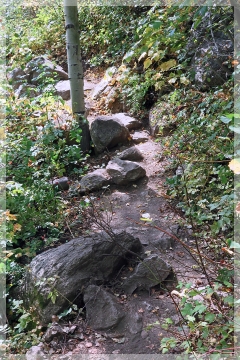
hiking Steamboat SpringsIn an article about how our post-pandemic new normal will evolve, the author suggested a process for businesses to identify what needs changing in their post COVID-19 world. As a way of illustrating their method, there was an aerial photograph of a college campus quad.  Before designing the walkways for this large green area surrounded on four sides by university buildings, the landscape architects simply sodded the field and observed how the students used the grassy expanse. After a while, the beaten down grass indicated the students’ preferred traffic patterns and it was on those favored paths that they finally placed paved walkways. At first glance, the asymmetric sidewalks seemed random but, once the process was explained, the strange arrangement of paths made sense. It was easy to see how they accommodated people’s tendency to take shortcuts and cut across corners.

While observing emerging patterns of behavior and then accommodating those patterns worked for that quad’s design and may be a good model for business, God doesn’t work that way. He’s not running a business, seeking to improve employee output, or trying to accommodate customers or students rushing to class. God is both perfect and immutable—unchallengeable and unchanging—and He has not designed the world or our lives to accommodate our preferences for ease, efficiency or profit. Instead, we are to adjust our lives to accommodate His desires!

The landscape architects accommodated the students’ tendency to take shortcuts and cut corners. Hoping to keep us from walking on the grass, God doesn’t place the sidewalks where we want them. Instead, He puts the walkways exactly where He wants them and posts signs saying, “Keep off the grass!” Cutting corners and taking shortcuts in life usually involve far more than walking on the grass and God is not about to pave the wrong way for us.

The path God chooses for us isn’t always the easy one. More often than not, it is pretty much guaranteed to be the hard way, one that is often rocky and steep. Nevertheless, since it is God’s way, it is the right way and only path to take.

Don’t look for shortcuts to God. The market is flooded with surefire, easygoing formulas for a successful life that can be practiced in your spare time. Don’t fall for that stuff, even though crowds of people do. The way to life—to God!—is vigorous and requires total attention. … What is required is serious obedience—doing what my Father wills. [Matthew 7:13-14,21 (MSG)]

Copyright ©2020 jsjdevotions. All rights reserved.

HAVING A KING

In those days Israel had no king; all the people did whatever seemed right in their own eyes. [Judges 17:6 (NLT)]

great blue heronAlthough God passed along some very detailed commands, the people of Israel frequently refused to obey them and, in Judges 17-18, we see what happens when people do whatever seems right in their own eyes. After stealing 1,100 pieces of silver from his mother, Micah hears her curse the thief. Fearful of her curse, he confesses and returns the money. After blessing Micah to remove the curse, his mother dedicates the money to the Lord. In honor of her thieving son, however, she gives 200 of those coins to a silversmith for the fashioning of an image (a figure carved from wood overlaid with silver) and an idol (a figure cast from molten silver). Micah then sets up a shrine for the prohibited items, adds some household idols of his own, makes an ephod (a priestly garment), and installs his son as his own personal priest. This was wrong in so many ways: not only were people expressly forbidden from making either carved images or molten idols but only a Levite could serve as a priest!

A Levite who seems to have no better grasp of God’s instructions than Micah stops at his house. Thinking the Levite’s presence will bring him prosperity and give legitimacy to his shrine, Micah buys the Levite’s services as his own personal priest. Wrong again! A Levite was to serve God only in the tabernacle but the man accepts and serves Micah in an idolatrous shrine.

The story continues with the arrival of five scouts from the tribe of Dan. Unable to conquer the land originally given to them, the Danite scouts are in search of easier pickings in Israel’s northern frontier. Finding the unprotected town of Laish, they return with 600 warriors. After stopping at Micah’s, where they steal his shine, ephod, image and idols, they offer the Levite a position as priest to their entire tribe and he accepts their offer. Although Micah protests the theft of idols and priest, he’s outnumbered, admits defeat, and returns home empty-handed while lamenting that he has nothing left.

The Danites easily defeat the town of Laish and rename it Dan. Micah’s pagan shrine is worshiped there for another 200 years. When the Kingdom divides, Jeroboam places a golden calf there for Israel’s worship while the Levite’s family continues to serve Dan until Israel’s exile.

Not once did any of these people consider God in their actions. Saying she dedicated the money to the Lord, Micah’s mother didn’t use it to honor Him. She used it to honor her larcenous son and what began with a son stealing from his mother evolved into idolatry. Micah wanted to worship the god he created rather than worship the God who created him. God made man while Micah’s gods were made by man. God is truth and righteousness but Micah’s gods came from deception and deceit. The tribe of Dan was too strong for Micah and his gods but nothing and no one is too strong for God. Unlike Micah’s gods, God can’t be stolen from us.

Without a king, the people did whatever seemed right to them but, sadly, as seen in Kings and Chronicles, they did little better with an earthly king. An earthly king may prevent social anarchy but only a Heavenly King can prevent spiritual anarchy. Without God as their King, people do only what is right in their own eyes. We have a King in Jesus; may we always do what is right in His eyes!

And this is what I’m praying: that your love may overflow still more and more, in knowledge and in all astute wisdom. Then you will be able to tell the difference between good and evil, and be sincere and faultless on the day of the Messiah, filled to overflowing with the fruit of right living, fruit that comes through King Jesus to God’s glory and praise. [Philippians 1:9-11 (NTE)]

Copyright ©2020 jsjdevotions. All rights reserved.

THE PEACE STORE

I have told you all this so that you may have peace in me. Here on earth you will have many trials and sorrows. But take heart, because I have overcome the world. [John 16:33 (NLT)]

Peace Store - Key West, FLBetween demonstrations that turn into brawls or rioting, incidents of mask rage, shootings, negative and misleading political ads, quarrelsome legislators, nations accusing one another of espionage and fraud, and the assorted armed conflicts throughout the world, I wish we could purchase peace as easily as we can items from Key West’s Peace Store. Actually, given the anger and nastiness so prevalent in the world today, I’m afraid wearing one of their tee-shirts politely requesting “Peace Please” or a face mask with the peace symbol could cause conflict rather than promote peace! Real peace, however, is more than the absence of conflict and it’s not something that can be purchased in Key West or anywhere else.

The Greek word usually translated as peace in the New Testament is eirēnē. In classic Greek, it meant the absence of war but, when found in the New Testament, eirēnē has a far broader meaning. This expanded meaning is because Jesus didn’t speak Greek and the word He would have used was shalom, which meant well-being in the widest sense of the word. In the Hebrew Scriptures, along with the lack of conflict, shalom was used for prosperity, physical health, contentedness both when going to sleep and at death, good relationships between nations and people, and salvation. When Gideon built an altar to the Lord, he named it Yahweh-Shalom, which meant “the Lord is peace.” For a Jew, shalom was the sense of general well-being that came from God alone.

When Jesus promised us peace or shalom, along with absence of discord, He included a sense of wholeness, health, welfare, safety, rest, soundness, tranquility, prosperity, perfectness, fullness, freedom from care, acceptance, and harmony. If we could purchase any or all of those at the Peace Store, their website would crash, the line out the door would be a mile long, and the store owners would be among the Fortune 500!

We can’t purchase peace because Jesus, the Prince of Peace, purchased it for us; shalom is ours simply for the asking. That peace doesn’t mean lack of hardship, sickness, death, grief, or difficulties. In fact, Jesus pretty much guaranteed we’d have those. He did, however, promise peace in every one of those situations.

If you’re ever in Key West, you can check out the Peace Store where they say, “Peace is always in fashion.” If, however, you’re looking for true peace, the kind of peace that far exceeds our understanding, you’ll find that only in a relationship with God. If we remain in Christ, keep the Holy Spirit within us, are obedient to His word, study and pray, serve and love, the shalom promised by the Prince of Peace will remain bright within our hearts and souls. Calling Key West “the gateway to paradise,” the Peace Store was wrong; the true path to paradise is found only in Jesus and His gospel of peace.

God cannot give us a happiness and peace apart from Himself, because it is not there. There is no such thing. [C.S. Lewis]

I am leaving you with a gift—peace of mind and heart. And the peace I give is a gift the world cannot give. So don’t be troubled or afraid. [John 14:27 (NLT)]

This is the message of Good News for the people of Israel—that there is peace with God through Jesus Christ, who is Lord of all. [Acts 10:36 (NLT)]

Copyright ©2020 jsjdevotions. All rights reserved.