
In that day the people will proclaim, “This is our God in whom we trust, for whom we waited. Now at last he is here.” What a day of rejoicing! [Isaiah 25:9 (TLB)]
Come, Thou long expected Jesus Born to set Thy people free;
From our fears and sins release us, Let us find our rest in Thee. [Charles Wesley]
 My daughter has become quite adept at hiding Christmas gifts from her husband. If she doesn’t, he will find the presents and open them early; patience is not one of his strong suits. It wasn’t one of Sarah and Abraham’s either. Although they’d been promised a son and many descendants, they grew impatient waiting and took matters into their own hands. Sarah gave Abraham her maidservant Hagar with whom to make a child. Although she made the offer, he didn’t have to accept—but he did. The boy Ishmael was the result of their rashness and the rivalry and strife that continue today in the Middle East came from that impatience. Like Sarah and Abraham, when my son-in-law knows a gift is coming, he just can’t wait until the correct time to receive it. Fortunately, while his wife may get annoyed when he takes matters into his own hands, his impulsiveness hasn’t resulted in centuries of international conflict.
Consider the people of Judah—they’d waited centuries for God’s promise to be fulfilled with the Messiah and most of them completely missed their gift. Tired of waiting, some lost faith and hope; they stopped looking for Him. Having anticipated royalty rather than an itinerant preacher, others didn’t recognize Him. Wanting someone to conquer Rome rather than sin, still others didn’t accept Him. Fortunately, my son-in-law isn’t like that. Even when he’s unsuccessful in his search for the gift, he never gives up. He knows it eventually will appear. Moreover, unlike the Judeans, he won’t ignore the package if it isn’t wrapped in fancy paper with an elaborate bow or reject it because it doesn’t fit his expectations.
David had to wait for God’s promise to materialize but, unlike Like Sarah, Abraham, and Judah, he waited patiently and never gave up hope. After being anointed by Samuel, he had to wait about fifteen years until being crowned king. He didn’t spend that time trying to force his kingship to happen nor did he sit idly and twiddle his thumbs impatiently. He wisely trusted God. The shepherd boy used his waiting time to prepare for the challenges of kingship by growing physically, intellectually, and spiritually so he was ready to receive his crown when God gave it to him.
Unlike David, Sarah, Abraham, and the Jews, my son-in-law knows exactly when his Christmas gifts will arrive—December 25! Unfortunately, when waiting on God to act, we rarely have a calendar marked with His delivery date and we certainly don’t know the date of Christ’s return. Needing patience, we can’t be like Sarah and Abraham who tried to make things happen before the appointed time. Needing faith, we can’t be like the Jews who stopped looking and believing in God’s promised provision. Instead, we must be like David who waited with patience and faith while readying himself for the receipt of God’s promised provision.
When He returns is not as important as the fact that we are ready for Him when He does return. [A.W. Tozer]
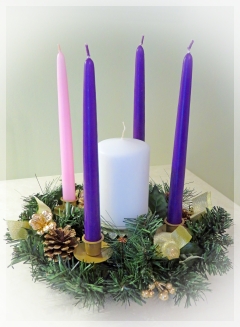 It’s less than a month until Christmas. This Christmas will be vastly different from past ones for us as I imagine it will be for you. Traditionally, our holiday season has been a busy and festive one of concerts, friends, church, fellowship activities, volunteering, entertaining, and family but being in the midst of a pandemic has changed all that. In an attempt to keep the spirit of Christmas alive in what has been a dreary and disappointing year, I’ve started decorating for the holiday and playing Christmas music. Christmas, however, is more than decorations, carols, presents, parties, and peppermint bark. Perhaps not having all of the fun-filled extras of this season will help us focus on its true meaning.
 When an irrevocable law was signed that prohibited praying to anyone but King Darius, Daniel prayed! Knowing he’d be thrown into a den of lions for doing so, the devout man went home, opened the windows, and prayed to God just as he always had done. Rather than starting with a fervent plea for God’s help, however, Daniel began with a prayer of thanks. His prayer of thanksgiving showed Daniel’s faith in a good God who was present in all circumstances!
 Avoid foolish controversies, arguments about genealogies, quarrels, and fights about Moses’ Teachings. This is useless and worthless. [Titus 3:9 (GW)]
 Rescue me, O Lord, from liars and from all deceitful people. … How I suffer in far-off Meshech. It pains me to live in distant Kedar. I search for peace; but when I speak of peace, they want war! [Psalm 120:2,5-6 (NLT)]
 Psalms 120 through 134 have the superscription A Song of Ascents. What that means exactly, no one really knows. The original word translated as ascent was “stair” or “step” and some scholars believe the title refers to the temple’s fifteen steps leading from the Court of the Women into the Court of the Sons of Israel. Jewish tradition holds that Levites sang a different one of these psalms as they climbed the steps to the temple. Other scholars posit that the title of the psalms has to do either with the rising moods or thoughts in the psalms’ words or their rising pitch as they were sung.
 Devotions of the Heart