LIKE A CANCER

So I am not the one doing wrong; it is sin living in me that does it. And I know that nothing good lives in me, that is, in my sinful nature. I want to do what is right, but I can’t. I want to do what is good, but I don’t. I don’t want to do what is wrong, but I do it anyway. But if I do what I don’t want to do, I am not really the one doing wrong; it is sin living in me that does it. … Oh, what a miserable person I am! Who will free me from this life that is dominated by sin and death? Thank God! The answer is in Jesus Christ our Lord [Romans 7:17-20,24-25 (NLT)]

Sin is like a cancer that destroys step by step, sometimes so slowly we don’t realize what’s happening to us. [David Jeremiah]

cormorantA suspicious spot was removed at my annual dermatology appointment. When the biopsy indicated cancer, I had Mohs surgery to remove it. In Mohs, the tissue is sliced off in stages and examined by the pathologist to determine if (and where) any cancerous tissue remains. If it does, the surgeon removes the next layer of tissue, the pathologist examines it, and the process continues until no cancer cells remain. While it’s a time-consuming process, Mohs spares healthy tissue while eradicating all of the cancer.

I had a fair amount of time between slicing sessions to ponder how sin is like cancer. Although I look at my face every day, I didn’t recognize that little spot as anything dangerous and I think we’re like that with sin. A large raised red patch would have been easy to notice—the same way a big sin like murder or armed robbery is easily spotted. Small cancers like mine are not so obvious to the naked eye just like a spot of envy, smidgen of gossip, slight stretch of truth, or speck of flirtation can easily be ignored. Moreover, both skin cancer and sin look quite different from one person to another and it seems we’re more likely to notice defects in others than in ourselves!

Unlike skin cancer, which some people get while others never do, none of us truly can avoid contact with sin! Like cancer, sin is opportunistic; it’s just waiting for a chance to invade healthy tissue (and lives). Just as a little spot of unnoticed cancer can grow both deeper and wider so can a little overlooked sin. Fortunately, both cancer and sin are treatable when discovered early enough; they both can be deadly when not.

Although my physician kept my medical record, biopsy reports, and before and after photos, once our sins are forgiven God does not remember them. Being saved means that our confessed and repented sins are forgiven and the slate is wiped clean. Being saved, however, doesn’t mean that we won’t continue to struggle with our propensity to sin any more than having that one spot of cancer removed means I’ll never have another. Just as using sun block with a high SPF is no guarantee against skin cancer, being saved does not guarantee a sin-free life. While sin no longer reigns, like a stray cancer cell, it manages to survive and will try to destroy us.

A dermatologist and pathologist were needed to diagnose my cancer but a little prayerful reflection is all we need to find the sin in our lives. When we ask God to point out anything He finds offensive in us, we can be sure the Holy Spirit will make His voice heard. We go to a doctor to eradicate cancer but, to free us from sin, we go to the Great Physician: Jesus Christ! When a cancerous growth is excised, the doctors and nurses do all of the work but the work of cutting out the sin in our lives requires our effort. Granted, we’ll be empowered by the Spirit but it’s up to us to yield to God’s will and obey His word. While the Holy Spirit enables us to overcome sinful thoughts, attitudes, and actions, it’s up to us to say “No!”

Christ is the good physician. There is no disease he cannot heal; no sin he cannot remove; no trouble he cannot help. He is the Balm of Gilead, the Great Physician who has never yet failed to heal all the spiritual maladies of every soul that has come unto him in faith and prayer. [James H. Aughey]


The Spirit of God, who raised Jesus from the dead, lives in you. And just as God raised Christ Jesus from the dead, he will give life to your mortal bodies by this same Spirit living within you. Therefore, dear brothers and sisters, you have no obligation to do what your sinful nature urges you to do. For if you live by its dictates, you will die. But if through the power of the Spirit you put to death the deeds of your sinful nature, you will live. For all who are led by the Spirit of God are children of God. [Romans 8:11-13]

Copyright ©2020 jsjdevotions. All rights reserved.

LOOKS ARE DECEIVING!

tussock mother caterpillar

Stay in control of yourselves; stay awake. Your enemy, the devil, is stalking around like a roaring lion, looking for someone to devour. [1 Peter 5:8 (NTE)]

When we took a photo safari in Tanzania several years ago, bathrooms were in short supply and the gentlemen occasionally would step out of the Land Rovers to “check the tires.”  The guides, however, always cautiously chose the “tire-checking” locations and only stopped in the middle of the road in open areas. While there was little privacy, predators had no place in which to hide and any that approached could be seen from a distance. After all, no one wanted to be surprised by a lion while answering nature’s call. Since Satan sometimes skulks around like a hungry lion, it is wise to remember the guides’ advice: never linger where lions (or other predators) may be lurking.

Satan, however, isn’t always as obvious as a prowling lion. Sometimes, he’s more like a snake hidden in the grass waiting for us to approach. Since deceit is the most powerful weapon in his arsenal, we can be sure he won’t be wearing a sign that says, “Danger – Don’t touch!”  In fact, unlike a lion or snake, he may look innocent and rather appealing, like the harmless looking caterpillar I saw while walking in the swamp. Bearing a slight resemblance to a piece of novelty or “eyelash” yarn, it was a pretty little creepy-crawly with delicate tufts of hair. Looking so soft, I was tempted to lightly bush my finger over it. Fortunately, I’d just seen a sign warning of poisonous caterpillars and, suspecting that little guy was not as innocent as it seemed, I kept my hands to myself. The cute critter tuned out to be a tussock moth caterpillar and even a light touch of its soft looking bristles will feel like being pricked by fiberglass! In fact, some species can leave a persistent and painful rash.

We must never forget that Satan is cunning, powerful, resourceful and persistent. Sometimes, like a hungry lion, he actively hunts and we can see him coming from a distance. On the other hand, like a poison caterpillar that looks inviting and innocent, he sometimes lays in wait for us where we’d least expect to find trouble. Either way, we need to be constantly alert. While it may announce itself with a roar, more often than not, temptation looks as harmless as a fuzzy caterpillar. Don’t venture too close!

There is a precipice near every man’s foot, and a snare in every man’s path. … There is a lure for every bird, a bait for every fish. … Watch constantly against those things which are thought to be no temptations. The most poisonous serpents are found where the sweetest flowers grow. [Charles Spurgeon]

Rather, each person is tested when they are dragged off and enticed by their own desires. [James 1:14 (NTE)]

Watch and pray so that you don’t get pulled down into the time of testing. The spirit is eager, but the body is weak. [Matthew 26:41 (NTE)]

Copyright ©2020 jsjdevotions. All rights reserved.

WAITING WITH PEACE

This is the Good News about Jesus the Messiah, the Son of God. It began just as the prophet Isaiah had written: “Look, I am sending my messenger ahead of you, and he will prepare your way. He is a voice shouting in the wilderness, ’Prepare the way for the Lord’s coming! Clear the road for him!’”  [Mark 1:1-3 (NLT)]

christmas starLast Sunday, my husband and I lit the candle of hope on our Advent wreath. This Sunday, we’ll re-light that one along with a second candle, the one we call the peace or Bethlehem candle. Because the Advent wreath custom has been adapted in a variety of ways through the years, there are several names for the candles and explanations for their symbolism that probably have more to do with the selling of wreaths, candles, and devotional booklets than with church tradition. There are no official names, meanings or rituals because an Advent wreath isn’t based on Scripture. It’s merely a tradition to help make this season more meaningful.
We’ve selected our Advent readings (or “lections”) from the Revised Common Lectionary (RCL), an ordered system of Scripture readings. The Christian church has used lectionaries since the 4th century but the RCL was adopted in 1992. An ecumenical project of several American and Canadian denominations, the goal was to provide a common experience of God’s word among all Christians as a way of uniting the Church. Used by a majority of the Protestant churches in the U.S. and Canada, the RCL is a three year cycle of weekly Scripture readings to be read at public worship. During most of the year, the four selections are from the Old Testament, Psalms, the Epistles and the Gospels. Chosen for their common theme and relevance to the church season, these common lections connect Christians with one another across denominational lines and enable an Episcopalian in Minneapolis to recite the same psalm or hear the same epistle as a Methodist in Denver or a Lutheran in San Diego.

Before lighting the candles Sunday, we’ll read portions of Isaiah 40, Psalm 85, and 2 Peter 3. Isaiah tells the people of Judah to be prepared: “Your God is coming!” Saying that salvation is near, the psalmist speaks of the meeting of unfailing love and truth and the kiss of righteousness and peace. Joining these verses are Peter’s words to live peaceful and righteous lives and be ready for the end times when “the day of the Lord will come.” These lections again remind us that Advent is not just about anticipating the Messiah’s birth; it’s a time to anticipate His return. As we prepare our homes for Christmas, let us remember that it is more important to prepare ourselves for meeting Jesus.

Advent is the perfect time to clear and prepare the Way. Advent is a winter training camp for those who desire peace. By reflection and prayer, by reading and meditation, we can make our hearts a place where a blessing of peace would desire to abide and where the birth of the Prince of Peace might take place. [Edward Hays]

On that day, he will set the heavens on fire, and the elements will melt away in the flames. But we are looking forward to the new heavens and new earth he has promised, a world filled with God’s righteousness. And so, dear friends, while you are waiting for these things to happen, make every effort to be found living peaceful lives that are pure and blameless in his sight. [2 Peter 3:12-14 (NLT)]

Copyright ©2020 jsjdevotions. All rights reserved.

THE JESSE TREE

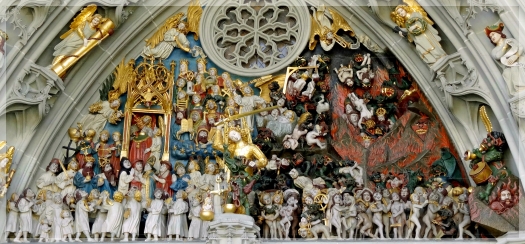
Last Judgment - Minster Cathedral - BernThere shall come forth a shoot from the stump of Jesse, and a branch shall grow out of his roots. And the Spirit of the Lord shall rest upon him, the spirit of wisdom and understanding, the spirit of counsel and might, the spirit of knowledge and the fear of the Lord. [Isaiah 11:1-2 (RSV)]

I remember standing in awe in front of an enormous sandstone sculpture of the Last Judgment at the entrance to Bern’s Minster Cathedral. With 294 figures, the naked wicked are on the right while the white-robed righteous are on the left. There are prophets, angels with trumpets, Jesus, Lady Justice, the wise and foolish virgins and both sinners and saints—the condemned and the blessed. In graphic detail, it illustrates God’s final judgment and the horrible fate of the damned!

It’s said that a picture is worth a thousand words and that’s true of the Last Judgment. In fact, much of the art in old European churches was there to illustrate Scripture for the largely illiterate population of the Middle Ages and early Renaissance. Seeing the portrayal of the last judgment, Michelangelo’s image of the outstretched hand of God giving life to Adam or Rembrandt’s picture of a distraught Moses smashing the stone tablets brought those stories to life for a people who couldn’t read them for themselves. Several churches had what was known as a Jesse Tree. Rather than a tree, these were large tapestries, carvings, or stained glass windows that illustrated the Bible’s salvation theme through the Old Testament to the birth of Jesus.

For example, the stained glass Jesse Tree in the Cathedral of Chartres (c.1150) portrays a sleeping Jesse at the bottom of the window. A shoot springing from his loins reaches up into four branches. Above Jesse are four kings (David, Solomon and two unnamed ones) and, above them, is Mary. At the top is Jesus surrounded by seven doves (representing the Holy Spirit and His gifts). Surrounding this center panel are fourteen figures holding scrolls. These are the people like Moses, Zechariah, Isaiah, and Samuel, who foretold the coming of a savior. In this single sixteen-by-five-foot window, the whole of the Old Testament prophecies and their fulfillment in Jesus is represented and God’s faithfulness in keeping His promises is illustrated.

The Jesse tree comes from Isaiah’s prophecy that the Messiah would come from Jesse’s line—the Davidic line of kings. Jesse was David’s father. The prophet referred to the lesser known Jesse rather than his famed son because, by the time of the Messiah, Judah would be a conquered nation and, with no more kings, David’s line would appear chopped off, like the stump of a hacked down tree. There was, however, life within that stump and a new branch, the Messiah, would sprout from it. The Jesse tree art in churches illustrated that Jesus’ story didn’t start in the New Testament. It began in the Old; Jesus was the fulfillment of God’s promises made thousands of years earlier.

Nowadays, some people celebrate Advent with a Jesse tree that serves as a sort of Advent calendar. Each day during December, a different Bible story is read and then a small ornament representing the story is placed on the “tree”—the family’s actual Christmas tree, a bare branch anchored in a stand, a small tabletop tree or even a felt hanging. An apple might accompany the story of the fall; an ark or rainbow, the story of Noah; and a scarlet cord, the story of Rahab.

Although I’m not decorating a Jesse tree, I am reading stories and prophecies from the Old Testament that tell of God’s faithfulness and plan for redemption. Starting in Genesis with God telling the serpent (Satan) that his final defeat will be brought about by one of Adam and Eve’s descendants, I’ll do a quick tour through the Old Testament and read about Abraham, Isaac, Jacob, Joseph, Moses, Joshua and David. As I prepare to celebrate Christ’s birth, I’ll put his arrival in historical context—in the world of Rahab, Gideon, Ruth, Samuel, Isaiah, Jeremiah, Habakkuk, and John the Baptist: a world in desperate need of salvation.

We often think of the Bible as two separate books—the Old and New, the Hebrew and the Christian, but it is one continuous story that leads across thousands of years to Christ’s birth, death and resurrection. Let us never forget that Jesus, as the Alpha, was there at the very beginning and, as the Omega, He will be there at the end.

And his delight shall be in the fear of the Lord. He shall not judge by what his eyes see, or decide by what his ears hear; but with righteousness he shall judge the poor, and decide with equity for the meek of the earth; and he shall smite the earth with the rod of his mouth, and with the breath of his lips he shall slay the wicked. Righteousness shall be the girdle of his waist, and faithfulness the girdle of his loins. … In that day the root of Jesse shall stand as an ensign to the peoples; him shall the nations seek, and his dwellings shall be glorious. [Isaiah 11:1-5,10 (RSV)]

Copyright ©2020 jsjdevotions. All rights reserved.

NOT FAIR

The fastest runner doesn’t always win the race, and the strongest warrior doesn’t always win the battle. The wise sometimes go hungry, and the skillful are not necessarily wealthy. And those who are educated don’t always lead successful lives. It is all decided by chance, by being in the right place at the right time. People can never predict when hard times might come. Like fish in a net or birds in a trap, people are caught by sudden tragedy. [Ecclesiastes 9:11-12 (NLT)]

With the back-to-back hurricanes that tore through Louisiana, two others that devastated Nicaragua and Honduras, and the consecutive typhoons that flooded the Philippines, a great many people must be asking, “Why us, Lord?” In spite of the meteorological explanations for the paths taken by those storms, there is something discomforting about the seeming randomness of such destruction. I can’t help but wonder, “Why them and not us?” In a universe of retribution and reward, we’d have a sense of being able to control our destiny; only bad things would happen to bad people and only good things to the good ones. If we did all the right things, life would go smoothly and, if we didn’t, we’d just be getting what we deserved! That, however, is not the way of the world and back-to-back hurricanes along with cancer, ALS, hit-and-run-drivers, stray bullets, and tornadoes hit both the deserving and undeserving.

If any man deserved blessings, it was Job. Described by God as blameless, he was a man of integrity who feared God and stayed away from evil. Even so, this righteous man gets hit with his own back-to-back hurricanes: he becomes penniless and loses children, livestock, servants, health, and social standing. When tragedy hits, Job’s friends come to comfort and console him and, for seven days, they sit silently with their suffering friend. During their week of mourning, Job wonders, ”Why me?” while his friends wonder, “Why him?”

Operating on the assumption that suffering, disaster, and adversity are always the result of serious sin, Job’s friend Eliphaz speaks of a world that operates on the law of cause and effect: a universe where those who plant trouble get more of the same. By claiming that the innocent don’t suffer, he implies his good friend is not an innocent man. After suggesting that Job’s affliction is God’s discipline, he tells him to acknowledge his sins and be delivered from his misery. Although Job claims innocence, Bildad echoes the words of Eliphaz. He even accuses Job’s children of sin and says their punishment was well deserved. Zophar joins his friends in confronting and accusing Job of some horrible sin to cause such severe punishment from God. Although Elihu rightly points out that suffering can be a tool of healing in God’s hands, like his friends, he is convinced that it is Job’s transgressions that caused his trouble.

A prominent man, Job was one of the city fathers who sat at the gate and settled disputes. Well respected by all, people listened intently when he spoke. The man assisted the blind and lame, stood up against the wicked, and was generous to the poor, widows and orphans. The men accusing Job were all long-time friends of his. They’d observed his behavior, respected his opinions, and enjoyed his hospitality, and yet they were sure he was guilty of sins deserving of such horrific punishment! I might have reacted as did they. It was more comforting for his friends to think that Job deserved his misery than to think he didn’t; a blameless Job meant that the same horrific things could happen to them! When Job eventually repents, it’s not of any sin that caused his suffering; he repents of falsely accusing God of injustice.

Faith, worship and works do not ensure our well-being or buy us a reward any more than sin guarantees earthly punishment or suffering. Just like back-to-back hurricanes, disaster can strike both the innocent and guilty! The evil can prosper and the righteous suffer. The book of Job never explains the why of his suffering, but it does tell us that our sovereign God is not cruel, capricious, or erratic. Nothing happens that hasn’t passed through God’s hands first and, while it makes sense to Him, it frequently seems incredibly random, unfair, undeserved, and arbitrary to us. Victim or onlooker, we must do as Job did: trust God in both the blessings and tragedies of life.

In this troubling time of disease, death, disaster, dissension, and destruction, let us continue to trust our loving and good God regardless of the storms assaulting us now. Job’s story ends with the restoration of all that he lost. Our story will end in restoration, as well; if not in this world, then in the life to come.

If I were to say “God, why me?” about the bad things, then I should have said “God, why me?” about the good things that happened in my life. [Arthur Ashe]  

He said, “I came naked from my mother’s womb, and I will be naked when I leave. The Lord gave me what I had, and the Lord has taken it away. Praise the name of the Lord!” In all of this, Job did not sin by blaming God. [Job 1:21-22 (NLT)]

Copyright ©2020 jsjdevotions. All rights reserved.

WHAT IS ENOUGH?

After all, we brought nothing with us when we came into the world, and we can’t take anything with us when we leave it. So if we have enough food and clothing, let us be content. But people who long to be rich fall into temptation and are trapped by many foolish and harmful desires that plunge them into ruin and destruction.  [1 Timothy 6:7-9 (NLT)]

squirrel

The Bible is filled with stories of God’s provision for his people’s needs. In spite of their complaints about God’s provision, the Israelites never went hungry during their forty year journey. When Elijah was hiding from Jezebel during a time of drought and famine, he was fed by ravens. In Zarephath, God provided Elijah, the widow and her son with enough flour and oil to feed the three of them for three years! Later, God provided Elijah with food enough to sustain him during a forty day journey to Mt. Sinai. Sometimes, God even blesses us with even more than enough, as He did when thousands were fed with a boy’s lunch and several baskets of leftovers remained.

While we may receive more than we need, God doesn’t promise a surplus. Elijah and the widow didn’t have excess flour and oil with which to open a bakery and, if the Israelites tried to squirrel away their manna for anything but the Sabbath, it spoiled and got maggots. Just enough was exactly what God wanted them to have and what He gave them—no more and no less.

The problem for us is that mankind’s concept of “enough” isn’t the same as God’s; David is a perfect example of that weakness. Most of us would think David, the shepherd boy who became a hero and king, had more than enough. He possessed Saul’s entire kingdom and wealth, lived in a palace, and had seven wives along with an unknown number of concubines. Enough was no longer enough, however, once David laid eyes on Bathsheba. Solomon, with his 700 wives and 300 concubines and 25 tons of gold a year, never seemed to think he had enough either!

When is enough enough? God knows, but we don’t. Adam and Eve had all of Eden with the exception of the fruit of one tree, but that wasn’t enough for them! Whether it’s money, friends, time, status, opportunities, jewelry, health, strength, wisdom, or faith—we probably think we don’t have quite enough of something. Whatever it is, we’re sure that if God would just give us a smidgen more of it, then we’d be satisfied. Of course, we wouldn’t because, like Solomon, David, Adam and Eve, we’d want more than enough!

If we’re seeking the Kingdom of God and following God’s plan, He will make sure we have enough and all the resources we need. We may not see it but, if we dig deep enough, we’ll find that God has given us exactly what we need to do His work. If we’re seeking the Kingdom of Self, however, we’ll never be satisfied that we have enough.

Do you have enough?

And this same God who takes care of me will supply all your needs from his glorious riches, which have been given to us in Christ Jesus. [Philippians 4:19 (NLT)]

Seek the Kingdom of God above all else, and live righteously, and he will give you everything you need. [Matthew 6:33 (NLT)]

Copyright ©2020 jsjdevotions. All rights reserved.