
For everything there is a season, a time for every activity under heaven. … Yet God has made everything beautiful for its own time. He has planted eternity in the human heart, but even so, people cannot see the whole scope of God’s work from beginning to end. [Ecclesiastes 3:1,11 (NLT)]
 When we spent winters in the mountains, our early morning walk took us by a gourmet restaurant. Occasionally, we’d get a whiff of a delectable mouth-watering aroma as we passed. What we smelled was a large pot of roasted beef and veal bones that had simmered on the back burner overnight. In this day and age of microwaves, Instant Pots, mixes and prepared foods, it’s difficult to understand a chef simmering stock for over 12 hours to concentrate it into a rich demi-glace. That, however, is how the restaurant’s chef gets the flavorful base she uses in her delicious sauces.
Sometimes prayer is like making stir-fry: put the ingredients in a hot wok, stir, and get quick results. Other times, prayer is more like making a demi-glace. We put it all together and then let it do a slow simmer on the back burner with just an occasional check to skim off the fat or impurities. Back-burner prayers are those far-reaching ones that take a long time coming, like the restoration of a ruptured relationship, the salvation of a child, a loved one’s sobriety, or a prodigal’s return.
When we put our prayers at a low simmer on the back burner, we trust God to do the work. As tempted as we are to fret, panic, meddle or intervene, God really doesn’t need us to keeping lifting the lid, stirring the pot, or adding ingredients. In fact, if we were making a demi-glace, our stirring would just slow things down by making the stock cloudy and greasy. The same thing usually happens when we try to do God’s job for Him!
I think of Sarah. Rather than leaving God’s promise of a child to simmer on the back burner until the time was right, she decided to stir the pot by giving Hagar to Abraham. Her interference didn’t turn out well for anyone! On the other hand, David, who’d been a teen when anointed king by Samuel, spent at least fifteen years waiting for the crown. Twice during that time he passed up the opportunity to speed things along by killing King Saul. Instead, he chose to trust in God’s timing saying, ”Surely the Lord will strike Saul down someday, or he will die of old age or in battle.” [2 Samuel 26:10]
God answers our prayers the moment we speak them; it’s just that we don’t immediately know His answer. It could be “Yes!” or, if what we asked isn’t in His will, “No!” After all, God might have something better in store for us! Sometimes, however, God’s answer is, “Not right now!” Those prayers go on the back burner to simmer until God’s time is right (or He tells us, “No!”)
Putting prayers on the back burner doesn’t mean we stop praying them any more than putting that stock pot on the back burner means the chef turned off the stove or forgot about it. It simply means that we have given our prayer over to the fullness of God’s time.
Persistent praying never faints or grows weary. It is never discouraged. It never yields to cowardice. It is motivated and sustained by a hope that knows no despair, and a faith that will not let go. Persistent praying has patience to wait and strength to continue. It never prepares itself to quit praying, and it refuses to get up from its knees until an answer is received. [E. M. Bounds]
 Two disciples, Philip and Andrew, are mentioned in John’s account of the day Jesus fed over 5,000 with a boy’s lunch. When Jesus asked Philip where they could find food enough for all of the people, the right answer would have been, “Lord, you have the power to feed them all.” Instead, Philip, who may have been the first century equivalent of an accountant before following Jesus, immediately did a feasibility study and figured the massive expense. Ignoring the solution standing in front of him, he only saw impossibility.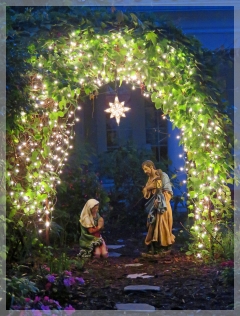
 As I put away our various nativity sets until next December, I noticed they all include at least one lamb. Since shepherds came to see Jesus, it’s logical there would be a lamb or two in most depictions of Christmas. Nevertheless, as I packed up the figures, I thought about the shepherds and sheep visiting the child who was both the Good Shepherd and the Lamb of God. That Jesus took on both roles is a bit of a paradox. The shepherd may have watched over the sheep but, in the end, his lambs were destined to be slaughtered for food or ritual sacrifice.
 After hearing people say, “It’s a miracle!” regarding the speedy development of the COVID-19 vaccines, I began to wonder what constitutes a miracle. In his book Systematic Theology, Wayne Grudem defines a miracle as “a less common kind of God’s activity in which he arouses people’s awe and wonder and bears witness to himself.” I’m not a theologian but his definition seems to qualify a miraculous event by its infrequency and awesomeness rather than its nature. By his definition, last month’s “great” conjunction of Jupiter and Saturn might qualify. It certainly was awesome and, since that hasn’t happened at night for nearly 800 years, it certainly qualifies as uncommon. It was, however, predictable and the two planets will be even closer together the night of December 25, 2874. I prefer Pastor Taylor Krug’s definition: “A miracle is a particular event that occurs within the natural world that cannot be sufficiently explained with a perfect science and an exhaustive understanding of the cosmos.”
 Devotions of the Heart