
Cast your cares on the Lord and he will sustain you; he will never let the righteous be shaken. [Psalm 55:22 (NIV)]
Cast all your anxiety on him because he cares for you. [1 Peter 5:7 (NIV)]
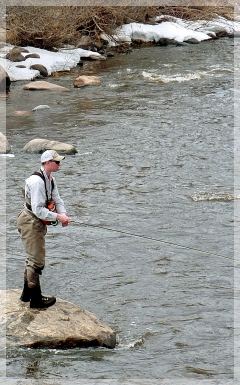 Even though I’m not an angler, whenever I read about casting my cares, I picture using a fly rod and casting my concerns out into the river so the fast moving water can carry them away to God. When we lived in the mountains, one of our favorite walking trails ran alongside the Yampa River and we often paused to watch as the fishermen (and women) cast their lines into the water. Fly fishing is all about the art of casting and a bit like poetry in motion. It was fascinating to watch an angler flick the rod back and forth, gradually increasing the speed of the motion, before finally casting the line forward so the fly would land in the perfect spot. Masquerading as a water insect, the fly is made of things like fur, feathers, fabric and tinsel and secured to a hook. Rather than purchasing flies, many fishermen spend hours tying their own flies. Not wanting to lose either fly or fish in the river, anglers use at least five different knots to securely connect the reel to the backing, fly line, leader, and tippet before finally tying on the fly.
There is an art to fly casting and fly fishermen spend years perfecting their technique, especially since no one cast is ideal for every situation. Christians, however, aren’t casting flies—they’re casting things like fear, problems, anxiety, and worry—the cares every believer faces in this fallen world. While there’s no special technique to casting those cares, like fly fishing, it’s often easier said than done. Just as a fly fisherman may labor over tying his flies and fret about choosing the perfect ones for the day’s conditions, we often spend a great deal of time focusing on our worries rather than casting them into God’s river. Just as the fisherman ties those five knots to keep from losing his fly, we tie ourselves up in knots when we’re reluctant to give up our cares to God!
The anglers casting their lines in the river want to catch and land a fish but, when we cast our cares, we want to bring in an empty line. They catch, we release! Our cares are not for God to take away from us but for us to release to Him. Because the flies on the end of a fishing line are nearly weightless and our cares often seem as heavy as boulders, casting cares seems harder than casting a fly in the river. Nevertheless, it can be done and is far more rewarding than a trophy-sized trout.
Fishermen go to the river with an empty creel and hope to return home with a full one but we go to God with a creel full of cares so we’ll end up with an empty one. Our creels may be empty but we’ll be filled with the peace of God!
He that takes his cares on himself loads himself in vain with an uneasy burden. I will cast my cares on God; he has bidden me; they cannot burden him. [Joseph Hall]
 These last few days, I’ve been discussing Paul’s instructions both to carry one another’s burdens and to carry our own loads. In between those two directives, we find a warning about the things that can prevent us from doing that: conceit and comparison.
 After saying we must carry each other’s burdens, the Apostle Paul seems to reverse himself three sentences later when he tells us we each must carry our own loads. It’s confusing; if we’re all supposed to carry our own loads, then nobody should need help carrying their burdens!
 Since we tend to think of burdens as demanding and often unwelcome duties or responsibilities, we’re certainly not anxious to take on a burden, especially one that actually belongs to someone else! Yet, that is exactly what we’re told we must do if we are going to fulfill Christ’s mandate. And what is that command? To love one another in the way God loves us.
 Yesterday, I wrote about Jesus’ Parable of the Three Servants, often called the Parable of the Talents. Although I used it as an example of excuse making, that’s not what the parable is about. This parable comes right after Jesus’ description of the end times and the Parable of the Ten Bridesmaids in which He urged readiness for the Day of the Lord. Immediately following this parable about the talents, Jesus spoke about the final judgment. The story of these three servants makes it clear that, when that last day comes, the master will settle accounts: faith will be rewarded and the righteous servants separated from the false ones.
 In 1 Samuel 15, after Samuel confronts Saul for disobeying God’s clear commands regarding the Amalekites, Saul makes excuses—first by denying his sin, then by justifying his disobedience, and finally by blaming others. It is only after Samuel tells him the consequences of his sin—the loss of his kingship—that Saul reluctantly admits the truth. In contrast, we have Nathan confronting David regarding his sinful behavior with Bathsheba and Uriah. Immediately after the rebuke, David confesses. It would have been easy for David to blame Bathsheba for seducing him, Uriah for hampering his cover-up scheme, or Joab for his part in Uriah’s death, but he didn’t. Acknowledging his guilt, the repentant David confessed.
 Devotions of the Heart