MARVELOUS WORKMANSHIP

For ever since the world was created, people have seen the earth and sky. Through everything God made, they can clearly see his invisible qualities—his eternal power and divine nature. So they have no excuse for not knowing God. [Romans 1:20 (NLT)]

We were discussing when and how we came to believe in the existence of God. Those who’d been brought up in families of faith said there never was a time they weren’t aware of God’s presence. Others spoke of believing in God because He is visible in His creation—in flowers, majestic mountains, birds, sunrises and sunsets, the vastness of space, or the miracle of birth. One came to believe in God while attending Vacation Bible School with a neighbor and another met God through a campus ministry. After apologizing in advance for “grossing” us out, one woman shared her experience while in medical school.

Not a believer at the time, she was sure science explained everything that needed explaining until she dissected a human brain. As she cut into the tissue and started labeling parts, she began to wonder. While slicing through the 100 billion neurons of a man’s brain, she questioned where she’d find the part that loved stroking his wife’s hair, knew the sound of his children’s laughter, taught his boys how to play football, or built a dollhouse for his daughter. She wondered which of those billions of neurons learned the alphabet and times tables, struggled to learn Spanish, loved his parents, knew how to play the guitar, told jokes to his friends, called blue his favorite color, or enjoyed both the Beetles and Bach? With each slice she asked things like, “Is this the part that knew sorrow at his child’s death or joy at his daughter’s wedding? Where is the memory of his first bicycle, first kiss, or honeymoon?”

She held the most fascinating and complex organ of the body in her hands and knew the name and function of every part of it but she couldn’t find the answers to her questions. Touching this man’s brain, she knew him more intimately than anyone. Nevertheless, she couldn’t uncover what made him who he was. When she couldn’t find his essence—his very soul—she realized that man is greater than the sum of his parts. Understanding that inside us all there is something unique that cannot be seen, cut into, labeled, or even explained was her “Aha!” moment. It was then that she recognized something or someone far greater is in charge. That moment she finally believed in God—the creator of heaven and earth and all things in between.

When she finished speaking, there was dead silence in the room and she started to apologize again for talking about cadavers and dissections. We reassured her there was no need for apology. Her compelling story had not turned our stomachs; rather, the beauty of it had taken away our breath! We sat in stunned silence as we each reflected on this great and marvelous Creator God who reveals Himself in such wonderful and unique ways.

You made all the delicate, inner parts of my body and knit me together in my mother’s womb. Thank you for making me so wonderfully complex! Your workmanship is marvelous—how well I know it. You watched me as I was being formed in utter seclusion, as I was woven together in the dark of the womb. [Psalm 139:13-15 (NLT)]

Copyright ©2025 jsjdevotions. All rights reserved.

SWIMMING WITH HOPE

Blessed be the God and Father of our Lord Jesus Christ. Because of his great mercy he has given us new birth into a living hope through the resurrection of Jesus Christ from the dead and into an inheritance that is imperishable, undefiled, and unfading, kept in heaven for you. [1 Peter 1:3-4 (CSB)]

Back in 1957 (long before PETA existed), Curt Richter, a professor at Johns Hopkins, conducted a series of cruel and inhumane experiments to demonstrate the power of hope and resilience in overcoming difficult situations. In this case, the difficult situation was rats being put in a bucket of water with no means of escape and timing how long it took them to drown. After two preliminary experiments, Richter hypothesized that introducing hope to the rats would increase their survival times.

In his third experiment, after being dropped into the water, the rats were observed as they progressed towards drowning but were rescued just before they gave up and died. After being dried and given time to recover, they were then re-immersed and the experiment repeated. Once the rats realized intervention and rescue was possible, they had hope of being rescued again. That glimmer of hope in their tiny rodent brains was a motivating factor for their perseverance and resilience and, instead of giving up and drowning within 15 minutes as they earlier did, they managed to swim 60 to 80 hours before finally giving up and drowning in exhaustion. (I said the experiment was cruel!)

In theory, Richter’s study applies to people as well as rats—if we have hope, we can survive (or at least survive longer) but, without hope, we will surely give up and drown. In 1 Peter, we find the Apostle writing to early Christians scattered throughout Asia Minor. Probably written around 64 AD, these new believers were encountering hostility and, before the year ended, they would experience wholesale persecution after Rome burned. Peter, however, wrote of hope, joy, and a priceless inheritance during their many trials. His message applies to Christians today, as well. Although our hope is eternal life, we don’t have to wait until the future to receive it; it is in the here and now! We have an inheritance that never will fade or decay!

Like all believers throughout time, we will encounter trouble and trials in this world but we can be confident in God’s plan and presence, put fear aside, have resilience in trials, and persevere as we tread water in our challenges! As Christians, we have good reason to keep swimming amid our trials and difficulties. Even if we’re not rescued from our problems in this life, we still have hope. Whether we continue to swim or sink, we’ve already been saved and have another, far better life, yet to come!

It’s been said, “Where there’s life, there’s hope!” The fact of life, however, isn’t what determines hope; it’s the faith of our life that does! As Christians, we have a living hope—a confident expectation that our God is present, faithful, and will do as He says. Unlike Richter and his rats, we know that God is not toying with us nor are we subjects of a cruel experiment. He doesn’t give us hope only to snatch it away; the hope He gives us is both living and lasting. We may not be rats but, like Richter’s subjects, we all need a reason to keep swimming! As Christ’s followers, we have it!

A Christian will part with anything rather than his hope; he knows that hope will keep the heart both from aching and breaking, from fainting and sinking; he knows that hope is a beam of God, a spark of glory, and that nothing shall extinguish it till the soul be filled with glory. [Thomas Brooks]

You rejoice in this, even though now for a short time, if necessary, you suffer grief in various trials so that the proven character of your faith—more valuable than gold which, though perishable, is refined by fire—may result in praise, glory, and honor at the revelation of Jesus Christ.…Through him you believe in God, who raised him from the dead and gave him glory, so that your faith and hope are in God. [1 Peter 1:6-7,21 (CSB)]

Copyright ©2025 jsjdevotions. All rights reserved.

A JEALOUS GOD

…for you shall worship no other god, for the Lord, whose name is Jealous, is a jealous God…. [Exodus 34:14 (ESV)]

idolAlong with sins of the heart like greed, pride, coveting, anger, and envy, we have jealousy. It’s hard to make a clear distinction between jealousy and envy and, in most cases, the words can be used interchangeably. The difference seems to be that the discontent and resentment of envy is focused outward toward something we desire and the person who has it while the discontent and resentment of jealousy is focused inward toward something we have and want to keep for ourselves. For example, Rachel was envious of Leah because she had given birth to Jacob’s children but both sisters were jealous of one another whenever Jacob slept with the other one. Most often used in the context of romantic relationships and often coming from insecurity, jealousy is a mix of overwhelming possessiveness with a little paranoia on the side.

We think of the excessive vigilance and suspicion of jealousy as bad and, in Scripture, jealousy has a negative connotation. James tells us that ”where jealousy and selfish ambition exist, there will be disorder and every vile practice,” [3:16] Paul chastised the Corinthians for their jealousy and strife and told the Romans not to walk in “quarreling and jealousy.” In his letter to the Galatians, the Apostle listed jealousy (along with things like idolatry, enmity, immorality, envy, and rivalries) as “works of the flesh.”

When jealousy is attributed to God, however, it is being used in a positive sense. In the Pentateuch (the first five books of the Hebrew Scriptures), we find Yahweh described as a “jealous” God. Qanna, the Hebrew word translated as jealous in these five books, is used only when describing God’s passion and zealousness for both His covenant people and His honor and always is found in the context of His prohibition of idolatry. Qanna describes the power and intensity with which God preserves and protects man’s exclusive relationship with Him. It denotes both His love for us and His intolerance of other gods in our lives; he will accept no rivals in His relationship with us!

At the time of the Exodus, the Israelites had been surrounded by polytheistic paganism and idolatry for centuries. The Egyptians had a least nine deities ranging from the sun god Re to Osiris, the ruler of the dead. Once in Canaan, the Israelites would encounter other polytheistic religions. The Canaanites had several gods including El, Asherah, Ba’al, and Moloch. The Babylonians had a host of gods with Marduk reigning over 300 in the heavens and another 300 on earth! It’s easy to see why Israel had difficulty understanding this jealous Yahweh—a God who demanded their full attention and would tolerate no rivals. He was not one god among many nor was the supreme god in charge of other gods; Yahweh was the one and only God—and a jealous, possessive, protective, loving, almighty God at that!

The first commandment recorded in Exodus made it clear: “You shall have no other gods before me.” [20:1] Even though Israel promised “We will do everything the Lord has commanded,” [24:3 ] they quickly grew dissatisfied with a God they couldn’t see and fashioned a golden calf; things went downhill from there! Before Moses died, God told him that Israel would break their covenant and worship other gods, which they repeatedly did!

While we’re not likely to fashion golden calves, erect Asherah poles, sacrifice to Molech, or build shrines for pagan deities, let’s not pat ourselves on the back just yet. John Piper defines an idol as “anything that we come to rely on for some blessing, or help, or guidance in the place of a wholehearted reliance on the true and living God.” We may not bow down to Ba’al, but do we bow down to the gods of self: things like materialism, power, wealth, politics, fame, sex, fitness, fashion, or youth? If anything becomes more fundamental to our happiness that our relation with God, we are worshipping an idol! Let us remember, God is jealous for our affection. Which do we love more? The Creator or the things in the world He created?

Whatever your heart clings to and confides in, that is really your God, your functional savior. [Martin Luther]

 Do not love the world or the things in the world. If anyone loves the world, the love of the Father is not in him. For all that is in the world—the desires of the flesh and the desires of the eyes and pride of life—is not from the Father but is from the world. And the world is passing away along with its desires, but whoever does the will of God abides forever. [1 John 2:15-17 (ESV)]

Copyright ©2025 jsjdevotions. All rights reserved.

COVETING AND ENVY

You shall not covet your neighbor’s house; you shall not covet your neighbor’s wife, or his male servant, or his female servant, or his ox, or his donkey, or anything that is your neighbor’s. [Exodus 20:17 (ESV)]

Bull ThistleWhile the Hebrew word translated as covet, chamad, can mean “take pleasure in,” it also means “ungoverned selfish desire.” Chamad ranges from wholesome delight to illicit craving. It’s not a stretch to see how taking pleasure in something that isn’t yours can lead to desiring it and wanting to acquire it. When David saw Bathsheba on the rooftop, he delighted in her beauty but that delight grew into such desire that he took what belonged to his neighbor. When Achan saw the riches that were to be set aside for God, he coveted the wealth for himself and stole it. When Elisha’s servant Gehazi saw the wealth Namaan brought to his master, he was filled with desire for what wasn’t his to take. Coveting the wealth that Elisha refused to accept, Gehazi chased after Namaan, concocted a lie, and took some of that wealth for himself.

Those stories show us how coveting what rightfully belongs to another can lead to more sin and dire consequences. Coveting his neighbor’s wife led David to commit rape, adultery, and murder. It resulted in the death of his infant son, violence and discord within his household, and the loss of stability in the kingdom. Achan’s theft of those riches caused the defeat of Israel’s army and the slaughter of 3,000 innocent Israelite soldiers along with his death and the deaths of his entire family. Because of Gehazi’s greed and deceit, he contracted leprosy.

Coveting and envy, while closely connected and equally wrong, are not quite the same. Rather than desire for something that belongs to another, envy involves anger and resentment at another person’s good fortune or possessions. It’s a combination of coveting what another person has and hatred for the person because he has it. For example, because Isaac was blessed by the Lord with large flocks and a huge grain harvest, his envious Philistine neighbors sabotaged his wells by filling them with dirt. Envious of his brother because God accepted Abel’s offering but not his, Cain killed Abel. Envious of their father’s affection toward Joseph, his brothers sold him into slavery and deceived their father. Because Saul was envious of David’s popularity and success, he hated the young man and, for the rest of Saul’s life, he was obsessed with plotting David’s death. Although Saul’s envy didn’t destroy David, it did destroy him!

As I read these stories of coveting and envy, I wondered how they apply to our everyday lives. Just because we’re not likely to covet our neighbor’s ox or donkey, doesn’t mean we’re free from wishing we had other’s people’s exotic vacations, washboard abs, designer wardrobes, seemingly unlimited bank balances, artistic talents, or well-behaved children. Just because we’re not likely to sell a sibling to slavers, commit fratricide, or poison someone’s well doesn’t mean we’re free from resenting someone because they’re more successful, have a beautiful house, drive a pricy sports car, look younger, or are better liked. When we think our happiness lies in what we don’t have or resent others because of their good fortune in possessing what we want, we’re like David, Achan, Gehazi, the Philistines, Joseph’s brothers, and Saul. The only difference is that we covet different things and envy different people!

Unlike action sins like theft, murder, taking God’s name in vain, and bearing false witness, coveting and envy are sins of the heart. As such, it’s easy to overlook the subtle seeds of discontent that can grow in our hearts. These stories, however, serve as warnings that our sins of the heart easily blossom into sins of action. May we never value what our neighbor has more than we value our neighbor!

The antidote for covetousness is contentment. The two are in opposition. Whereas the covetous, greedy person worships himself, the contented person worships God. Contentment comes from trusting God. [John MacArthur]

For the commandments, “You shall not commit adultery, You shall not murder, You shall not steal, You shall not covet,” and any other commandment, are summed up in this word: “You shall love your neighbor as yourself.” [Romans 13:9 (ESV)]

Copyright ©2025 jsjdevotions. All rights reserved.

HE’S NOT TAME 

O clap your hands, all ye people; shout unto God with the voice of triumph. For the Lord most high is terrible; he is a great King over all the earth. [Psalm 47:1-2 (KJV)]

The Lord is great in Zion; and he is high above all the people. Let them praise thy great and terrible name; for it is holy. [Psalm 99:2-3 (KJV)]

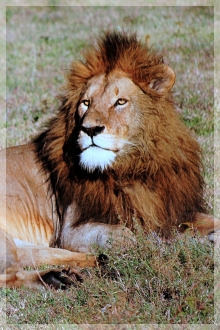
lion - tanzania

“He’s not a tame lion.” Anyone familiar with The Chronicles of Narnia by C.S. Lewis knows to whom this sentence refers. Throughout the seven Narnia books, that same thought is expressed in various ways when describing Aslan (the Christ-like character in the series). When the Pevensie children discover that Aslan is a lion, they ask if he’s safe. “Who said anything about safe?” is the reply. “’Course he isn’t safe,” adds Mr. Beaver, “But he’s good. He’s the King, I tell you.” A safe lion would be a tame lion because a tame lion has been trained. It’s predictable and can be managed, manipulated, controlled, and taught. Aslan, most definitely, is not tame but he is good and, at times, that fact is forgotten. Perhaps it is because, as Lewis explains: “People…sometimes think that a thing cannot be good and terrible at the same time.”

The Hebrew word describing God in the Psalms and translated as “terrible” in the King James, was yare, meaning “to be feared.” Most other modern translations use “awesome” or a similar less terrifying word. Back in the 1600s, when the King James version was first published, the type of “terror” associated with the word was a reverent fear of God. It conveyed both dread and terror as well as solemn awe and reverence—an appropriate response to a Being who is far greater and more powerful than any human could ever hope to be. When describing God (or Lewis’ lion Aslan), “terrible” means tremendous, awe-inspiring, formidable, intense, and fearsome. Our God is all that and more; what He isn’t is tame!

The children eventually understand that Aslan is intrinsically good and, because the lion is good, it doesn’t matter that he isn’t tame. The same goes for God! If we truly believe Him to be good, we can trust that everything He does is for our good. When life takes a bad turn, however, we tend to lose sight of God’s goodness and love. Forgetting that His inherent goodness and terribleness are inseparable, we allow challenging circumstances to steal our confidence in a good God. Like Aslan, God can’t be evil any more than He can be tamed.

Afraid of trusting an unpredictable, fearsome, and awesome God, we would prefer a God who is tame—one we could tell what to do along with when and how to do it. We wouldn’t need to please a tame God; He’d want to please us. He would coddle rather than challenge and beg rather than demand. A tame God would answer to us rather than hold us accountable to Him. Since a tame God would live to please our sinful nature, a tame God could not be good!

In Lewis’ books, the untamed but good lion brings the children into Narnia not to live bland or boring lives but to face foes, trials, and difficulties and become better for it. Nevertheless, they never face those challenges alone; Aslan is always there for them. In the same way, our awesome God does not call us to lead humdrum safe lives. He calls us to live far-reaching, uncompromising, purposeful, profound, and often challenging ones. Jesus told His disciples to take up their crosses and have lives of radical goodness and love; He tells us to do the same thing.

Our God is not tame, but He is good; He is untamed goodness and love!

Ascribe ye strength unto God: his excellency is over Israel, and his strength is in the clouds. O God, thou art terrible out of thy holy places: the God of Israel is he that giveth strength and power unto his people. Blessed be God. [Psalm 68:34-35 (KJV)]

Come and see the works of God: he is terrible in his doing toward the children of men. He turned the sea into dry land: they went through the flood on foot: there did we rejoice in him. [Psalm 66:5-6 (KJV)]

Copyright ©2025 jsjdevotions. All rights reserved.

HE’S BIGGER

Though you have not seen him, you love him; though not seeing him now, you believe in him, and you rejoice with inexpressible and glorious joy, because you are receiving the goal of your faith, the salvation of your souls. [1 Peter 1:8-9 (CSB)]

lion - tanzania

Although C.S. Lewis never intended the seven books in The Chronicles of Narnia series to be allegories, they are filled with Christian imagery and allusions. Having enjoyed reading (and re-reading) the Narnia books, I was pleased when the Pastor opened his sermon on “The Supremacy of Jesus” by quoting from it. In Prince Caspian, after a year’s absence from Narnia, Lucy encounters Aslan the lion (the Christ-like figure in the series) and says, “Aslan, you’re bigger.” The lion replies, “That is because you are older, little one.” When she asks, “Not because you are?” the lion assures her, “I am not.” He then explains, “But every year you grow, you will find me bigger.”

Only a year had passed in Lucy’s world since she last saw Aslan, but 1,300 years had passed in Narnia. Even so, in all that time, Aslan hadn’t gotten larger. As Hebrews 13:8 reminds us, “Jesus Christ is the same yesterday, today, and forever.” Indeed, God is unchangeable in His being, character, will, attributes, power, and promises.

Lucy’s misperception of Aslan’s size is not because she’s another year older or two inches taller. While we tend to think of growing as getting older or larger, growing in the spiritual sense is different. It’s a little like seeing people from a distance. From afar, they seem small but, as we grow closer to them, they seem to enlarge. Once face-to-face, we finally perceive how large they really are! Spiritual growth is coming closer to God so that we perceive how big He is and how small we are. Growth in our spiritual life doesn’t mean there is more of us; if anything, there is less of us and more of God! While God is immutable, our relationship with Him is not.

As we grow and mature spiritually, like Lucy, our perception of God will change proportionally. The more we move toward Him, the larger He becomes! We will come to see both our spiritual brokenness and the greatness of God’s mercy, our sinfulness and His immeasurable holiness, our weakness and His infinite power, our poverty and His limitless grace, our emptiness and His abundant love. As we accept our inadequacy and hopelessness, our small perspective of God changes and we begin to grasp the full extent of God’s wisdom, glory, power, and majesty. Indeed, our God is a big God!

Aslan played a prominent role in the first Narnia book so all four of the children know he exists. Nevertheless, upon their return to Narnia, they don’t see him. But, that doesn’t mean he wasn’t there. Lucy is the only one who finally sees him, perhaps because, unlike her siblings, she was the only one who believed Aslan would help them. For the other three children, Aslan remains invisible until, one by one, like Lucy, they start having faith in him. It’s been said that “seeing is believing.” In this case, it is the believing that allowed for the seeing! I expect that, as their faith increased, like Lucy, each sibling said, “Aslan, you’re bigger!”

And, so it is with Jesus. We must believe in Him to see Him and the more we trust Him, the bigger He gets!

Jesus said to her, “Didn’t I tell you that if you believed you would see the glory of God?” [John 11:40 (CSB)]

Jesus said, “Because you have seen me, you have believed. Blessed are those who have not seen and yet believe.” [John 20:29 (CSB)]

Now without faith it is impossible to please God, since the one who draws near to him must believe that he exists and that he rewards those who seek him. [Hebrews 11:6 (CSB)]

Copyright ©2025 jsjdevotions. All rights reserved.