
You are the salt of the earth. But what good is salt if it has lost its flavor? Can you make it salty again? It will be thrown out and trampled underfoot as worthless. [Matthew 5:13 (NLT)]
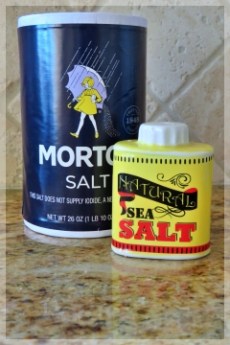 Today, when someone is called the “salt of the earth,” the speaker probably means he or she is a dependable, unpretentious and honest person—someone of moral integrity. That is well and good as far as it goes, but Jesus meant more than that when He called us to be “the salt of the earth.”
Nowadays, salt is inexpensive and a 26-ounce box of generic table salt cost less than 2 cents an ounce. Even if you wanted to go gourmet with some pink Himalayan table salt, you’d only pay about 25 cents per ounce. In ancient times, however, salt was so precious that Roman soldiers received their pay in it. When that became cumbersome, they received an allowance for its purchase. Called salarium argentum and meaning salt money, salarium remains in the English language as the word “salary.” Slave traders often bartered salt for slaves which gave rise to the expression that someone useless isn’t “worth his salt.” It was the preciousness of salt that made it so meaningful when making covenants or treaties in the ancient world. When Jesus said we are the “salt of the earth,” He meant we were as valuable as this precious commodity of the 1st century. But, aside from being valuable, what other qualities could Jesus have had in mind with His metaphor?
Salt is a flavor enhancer and we, as Christ’s disciples can add flavor and meaning to the lives of others. Salt makes people thirsty and we, as the salt of the earth, can make people thirst for and desire Christ. In ancient times, salt water was considered a natural antiseptic. Used to clean wounds and prevent infection, newborns were bathed in salt water. As salt of the earth, we can do our part in preventing sin’s infection.
Salt can lessen the pain of bee stings and bug bites and we, as salt, can lessen sin’s sting. On the other hand, salt rubbed into a wound stings and we, as salt, can rebuke and admonish the world with words that may sting. Salt can remove stains and, as Christ’s salt, we can remove the stain of sin with news of repentance and God’s forgiveness.
A paste of salt, flour and vinegar can remove rust and polish brass and copper; as salt in God’s service, we can certainly polish up this tarnished world of ours. Salt is used to stop food decay and we, acting as messengers of the Gospel, have the ability to keep people from perishing and rotting in Hell. Salt also has destructive properties and the term “salting the earth” refers to the ancient military practice of plowing fields of enemies with salt so that no crops could be grown. In the same way, we want to sow Satan’s fields with our salt to make them barren.
In spite of warnings from our cardiologists, a certain amount of salt is essential for life. Without it, our bodies become chemically unbalanced, our muscles and nervous system cease to function, and eventually we’ll die. Without a doubt, the message of Christ’s saving grace is essential for eternal life. Even though our body fluids (blood, sweat, tears) are salty, we cannot produce salt on our own nor can we obtain salvation on our own! Salvation comes by God’s grace through faith!
Finally, salt is white, the color of purity, and, as salt of the earth we should be pure, which brings us full circle to salt that has lost its saltiness or has become tainted. The salt used in Jesus’ time was obtained from salt marshes and salt lakes. Because it wasn’t refined, it always contained other minerals. If the sodium chloride was leached away by dampness or became fouled by dirt, what remained was without flavor and contaminated. Good for nothing, it was strewn on the roads like gravel. Like salt without flavor, disciples who don’t live out the values of the Kingdom cannot fulfill their purpose.
Moreover, no matter how valuable, pure, flavorful, or essential it is for life, salt that is kept in a sealed package is useless. Jesus wants us to get out of the box and into the world so we can spread our saltiness around in words and deeds as we share His Good News.
Salt, when dissolved in water, may disappear, but it does not cease to exist. We can be sure of its presence by tasting the water. Likewise, the indwelling Christ, though unseen, will be made evident to others from the love which he imparts to us. [Sadhu Sundar Singh]
 Eighteen years after the kingdom divided and Jeroboam became king of the northern kingdom of Israel, Rehoboam’s son Abijah became king of Judah, the southern kingdom. As Solomon’s grandson and David’s great-grandson, Abijah was part of David’s dynasty; Jeroboam was not. Although 1 Kings called Abijah a sinner, 2 Chronicles recorded the one highpoint of his short reign. War broke out between Israel and Judah and Judah’s warriors were outnumbered two to one. As the two kings squared off, Abijah shouted out to Jeroboam and his army. Referring to the “covenant of salt” between God and David, Abijah called Jeroboam a traitor, his men scoundrels, and charged Israel with rebellion against the Lord’s chosen Davidic dynasty of kings. Their rebellion hadn’t been against Solomon or Rehoboam; they’d rebelled against the kingdom of the Lord! Continuing with his tirade, Abijah charged the northern kingdom with apostasy because of their idolatry and illegitimate priests. After pointing to Judah’s faithful worship, he warned Israel they would not succeed because God was with Judah. Indeed, in spite of overwhelming odds, Scripture tells us “God routed Jeroboam and all Israel” and the Judeans were victorious because they “relied on the Lord, the God of their ancestors.”
 When talking with my husband about the story of Jonah, he said that the fish story was a “little too hard to swallow”— too incredible to believe. Miracles! The Bible is full of them and, since they are supernatural events, they’re all hard to accept as true. Improbability is the nature of miracles. Along with the fish saving Jonah, the story is filled with other miracles: the immediate calming of the storm once Jonah was thrown in the sea, the deliverance of the prophet from the fish safely onto the beach, Nineveh’s immediate repentance, the appointment of the plant, worm and scorching east wind as teaching tools, and even God’s revelation of Himself directly to Jonah! Yet, if we believe the Bible is God-breathed and without error, we don’t have the privilege of picking and choosing which miracles we will believe and which ones we won’t. We have only one choice to make—all or none!
 When I came across this revised version of the 23rd Psalm, I was sure it was written by a cynic as a way of mocking God, Christianity, and many of today’s popular evangelists. Imagine my surprise when I learned that it was written in all seriousness by Charles Fillmore, the founder of Unity, a church within the New Thought movement. The “revised” psalm was published in Fillmore’s book Prosperity in 1938. Although we may associate the beginnings of prosperity or “health and wealth” theology with televangelists like Jimmy Swaggart and Jim and Tammy Bakker in the 1970s, the movement began in the late 19th century. Sadly, in one form or another, it still is preached today.
 My husband loves to watch the chefs on Food Network but watching food being prepared on television doesn’t fill his empty stomach any more than just seeing his bottle will quiet a hungry baby. I could show you photos of the tulips and daffodils in Holland’s Keukenhof Gardens but that wouldn’t give you the experience of walking among hundreds of thousands of blooming flowers and smelling their fragrant aroma. You could tell me all about your children and even show me their pictures and, while I’d know about them and even recognize them, I wouldn’t know them until we met face to face and spent time together. Before I had my first child, I attended birthing classes and read all about labor and childbirth but nothing I learned came anywhere near to approximating the actual event! It’s been thrilling watching the Olympic athletes compete in the bobsled and monobob events, but watching from my sofa doesn’t come close to actually riding a sled down an icy track at more than 80-mph, dropping 384 feet in less than a mile while negotiating 16 turns, and feeling forces five times the pull of gravity on one’s body! Second-hand information is fine as far as it goes, but it never equals the genuine experience.
 Devotions of the Heart