
But the Holy Spirit produces this kind of fruit in our lives: love, joy, peace, patience, kindness, goodness, faithfulness, gentleness, and self-control. [Galatians 5:22-23 (NLT)]
 As we continued our brief study on prayer, one person shared that his prayer frequently is for patience. Agreeing, I admitted often praying, “Lord, please give me patience…and give it to me now!” While patience is a fruit of the Spirit, I have a problem getting it to grow in the garden of my life.
Without a doubt, we live in a fast-paced world and perhaps we’ve grown more impatient because of that. For example, a good download speed is 100 Mbps which allows for the receipt of 12.5 MB per second. A byte is the equivalent of one typed character so that’s like 12.5 million letters in one second (or four complete King James Bibles)! Nevertheless, we complain when we see that download circle spin for even a few seconds!
We no longer need to visit the library or bookstore for a book, the encyclopedia for an answer, or Blockbuster for a movie. Our apps mean we skip the checkout lines and our DVRs allow us to skip the commercials! Grocery shopping takes only a few minutes thanks to Instacart and DoorDash allows us to skip the groceries altogether! We pay bills, do our banking, plan travel, and shop with a few clicks of a mouse and what we order today appears on our doorstep tomorrow! We literally live in a world of instant pots, grams, chargers, coffee, rice, carts, and gratification. Patience may be a virtue but it seems as rare as handwritten letters and phone booths. Its rarity, however, doesn’t mean it’s unnecessary!
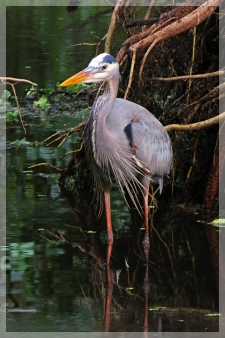
I thought about patience this morning while walking in a nearby park. We were mesmerized while watching a beautiful Great Blue Heron ((Ardea herodias) hunt for breakfast. With a height of four feet and a wingspan of nearly seven feet, the Great Blue is an impressive bird. When foraging, it stands still for long periods of time with only his head moving while patiently scanning the water for prey. When a heron wades through the water, it seems to glide. Its long legs move so deliberately and gracefully there’s not even a ripple in the water. At the Great Blue stalks its food in the wetlands, this statuesque bird is a model of focus, diligence, and purpose. Watching a heron hunt is like seeing something in ultra-slow-motion. But, when its next meal comes swimming past, the heron moves with lightning speed, uncoils its long neck, and plunges its sizable beak and head into the water. On occasion it comes up empty-beaked but, more often than not, its patience pays off and the bird emerges with a fish, frog, snake or other unlucky critter. While I’ve gotten plenty of photos of a heron hunting and several of one enjoying its catch, I’ve never gotten one of the bird actually getting its meal. You see, the heron’s patience exceeds my own. No matter how long I stalk the bird for the perfect shot, I give up before it does! Were I a heron, I surely would go hungry!
Watching the heron today was a beautiful reminder to slow down and exercise patience as we move through life. It’s easy to lose faith when things don’t move along at the pace we want them to go but life isn’t meant to be measured at megabits per second. Unlike Siri, God isn’t at our beck and call with answers to every question. Moreover, unlike UPS, He doesn’t give us a tracking link to check on a prayer’s progress and know its delivery date. God works in His time and way and what seems like a delay on His part is just our unrealistic expectations concerning God’s perfect plan.
God speaks to us through his creation and nature (like God) takes its own sweet time to accomplish its purpose. Indeed, “For everything there is a season.” It takes time for seeds to germinate, seedlings to flower, and flowers to bear fruit. It takes time for nests to be built, eggs to hatch, and eaglets to fly. It takes time for bees to pollinate, seasons to change, caterpillars to become butterflies, saplings to become tall oaks, tadpoles to become frogs, and for the heron to stalk its meal! May God’s beautiful world remind us to slow down and savor the moments and people with whom we are blessed.
Lord, please give us patience—for other people’s sentences to be completed, for projects to be finished, for questions to be answered, and for problems to be solved. Give us patience to let our children mature, for friendships to grow, and for skills to develop. May we have patience for tempers to cool and relationships to mend, patience with our own shortcomings and those of others, patience for healing to occur, and patience for prayers to be answered. Teach us how to wait!
Adopt the pace of nature: her secret is patience. [Ralph Waldo Emerson]
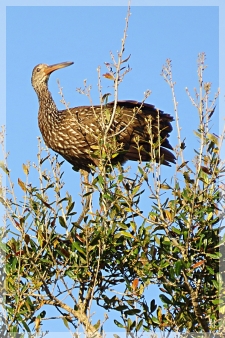 Looking like a cross between a heron and an ibis, the limpkin (Aramus guarauna) is common along Florida’s fresh water canals, wetlands, and swamps. While they’re lovely to look at, they’re not lovely to hear. Often referred to as the wailing or crying bird, limpkins have a loud piercing “banshee” scream that usually is heard at night, dawn, and dusk. During courtship, a male limpkin makes repetitive long, loud, rattling calls while a female replies with slightly lower (but still disturbing) screams.
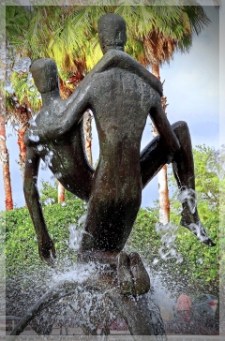 Back when I did weight training, I’d often find myself struggling with my last few reps. When I thought I couldn’t get the dumbbell up another inch and was about to give up, my trainer often gave me a little help so I could finish the rep. Disappointed that I couldn’t do it on my own, he’d remind me, “There’s nothing wrong with a little assisted lifting!”
 When writing about pride earlier this week, I remembered the Bible’s stories of proud men who got their comeuppance. 2 Chronicles 26 tells of Uzziah who, as long as he “sought guidance from the Lord, God gave him success.” His mighty army defeated the Philistines, Arabians, and Meunites (who then paid him an annual tribute) and, under his rule, Jerusalem’s walls were fortified, wilderness forts were established, water cisterns were dug, and something like catapults were erected on the walls to defend the city. With Uzziah as king, Judah prospered and the powerful king’s fame spread “far and wide.” Sadly, along with prosperity, power, and fame came pride. Believing he was above the law, the proud king entered the sanctuary and usurped the high priest’s role by offering incense. When priests warned him about his sacrilege, the proud king raged at them and immediately was stricken with leprosy—a disease that meant the “unclean” man lived the rest of his life in isolation and never again could enter the Temple. All the blessings, accomplishments, and prosperity of his reign were overshadowed by Uzziah’s one act of pride, insolence, and arrogance.
 While both Kings and Chronicles relate the history of the Israelite monarchies and cover much of the same time period, they are quite different because they relate more than events—they relate Israel’s relationship with God. Continuing the nation’s history begun in Samuel, Kings was written for the captives during their exile in Babylon. Completed around 560 BC, the author shuttles between the kings of Israel and Judah until Israel’s captivity. Judah’s history continues to the Babylonian conquest and Jerusalem’s destruction; its history ends with Jehoiachin’s release from prison during captivity. Kings’ purpose was to explain how and why God’s children ended up in exile by showing how their kings failed to follow the law as written in Deuteronomy. They’d built shrines, worshiped in “high places,” made sacrifices away from the temple, defiled the Temple with idols, and rejected God’s prophets while embracing false ones. Reflecting the author’s decidedly negative viewpoint of both kingdoms’ leadership, only four of the thirty-nine kings following Solomon (all from Judah) got good reviews with another five kings getting mixed ones. Of the remainder—all “did what was evil in the Lord’s sight.” The book of Kings clearly answered the people’s question of why they were suffering in exile
 Because we know little about the geography or politics of Jesus’ time, we sometimes miss subtleties in the gospel accounts. We know Jesus was from Galilee but what do we know of Galilee? Located north of Judea with the province of Samaria separating them, Galilee originally was settled by the tribes of Naphtali, Asher, Issachar, and Zebulun—all of whom failed to drive out the Canaanites. King Solomon gave twenty towns in the northern part of Galilee to King Hiram of Tyre either as payment for the cedar, cypress, and gold Hiram provided for the Temple’s construction or as collateral to cover later payments. In any case, Hiram later returned the cities to Solomon who then settled Israelites in them. When the kingdom divided, this region became part of the northern kingdom of Israel.
