
There may be so-called gods both in heaven and on earth, and some people actually worship many gods and many lords. But for us, there is one God, the Father, by whom all things were created, and for whom we live. And there is one Lord, Jesus Christ, through whom all things were created, and through whom we live. [1 Corinthians 8:5-6 (NLT)]
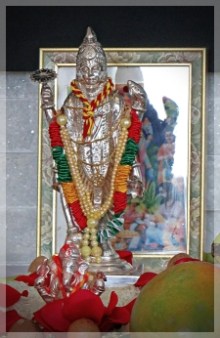 I recently met Esha while walking and we occasionally stop to chat. Although the bindi (mark) on her forehead told me she is a Hindu and the cross I wear told her I am Christian, our different faiths have not prevented us from talking about God and our beliefs. My younger son’s marriage brought many Hindus into our extended family and I try to understand this complicated religion.
When talking with my Hindu friends like Esha, they often say, “It’s all the same God.” While there is, indeed, only one God, the true God is not the one about whom they speak. Esha, like most Hindus, believes in one supreme god (often called Brahman) who manifests himself in a sort of hierarchy of lesser gods. Different Hindus worship different gods according to their own needs and perspective. One person may worship Ganesha while another Vishnu or Shiva.
Christians, however, believe that there is just one God and, as diverse as Christians are, we all worship the same God. While God is one in essence, He has three persons: God the Father, God the Son, and God the Holy Spirit. As Father, He is creator of all things, all-powerful and all-knowing; as Son, He is Jesus Christ: God in human form who lived on earth; and, as Holy Spirit, He is invisible, yet present in people and across the world. These three persons, however, are not lesser gods or worshipped apart from one another. While each personage is distinct and fully and completely God, they are simultaneously and eternally just one. Christians worship one true God who eternally exists as Father, Son, and Holy Spirit.
Although most Hindus see their supreme god as genderless, the lesser gods are viewed as being male, female, androgynous, or even gender-fluid. Although God presented as a man with Jesus’ incarnation, God is a spirit and, as such, has no bodily parts, size, or weight. In spite of speaking of God as “our Father” and referring to Him with male pronouns, God is genderless. That we’re created in God’s image doesn’t refer to His physical characteristics. We are made in God’s image because He endowed us with His spiritual characteristics—we have mind, intellect, emotions, will, and moral capacity.
My friend Esha often speaks of God being everywhere and we agree on that point. God is omnipresent. He is everywhere all at once—throughout the entire universe—from the deepest depths of the ocean to beyond the farthest star known to man! He fills every part of heaven and earth with His holy presence. While there is no place God does not inhabit, Esha and I disagree on exactly how God does that. As a Hindu, she believes that God is in everything and everything is in God. To her, God is some sort of transcendent force or energy. Since this energy inhabits the universe, the universe is God and anything found in the universe is God. As a result, if the universe should cease to exist, so would God.
While Esha and I agree on God’s omnipresence, we disagree on His nature. Rather than some sort of supernatural force or energy, God is a being! While evidence of God’s character and magnificence is found in His creation, He is as distinct from His creation as a painter is from his painting. God doesn’t need the universe to exist. As its creator, God would exist even if the universe ceased to exist!
There is only one true God, but the gods of faiths like Hinduism, Islam, Jainism, Confucianism, and a host of other isms are not Him! That does not mean that we can’t be friends and respectful of one another’s beliefs. Let us remember that the same God made us and, regardless of our beliefs, we all are God’s children. Nevertheless, let’s never fall for the line that “It’s all the same God!” when it isn’t God at all.
 When Nehemiah arrived in Jerusalem, over ninety years had passed since the first of the exiled Jews had returned to Judah. Although the temple had been rebuilt for seventy years, Jerusalem’s city walls and gates were still in ruins. Nevertheless, within fifty-two days of his arrival, the walls were reconstructed and new gates installed. That Nehemiah managed to accomplish in less than two months what hadn’t been done in ninety years is a case study in Management 101.
 Even without knowing what a petard is, we probably know that when someone gets “hoisted by his own petard,” he’s been foiled by his own scheme. When Shakespeare’s audience heard this phrase spoken by Hamlet in 1600, they knew a petard was a bomb. In the bard’s day, hoisted had more than one meaning. Along with lifted, it meant removed or taken out. Taken literally, Hamlet’s phrase meant that his enemy would be blown up by his own bomb!
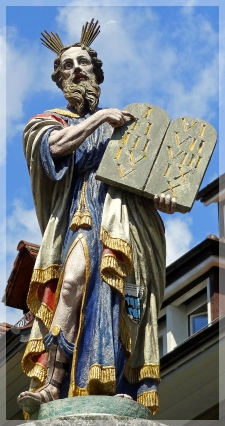 Our Colorado church had a large worship center with excellent acoustics so, when the local Jewish congregation wanted to present a concert of Jewish music by a well-known Jewish performer, we were happy to offer our venue to them. The Christians in attendance never expected the evening to end with Jews and Christians joining hands and dancing the hora around the church while singing “Hava Nagilah” (Let Us Rejoice). What the Jews hadn’t expected were the Bibles on the back of every chair. Before the concert began, many intently looked through them and, after the concert, they expressed their surprise at finding their Hebrew Scriptures in our Christian Bibles!
 The Apostle Peter tells us that true prophecy isn’t a product of the prophet—prophets only speak God’s revelation. Directed by the Spirit, their words communicate the message the Lord wants sent. Sometimes, however, prophecy is difficult to understand and interpretations of Revelation go from one extreme to the other. Some, like that priest in Monday’s devotion, dismiss it as completely symbolic. To them, Revelation is an allegory about the conflict between good and evil with good winning in the end. On the other extreme, we find obscure theories, convoluted correlations, and implausible explanations of every symbol and metaphor along with sensationalism and unchecked speculation connecting Revelation to current events.
