IT HURTS

I was given the gift of a handicap to keep me in constant touch with my limitations. Satan’s angel did his best to get me down; what he in fact did was push me to my knees. No danger then of walking around high and mighty! At first I didn’t think of it as a gift, and begged God to remove it. Three times I did that, and then he told me, “My grace is enough; it’s all you need. My strength comes into its own in your weakness.” [2 Corinthians 12:7-9 (MSG)]

oleander - rocky mt. bee plant

I recently read about a man who can’t feel pain because of a rare neurological condition called “congenital insensitivity to pain.” As someone who often reaches for the Ibuprofen because of assorted aches and pains, this sounded like a true blessing. In actuality, as nice as never having a headache, sciatica, or feeling the sting of fire ants initially sounds, it is life-threatening. Although this man can identify whether something is warm or cool, he can’t know that the coffee is burning his tongue, the stovetop is blistering his fingers, or the subzero temperatures have given him frostbite. He won’t feel the pain in his abdomen before his appendix bursts or the tightening in his heart signaling a heart attack. He chewed off part of his tongue when just a baby and has broken over seventy bones simply because he doesn’t know how to avoid injury. With no pain to restrain them, children with this condition tend to be daredevils. Pain is what teaches us to use our bodies correctly and safely. It warns of danger by telling us when something is too hot, cold, heavy, tight, hard or sharp and alerts us when something is wrong—a muscle is torn, a bone is broken, or an infection has set in.

Not only does pain protect and correct us, it certainly gets our attention, knocks us to our knees and turns us toward God. Moreover, it offers an opportunity both for our church family to draw near and comfort us and for us to witness to others in our pain.  As much as we don’t appreciate pain, it is a blessing rather than a burden. In reality, along with thanking God for the Ibuprofen, we should be thanking Him for the pain.

Pain insists upon being attended to. God whispers to us in our pleasures, speaks in our conscience, but shouts in our pain: it is His megaphone to rouse a deaf world. [C.S. Lewis]
Once I heard that, I was glad to let it happen. I quit focusing on the handicap and began appreciating the gift. It was a case of Christ’s strength moving in on my weakness. Now I take limitations in stride, and with good cheer, these limitations that cut me down to size—abuse, accidents, opposition, bad breaks. I just let Christ take over! And so the weaker I get, the stronger I become. [2 Corinthians 12:8-10 (MSG)]

Be cheerful no matter what; pray all the time; thank God no matter what happens. This is the way God wants you who belong to Christ Jesus to live. [1 Thessalonians 5:16-18 (MSG)]

Copyright ©2018 jsjdevotions. All rights reserved.

TRUSTING GOD

This I declare about the Lord: He alone is my refuge, my place of safety; he is my God, and I trust him. [Psalm 91:2 (NLT)]
The Lord is my light and my salvation—so why should I be afraid? The Lord is my fortress, protecting me from danger, so why should I tremble? [Psalm 27:1 (NLT)]

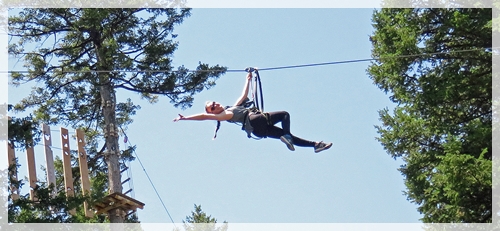
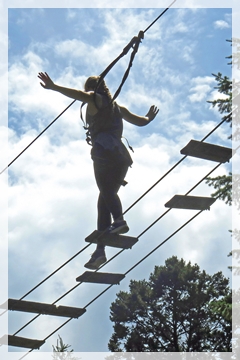
During our western trip with the grands, I wasn’t the only one to step out of my comfort zone. The two youngsters (fifteen and eighteen) took some big steps when they did a four-hour “Treetop Adventure” – think Swiss Family Robinson crossed with the X-Games or Tarzan meets American Ninja Warrior. After ascending the mountain, they had a short safety briefing, suited up in body harnesses with tethers, and set off on their aerial adventure. They maneuvered through the tree tops on elements like swaying bridges, z-shaped balance beams, high wires, hanging ropes, swinging logs, and flying skateboards. They climbed ladders, scrambled up and through cargo nets, rode thirteen zip lines, tree top adventure - jacksonand literally jumped through hoops; all of this took place some twelve to eighty feet above the forest floor.
Their equipment included a safety belay system which, in theory, always kept them clipped to a safety wire. Although participants could fall, the harness and tethers would keep them from falling more than a few feet. While it would be difficult, they could pull themselves back up and continue the course. If unable to get back up, injured, exhausted, or faint of heart, there were a few guides scattered about who could effect a rescue and lower them down to the ground. In spite of all the safety precautions, the detailed waiver we’d signed that morning made it clear there was an element of risk to the activity.

As we watched (and prayed) from the ground while the teens progressed through the course, I thought of my granddaughter’s words earlier that day: “I know it’s dangerous and that I might fall, but I also know that I’m tethered to the cable and can’t fall far.” That’s the sort of confidence we find in the Psalms. David, of course, faced far greater challenges than a ropes’ course and zip lines and, rather than trusting a cable and safety harness, he trusted God. Trusting God doesn’t mean there’s no risk or that we might not fall. Trusting God means that, like the safety harness, we know God’s there to catch us! Trusting God doesn’t mean that our journey will be easy or effortless. Trusting God means that while our journey may be challenging, like the arduous ropes’ course, getting through it is possible. Trusting God doesn’t mean we’ll never find ourselves in a dark valley. Just as the guides were there to help in an emergency, trusting God means we know we’ll never be in that dark place alone; God is always with us.

The kids completed their adventure without mishap (Praise God!). Their confidence in facing that extreme course made me wonder why I so often am hesitant about taking on much lesser challenges: not challenges requiring a liability waiver or a tethered safety harness but challenges that simply require trusting in the Lord.

If the Lord be with us, we have no cause of fear. His eye is upon us, His arm over us, His ear open to our prayer – His grace sufficient, His promise unchangeable. [John Newton]

Even when I walk through the darkest valley, I will not be afraid, for you are close beside me. Your rod and your staff protect and comfort me. [Psalm 23:4 (NLT)]

I entrust my spirit into your hand. Rescue me, Lord, for you are a faithful God. …  So be strong and courageous, all you who put your hope in the Lord! [Psalm 31:5,24 (NLT)]

Copyright ©2018 jsjdevotions. All rights reserved.

UNIMAGINABLE  BUT TRUE

Then the rich man said, “O Father Abraham, then please send him to my father’s home—for I have five brothers—to warn them about this place of torment lest they come here when they die.” But Abraham said, “The Scriptures have warned them again and again. Your brothers can read them any time they want to.” The rich man replied, “No, Father Abraham, they won’t bother to read them. But if someone is sent to them from the dead, then they will turn from their sins.” But Abraham said, “If they won’t listen to Moses and the prophets, they won’t listen even though someone rises from the dead.” [Luke 16:27-31 (TLB)]

A land of contradictions, a spectacular pageant, a world incomprehensible…a wonderful gift to men from a benign God—all this and more. [Olin Wheeler, 1914]

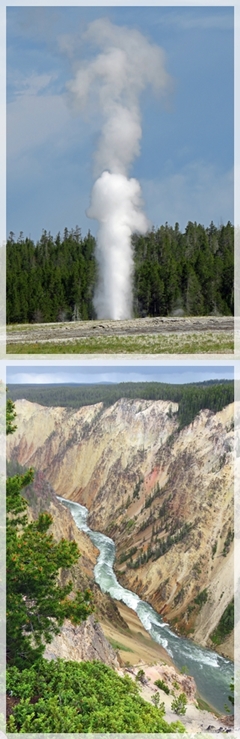
lion geyser - grand canyon of yellowstone

Although Native Americans have existed in the Yellowstone area for as long as 11,000 years, it took three major expeditions before the American public finally believed that the wonders in what is now Yellowstone National Park actually existed. The earlier descriptions of “fire and brimstone,” huge waterfalls, exploding geysers, boiling mud pots and other strange features of the region were met with unbelief until William Jackson’s photographs and Thomas Moran’s paintings from their 1871 Yellowstone expedition were presented to Congress. Once people had visual proof of the area’s bizarre geothermal wonders, they finally believed and Yellowstone became our nation’s first national park.

Indeed, having recently toured this park that sits on atop of the largest super-volcano in North America, I can understand how unbelievable those first mountain men’s stories must have seemed. In my wildest dreams, I couldn’t have imagined either the beauty or the strangeness of Yellowstone—colored travertine terraces, mud volcanos, steaming caves, a 24-mile long canyon, over 200 waterfalls, and more than 10,000 geysers and hot springs. Other worldly, it is something that truly must be seen to be believed.

Jesus told the Pharisees a parable about two men: the unrighteous rich man who died and went to a place of torment and the beggar Lazarus who died and went to a heavenly banquet. The rich man wanted to send Lazarus back to warn his brothers to change their ways. His request was denied since, like him, his brothers had ignored the warnings found in the Law and the Prophets so they wouldn’t be convinced by someone returning from the dead. Indeed, even though Jesus did return from the dead, there are many who do not believe.

We often wonder what heaven and/or hell will be like. Jesus didn’t mince any words when he spoke of the final judgment and it doesn’t sound pleasant. When the Apostle John was given a glimpse of heaven, his words in Revelation seem almost as incomprehensible to us as the words the mountain men used to describe Yellowstone’s bubbling mud pots and hissing fumaroles were to nineteenth century Americans. Father Abraham didn’t send back Lazarus and no one is going to return from death with photographs or paintings to prove what happens when we take our last breath.

Words can’t adequately describe Yellowstone and the few Biblical descriptions of both heaven and hell don’t do them justice, either. Nevertheless, like the rich man’s brothers, we have all the information we need in Scripture. As the American public learned in 1871, just because we can’t imagine something doesn’t mean it isn’t there!

Just as in this story the thistles are separated and burned, so shall it be at the end of the world: I will send my angels, and they will separate out of the Kingdom every temptation and all who are evil, and throw them into the furnace and burn them. There shall be weeping and gnashing of teeth. Then the godly shall shine as the sun in their Father’s Kingdom. Let those with ears, listen! [Matthew 13:40-43 (TLB)]

Copyright ©2018 jsjdevotions. All rights reserved.

HIS TIME IS THE RIGHT TIME

butterfly weedBut when the right time came, God sent his Son, born of a woman, subject to the law. [Galatians 4:4 (NLT)]

When an angel of the Lord told the elderly priest Zechariah that his barren wife, Elizabeth, would conceive a son, the old man was struck dumb because of his unbelief. As happened with Samuel more than 1,000 years earlier, this child’s future was decided even before his conception. This time, however, it was God who decided the boy would be a Nazirite, have the spirit and power of Elijah, prepare the people for the coming of the Lord, and be named John. Imagine the mute Zechariah, with gestures and writing, trying to explain his supernatural encounter to Elizabeth and her reaction to his shocking news.

As strange as God’s timing must have seemed to the elderly Elizabeth, God’s timing probably seemed even stranger to Elizabeth’s cousin, a young virgin in Nazareth named Mary. While Elizabeth’s unexpected pregnancy seemed late in coming, Mary’s must have seemed terribly premature to her and her betrothed, a carpenter named Joseph. Nevertheless, both of these unexpected pregnancies were part of God’s enigmatic plan and came at exactly the right time, at least for Him.

We don’t know why God chose that particular time in history for the births of John and Jesus. Did God pick it because He had the right people to be the parents he needed? The priest and his wife were “righteous in God’s eyes, careful to obey all of the Lord’s commandments and regulations,” [Luke 1:6] which certainly qualified them as a prophet’s parents. For the parents of Jesus, God needed a both a virgin and lineage to King David. Rather than glowing words to describe Mary, we only have the virgin’s obedient and willing response. Risking rejection, disgrace, and even stoning, she willingly offered herself as God’s vessel. As for Joseph, he was a righteous man, of the house of David, and, like Mary, obedient to the Lord. Perhaps God chose that time because conditions were favorable for the start of a ministry: there was peace in the empire, Greek had become the universal language, an excellent road system enabled easy travel, and a postal service existed. Was it a perfect combination of both people and conditions? We’ll never know; we only know that the time was right for God.

Nevertheless, I’m sure God’s timing didn’t make much sense to either woman. For Elizabeth, God seemed late and, for Mary, He seemed way too early. Let us remember, however, that God is neither late nor early; He’s always right on time!

In the infinite wisdom of the Lord of all the earth, each event falls with exact precision into its proper place in the unfolding of His divine plan. Nothing, however small, however strange, occurs without His ordering, or without its particular fitness for its place in the working out of His purpose; and the end of all shall be the manifestation of His glory, and the accumulation of His praise. [B.B. Warfield]

Yet God has made everything beautiful for its own time. He has planted eternity in the human heart, but even so, people cannot see the whole scope of God’s work from beginning to end. [Ecclesiastes 3:11 (NLT)]

Copyright ©2018 jsjdevotions. All rights reserved.

THE PLAN

“For this child I prayed, and the Lord has granted me my petition that I made to him. Therefore I have lent him to the Lord. As long as he lives, he is lent to the Lord.” [1 Samuel 1:27-28 (ESV)]

Maligne Lake - CanadaRichard Williams was watching TV when he saw a tennis player awarded a $40,000 check for winning a tournament. He decided then that his as yet unborn children would become tennis stars. Williams wrote a 78-page plan detailing their future, taught himself how to play tennis and, when his girls were four, started teaching them to play the game. Before they were even born, he’d planned the future for tennis greats Serena and Venus Williams.

Hannah did much the same thing for her child Samuel. Heartbroken at her inability to get pregnant, she promised God that, if He gave her a son, she would give him back to God as a Nazirite. Although the Nazirite vow was to be voluntary and temporary, Hannah committed her as yet unconceived child to a lifetime of separating himself from the world, dedicating himself to the Lord, and never cutting his hair, consuming wine (or any grape product), or getting near a dead body. After giving birth to Samuel, she fulfilled her vow; once he was weaned, she brought him to Shiloh and left him in the care of Eli the priest.

Can you imagine the youngster’s tears as he watched his parents leave? Every year, when his family returned to Shiloh for worship and sacrifice, Hannah brought a new coat for the boy and, every year, Samuel remained in Shiloh while his family went back home with the five siblings that arrived after his birth. Instead of playing whatever little boys played in 1100 BC, Samuel remained as an apprentice to an old priest in the temple. Can you imagine his loneliness and grief? Nevertheless, this is the life Hannah decided he should have.

Perhaps, however, it wasn’t Hannah but rather God who wrote the plan for Samuel. Hannah had no children because “the Lord had closed her womb.” Could He have been waiting to open her womb until she became desperate enough to make such an amazing sacrificial vow?

The priest Eli had two grown sons, Hophni and Phinehas. In spite of being priests, they were wicked worthless men who cheated, seduced women, stole from the people, and were unworthy to carry on Eli’s priestly duties. Could God have arranged circumstances so that someone worthy of the task could grow in godliness while apprenticing to Eli? When Eli and his sons died, it was Samuel who became the priest, prayer warrior, first of the prophets, and last (and most effective) of Israel’s judges. It was Samuel who anointed both Saul and David. It was Samuel, the child given to God before his conception, who was listed by Paul in the Hall of Faith.

At first glance, Hannah seemed a bit like Richard Williams (and a host of stage moms and sport dads) who decide their children’s dreams for them. Looking closer, we see that God mapped out a scenario even more elaborate than Richard William’s 78-page plan. I’m sure it didn’t make much sense to Hannah when she made the vow that took her son from his family and it certainly didn’t make sense to the young Samuel when he watched them wave farewell. In retrospect, however, it makes all the sense in God’s world; He has a way of making sense of it all!

And Samuel grew, and the Lord was with him and let none of his words fall to the ground. And all Israel from Dan to Beersheba knew that Samuel was established as a prophet of the Lord. [1 Samuel 3:19-20 (ESV)]

Copyright ©2018 jsjdevotions. All rights reserved.

TAKE NOTHING BUT YOUR FAITH

He sent the apostles out to tell about God’s kingdom and to heal the sick. He said to them, “Take nothing for your trip, neither a walking stick, bag, bread, money, or extra clothes. [Luke 9:2-3 (NCV)]

giant swallowtaiil butterflyTake only what I’ve got on my back and the one pair of sandals on my feet? You’ve got to be kidding! Obviously, Jesus hasn’t looked in my suitcase! We’re taking the grands through the Tetons and Yellowstone and I need hikers, sneakers, and Tevas along with my sandals! In addition, I need my backpack, water bottles, hiking poles, shorts, hiking pants, jeans, tops, swim suit, jacket, fleece, cap, undies, toiletries, and assorted other essentials (like phone and iPad). While attempting to cram everything I want into my bags, I pondered this verse: take nothing. At least we have hotel reservations for our entire journey; the disciples didn’t even have that. They were expected to depend on the good will and hospitality of the towns they visited.

Would I have taken nothing with me or would I have squirreled away a little money in my robe’s pocket “just in case”? Would I have had enough faith that God would provide everything I needed or would I have worried about my next meal or finding a place to rest my head at night? We know the end of the story: Jesus died and rose again. He truly was the son of God—the promised Messiah—God in flesh. The disciples, however, weren’t yet Easter people; they were followers of an itinerant rabbi from Nazareth. Nevertheless, they followed his command; their faith in Him was that strong!

Thank you, Jesus, for the faith of those who went before us. Forgive us, Lord, for our lack of faith and for our deep attachment to the things of this world. We know that if we truly rely on your power, you will, indeed, provide everything we need. Help us surrender our lives and future to you, confident in your provision and love.

Then Jesus said to the apostles, “When I sent you out without a purse, a bag, or sandals, did you need anything?” They said, “No.” [Luke 22:35 (NCV)]

Don’t worry and say, “What will we eat?” or “What will we drink?” or “What will we wear?” The people who don’t know God keep trying to get these things, and your Father in heaven knows you need them. Seek first God’s kingdom and what God wants. Then all your other needs will be met as well. [Matthew 6:31-33 (NCV)]

Copyright ©2018 jsjdevotions. All rights reserved.