
But the Lord said to her, “My dear Martha, you are worried and upset over all these details! There is only one thing worth being concerned about. Mary has discovered it, and it will not be taken away from her.” [Luke 10:41-42 (NLT)]
 My father always had a fixed itinerary for everything he did and, for him, a schedule, once made, was set in stone. Unless it was on his agenda, he never stopped to “smell the roses.” Whenever we vacationed, he had a list of sites to visit and things to accomplish for each day. For example, as soon as we arrived at the Japanese Tea Garden in San Francisco’s Golden Gate Park, he got out his list and, without even pausing to view the flowers or drink any tea, crossed off the park, and announced, “Well, that’s out of the way; now we’re off to the top of the Mark!” Once there, our cursory look out its windows at the city went much the same way and we rushed off the next destination on his itinerary. Had we visited in Jerusalem in Jesus’ time, rather than stopping to listen to Him speak from the hillside, we’d have rushed off to see the Pool of Siloam or Jacob’s well in Sychar!
I thought of my father’s version of sightseeing when visiting the bird sanctuary. We were oohing and aahing at a mother owl feeding her owlets only a few feet away. As a young man approached, we started to point them out but, without even turning his head, he quickly strode past. This swamp is one of southwest Florida’s “must see” destinations but, apparently, like my father, the fellow was anxious to cross it off his list and get on to the next thing. He missed an “Aha” moment (along with the herons, wood storks, alligators and blue flag iris) and will probably tell people his walk wasn’t worth the entrance fee.
Being the promised Messiah was a heavy assignment and Jesus knew he had a limited time on earth, yet we never read of him being in a hurry, rushing somewhere, or not stopping when someone called to him. Rather than grab a quick falafel at a first century fast-food stand, He stopped and dined in people’s homes. He didn’t rush by those who needed healing. While on the way to Jairus’ house to heal the man’s daughter, he paused long enough to heal a bleeding woman. He was never too busy to answer questions and he seized any opportunity to share God’s love and forgiveness. After chatting with the woman at the well, he interrupted his travels to stay with the Samaritans for two more days. Although large crowds followed him, he always found time for prayer and little children. He taught, preached, and healed, but he never was too busy to stop.
Our lives should be more than a “to do” list of events, destinations, and achievements. Granted, we need plans and goals, but we should be willing to adjust our schedules and revise our plans. Rather than think of life’s interruptions as distractions, we could consider them as opportunities presented by God. He gave roses a lovely aroma for a reason; perhaps it’s so we’ll stop to smell them! At the age of 56, my father, a man who never stopped to smell those roses, died of a massive coronary. There’s a lesson to be learned from his sudden death—the time to smell the roses is now! If we don’t, we’ll miss out on more than just a few “Aha!” moments when on vacation. We may miss precious opportunities with family, friends, and God. Isn’t that what Jesus was telling Martha so long ago?
As we journey through life, Lord, slow us down and stop us when necessary. Don’t allow us to become so intent on some distant objective that we forget to cherish the scenery, people, and opportunities we encounter along the way. May we always welcome interruptions that allow us to serve you, share your love, or appreciate your bountiful gifts.
Never lose an opportunity of seeing anything that is beautiful; for beauty is God’s handwriting—a wayside sacrament. Welcome it in every fair face, in every fair sky, in every fair flower, and thank God for it is a cup of blessing. [Ralph Waldo Emerson]
Look here, you who say, “Today or tomorrow we are going to a certain town and will stay there a year. We will do business there and make a profit.” How do you know what your life will be like tomorrow? Your life is like the morning fog—it’s here a little while, then it’s gone. [James 4:13-14 (NLT)]
Copyright ©2022 jsjdevotions. All rights reserved
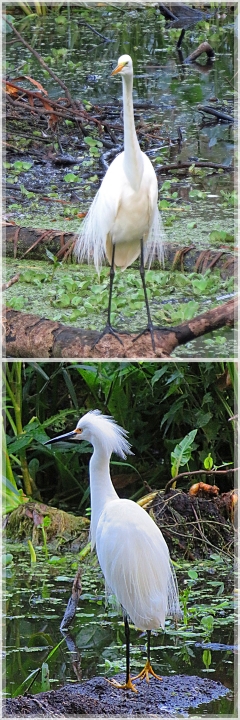 The wading birds of southwest Florida are absolutely beautiful, especially this time of year when they’re wearing their mating plumage. We’ve lived here eleven years and I still haven’t tired of their beauty as I encounter them daily in our ponds. 115 years ago, however, I would have been hard put to see any of these beautiful creatures anywhere. In the late 1800s, bird feathers became the fashion craze in women’s hats. Along with a plethora of plumes, some hats even featured an entire exotic bird! By 1900, more than five million birds were being killed every year and plume hunters had nearly wiped out the entire egret population. It wasn’t just the egrets with their white mating plumes—herons, roseate spoonbills, flamingoes, and peacocks were among the fifty North American species being killed for their plumage. No bird was safe.
 With nearly 20,000 tweets, the 2022 Twitter “Lent Tracker” revealed that the top Lenten fast for Twitter users was alcohol. Twitter and social networking took second and third places followed by Lent, sex, coffee, chocolate, swearing, men and meat. Using Twitter to give up Twitter seems somewhat counter-productive and giving up Lent for Lent makes no sense at all. Then again, since I don’t tweet, Twitter itself doesn’t make sense to me. In a survey by YouGov, people were asked what would be the hardest thing to abstain from for Lent and watching TV or using streaming services was the number one answer in all age groups except for ages 18 to 24. It’s no surprise that the hardest thing to relinquish for that group was social networking!
 While asking one’s teacher how to pray was a typical request in Jesus’ day, Jesus was anything but a typical teacher. He’d walked on water, stilled storms, healed the sick, raised the dead, and turned water into wine, but His disciples didn’t ask how to do those impressive miracles. Instead, they asked Him how to pray.
 When the Academy Awards were held recently, Oscars were presented for things like best director, best lead and supporting actors and actresses, and even best make-up and hair styling. If it’s true (as my theater teachers claimed) that, “There are no small parts, only small actors!” how is it that no awards were given to the best small part players? Regardless of the perfection with which they may have fulfilled their “bit parts”, their screen time was too short to be nominated for anything. To add insult to injury, they may have been known only as Dog Walker or Nurse #2! The small role, however, doesn’t mean the character played an insignificant part in the story. Nevertheless, after moving the story forward, the bit part players just fade into the background. Even so, while their names may be forgotten, the story wouldn’t have been the same had they not played their roles.
 In four of Paul’s epistles, he instructs his readers to greet one another with a sacred kiss. The word he used was philéma which meant a kiss of respect or affection between friends rather than one of romance. It seems odd to us today but, when greeting or saying farewell in the ancient world, people frequently kissed one another on the cheek, forehead, beard or hands. In the Old Testament, for example, both Laban and Esau kissed Jacob, Joseph kissed his brothers, Moses kissed Aaron and Jethro, Samuel kissed Saul, David kissed Barzillai and Jonathon, and Absalom curried favor by kissing just about everyone who approached him!
 Devotions of the Heart