THE PURSUIT OF HAPPINESS – Independence Day

Give me understanding and I will obey your instructions; I will put them into practice with all my heart. Make me walk along the path of your commands, for that is where my happiness is found. [Psalm 119:34-36 (NLT)]

Today we celebrate the adoption of the Declaration of Independence 246 years ago—when American colonists shed the tyranny of Great Britain and King George III to form the United States of America. Among the unalienable rights cited in this historic document are “life, liberty, and the pursuit of happiness.” During this long holiday weekend, Americans have been busy enjoying life, celebrating liberty, and pursuing happiness with a variety of activities that, among other things, probably include parties, picnics, flags, fireworks, parades, sparklers, and carnivals along with beaches, pools or sprinklers, and hot dogs, burgers, potato salad, and ice cream!

“The pursuit of happiness,” however, had a different meaning back in 1776 than it does today. When our Founding Fathers wrote of pursuing happiness, they weren’t thinking about 4th of July fireworks, fun, and games. Rather than a temporary emotion, they were thinking of a state of being and envisioning the kind of happiness that comes from having a government in which people can participate, their voices are heard, they can control their destiny, justice prevails, talents are nurtured, people can work and move ahead, the nation is tranquil, and its borders are defended. Pursuing happiness in 1776 wasn’t about self-gratification; it was about an individual’s contribution to society. As Supreme Court Justice Anthony Kennedy explained, “For them, happiness meant that feeling of self-worth and dignity you acquire by contributing to your community and to its civic life.”

Unfortunately, a prevalent attitude in our nation today focuses on individual needs and desires and the pursuit of happiness is interpreted as meaning, “Do whatever makes you happy!” We might want to exercise some caution when pursuing happiness while focusing only on ourselves. It didn’t end well in Eden when Adam and Eve decided to pursue happiness by eating the forbidden fruit nor did focusing on their own desires work for David or Sampson. A hungry Esau pursued happiness with a hearty bowl of stew and his brother pursued it by deceiving Isaac. Achan pursued happiness by keeping plunder from Jericho as did Saul when he kept the best spoils from Agag. Sarah foolishly pursued happiness by giving Hagar to Abraham and, like many of us, Noah sought happiness in too much wine. Yet, none of those pursuits brought happiness. In spite of his wisdom, Solomon pursued happiness by accumulating massive amounts of silver and gold, 700 wives, and 300 concubines and yet his words in Ecclesiastes are not those of a happy man. As Thomas Jefferson said, “It is neither wealth nor splendor; but tranquility and occupation which give you happiness.”

While we live in a free country and God has given us free will, we need to be sure we don’t ever use our freedom to fall into another kind of tyranny—a tyranny much worse than that of King George III—the tyranny of sin.

There are two freedoms—the false, where man is free to do what he likes; the true, where he is free to do what he ought. [Charles Kingsley]

Well then, since God’s grace has set us free from the law, does that mean we can go on sinning? Of course not! Don’t you realize that you become the slave of whatever you choose to obey? You can be a slave to sin, which leads to death, or you can choose to obey God, which leads to righteous living. [Romans 6:15-16 (NLT)]

Copyright ©2022 jsjdevotions. All rights reserved

SHIFTING SANDS

Dome house - Cape RomanoAnyone who listens to my teaching and follows it is wise, like a person who builds a house on solid rock. Though the rain comes in torrents and the floodwaters rise and the winds beat against that house, it won’t collapse because it is built on bedrock. But anyone who hears my teaching and doesn’t obey it is foolish, like a person who builds a house on sand. When the rains and floods come and the winds beat against that house, it will collapse with a mighty crash. [Matthew 7:24-27 (NLT)]

5-miles south of Marco Island, Florida, the remains of the Cape Romano dome house are a perfect illustration of Jesus’ parable about building on a solid foundation. When completed in 1982, the 2,400 sq. ft. house was on Tice Island and about 100 feet from the water. Consisting of six interconnected dome-shaped modules, it was eco-friendly and state-of-the-art. Completely self-sustaining, it had solar panels, generator, satellite TV, a 23,000-gallon cistern that collected water runoff, a water filtration system, and even air conditioning. While its rounded domes survived the hurricane force winds of Andrew in 1992, in the years following, water levels began to rise and destabilize the house’s foundation. After 2005’s Hurricane Wilma, the domes began leaning as the shifting sands eroded their foundation. As the beach retreated, the domes appeared to be marching into the Gulf and, by 2013, they were standing in 6-feet of water. After Hurricane Irma in 2017, two of the domes collapsed into the sea. The remaining domes now sit about 300 feet offshore. When the house was built in the 1980s, two other large houses stood on the island. But, like the dome house, they were no match for Florida’s storms that sucked the sand beneath them right back into the Gulf of Mexico; they, too, are a thing of the past!

Before erecting this house, the owner built a prototype in Tennessee to test his design and it still is standing. Since sand from the beach was used for the concrete, the sand was analyzed to make sure it had the proper aggregate for construction. The problem, however, wasn’t with the concrete or the domes’ unique design; the problem was with the choice of foundation! Rather than bedrock, it was sand!

The Sermon on the Mount concludes with the parable of The Wise and Foolish Builders. Israel is known for torrential rains that cause floods and, when the winter rains came, the Jordan River would pour into the sea causing it to overflow its banks. While the sand around the Sea of Galilee was hard on the surface during the hot summer months, a wise builder would not be fooled those conditions. He’d dig down as far as ten feet below the surface to reach the bedrock for the foundation of the house. The foolish builder, however, takes the easy way and doesn’t dig down to the bedrock. Like the homes on Tice Island, both homes would look secure in good weather. It was only when the storms hit that the difference would become obvious. Houses built on the bedrock can withstand floods and erosion while those built on sand won’t.

Having been raised by a builder, Jesus knew His topic well but He wasn’t giving a lesson in construction. Many of His listeners had built their lives on surface righteousness—one of cursory adherence to the letter of the Law without actually building a deep faith in and obedience to God. No matter how carefully they observed the outward rituals of Judaism, without an inner relationship with the Lord, they had no foundation. They’d built something that looked good on the outside but was weak on the inside and would not stand strong during life’s tempests and turmoil.

It’s inevitable that one or more storms will pummel us and challenge our foundation and this parable still applies to us. Foolish builders choose to build their lives on worldly things like the false gods of wealth, status, looks, power, and self. However, their lives will crumble and collapse when those things disappear. As with the dome house, it may not occur all at once but it will happen. Because wise builders build their lives on faith in the unchanging Lord and His Word, they can withstand life’s challenges. If our foundation is laid in the bedrock of Jesus and Scripture, while battered and bruised, we will remain standing.

When the homes on Tice Island originally were built, they looked sturdy—but looks are deceiving. Without a firm foundation, they couldn’t stand; neither can we! How firm is your foundation?

Therefore, this is what the Sovereign Lord says: “Look! I am placing a foundation stone in Jerusalem, a firm and tested stone. It is a precious cornerstone that is safe to build on. Whoever believes need never be shaken. [Isaiah 28:16 (NLT)]

Copyright ©2022 jsjdevotions. All rights reserved.

THE SAD STORY

After that generation died, another generation grew up who did not acknowledge the Lord or remember the mighty things he had done for Israel. … In those days Israel had no king; all the people did whatever seemed right in their own eyes. [Judges 2:10, 21:25 (NLT)]

tulipAs a history of Israel’s disobedience, idolatry, and moral depravity, Judges is one of the saddest books of the Bible; it also is one of the bloodiest and violent. After starting well with war against the pagan tribes of Canaan, it ends with civil war and Israelite killing Israelite. While some tribes obediently drove the pagan people from their land, others found it easier to tolerate sin than fully eradicate it. By the time of Gideon, altars to Baal and Asherah poles had been erected and people wanted to kill Gideon for destroying them. It only went from bad to worse after Samson. Micah sinfully set up a shrine for his idols, wrongly fashioned a priestly ephod, ordained his son into the priesthood, and then purchased the services of a Levite as his personal priest! After the Danites stole his idols, ephod, and Levite, they set up their own idolatrous shrine with the Levite as priest. Did no one remember God’s laws given to them by Moses that specifically covered priests, ephods, Levites, and the worship of idols?

As for violence—along with the carnage of battle, there’s a disembowelment, a tent peg hammered into a head, eyes getting gouged out, and a king’s thumbs and big toes get amputated to humiliate him. Thirty men are killed just to pay a gambling debt and a father’s foolish vow ends in the sacrifice of his daughter. After 300 foxes are set on fire in a vengeful act that destroys a town’s grain fields, vineyards, and olive groves, a father and daughter are burned to death as payback!

Instead of conquering the fertile land they’d been given, the Danites moved north, burned the peaceful city of Laish, and mercilessly killed its inhabitants. When the men of Gibeah raped and killed a Levite’s concubine, the Levite dismembered her body to summon the tribes of Israel. Then, after they nearly eradicate the entire tribe of Benjamin in retaliation for the concubine’s death, the men regret their actions. To right the wrong, they slaughter every man, woman, and child in Jabesh-gilead except for 400 virgins who are given to the surviving soldiers of Benjamin. Needing more virgins, another 200 young women were forcibly abducted from Shiloh. How did this happen? What happened to God’s law? How did Israel fall into such sin, violence, and mayhem?

Scripture tells us that one generation after Joshua’s death, the people forgot and, within one generation of the death of each judge, they forgot again! There was a reason God wanted his word passed on through the generations and a reason he commanded people to keep repeating the law to their children. Whether the command to put His words on hands, foreheads, and doorposts was literal or figurative, God wanted His word to be an inescapable part of His people’s lives and the lives of every generation that followed. Why? Because God’s Word means life!

When I look at the disobedience, idolatry, moral depravity, and violence in Judges, I can’t help but see parallels today. As my mother would say, it seems that the world is going to hell in a handbasket. Indeed, it does! There’s a reason the world doesn’t seem much better in 2022 than during the 300 plus years of turmoil recounted in Judges. As they did nearly 3,400 years ago, people continue to do whatever seems right in their own eyes. We’ve allowed the full story of God’s redemption to be forgotten, disregarded, or never heard. The people of Israel didn’t need a king; they needed God. So do we! What are we going to do about it?

And you must commit yourselves wholeheartedly to these commands that I am giving you today. Repeat them again and again to your children. Talk about them when you are at home and when you are on the road, when you are going to bed and when you are getting up. Tie them to your hands and wear them on your forehead as reminders. Write them on the doorposts of your house and on your gates. [Deuteronomy 6:6-8 (NLT)]

Copyright ©2022 jsjdevotions. All rights reserved

GOOD INTENTIONS

This is why I remind you to fan into flames the spiritual gift God gave you when I laid my hands on you. For God has not given us a spirit of fear and timidity, but of power, love, and self-discipline. [2 Timothy 1:6-7 (NLT)]

rocky mountain national parkBritish mystery author Ruth Rendell often received letters from would-be authors who wanted to know how to get started. Her response was simple: “I tell them to stop writing to me and get on with it.” Author Jodi Picoult said when she can’t write a good page, she simply revises a bad one while pointing out, “You can’t edit a blank page.” If we want a page filled with words, we’ve got to sit down and write them.
Even when working for God, we need more than good intentions or even prayer. Ten years ago, I was part of a Christian women’s ministry that hosted a web site for twelve writers all of whom believed they’d been called by God to expand His kingdom through their writing. We were a diverse multi-generational group and the website offered links to our individual blogs. We regularly shared our prayer concerns with one another and rarely a week went by without a prayer request for divine inspiration for someone’s writing. Sadly, the ministry disbanded within two years because only a few of the writers ever wrote anything. Apparently, good intentions and even prayer were no substitute for actually sitting down and doing the work!

By simply leaving things up to God and giving Him the entire responsibility for our work, we yield to the temptation not to take any initiative. While God is the one who enables us and deserves the glory, we are His hands and feet here on earth and the ones who are called to do His work! Remember, the Israelites had to take the initiative by stepping into the Jordan River before God stopped its flow and they were the ones who marched around Jericho for seven days before God made its walls come tumbling down! I believe in the power of prayer but prayer alone didn’t get the Israelites across the river or defeat Jericho; the people had to do the walking and the wielding of the swords. In the same way, prayer alone doesn’t provide us with the words for a devotion, sobriety, a job, health, good grades, a thriving business, a successful marriage, a college degree, or a speaking ministry. God gives us the power, guidance, inspiration, and even victory, but we still have to do the work!

When we’re called by God, He will provide us with the talent, tools, situation, time, assistance, and spiritual gifts necessary for that task. The one thing He won’t provide is the finished product. He expects us to do the labor and, as powerful as prayer is, it is no substitute for work. When Jesus spoke of moving mountains and promised us, “You can pray for anything, and if you have faith, you will receive it,” He wasn’t offering us a magic wand to capriciously move mountains into the sea. If God really wants that mountain moved, however, He might just provide the shovel and tell us to start digging!

In Eden, God gave man the gift of work and a sense of purpose. After the fall, however, thistles and thorns appeared and man’s work became difficult. Work was still good; it just wasn’t easy. When faced with a garden full of weeds, we can pray those weeds will disappear and wait for divine intervention or, while praying, we can put on our work gloves and start pulling them out!

I consider it an error to trust and hope in any means or efforts in themselves alone; nor do I consider it a safe path to trust the whole matter to God our Lord without desiring to help myself by what he has given me; so that it seems to me in our Lord that I ought to make use of both parts, desiring in all things his greater praise and glory, and nothing else. [St. Ignatius]

Pay careful attention to your own work, for then you will get the satisfaction of a job well done, and you won’t need to compare yourself to anyone else. For we are each responsible for our own conduct. [Galatians 6:4-5 (NLT)]

Copyright ©2022 jsjdevotions. All rights reserved.


ORDINARY TIME

And so, dear brothers and sisters, I plead with you to give your bodies to God because of all he has done for you. Let them be a living and holy sacrifice—the kind he will find acceptable. This is truly the way to worship him. [Romans 12:1 (NLT)]

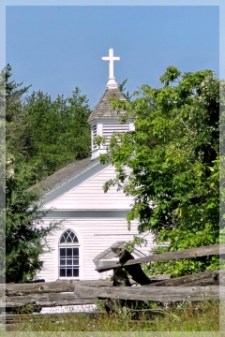
church - old world wisconsinI grew up in a church with hymn boards in the front of the sanctuary that displayed the liturgical church date and the day’s hymns. I loved seeing “First Sunday in Advent” because that meant there were only three more Sundays until Christmas. While “Lent” meant six weeks of no candy, “Palm Sunday,” with its promise of Easter (and Easter baskets) in just a week was always welcome. For most of the year, however, that sign was uninspiring. The weeks after Easter were simply noted as the first through the seventh Sundays of Easter until the arrival of Pentecost 50 days after Easter.
Yesterday was Pentecost Sunday which commemorates the receipt of the Holy Spirit by the early church [Acts 2]. A mighty wind filled the house where the believers were meeting, what looked like tongues of fire settled on each person, and everyone was filled with the Holy Spirit. Because of the uproar, people gathered, Peter preached, and 3,000 new believers were added to the church that day. Pentecost was the day the Christian church was born! On the hymn board in our church, Pentecost also was the last notable event for the next six months!

From then on, that board marked time by how many Sundays it was after Pentecost until the church year started over again with the first Sunday in Advent. For a child, those months between Easter and Advent pretty much lived up to their church name: Ordinary. It felt like we were just marking time until something important, like Christmas or Easter, happened. What I didn’t understand as a child is that Ordinary Time in the church year doesn’t mean dull or commonplace. “Ordinary” comes from the Latin word ordinalis and refers to numbers in a series. It’s called “Ordinary Time” because ordinal numbers are used to count the Sundays as they relate to major church celebrations like Easter and Pentecost.

Granted, days like Christmas, Easter, and Pentecost commemorate significant events in the life of Christ and the church but that doesn’t mean any other worship service is less special or significant. Rather than celebrating specific events such as His birth, death, resurrection, ascension, and the descent of the Holy Spirit, the season of Ordinary Time celebrates the presence of Christ in our lives throughout the year. It is during this in-between time that we learn, grow, mature, witness, and serve as we live out our faith in Christ. If we think about it, the really extraordinary events in our lives usually happen in ordinary times!

Nothing in Scripture demands observing the liturgical year—it just is a tradition followed by several denominations. Nevertheless, whether or not we observe Ordinary Time, our worship should never be ordinary, sporadic, or missing altogether. Too many of those who claim to be Christians are little more than “birth and resurrectionists.” The message of the resurrection doesn’t end once the eggs are found nor does the significance of the risen Christ stop when the last of the jelly beans and chocolate bunnies are eaten. The promise of our salvation doesn’t disappear when Easter dinner is finished only to reappear at Christmas and disappear again when the tree is taken down. Christ’s birth and resurrection bring us love, grace, peace, forgiveness, redemption, and salvation, not just on Easter and Christmas, but in every ordinary day of our lives. Following Jesus isn’t limited to two days a year and the gospel message isn’t limited to a few events in Christ’s life. None of the days He walked on earth were ordinary and every day with Him is extraordinary!

The discovery of God lies in the daily and the ordinary, not in the spectacular and the heroic. If we cannot find God in the routines of home and shop, then we will not find Him at all. [Richard J. Foster]

But the time is coming—indeed it’s here now—when true worshipers will worship the Father in spirit and in truth. The Father is looking for those who will worship him that way. [John 4:23 (NLT)]

Copyright ©2022 jsjdevotions. All rights reserved.

SIMON OF CYRENE

Then he said to the crowd, “If any of you wants to be my follower, you must give up your own way, take up your cross daily, and follow me.” … As they led Jesus away, a man named Simon, who was from Cyrene, happened to be coming in from the countryside. The soldiers seized him and put the cross on him and made him carry it behind Jesus. [Luke 9:23, 23:26 (NLT)]

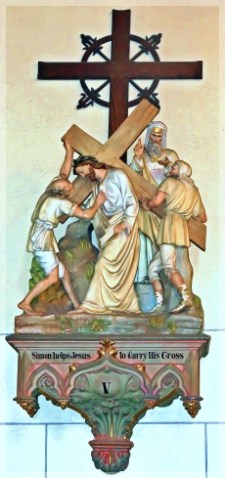
Simon Carries the Cross
Although Jesus spoke of carrying your own cross, it was Simon of Cyrene who carried His. Cyrene was in Cyrenaica, a land just east of Egypt in what now is Libya. We don’t know if Simon had resettled in Judea or if he was there just for the Passover. We only know that Simon had just come into the city from the fields (or countryside) when the soldiers pressed him into service. Carrying a 75-to-125-pound cross-beam (patibulum) of a Roman cross certainly hadn’t been in Simon’s plans that day but one didn’t refuse a Roman soldier.

If we’re supposed to carry our own cross, why didn’t Jesus carry His? Perhaps because that cross was as much Simon’s as it was Peter’s and John’s and yours and mine. That cross weighed more than 125 pounds because it carried the weight of mankind’s sins. It was at Golgotha that Simon surrendered the weight of his (and everyone else’s) sins to Jesus. Not only did Simon carry his own cross but Luke tells us specifically that Simon followed Jesus as he did it!

When they impressed Simon into service, it seems as if the Roman soldiers finally showed some compassion on the man they’d so mercilessly beaten earlier that day. Kindness, however, may not have been their motivation. Not everyone condemned to the cross survived the soldiers’ scourging but they’d been told to crucify Jesus. If He died before getting to Golgotha, they’d have failed at their task. The soldiers may have enlisted Simon simply to keep Jesus alive long enough so they could inflict more torture on Him!

Whatever the soldier’s motive was for conscripting Simon, theologian John Piper posits that God put Simon there for Jesus. Let us remember that the man who healed the sick, turned water into wine, fed a multitude with a boy’s lunch, gave life back to Jairus’ daughter, and called Lazarus out of the tomb had the power to stop his suffering at any time that day. If we thought Jesus’ anguish was great the previous night while praying to do God’s will, His agony that day was far worse. If we thought Jesus’ temptation to yield to Satan was great in the wilderness, it was even greater as He stumbled toward Golgotha. Angels, however, ministered to our Lord in the wilderness and an angel strengthened Jesus in the Garden of Gethsemane. In the same way, did God have Simon carry the cross as a way of helping and sustaining His Son so that Jesus’ obedience would not falter?

God works in amazing ways and maybe Simon of Cyrene was placed on that roadside at just that time for just such a purpose! Could God have placed us somewhere today so that we can serve as one of His ministering angels?

The Spirit then compelled Jesus to go into the wilderness, where he was tempted by Satan for forty days. He was out among the wild animals, and angels took care of him. [Mark 1:12-13 (NLT)]

“Father, if you are willing, please take this cup of suffering away from me. Yet I want your will to be done, not mine.” Then an angel from heaven appeared and strengthened him. [Luke 22:42-43 (NLT)]

Copyright ©2022 jsjdevotions. All rights reserved.