
 And I will give you a new heart, and I will put a new spirit in you. I will take out your stony, stubborn heart and give you a tender, responsive heart. And I will put my Spirit in you so that you will follow my decrees and be careful to obey my regulations. [Ezekiel 36:26-27 (NLT)]
Last Friday, doctors in Maryland made history when they transplanted a genetically modified pig’s heart into a human in a last-ditch effort to save the life of David Bennett, Sr. A medical first, Bennett was too ill to qualify for a routine heart transplant or an artificial ventricular assist device. The 57-year-old’s prognosis is uncertain and it will be months before doctors know whether the transplant can be deemed a “success.” As with any organ transplant, the main risk is that of organ rejection and Bennett will need potent immunosuppressing drugs for the remainder of his life.
I remember how astonished the world was back in 1967 when Dr. Christiaan Barnard performed the first human-to-human heart transplant. The news that a surgeon had cut open someone’s chest, lifted out a diseased heart, and successfully replaced it with a healthy one from a dead donor was astounding. Although that first heart transplant recipient lived only eighteen days, today’s recipients have an 85% chance of living one year and a 69% chance of surviving five. The survival rate continues to decrease through the years with only 50% of heart transplant recipients living ten years and just 15% making 20 years. In spite of the risks, last year over 50,000 transplant candidates worldwide vied for the 5,000 hearts that were available. Sadly, there just aren’t enough hearts to go around.
54 years ago, the medical journals were wrong when they credited Dr. Bernard with the first heart transplant; God has been replacing hearts for ages! He takes our damaged hearts of stone, hearts unwilling to respond to Him, and replaces them with a new heart and spirit. After accepting His new heart, we have no need for immunosuppressive drugs because the new heart won’t be rejected. Unlike transplant candidates, we don’t have to meet specific criteria or put our names on a waiting list. Everyone qualifies and all we have to do is repent! The best news is that there’s no heart shortage and we don’t have to wait for someone to die; Jesus did that for us 2,000 years ago!
Even with a pig’s heart, Mr. Bennett won’t to want to live in a sty, cool off with a mud bath, snuffle in the soil, or start eating a mix of corn, soybeans, sorghum, and wheat. While his new heart will give him a new lease on life (at least for a short time), it will not change him. He will be the same man with the same favorite activities, world view, media preferences, attitudes, likes and dislikes, morals and principles he had before surgery. On the other hand, the new heart God gives us will make a huge change in us. We will have a new mind, new preferences, new spiritual gifts, new beliefs and morals, a new love for who and what we may have hated, and a new aversion to things we once might have loved. Rather than getting immunosuppressant drugs, we will receive an infusion of love, joy, peace, patience, kindness, goodness, faithfulness, gentleness, and self-control! Getting a new heart in God’s hospital also yields a far better survival rate—no death, only eternal life!
O Holy Spirit, descend plentifully into my heart. Enlighten the dark corners of this neglected dwelling and scatter there thy cheerful beams. [Augustine]
 The Bible is filled with evidence of God’s goodness and the great (and miraculous) things He’s done for His people. Daniel emerges unscathed from a lion’s den, David defeats Goliath and the shepherd boy becomes a king, wisdom and riches are given to Solomon, and Shadrach, Meshach, and Abednego aren’t even scorched from a fire. Water is parted more than once, the walls of Jericho collapse, jail doors miraculously open, and storms cease at a word. Armies are led to victory, manna falls from heaven, fish and bread multiply, the barren give birth, the sick and lame are healed, and the dead rise. The Bible is full of marvelous accounts of miracles, majesty, and triumphs.
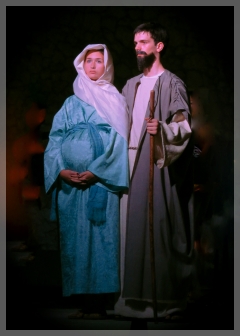 Until learning about Las Posadas, I hadn’t given much thought to the difficulty of Joseph and Mary’s journey to Bethlehem or to how frightened and desperate the couple must have been that night so long ago. As the crow flies, it’s only a 70-mile trip from Nazareth to Bethlehem but Joseph and Mary weren’t crows and the route was not a straight one. Because of the hilly terrain, the most direct route south was the most physically challenging and, because it led right through Samaria, it also was the most dangerous. Wanting nothing to do with Samaritans, Jews typically detoured to the east before going south along the flatlands of the Jordan River, turning west at Jericho, going over the hills surrounding Jerusalem, and on south into Bethlehem—a trip of 90 to 100 miles. The trek from Jericho to Bethlehem would have been the hardest since it was an uphill hike with an elevation change of 3,500 feet! In good circumstances, people could walk about 20 miles a day so Mary and Joseph feasibly could have made Bethlehem in five 8-hour days. Mary, however, was about ready to give birth so a trip of seven to ten days is more likely.
 I’d gotten sidetracked taking pictures of the water lilies at the Botanic Gardens. I looked around for my husband and saw him sitting quietly on a nearby bench. Although his head was down, I knew he wasn’t snoozing. Sitting down beside him, I said, “He really is amazing, isn’t He?” We both spent a few minutes reflecting on how great our God is and thanking Him for using all 120 of the crayons in his heavenly box when he made the flowers. He’s an extraordinary artist!
 Since there are about 25 genealogy lists in the Bible, genealogy must be important to both God and His people. Genealogies were important to the Jews since priests and Levites could serve only if they were of pure ancestry. In Chronicles we saw how genealogies provide a connection between generations and the promises made to their ancestors. Matthew and Luke’s genealogies were important to Jewish believers because they showed that Jesus came from the Davidic line and important to Gentiles because Jesus’ Gentile ancestry shows that God sent His son for all people. What do they mean to Christians today?
 Devotions of the Heart