
The thief comes only to steal and kill and destroy. I came that they may have life and have it abundantly. I am the good shepherd. The good shepherd lays down his life for the sheep. He who is a hired hand and not a shepherd, who does not own the sheep, sees the wolf coming and leaves the sheep and flees, and the wolf snatches them and scatters them. [John 10:10-12 (ESV)]
 In a cartoon drawn by Paul Noth, an enormous political billboard overlooks a pasture inhabited by a flock of sheep. Looking up at the picture of a grinning wolf in coat and tie saying, “I am going to eat you!” one sheep tells another, “He tells it like it is.” Would that all politicians were so forthright!
While the cartoon was political commentary by Noth, the sheep and wolf reminded me of Scripture’s many analogies likening us to sheep and Satan to a predator like a wolf. Unlike that wolf, however, Satan would never be so honest as to openly announce his intention to devour us. Like many politicians, he distorts, deceives, and betrays us for his own purposes.
In Matthew 4:7-10, we read of Jesus being led into the wilderness to be humbled and tested. For forty days Jesus fasted and, during that time, Satan visited Him. Like a politician who, knowing the people’s hunger, promises a chicken in every pot, the tempter reminded Jesus that, as the Son of God, He could turn the stones under his feet into bread with just a word. Satan was tempting the hungry man to act independently of God and use His own power to ease His hunger. Jesus, however, responded by citing Deuteronomy 8 and telling Satan that God let Israel hunger so they would know that man doesn’t live by bread alone “but by every word that comes from the mouth of God.”
Satan then took Jesus to the highest point of the Temple where, like a true politician, he offered only a half-truth. Omitting a few words and misapplying God’s promise, he quoted from Psalm 91 that the angels “will bear you up, lest you strike your foot against a stone,” and dared Jesus to jump. The Lord again responded with words from Deuteronomy that, “You shall not put the Lord your God to the test.” [6:6] God is to be trusted rather than tested!
Finally, Satan took Jesus to a mountain peak and promised to give Him all the nations of the world if Jesus would kneel and worship the evil one. Like many a politician, Satan was promising something that wasn’t his to give—God the Father already had promised Jesus the kingdoms of the world! Countering Satan’s offer to take a shortcut and sidestep the cross, Jesus quoted the words from Deuteronomy prohibiting idolatry.
Satan tested Jesus by offering Him ways to take the easy way by misusing His power but, every time he did, Jesus refuted the tempter’s deceitful words with Scripture. There is power in the word of God that even Satan cannot deny.
Unlike the sheep in Noth’s cartoon, our shepherd has not left His flock defenseless; He’s given us the sword of God’s Word. Perhaps, it’s time to sharpen up our blades with some Bible reading so that, when we’re tempted, we too can say “It is written…!” It was Thomas Jefferson who said, “A well informed citizenry is the best defense against tyranny.” Those words apply to the citizens of God’s kingdom, as well; when we know the truth, the enemy can’t bamboozle us with his lies.
 A certain amount of discontent seems to be built into us, which isn’t all bad since discontent can be the incentive to make improvements. Dissatisfaction with the harpsichord’s inability to vary the intensity of its sound led Bartolomeo Cristofori to invent the piano around 1708. Benjamin Franklin’s annoyance at having to switch between two pairs of glasses led to his invention of bifocals and it probably was his discontent with a cold house that led to his invention of the metal-lined Franklin stove. The invention of the “ballbarrow,” with its rust-proof plastic bin and ball-shaped wheel that won’t sink into soft soil, is the result of James Dyson’s discontent with the traditional wheelbarrow. As Thomas Edison said, “Discontent is the first necessity of progress.”
 Many years ago, my two boys were playing at their grandparents’ house. While Grandpa worked in the garden, the brothers climbed up into the apple tree and started to throw apples at him. A patient man, their grandfather told them to stop and, when more apples came whizzing at him, he offered a sterner warning. After briefly stopping their barrage, the rascals were unable to resist the temptation and chucked more apples at Grandpa. To their surprise, this gentle and loving man turned around, picked up some apples, and returned fire. Having played ball as a boy, Gramps had a strong throwing arm and excellent aim. He didn’t pull any punches as he pitched those apples back at his grandsons. The boys, unable to maneuver easily in the tree, quickly learned the meaning of “as easy as shooting fish in a rain barrel.” When they called, “Stop, Grandpa, it hurts!” he replied, “Yes, I know it does, but you needed to learn that!” It wasn’t until those hard apples hit their bodies that the youngsters understood how much their disobedience hurt their grandfather (both physically and emotionally).
 Many years ago, while my son and his pals were playing baseball in the field next to the Miller house, the ball ended up going through the Miller’s window! When my son returned home, he asked me to call Mrs. Miller and ask for the return of his ball. Once I knew how the ball came to be in her possession, I told him he had to pay for the broken window before getting back his ball. So, for the next few weeks, the boy worked extra chores to pay off his debt.
 Do these verses mean I can’t wear my pearl earrings, diamond wedding ring, or gold cross to church? Do I have to say “farewell” to Nordstrom’s and start shopping solely at outlets and discount stores? Although my hair is short, it’s hard to believe my grand’s lovely French braids are inappropriate at church or anywhere else. What did Paul and Peter mean with their admonitions about women’s attire and modesty?
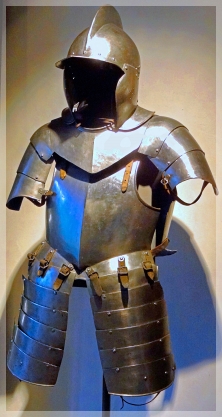 Back in in 1586, during the Eighty Years’ War, Sir Philip Sidney was fighting for the Protestant cause against the Spanish when he noticed another soldier was without leg armor. Believing that he shouldn’t be better protected than his men, Sidney gave the man his cuisses (armor that covered the thigh). During the Battle of Zutphen, Sidney was fatally wounded in his thigh during the final charge and, three weeks later, he died of gangrene from the injury. While heroic, his death was avoidable if the man had worn his complete set of armor!
 Devotions of the Heart