
Peter said to him, “You shall never wash my feet.” Jesus answered him, “If I do not wash you, you have no share with me.” Simon Peter said to him, “Lord, not my feet only but also my hands and my head!” Jesus said to him, “The one who has bathed does not need to wash, except for his feet, but is completely clean. And you are clean, but not every one of you.” [John 13:8-10 (ESV)]
 Apparently speechless when Jesus washed their feet, John records no one objecting to His doing so until Jesus came to Peter. After protesting that Jesus never would never wash his feet, the Lord warned the disciple that unless he allowed Jesus to wash him, Peter wouldn’t belong to Him. Eager to show his devotion to Jesus, Peter then enthusiastically offered the rest of his body for cleansing. Jesus explained that, because Peter already bathed, only his feet needed washing, while adding that not all of those present were clean. Since we know the rest of the story, we know He was referring to Judas. The reference to Judas not being clean, however, tells us that this exchange is about more than washing the filth of Judah’s roads off the disciple’s feet. Since Jesus wasn’t giving a hygiene lesson, what did He mean?
When Jesus said he must wash Peter’s feet, the Greek word used was niptó, a word used for washing or wetting only a part of the body, as we would with our hands before dinner or as Jesus did with the men’s feet. But, when Jesus said the men already were clean because they had bathed, the Greek word used was louó which meant bathing the entire body as we would in a long hot shower. Using both words in John 13:10, Jesus said that the one who bathed (louó) was completely clean and didn’t need to wash (niptó) except for his feet. What do bathing and washing have to do with mankind’s relationship with Jesus?
The total bath—the louó—occurs when we come to Jesus. It is when our sins are forgiven “as far as the east is from the west” [Psalm 103:12] and our scarlet sins are made “as white as snow.” [Isaiah 1:18] Once-and-done, the bath of salvation does not need to be done over and over again. With the exception of the unclean Judas, all of the disciples had bathed by trusting and believing in Jesus. When Jesus died on the cross, He paid the price for our sins (past, present, and future) once and for all time.
Having once been bathed and made new in Christ, we don’t need another bath. That our eternal salvation is secure in Christ, however, doesn’t negate the need to repent of our daily sins and ask for His forgiveness. No matter how clean they were every morning, the disciples’ feet got soiled while walking through Judah’s dirt so they needed to be washed daily. As clean as we are because of bathing in the righteous of Christ and try as hard as we might, we’re bound to step in some mud puddles and become soiled by the world’s sins as we walk through life in our fallen world. If we want to walk in daily fellowship with our Lord, we must confess and repent of the sins that soil us and allow Jesus to wash (nipto) away the filth of our fallen world every day. Salvation (the bathing) is a one-time act but sanctification (the washing) is a lifelong process; it is what allows His forgiveness to change our lives.
 Friends recently watched their young grandson while his parents enjoyed a much needed “adults only” vacation. Accustomed to the permissive parenting of today, the youngster wasn’t overly familiar with obedience. One of the first things he learned during his visit was that, “Grandpa doesn’t count.” Apparently, his parents give him a count of three (or more) to decide whether or not to obey them; Grandpa, however, did not!
 Every breakfast, lunch and dinner, a recent house guest consumed between five and fifteen supplements like flaxseed and fish oils, magnesium, vitamin D, calcium, turmeric, ginger, cinnamon, and resveratrol (among others). Annually, people like our guest spend around $35 billion on supplements, vitamins, minerals, botanicals, and other substances to enhance their health. It doesn’t stop there; every year, five million diet books are published, at least 17 million cookbooks are purchased, and $33 billion is spent on weight loss products. Add to that all of the magazines, food channels, websites, blogs, and podcasts dedicated to nutrition, recipes, and weight loss and you have a nation of people who seem obsessed with what goes into their bodies.
 When writing about mimicry yesterday, I thought of Esther and her cousin Mordecai. The book of Esther takes place between 483 and 473 BC but the story began about 120 years earlier when Mordecai’s great-grandfather was in the second group of Jews deported from Jerusalem to Babylon. Rather than treating these deportees as captives or slaves, they were more like immigrants. Although they were given new Babylonian names, the were allowed to keep their God as long as they also worshipped the Babylonian ones. After Babylon fell to Persia in 539 BC, the first Jewish exiles returned to Jerusalem the following year. Perhaps because they’d become comfortable in their new homeland or feared the challenge of rebuilding Jerusalem, like many others, Mordecai and Esther’s family did not return.
 Even though they have their own unique song, northern mockingbirds usually incorporate the songs of other birds into theirs. With their ability to sound like jays, thrashers, hawks, orioles, and robins (along with car alarms and frogs), rather than sounding like themselves, these masters of mimicry can sound like what they’ve heard.
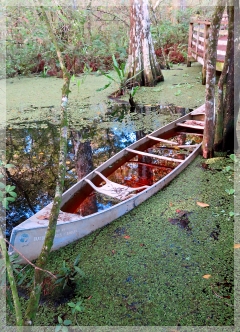 Whenever I saw the swamped canoe at the swamp/bird sanctuary, I remembered the old aluminum canoe we had at our cottage. Because it remained down at the lakefront all year long, the canoe served as winter home to the chipmunks and mice. After decades of rodents taking refuge there, the critters eventually chewed up all the foam flotation blocks in both ends of the craft. Since a boat will float only as long as it weighs less than the maximum amount of water it displaces, those empty chambers didn’t affect the canoe if it remained upright and relatively dry. But, if the craft capsized, its empty chambers would rapidly fill with water and, with the extra weight, sink. Knowing how easily the canoe could sink made us extra cautious—it was used only when the water was calm, no one deliberately tipped it, and lifejackets were required.
 Devotions of the Heart