
All of us like sheep, have strayed away. We have left God’s paths to follow our own. [Isaiah 53:6a (NLT)
 In the years that followed our first maze experience, we continued the pumpkin patch/corn maze tradition but at a farm with a smaller and easier maze. While there were no arrows on stakes to assist the totally confused, there was a larger and better map. Since my daughter and husband have a far better sense of direction than do I, they carried the map and led the rest of us through the maze.
When grazing, sheep like to keep at least four or five other sheep in eyesight and I’m no different. As long as the family remained in view, I paid no attention to where we were. On one outing, after noticing some deep blue morning glories, I stopped to take photos. Spotting a butterfly near the flowers, I briefly turned away from the family to follow it down the trail. When I turned around, my family was nowhere in sight. With no map and in a labyrinth of corn stalks, I was totally lost. Every path seemed to be a dead end and, having left my phone in the car, I couldn’t even make a call! As I wandered in what I hoped was the right direction, I grew anxious. Eventually, I heard someone call my name. Looking up, I saw my family standing on a high viewing platform in the middle of the corn field. From their vantage point, they managed to guide me through the maze until I rejoined them.
Until I got lost in that maze, I’d often wondered about Jesus’ parable of the Good Shepherd. If the shepherd was properly shepherding his flock, how did that one sheep get lost? Now I know! By guiding the flock, the shepherd was doing his job and, by obediently following their shepherd, the rest of the flock were doing theirs. But, that one lost lamb wasn’t paying attention to either shepherd or flock. Perhaps it stopped for some tasty red clover and, after spotting a field of pink vetch, had wandered over for a nibble of it. Maybe, like me, it followed a butterfly and, before the lamb knew what happened, it was all alone. It didn’t mean to stray; it just stopped following the flock and paying attention to the shepherd. Once on its own, the lamb was vulnerable to attack. Fortunately, the good shepherd went looking for it just as my family looked for me.
It’s incredibly easy to lose our way, not just in mazes and pastures, but in the complicated, bewildering, and often perilous world in which we live. Knowing that predators go after the lone sheep that wanders from the herd, our Shepherd has given us His flock—the people of His Church. Unfortunately, instead of morning glories or butterflies, we can get distracted by anything from busyness to boredom, success to defeat, or prosperity to poverty. We don’t mean to stray from the Shepherd’s flock but things like ambition, popularity, self-importance, doubt, worry, discontent, anger, guilt, or disappointment easily can sidetrack us. We start to wander and, before we know it, we’re lost and vulnerable to the enemy’s attack. Fortunately, we don’t need a phone to call our Good Shepherd; a simple prayer is all it takes.
Staying connected with other people of faith—people who follow the Shepherd and will guide us when we’re lost, encourage us when we’re overwhelmed, and correct us when we make a wrong turn—is vital for our survival. As I discovered in the corn maze, it’s best to stay close to the people who have the map and know where they’re going! On the other hand, as members of His flock, it’s important to notice when one of His sheep goes missing.
 Believing that God’s spirit would not enter into something flawless, various Native American people intentionally strung a wrong-colored bead (the spirit bead) into an otherwise perfect pattern of beadwork so to create an opening through which God’s spirit could flow. In a similar way, believing that a perfectly woven rug or carpet would be an offense to Allah, followers of Islam would make an intentional small mistake in their weaving. Concerned that a perfect quilt would encourage pride, imperfect squares called humility squares or blocks, are said to have been deliberately placed in quilts by Puritan women as their acknowledgment that only God is perfect.
 Since my 18-year-old grand is a new driver, I was surprised when her parents purchased a new car for her. Remembering the many dings, scrapes, and dents our teens left on their cars, I asked why they’d replaced the 15-year-old car on which she learned to drive with a new one; “safety features” was their simple and logical explanation. This new car offers things like forward collision warning, automatic emergency braking, adaptive cruise control, blind spot monitoring, lane departure warnings, lane-keeping assist, backup cameras, active park assist, rear cross traffic alert, and a whole variety of air bags (front, side, seatbelt, knee, foot, and curtain along with rollover sensors to deploy them.) Knowing that accidents happen to even the best drivers, damage to a new car is far more acceptable than any damage done to their daughter!
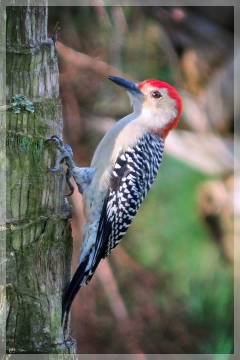 No respecter of early mornings, an annoying woodpecker was busy drumming on the gutters of a nearby house. A few streets later, I spotted a woodpecker determinedly drilling into the stucco of another house. As it excavated a roost hole in the decorative trim, the determined little bird was doing as much damage with his beak as a heavy sledge hammer. A plaster patch nearby told me this wasn’t the first time the wall has been under attack! Throughout our community I see reflective streamers, children’s pinwheels, life-sized plastic owls, and strips of aluminum foil hanging from the eaves of houses. Nothing, however, seems to deter these birds from their drumming and drilling.
 Along with proclaiming the Word of God, the young Church was committed to ensuring that there were no needy among them. As a result, many of the early believers voluntarily sold their property and shared their wealth with the rest of the church community. Barnabas, for example, sold a field he owned and generously brought the money to the apostles for those in need.
 Devotions of the Heart