
Feed the hungry! Help those in trouble! Then your light will shine out from the darkness, and the darkness around you shall be as bright as day. [Isaiah 58:10 (TLB)]
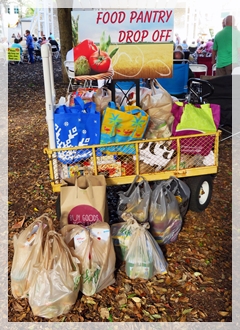 While tucking toothbrushes, dental floss, Band-Aids, and soap into shoeboxes already filled with pencils, notebooks, markers, tee-shirts, and toys, I thanked God, not just for the privilege of giving, but also that basic items like these are not a luxury in my world. In many parts of the world, however, they are! For example, our pastor just returned from Cuba where a sample-size tube of toothpaste costs the equivalent of $5 and is so sparingly squeezed that it lasts a family of four one month. The gifts he’d packed in his suitcase were simple drugstore items such as toothpaste, feminine hygiene products, and pain relievers, but the people who received those basics were as appreciative as if he’d delivered a treasure chest of gold and diamonds.
Dwight Moody once told of a man at sea who was ill and confined to his cabin. Hearing that a sailor had fallen overboard and not knowing what he could do to help, the man picked up his light and held it against the port-hole. Upon hearing that the sailor had been rescued, the man returned to his bunk. When walking on the deck after his recovery, this gentleman met the fellow who’d fallen overboard that night. Recounting the frightening episode, the sailor said he’d been sure no one would see him in the darkness as he desperately tried to stay afloat in the churning waves. But, just as he started to go down for what he was sure was the last time, a light from out of a port-hole shone on him; finally seeing the drowning sailor, a man caught his hand and pulled him into the life-boat.
Our pastor’s suitcase of basics and the clothes he and his wife left behind in Cuba can’t stop the blackouts, ease the nation’s food shortages, or shorten the queues waiting for a bus or a few gallons of gas. The Samaritan’s Purse shoeboxes our church filled won’t change governments, provide jobs, or feed the hungry. The meals packed for food banks, clothes donated to resale shops, gifts purchased for strangers whose names hang on a giving tree, food served at a homeless shelter, change dropped into the bell ringers’ buckets, checks written to the Salvation Army, or the animal purchased for Heifer International won’t solve the world’s problems. Nevertheless, while we can’t change the world, we all can do our part to change the world for someone, even if it’s just with a toothbrush or a tube of toothpaste!
“Let us take the torch of salvation and go into these dark homes and hold up Christ to the people as the Savior of the world,” said Moody as he finished his story of the light in the port-hole. “Not all of us can do great things. But we can do small things with great love,” were the words of Mother Teresa. Few, if any, of us will pull a drowning sailor from the sea and we’re not likely to win a Nobel Peace Prize for our humanitarian efforts. Nevertheless, in our own small ways, we each can make a difference by shining a light for those in despair. Let us be the light that brings Christ’s love into the world!
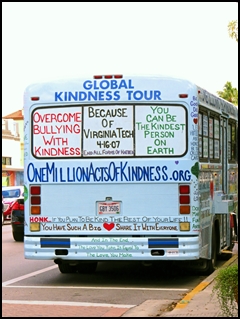 The mission of the World Kindness Movement (WKM) is to “inspire individuals and connect nations to create a kinder world.” Having no political or religious affiliations, the WKM is an international coalition of like-minded kindness NGOs (non-governmental organizations typically set up to address a social or political issue). Since its introduction in 1998, “World Kindness Day” has been observed every November 13. The purpose of this day is to “highlight good deeds in the community because kindness is the common thread that unites us all.”
 Twenty-one of the twenty-seven books of the New Testament are letters (epistles) written by Paul, James, Peter, John, and Jude. While the gospels tell us about the life, death, and resurrection of Jesus, the epistles are letters of instruction, clarification, encouragement and, sometimes, caution to the new Christian community. I can’t help but wonder if those early letter writers realized the scope of their writing. Did they have any idea how fast and wide Christianity would spread? Did they envision how many people would come to know both their names and words? While they expected their messages to be read aloud to the members of the 1st century church, did they even dare hope that 2,000 years later their letters still would be read aloud regularly in many churches, that some of their words would even be used in Christian liturgy, or that people around the world would gather together to study their messages?
 Live wisely among those who are not believers, and make the most of every opportunity. Let your conversation be gracious and attractive so that you will have the right response for everyone. [Colossians 4:5-6 (NLT)]
 Although the word “apologetics” sounds a bit like acknowledging guilt or expressing remorse, it isn’t. In 1 Peter 3:15, we first find its use when Peter tells the persecuted Christians in Asia Minor to be ready to make a defense (apologia) to anyone who asks for a reason for their hope. In a nutshell, that one verse is what Christian apologetics is about: the communication of the evidence and reasons that Christianity is true. Of course, Peter adds that this must be done with gentleness and respect and his words hold true today.
 Last week, when Brandt Jean chose to offer his forgiveness and embrace the woman who killed his brother, he did it out of Christian love. Judge Tammy Kemp, moved by Brandt’s example, then handed the convicted murderer one of her personal Bibles and encouraged her to forgive herself. When the defendant asked her for a hug, the judge remembered a recent sermon about love and compassion and couldn’t deny her. Nevertheless, many people were outraged and turned their simple acts into political statements. They saw issues of race, civil rights, proselytizing, and something called “post-traumatic slavery syndrome” where there was only love, kindness, and forgiveness. Neither brother nor judge excused or absolved Amber Guyger of her crime; they simply extended compassion and forgiveness. Let us not forget that their actions were also in obedience to Christ!
 Devotions of the Heart