
For there is one body and one Spirit, just as you have been called to one glorious hope for the future. There is one Lord, one faith, one baptism, one God and Father of all, who is over all, in all, and living through all. [Ephesians 4:4-6 (NLT)]
 It is said that John Wesley (the founder of the Methodist movement) once dreamt of visiting the gates of Hell. Curious, he asked the gatekeeper how many in Hell were Presbyterians, Episcopalians, and Baptists. “We have many,” was the gatekeeper’s answer regarding each denomination. Nervously, Wesley then asked if there were any Methodists and was disheartened to learn there were plenty of them there, as well.
Dismayed, Wesley proceeded to the gates of Heaven. The preacher asked how many in Heaven were Presbyterians, Episcopalians, and Baptists. To each question, the gatekeeper replied, “Not a one.” After Wesley asked how many Methodists were there, his heart dropped at the gatekeeper’s reply of, “None!” Perplexed, the concerned preacher asked who was in Heaven. The angel at the gate replied, “The only ones here are those who love the Lord and the only name by which they are known is that of Christian!”
From that strange dream, John Wesley is said to have concluded that unity within the Christian church was essential for its mission. Nevertheless, acknowledging that there will be different points of view, he said, “Although a difference in opinions or modes of worship may prevent an entire external union, yet need it prevent our union in affection? Though we cannot think alike, may we not love alike? May we not be of one heart, though we are not of one opinion? Without all doubt we may.”
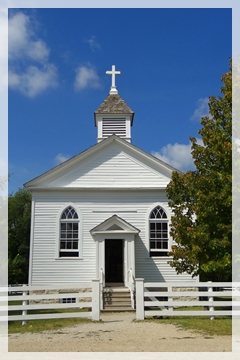
I thought of John Wesley’s dream when my husband told me how, as a boy, he refused to say the word “catholic” when reciting the Apostle’s or Nicene Creeds. Not attending a Roman Catholic church, he didn’t know how he could say he believed in it! Of course, he didn’t understand that catholic (with a small c) has never meant a specific denomination.
Etymologically, “catholic” comes from two Greek words, kata or kath (meaning “throughout”) and holos (meaning “whole”). When joined as katholikos, it means, “throughout the whole.” Meaning more than universal, “catholic” captures the dual sense of “throughout all time and in all places” while pointing to the essential unity or wholeness of Christ’s Church. When the creeds state, “I believe in the holy catholic church,” they aren’t referring to any branch of Christianity; they refer to the entirety of the whole Church, not just here and now, but everywhere in the past and future as well. First used in the early 2nd century, the adjective “catholic” didn’t mean a particular denomination; it simply described the universal scope of the Christian Church. It was not until the Reformation that the Roman church used “Catholic” (with a capital C) as a denominational title to distinguish itself from the Protestants.
To avoid confusion, many Protestant churches have replaced “catholic” with “Christian” when saying the creed. Nevertheless, the original word has a beautiful subtext because it refers to the wholeness of the entire church and the unity of all believers in the body of Christ, throughout all time and in all places. The “holy catholic church” simply refers to all true believers in the Lord Jesus Christ—people like the ones John Wesley found in heaven! Indeed, we won’t all think alike nor will we worship alike but we all can love alike!
Where Jesus Christ is, there is the catholic church. [Ignatius of Antioch]
 A few weeks ago, in Charles Schultz’s classic comic Peanuts, Snoopy sat on his doghouse and decided not to tell his little bird friend Woodstock about Santa Claus. “He’ll never get any presents anyway. Santa Claus never brings presents to tiny, nondescript, nobody birds,” he thought before concluding, “It’s kind of sad at Christmastime to be a nobody bird.” I wasn’t so sure about Santa ignoring the “nobody birds.” The previous day, several from our church had participated in a project that demonstrated just how much “Santa” really does care.
 The story is told of a minister who made this announcement just before passing out the offering plates: “The good news is that God has all of the funds necessary to fund His church’s ministry.” As the congregation started to return their checks and cash to their wallets, the pastor added, “But the bad news is that it’s still in our pockets!”
 My friend called to make sure I’d be at an event and then asked, “Do you have a minute?” When people ask that, we all know they really mean twenty minutes. With a to-do list as long as my arm, I had a minute to spare but not twenty. Nevertheless, I’ve been praying for this woman and her family for several years. I knew she needed to unburden her heavy heart, so I said, “Yes.” Twenty minutes later, she asked to meet for lunch the following day. Again, I really didn’t have the time, but I knew she needed guidance, encouraging words and reassurance about some difficult decisions she’d made. She needed a friend!
 James warns of the dangers of an untamed tongue and the damage that can be done with ill-considered words. Although he was speaking of speech, the same goes for the written word. Whether we’re holding a pen, our fingers are speeding across a keyboard, or our thumbs are tapping out a text, our words are powerful. Whether we use them to build or destroy is our choice.
 In the comic strip Peanuts, drawn by Charles Schultz, Linus and Lucy van Pelt are brother and sister who, like many siblings, often fight. For several days last week, Lucy tried to convince Linus to give her a Christmas gift. When she insisted the giving of Christmas presents is in the Bible, he called her bluff saying, “You can’t fool an old theologian.” Two days later, while Lucy searched in the Bible, she exclaimed, “I found it!…The word ‘sister’ in the Bible!…That proves you have to give me a Christmas present!” Her little brother merely sighed, “Oh, good grief.” While not as blatant as Lucy, we often find people taking Scripture out of context to justify their own meaning.
 Devotions of the Heart