
SECRET KINDNESS

deptford pink flowersDo nothing from selfishness or conceit, but in humility count others better than yourselves. Let each of you look not only to his own interests, but also to the interests of others. [Philippians 2:3-4 (RSV)]

While we usually think of charity as giving to the poor, Biblical charity means love or agape: absolute love of God and universal good will to men. Not limited to gifts of money or goods, charity is any act of kindness or generosity to others. Perhaps Paul gave us the best definition of charity in his words to the Philippians—charity starts with caring for others more than we care for ourselves!

My next exercise in learning how to live an abundant life was one of charity, with the additional element of anonymity; I was to secretly do something kind and not get caught! This seemed better suited for another century when people left May baskets on doorstep. Nowadays, with surveillance cameras at every doorway and corner, it’s difficult to do anything without getting caught (and possibly shot)!

While I’d like to think we all regularly do kind things, we usually don’t keep our actions secret. “Kindness is the law of Christ’s kingdom,” said preacher Matthew Henry and our motivation for any kindness should be our desire for God’s approval rather than man’s. Nevertheless, we rarely make anonymous donations to charities and we often point out favors we’ve done so they don’t go unacknowledged! When Jesus said to keep the left hand from knowing what the right has done, he was telling us to keep our giving a secret. [Matthew 6:1-4] This exercise of doing a secret kindness, albeit a small one, was a way to understand what He meant. As Matthew Henry explained, “Do it because it is a good work, not because it will give thee a good name.” Giving, whether of money, goods, or good turns, is not a spectator sport.

I wondered how this exercise in anonymous kindness would lead to better experiencing the abundant life promised by Jesus until I remembered Jesus’ words found in Luke 6:38: “Give, and it will be given to you; good measure, pressed down, shaken together, running over, will be put into your lap. For the measure you give will be the measure you get back.” The blessings given to us from God are far greater than any we could possibly give and yet it appears from His words that our blessings depend on the generosity of our spirit. Jesus, however, never promises those blessings will come back in kind. Leaving someone a May basket doesn’t mean we’ll get a basket on our doorstep and writing a check to a charity doesn’t mean we’ll get a larger check in tomorrow’s mail. Nevertheless, Jesus promises that we’ll get back more than we give. When we freely give of our love, joy, kindness, compassion, forgiveness, and grace while expecting neither recognition nor acknowledgement, God will refill our stockpile until it overflows. That is abundance!

If you want love and abundance in your life, give it away. [Mark Twain]

And God is able to provide you with every blessing in abundance, so that you may always have enough of everything and may provide in abundance for every good work. [2 Corinthians 9:8 (RSV)]

 One man gives freely, yet grows all the richer; another withholds what he should give, and only suffers want. [Proverbs 11:24-25 (RSV)]

Copyright ©2020 jsjdevotions. All rights reserved.

SEEING HIS FACE IN AN UNLIKELY PLACE

And the King will say, “I tell you the truth, when you did it to one of the least of these my brothers and sisters, you were doing it to me!” [Matthew 25:40 (NLT)]

painted bunting - corkscrew swamp sanctuaryAfter my walk through the bird sanctuary, I visited the ladies’ room. While washing my hands, I heard someone struggling to open the door. As I opened it, a heavy set woman shuffled unsteadily into the room. I gave her my arm as she explained that she suffers from MS. After assisting her into the stall, I offered to stay in the rest room until she was done. As I lent a hand while she washed up, she thanked me profusely for my help and explained that her husband didn’t feel comfortable coming into the ladies’ room to assist her. I said that she’d do the same for someone else if she could. “Of course, I would,” she replied, pulling out a cross from around her neck, ”I’m a Christian.” My reply was a simple, “As am I!” I helped her out to the lobby and got her settled back into her wheelchair. “You see,” she explained, “I just had to come. I want to see the painted-buntings again before I leave for home.” I hope she wasn’t disappointed; I, too, had wanted to see the buntings but they’d remained hidden in the trees that morning.

I don’t know if she saw the birds that day but I do know what we both did see: the face of Christ. She saw it in a woman wearing glasses, a baseball cap, and a jean jacket who offered assistance, a few kind words, and a steady arm. I saw it in the smile of a gray-haired woman, visiting from England, who just needed a little help and a few minutes of my time. Thank you, Lord, for showing me your face when I took the time to help one of your children.

To love another person is to see the face of God. [Victor Hugo]

Dear friends, let us continue to love one another, for love comes from God. Anyone who loves is a child of God and knows God. … No one has ever seen God. But if we love each other, God lives in us, and his love is brought to full expression in us. And God has given us his Spirit as proof that we live in him and he in us. [1 John 4:7,12-13 (NLT)]

Copyright ©2020 jsjdevotions. All rights reserved.

CANDLEMAS

Sovereign Lord, now let your servant die in peace, as you have promised. I have seen your salvation, which you have prepared for all people. He is a light to reveal God to the nations, and he is the glory of your people Israel! [Luke 2:29-32 (NLT)]

You may have celebrated the Feast of the Presentation of Christ in the Temple (or Purification of Mary) at church yesterday. Also known as Candlemas, this day commemorates an incident found in Luke 2 when, forty days after the birth of Jesus, three important events occurred: the ceremonial purification of Mary, Joseph and Mary’s dedication of their firstborn son to God, and Jesus’ first entrance into the Temple. It was then that Simeon and Anna recognized Jesus as the Messiah for whom they’d patiently waited. The association of candles with this event in Jesus’ life is understandable; upon seeing Jesus, Simeon declared him to be the light that would reveal God to the nations. Traditionally, a candle-lit procession preceded the Mass and all of the candles that would be used in the church that year were blessed. Candlemas night, people would place lit candles in their windows.

Although seven major festivals were ordained by God in the Old Testament, none were ordained in the New and nothing in Scripture requires the observance of any of our traditional Christian holy days. Although the liturgical year is not God-ordained, it does follow major events in the life of Jesus as told in the Gospels. Christ’s resurrection was observed in the second century and His birth may have been celebrated as early as AD 336. As for Candlemas, a sermon about the importance of this date goes back to AD 312 and the earliest rites to AD 381! Initially, a small celebration, Candlemas became one of the twelve major feast days throughout Europe after prayer and fasting stopped a plague in Constantinople in AD 541.

Because God never ordained the celebration of any of the events in Jesus’ life, some Christians, in strict obedience to the command to neither add nor subtract from God’s Word, do not observe any of the usual Christian holy days such as Christmas or Easter. Others object to their celebration because so many of them have pagan roots or are associated with superstition. For example, coming half-way between the winter solstice and spring equinox, Candlemas coincided with the Gaelic festival of Imbolc and people believed that the weather this day predicted the climate for the rest of the winter (an early Groundhog Day).

Most evangelical Protestants do not observe Candlemas while most Anglican, Roman Catholic, and Greek Orthodox churches do. Should Christians observe Candlemas, days like Christmas or Easter, or seasons like Advent, Epiphany or Lent? As long as we don’t add superstitions or non-Scripture based significance to them, there seems no harm in remembering the day Jesus was born, the Magi’s visit, His forty days in the wilderness, the resurrection or the day the Jesus visited the Temple and was recognized as the light of the world. May this day serve as a reminder of the darkness that existed on earth until Jesus brought His light into it. Let His light shine within each one of us!

Our bright shining candles are a sign of divine splendor of the one who comes to expel the dark shadows of evil and to make the whole universe radiant with the brilliance of his eternal light. Our candles also show how bright our souls should be when we go to meet Christ. [Sophronius, Patriarch of Jerusalem (AD 638)]

I have come as a light to shine in this dark world, so that all who put their trust in me will no longer remain in the dark. [John 12:46 (NLT)]

Live clean, innocent lives as children of God, shining like bright lights in a world full of crooked and perverse people. [Philippians 2:14b (NLT)]

Copyright ©2020 jsjdevotions. All rights reserved.

POINTING

The next day John saw Jesus coming toward him and said, “Look! The Lamb of God who takes away the sin of the world! He is the one I was talking about when I said, ‘A man is coming after me who is far greater than I am, for he existed long before me.’” [John 1:29-30 (NLT)]

red-shouldered hawkA red-shouldered hawk soared through the sky, swooped down, and settled in a tree just a few feet from us. After getting a photo, I walked back to a man we’d passed earlier on the boardwalk. His tripod and huge lens told me he was hoping to get some good shots and I let him know a Kodak moment was waiting on the side trail. He followed me back and my husband pointed out the impressive bird perched above him.

Later, we came upon one of the sanctuary’s naturalists who admitted she’d been waiting for someone to come along so she could point out a limpkin. With its dark brown body and white speckles, the bird blended into the underbrush and we never would have seen him without her direction. Then, opening a small jar of pond water she’d collected, she pointed out two dragonfly nymphs swimming around. Walking on, my husband pointed out an anhinga high in the trees and I returned the favor when I spotted a black-crowned night heron across the lake. Seeing the naturalist coming toward us, I waited so I could show her the easily missed bird.

When people come to the bird sanctuary, they come to see the swamp’s flora and fauna. But, if they don’t know where to look, it’s easy to miss the things that make the walk worthwhile. The naturalists often leave signs indicating points of interest and, when the ghost orchid is blooming, they leave a scope focused on the rare flower. Bird lovers share their findings on various bird websites and last week, after such a posting, dozens of birders turned up hoping to catch a glimpse a Hammond’s flycatcher.

John the Baptist was surrounded by a crowd of people who’d come to be baptized and hear him preach. Can you imagine what it was like when John saw Jesus and, pointing to the Lord, identified Him as the Lamb of God? Did all the heads turn and look? John’s job was to prepare the way and point the people to Jesus, the promised Messiah, and he did his job well.

While I’m happy to point out hawks, herons, swamp lilies, alligators and scarlet hibiscus to visitors at the bird sanctuary, I have another more important job that is shared with every Christian. Just as John pointed to the living Christ, we are to point to the risen Christ! But, I’m not sure pointing is enough. Had we just pointed in the hawk’s direction, the photographer might have ignored us and, if the naturalist had merely pointed toward the limpkin, we wouldn’t have seen it. It was only when she told us what to look for and described his location that we saw the bird. It seemed like her jar was filled only with murky swamp water until she showed us the nymphs and explained what they were.

When people come to the bird sanctuary, just knowing there are wood storks, herons, painted buntings, and old growth cypress isn’t the same as being shown those things. With our words, we can point people to Scripture, the church, and Jesus. Better than that, however, is showing people how the words of Scripture apply, what the church means, and how Jesus’ followers live a life of peace, joy, patience, forgiveness, love, compassion and service. It is by living the way we say we believe, by loving and serving, by praying both for and with someone, by seeking and interacting with the lost, by sharing our stories, and by listening to theirs that we truly show people the Lamb of God.

Birders are so enthusiastic that they share their sightings with everyone. Are we that enthusiastic about Christ? Like John, are we witnesses to His light? Do we show the Way?

If someone claims, “I know God,” but doesn’t obey God’s commandments, that person is a liar and is not living in the truth. But those who obey God’s word truly show how completely they love him. That is how we know we are living in him. Those who say they live in God should live their lives as Jesus did. [1 John 2:4-6 (NLT)]

Copyright ©2020 jsjdevotions. All rights reserved.

TRADING PLACES

My heart is filled with bitter sorrow and unending grief for my people, my Jewish brothers and sisters. I would be willing to be forever cursed—cut off from Christ!—if that would save them. [Romans 9:2-3 (NLT)]

little blue heron (juvenile) - great blue heronBereft that the people of Israel had rejected Jesus, Paul’s words are some of the saddest ones found in the epistles. I can see the tears in his eyes and hear the anguish in his voice as he dictated them to Tertius, his scribe. Young’s Literal Translation translates Paul’s words as having “great grief and unceasing pain in my heart.” Although he knows that nothing could cut him off from Christ, Paul says he’d be willing to sacrifice himself for his people if it were possible. That’s not just his life he’s offering; the word he used was anathema, meaning he was willing give up his salvation. If it would save the people of Israel, he would be delivered over to the wrath of God for eternal destruction: to spend an eternity in Hell!
While Paul probably was the greatest of Christian evangelists, we mustn’t forget that first and foremost, he was a Jew. A Pharisee who’d studied under the best teachers, he was from the tribe of Benjamin. Describing himself as “a real Hebrew if there ever was one,” all of his family and friends were Jews. He was one of God’s chosen people to whom the Messiah had been promised. Although Jesus came to the Jews first, Paul wondered how so many of God’s chosen could reject Him. Paul’s message throughout Romans was salvation by grace through faith. It must have broken his heart that the majority of his Jewish brothers and sisters would miss out on that salvation because they didn’t have faith.

Paul’s willingness to sacrifice salvation for his people shows what a burden their unbelief was on him. A similar burden is borne by many Christians when their loved ones aren’t Christ followers. Like many others, I have adult family members who don’t believe and their unbelief breaks my heart as much as the Jews’ unbelief broke Paul’s. Many of my friends have shared their grief that, in the life to come, they will not be reunited with their unbelieving family members. Like Paul, we would sacrifice our salvation if it would ensure theirs. That, however, is not how salvation works. Although Jesus suffered, died and took our punishment upon Himself, we cannot take theirs. Only Jesus can save them!

It’s been asked, “How do you convince a person they’re in danger of being burned when they’re floating on a raft in the ocean?” I really don’t know! As parents and grandparents, we don’t want to lose our children or grands in this life or the next. Knowing that we are not in control, we must accept and respect their choices. In the end, only God can convince them of the truth of the Gospel! Nevertheless, we continue to love (and listen) to them, model Christ in our behavior, bear the Fruit of the Spirit, and pray continually and expectantly for them. Let us trust that God has a plan for our children. The good news is that, no matter what our loved ones have said or done in the past, they are only one step away from Jesus! Until then, let us pray!

And that message is the very message about faith that we preach: If you openly declare that Jesus is Lord and believe in your heart that God raised him from the dead, you will be saved. For it is by believing in your heart that you are made right with God, and it is by openly declaring your faith that you are saved. [Romans 10:8b-10 NLT)]

Copyright ©2020 jsjdevotions. All rights reserved.

OBITUARY OR LEGACY?

Those who are righteous will be long remembered. … They share freely and give generously to those in need. Their good deeds will be remembered forever. [Psalm 112: 6,9 (NLT)]

Live so that when the final summons comes you will leave something more behind you than an epitaph on a tombstone or an obituary in a newspaper. [Billy Sunday]

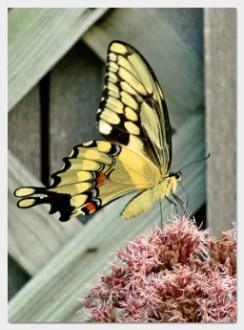
giant swallowtailMore than thirty years ago, a friend confided that she wanted her obituary to be a good one. A few years ago, explaining that she wanted an updated photo in case it was needed for her obituary, she asked me to take her picture. Although she was in excellent health at the time, this woman clearly understood the fragility of life. Sadly, she died unexpectedly just a few days ago.

When considering a “legacy,” we usually think in monetary terms, but a legacy can be anything given by or received from an ancestor, predecessor, or the past. It’s the body of work we leave behind when we’re gone and, in actuality, my friend was far more concerned with leaving a legacy of service and love than with the words of her obituary! She wasn’t trying to impress others, pad her resume with good works, or serve her way into heaven. A woman of deep faith, she knew she was saved by grace not works. Nevertheless, she served the Lord she loved by loving and serving His people. Although she’d expressed concern about some of her denomination’s doctrine, she had no doubts about Jesus. The Holy Spirit was present in her life and she never missed an opportunity to be a blessing to others.

My friend was no saint—she was just another imperfect Christ follower struggling to make it through each day the best she could. Her life wasn’t easy and she had more than her share of heartbreak and disappointment. Nevertheless, as her obituary read, “She began and ended each day with the intent of making people smile and laugh. She accomplished that every day of her life. … In her wake, she left a trail of smiles, heartfelt laughter and love.”  Indeed, the world was a better place because of her and, as she had hoped, her obituary was filled with glowing words and the picture was a recent one. Her obituary’s words, however, will soon be forgotten. It is the humble way she served her neighbor and the seeds of faith, love, and joy she scattered wherever she went that will live on in the many lives she touched.

Our true legacy has nothing to do with wills, trusts, bank accounts or property titles; it begins with our relationship with God and ends with our relationship to His children. What we leave behind when we’re gone is determined by how we choose to live today! Do you want to be remembered with a long obituary or a legacy of love?

What does love look like? It has the hands to help others. It has the feet to hasten to the poor and needy. It has eyes to see misery and want. It has the ears to hear the sighs and sorrows of men. That is what love looks like. [Augustine]

And I heard a voice from heaven saying, “Write this down: Blessed are those who die in the Lord from now on. Yes, says the Spirit, they are blessed indeed, for they will rest from their hard work; for their good deeds follow them!” [Revelation 14:13 (NLT)]

Copyright ©2020 jsjdevotions. All rights reserved.